AQA · A-Level · Sociology
Course version: 7192 · Version from Sept 2015
Dimensions of inequality: class, status and power; differences in…
Full specification wording
Stratification and Differentiation: dimensions of inequality: class, status and power; differences in life-chances by social class, gender, ethnicity, age and disability
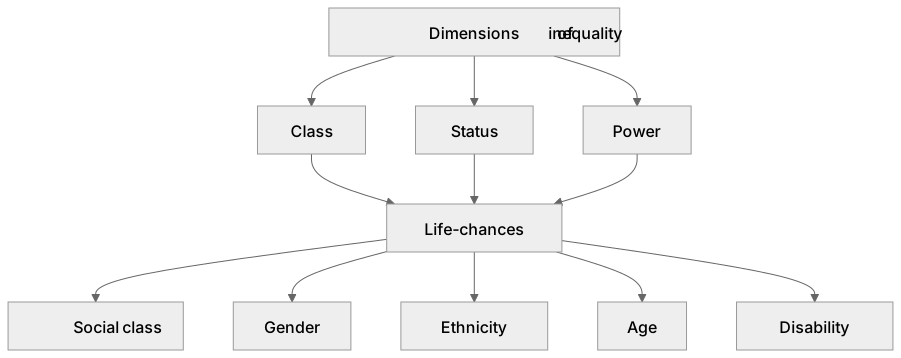
Inequality spans three dimensions: class (wealth), status (prestige), and power (influence).
Checked against the AQA 7192 specification (opens in a new tab) on .
- Point 2 of 3
- 2 key terms
Study notes
From the checked teaching notes for this specification point.
The idea
Inequality spans three dimensions: class (wealth), status (prestige), and power (influence). Weber noted these can diverge; a priest holds high status but low class. These dimensions dictate life-chances—opportunities to secure positive outcomes like health and education. Life-chances are unequally distributed. Working-class people often experience lower life expectancy. Women frequently face a gender pay gap, while ethnic minorities encounter hiring penalties. Age discrimination limits career progression for older workers, and disabled individuals face structural barriers to accessible housing. Together, class, gender, ethnicity, age, and disability systematically shape an individual's trajectory and access to societal resources.
What earns the marks
- Identify class, status, and power as the three distinct dimensions of inequality in Weberian theory.
- Define life-chances as the opportunities individuals have to improve their quality of life and achieve positive outcomes.
- Recognise how social class, gender, ethnicity, age, and disability intersect to compound social inequalities.
- Provide concrete examples of unequal life-chances, such as disparities in health, education, or income across different demographic groups.
Common mistakes and how to put them right
Treating class, status, and power as identical concepts.
Put it right: Distinguish between economic class, social status (prestige), and political power, noting they can operate independently.
Assuming life-chances only refer to economic wealth.
Put it right: Broaden the definition of life-chances to include health, education, housing, and general well-being.
Viewing inequalities in isolation.
Put it right: Recognise that dimensions like gender, ethnicity, and disability often intersect with social class to create compounded disadvantages.
Exam tips
- Use Weber's tripartite model of stratification to explain how status and power can differ from economic class.
- Memorise specific statistical trends or sociological studies that demonstrate unequal life-chances for each named demographic group.
- When discussing life-chances, explicitly link the demographic factor (such as disability) to a concrete outcome (such as employment rates).
Try the lesson
The start of the Stratification and Differentiation: dimensions of inequality: class, status and power; differences in life-chances by social class, gender, ethnicity, age and disability lesson, made from checked teaching notes for this specification point.
Have a go first
Which of the following best describes the dimension of inequality that Max Weber referred to as 'status'?
Listen
Inequality spans three dimensions: class (wealth), status (prestige), and power (influence). Weber noted these can diverge; a priest holds high status but low class. These dimensions dictate life-chances—opportunities to secure positive outcomes like health and education. Life-chances are unequally distributed. Working-class people often experience lower life expectancy. Women frequently face a gender pay gap, while ethnic minorities encounter hiring penalties. Age discrimination limits career progression for older workers, and disabled individuals face structural barriers to accessible housing. Together, class, gender, ethnicity, age, and disability systematically shape an individual's trajectory and access to societal resources. A strong answer earns marks for these points. Identify class, status, and power as the three distinct dimensions of inequality in Weberian theory. Define life-chances as the opportunities individuals have to improve their quality of life and achieve positive outcomes. Recognise how social class, gender, ethnicity, age, and disability intersect to compound social inequalities. Provide concrete examples of unequal life-chances, such as disparities in health, education, or income across different demographic groups. A common slip: Treating class, status, and power as identical concepts. Instead, Distinguish between economic class, social status (prestige), and political power, noting they can operate independently. Exam tip: Use Weber's tripartite model of stratification to explain how status and power can differ from economic class.
See it
Key words
Say what each word means before you turn the card.
Weberian theory
Try answering aloud or in your head before turning the card.
Life-chances
Try answering aloud or in your head before turning the card.
See every definition
- Weberian theory
- A perspective holding that inequality spans three dimensions: class (wealth), status (prestige) and power (influence), which can diverge from one another.
- Life-chances
- The opportunities individuals have to secure positive outcomes like health and education, which are unequally distributed.
Label the diagram
Some boxes have lost their names. Pick the right name for each number.
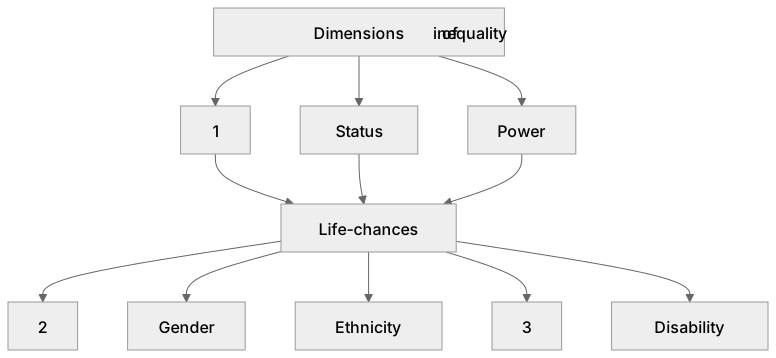
1Box 1
2Box 2
3Box 3
There is more to this lesson
The full lesson goes on to check your understanding and help you earn the marks. Create a free account to carry on, with your progress saved.
A week of Premium from your first lesson · Then the free plan continues · No card, no charge
Test your understanding of Stratification and Differentiation: dimensions of inequality: class, status and power; differences in life-chances by social class, gender, ethnicity, age and disability
Active recall beats re-reading. Take an instant quiz now to test what you’ve learned and lock it into long-term memory.
A week of Premium from your first lesson · Then the free plan continues · No card, no charge