AQA · A-Level · Sociology
Course version: 7192 · Version from Sept 2015
Core themes - 4.1.3 Theory and Methods: consensus, conflict, structural…
Full specification wording
Subject Content – A-level: Core themes - 4.1.3 Theory and Methods: consensus, conflict, structural and social action theories
Sociological theories are categorised into structural (macro) and social action (micro) approaches.
Checked against the AQA 7192 specification (opens in a new tab) on .
- Point 6 of 9
- 4 key terms
Study notes
From the checked teaching notes for this specification point.
The idea
Sociological theories are categorised into structural (macro) and social action (micro) approaches. Structural theories view society as a system shaping individual behaviour through institutions. Within this, consensus theories, like functionalism, argue society is based on shared values and cooperation, maintaining social order. Conversely, conflict theories, including Marxism and feminism, argue society is characterised by inequality, exploitation, and power struggles between groups such as classes or genders. In contrast, social action theories, like interactionism, focus on how individuals construct society through everyday interactions and meanings, rather than being passive puppets of social structures.
What earns the marks
- Identify functionalism as a structural consensus theory that emphasises value consensus and social solidarity.
- Recognise Marxism and feminism as structural conflict theories focusing on class and gender inequalities respectively.
- Distinguish social action theories, such as symbolic interactionism, as micro-level approaches focusing on individual agency and meaning-making.
- Contrast structural theories, which take a top-down approach, with social action theories, which take a bottom-up approach to explaining human behaviour.
Common mistakes and how to put them right
Confusing structural and social action theories.
Put it right: Structural theories are macro and top-down, while social action theories are micro and bottom-up.
Assuming all structural theories are consensus-based.
Put it right: Structural theories include both consensus approaches like functionalism and conflict approaches like Marxism.
Believing social action theorists ignore society entirely.
Put it right: They acknowledge social context but argue society is actively constructed by individuals rather than determining their behaviour.
Exam tips
- Use specific examples of theories, such as functionalism, Marxism or interactionism, when defining consensus, conflict, structural, and social action approaches.
- When evaluating a structural theory, use a social action theory to critique its deterministic nature.
- Clearly distinguish between macro (large-scale) and micro (small-scale) perspectives when comparing theoretical approaches.
Try the lesson
The start of the Subject Content – A-level: Core themes - 4.1.3 Theory and Methods: consensus, conflict, structural and social action theories lesson, made from checked teaching notes for this specification point.
Have a go first
Which of the following best describes the fundamental difference between structural theories and social action theories in sociology?
Listen
Sociological theories are categorised into structural (macro) and social action (micro) approaches. Structural theories view society as a system shaping individual behaviour through institutions. Within this, consensus theories, like functionalism, argue society is based on shared values and cooperation, maintaining social order. Conversely, conflict theories, including Marxism and feminism, argue society is characterised by inequality, exploitation, and power struggles between groups such as classes or genders. In contrast, social action theories, like interactionism, focus on how individuals construct society through everyday interactions and meanings, rather than being passive puppets of social structures. A strong answer earns marks for these points. Identify functionalism as a structural consensus theory that emphasises value consensus and social solidarity. Recognise Marxism and feminism as structural conflict theories focusing on class and gender inequalities respectively. Distinguish social action theories, such as symbolic interactionism, as micro-level approaches focusing on individual agency and meaning-making. Contrast structural theories, which take a top-down approach, with social action theories, which take a bottom-up approach to explaining human behaviour. A common slip: Confusing structural and social action theories. Instead, structural theories are macro and top-down, while social action theories are micro and bottom-up. Exam tip: Use specific examples of theories, such as functionalism, Marxism or interactionism, when defining consensus, conflict, structural, and social action approaches.
See it
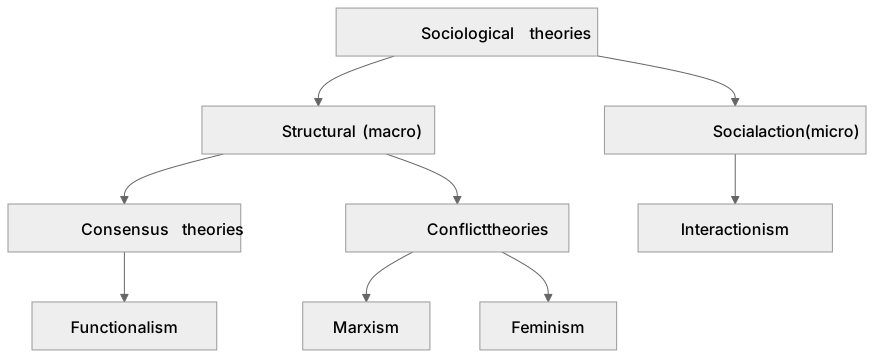
Key words
Say what each word means before you turn the card.
Consensus theories
Try answering aloud or in your head before turning the card.
Conflict theories
Try answering aloud or in your head before turning the card.
Structural theories
Try answering aloud or in your head before turning the card.
Social action theories
Try answering aloud or in your head before turning the card.
See every definition
- Consensus theories
- Theories, like functionalism, that argue society is based on shared values and cooperation, maintaining social order.
- Conflict theories
- Theories, including Marxism and feminism, that argue society is characterised by inequality, exploitation, and power struggles between groups such as classes or genders.
- Structural theories
- Macro, top-down approaches that view society as a system shaping individual behaviour through institutions.
- Social action theories
- Micro, bottom-up approaches, like interactionism, that focus on how individuals construct society through everyday interactions and meanings.
Label the diagram
Some boxes have lost their names. Pick the right name for each number.
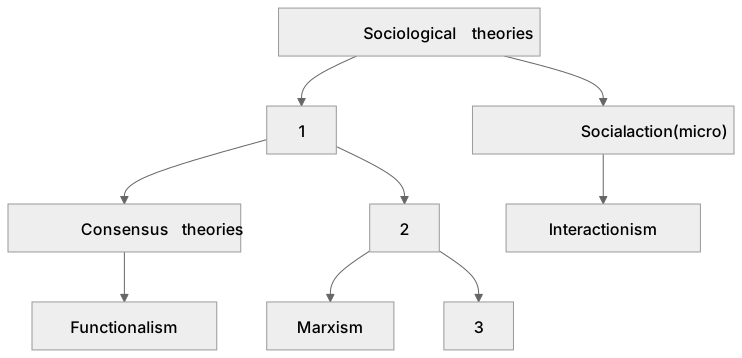
1Box 1
2Box 2
3Box 3
There is more to this lesson
The full lesson goes on to check your understanding and help you earn the marks. Create a free account to carry on, with your progress saved.
A week of Premium from your first lesson · Then the free plan continues · No card, no charge
Test your understanding of Subject Content – A-level: Core themes - 4.1.3 Theory and Methods: consensus, conflict, structural and social action theories
Active recall beats re-reading. Take an instant quiz now to test what you’ve learned and lock it into long-term memory.
A week of Premium from your first lesson · Then the free plan continues · No card, no charge