AQA · A-Level · Sociology
Course version: 7192 · Version from Sept 2015
Core themes - 4.1.3 Theory and Methods: sources of data, including…
Full specification wording
Subject Content – A-level: Core themes - 4.1.3 Theory and Methods: sources of data, including questionnaires, interviews, participant and non-participant observation, experiments, documents and official statistics
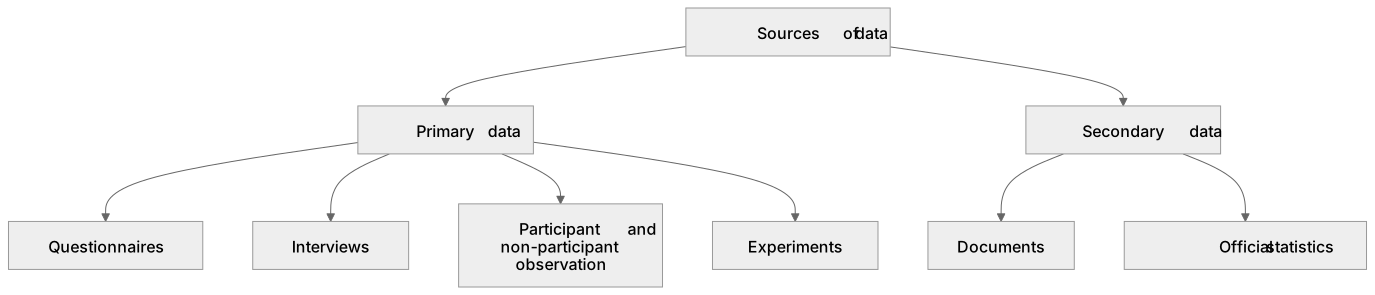
Sociologists use various data sources, categorised into primary and secondary types.
Checked against the AQA 7192 specification (opens in a new tab) on .
- Point 2 of 9
- 4 key terms
Study notes
From the checked teaching notes for this specification point.
The idea
Sociologists use various data sources, categorised into primary and secondary types. Primary data is collected firsthand using questionnaires, interviews, participant and non-participant observation, and experiments. For example, using participant observation to study a subculture yields high validity. Secondary data relies on existing information, including documents and official statistics like government crime rates. Each method presents distinct practical, ethical, and theoretical issues. Positivists prefer quantitative methods like questionnaires and official statistics for their reliability. Conversely, interpretivists favour qualitative methods like unstructured interviews and observation to achieve deep understanding and verstehen.
What earns the marks
- Identify the difference between primary data (collected firsthand) and secondary data (existing sources).
- Evaluate the practical, ethical, and theoretical strengths and limitations of questionnaires and interviews.
- Distinguish between participant and non-participant observation, assessing their impact on validity and reliability.
- Assess the usefulness of experiments (laboratory and field) in sociological research.
- Analyse the advantages and disadvantages of using documents and official statistics as secondary data sources.
Common mistakes and how to put them right
Confusing primary and secondary data.
Put it right: Primary data is generated by the researcher for their specific study, whereas secondary data already exists and was collected by someone else.
Assuming all interviews produce qualitative data.
Put it right: Structured interviews often produce quantitative data, while unstructured interviews produce qualitative data.
Believing official statistics are always objective facts.
Put it right: Official statistics are socially constructed and may lack validity, as seen in the dark figure of crime where not all offences are recorded.
Exam tips
- Always link the choice of research method to the theoretical perspective (positivism or interpretivism) that would favour it.
- Use the acronym PET (Practical, Ethical, Theoretical) to structure your evaluation of any data source.
- When discussing secondary data, explicitly mention documents or official statistics rather than just referring to existing research.
Try the lesson
The start of the Subject Content – A-level: Core themes - 4.1.3 Theory and Methods: sources of data, including questionnaires, interviews, participant and non-participant observation, experiments, documents and official statistics lesson, made from checked teaching notes for this specification point.
Have a go first
Which of the following sources of data typically provides secondary quantitative data for sociological research?
Listen
Sociologists use various data sources, categorised into primary and secondary types. Primary data is collected firsthand using questionnaires, interviews, participant and non-participant observation, and experiments. For example, using participant observation to study a subculture yields high validity. Secondary data relies on existing information, including documents and official statistics like government crime rates. Each method presents distinct practical, ethical, and theoretical issues. Positivists prefer quantitative methods like questionnaires and official statistics for their reliability. Conversely, interpretivists favour qualitative methods like unstructured interviews and observation to achieve deep understanding and verstehen. A strong answer earns marks for these points. Identify the difference between primary data (collected firsthand) and secondary data (existing sources). Evaluate the practical, ethical, and theoretical strengths and limitations of questionnaires and interviews. Distinguish between participant and non-participant observation, assessing their impact on validity and reliability. Assess the usefulness of experiments (laboratory and field) in sociological research. A common slip: Confusing primary and secondary data. Instead, primary data is generated by the researcher for their specific study, whereas secondary data already exists and was collected by someone else. Exam tip: Always link the choice of research method to the theoretical perspective (positivism or interpretivism) that would favour it.
See it
Key words
Say what each word means before you turn the card.
Primary data
Try answering aloud or in your head before turning the card.
Secondary data
Try answering aloud or in your head before turning the card.
Positivists
Try answering aloud or in your head before turning the card.
Interpretivists
Try answering aloud or in your head before turning the card.
See every definition
- Primary data
- Data collected firsthand using questionnaires, interviews, participant and non-participant observation, and experiments.
- Secondary data
- Existing information relied on, including documents and official statistics like government crime rates.
- Positivists
- Those who prefer quantitative methods like questionnaires and official statistics for their reliability.
- Interpretivists
- Those who favour qualitative methods like unstructured interviews and observation to achieve deep understanding and verstehen.
Label the diagram
Some boxes have lost their names. Pick the right name for each number.
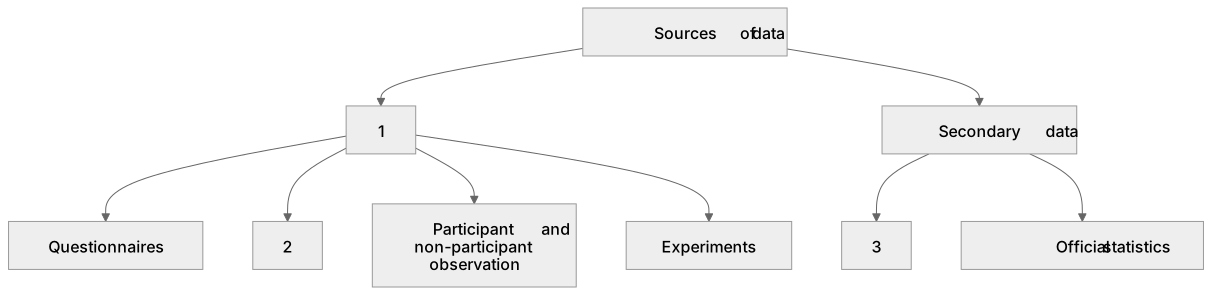
1Box 1
2Box 2
3Box 3
There is more to this lesson
The full lesson goes on to check your understanding and help you earn the marks. Create a free account to carry on, with your progress saved.
A week of Premium from your first lesson · Then the free plan continues · No card, no charge
Test your understanding of Subject Content – A-level: Core themes - 4.1.3 Theory and Methods: sources of data, including questionnaires, interviews, participant and non-participant observation, experiments, documents and official statistics
Active recall beats re-reading. Take an instant quiz now to test what you’ve learned and lock it into long-term memory.
A week of Premium from your first lesson · Then the free plan continues · No card, no charge