AQA · A-Level · Sociology
Course version: 7192 · Version from Sept 2015
Core themes - 4.1.3 Theory and Methods: the distinction between primary…
Full specification wording
Subject Content – A-level: Core themes - 4.1.3 Theory and Methods: the distinction between primary and secondary data, and between quantitative and qualitative data
Sociological research uses data categorised by source and form.
Checked against the AQA 7192 specification (opens in a new tab) on .
- Point 3 of 9
- 4 key terms
Study notes
From the checked teaching notes for this specification point.
The idea
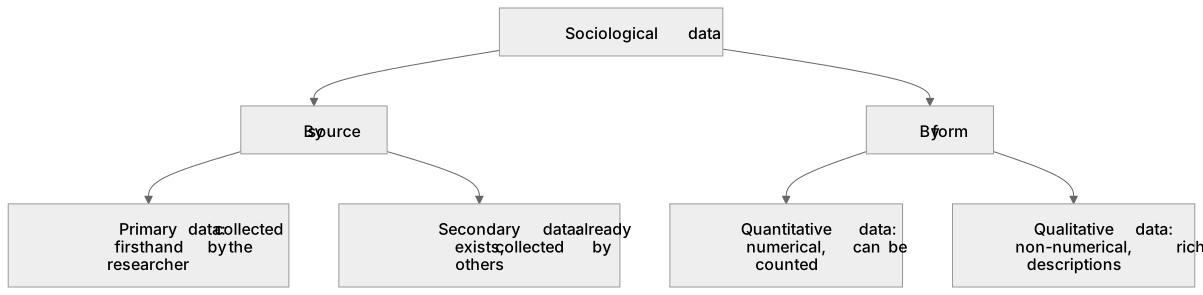
Sociological research uses data categorised by source and form. Primary data is collected firsthand by the researcher for a specific study, such as conducting interviews. Secondary data already exists and was collected by others, like government statistics or diaries. Data is also distinguished by its form. Quantitative data is numerical and can be counted, allowing for statistical analysis of trends, such as exam pass rates. Qualitative data is non-numerical, providing rich descriptions of meanings and experiences, like transcripts exploring students' attitudes. Understanding these distinctions is crucial for evaluating the validity, reliability, and theoretical preferences of sociological research methods.
What earns the marks
- Identify primary data as information collected firsthand by the sociologist for their own research purposes.
- Identify secondary data as existing information that was collected by someone else for their own purposes.
- Define quantitative data as numerical information that can be measured, counted, and analysed statistically.
- Define qualitative data as non-numerical information that provides detailed descriptions of meanings, feelings, and motives.
- Recognise that a single research method can sometimes produce both quantitative and qualitative data, such as a questionnaire with both closed and open questions.
Common mistakes and how to put them right
Confusing primary and secondary data based on when it was collected.
Put it right: The distinction is based on who collected the data and for what purpose, not simply its age.
Assuming that all questionnaires only produce quantitative data.
Put it right: Questionnaires can produce qualitative data if they include open-ended questions that allow respondents to write detailed answers.
Believing that secondary data is always quantitative.
Put it right: Secondary data can be qualitative, such as historical documents, personal diaries, or media broadcasts.
Exam tips
- When evaluating a research method, explicitly state whether it typically produces primary or secondary, and quantitative or qualitative data.
- Link the type of data to theoretical perspectives; remember that positivists generally prefer quantitative data, while interpretivists prefer qualitative data.
- Use concrete examples of data types when discussing methods, such as citing official statistics as secondary quantitative data.
Try the lesson
The start of the Subject Content – A-level: Core themes - 4.1.3 Theory and Methods: the distinction between primary and secondary data, and between quantitative and qualitative data lesson, made from checked teaching notes for this specification point.
Have a go first
A sociologist conducts a series of unstructured interviews to explore the lived experiences of homeless individuals. How should the data collected in this study be classified?
Listen
Sociological research uses data categorised by source and form. Primary data is collected firsthand by the researcher for a specific study, such as conducting interviews. Secondary data already exists and was collected by others, like government statistics or diaries. Data is also distinguished by its form. Quantitative data is numerical and can be counted, allowing for statistical analysis of trends, such as exam pass rates. Qualitative data is non-numerical, providing rich descriptions of meanings and experiences, like transcripts exploring students' attitudes. Understanding these distinctions is crucial for evaluating the validity, reliability, and theoretical preferences of sociological research methods. A strong answer earns marks for these points. Identify primary data as information collected firsthand by the sociologist for their own research purposes. Identify secondary data as existing information that was collected by someone else for their own purposes. Define quantitative data as numerical information that can be measured, counted, and analysed statistically. Define qualitative data as non-numerical information that provides detailed descriptions of meanings, feelings, and motives. A common slip: Confusing primary and secondary data based on when it was collected. Instead, The distinction is based on who collected the data and for what purpose, not simply its age. Exam tip: When evaluating a research method, explicitly state whether it typically produces primary or secondary, and quantitative or qualitative data.
See it
Key words
Say what each word means before you turn the card.
Primary data
Try answering aloud or in your head before turning the card.
Secondary data
Try answering aloud or in your head before turning the card.
Quantitative data
Try answering aloud or in your head before turning the card.
Qualitative data
Try answering aloud or in your head before turning the card.
See every definition
- Primary data
- Information collected firsthand by the sociologist for their own research purposes.
- Secondary data
- Existing information that was collected by someone else for their own purposes.
- Quantitative data
- Numerical information that can be measured, counted, and analysed statistically.
- Qualitative data
- Non-numerical information that provides detailed descriptions of meanings, feelings, and motives.
Label the diagram
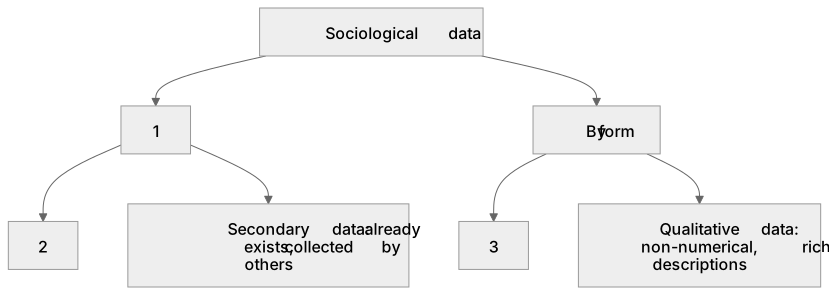
Some boxes have lost their names. Pick the right name for each number.
1Box 1
2Box 2
3Box 3
There is more to this lesson
The full lesson goes on to check your understanding and help you earn the marks. Create a free account to carry on, with your progress saved.
A week of Premium from your first lesson · Then the free plan continues · No card, no charge
Test your understanding of Subject Content – A-level: Core themes - 4.1.3 Theory and Methods: the distinction between primary and secondary data, and between quantitative and qualitative data
Active recall beats re-reading. Take an instant quiz now to test what you’ve learned and lock it into long-term memory.
A week of Premium from your first lesson · Then the free plan continues · No card, no charge