AQA · A-Level · Sociology
Course version: 7192 · Version from Sept 2015
Organisation and control of the labour process, including the division of…
Full specification wording
Work, Poverty and Welfare: organisation and control of the labour process, including the division of labour, the role of technology, skill and de-skilling
The organisation and control of the labour process refers to how work is structured by employers to maximise efficiency and profit.
Checked against the AQA 7192 specification (opens in a new tab) on .
- Point 4 of 5
- 4 key terms
Study notes
From the checked teaching notes for this specification point.
The idea
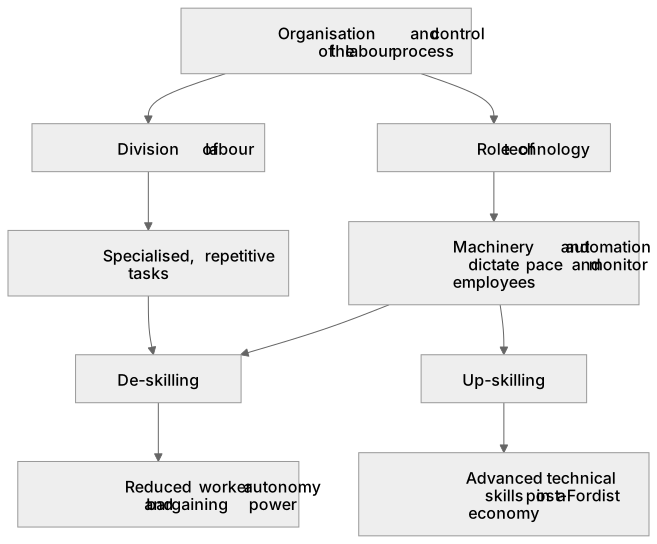
The organisation and control of the labour process refers to how work is structured by employers to maximise efficiency and profit. A key feature is the division of labour, where production is broken down into specialised, repetitive tasks, famously analysed by Marx and Braverman. The role of technology is central to this control; machinery and automation can dictate the pace of work and monitor employees. This often leads to de-skilling, where complex craft skills are replaced by simple tasks, reducing worker autonomy and bargaining power. However, some sociologists argue that new technologies can also lead to up-skilling, requiring workers to develop advanced technical skills in a post-Fordist economy.
What earns the marks
- Define the labour process as the way work is organised and controlled by management to extract surplus value.
- Explain the division of labour as the separation of a work process into a number of tasks, with each task performed by a separate person or group.
- Analyse the role of technology in controlling the workforce, such as algorithmic management or assembly line pacing.
- Evaluate Braverman's de-skilling thesis, which argues that capitalism degrades work by separating mental conception from manual execution.
- Contrast de-skilling with up-skilling theories, which suggest flexible specialisation requires highly skilled, adaptable workers.
Common mistakes and how to put them right
Confusing the division of labour with social stratification.
Put it right: The division of labour refers specifically to the specialisation of tasks within the production process, not the broader class structure of society.
Assuming technology only leads to de-skilling.
Put it right: While Braverman argued for de-skilling, other theorists point out that technology can also lead to up-skilling and the creation of new, complex roles.
Treating the labour process as a neutral, purely technical concept.
Put it right: Recognise that the labour process is inherently political and involves power dynamics and control between employers and employees.
Exam tips
- Use Braverman's concept of the degradation of work to evaluate the impact of technology on the labour process.
- Contrast Fordist mass production, associated with de-skilling, with post-Fordist flexible specialisation, associated with up-skilling.
- Apply contemporary examples, such as gig economy platforms or surveillance software, to illustrate modern control of the labour process.
Try the lesson
The start of the Work, Poverty and Welfare: organisation and control of the labour process, including the division of labour, the role of technology, skill and de-skilling lesson, made from checked teaching notes for this specification point.
Have a go first
Which of the following best describes Harry Braverman's concept of 'de-skilling' in the labour process?
Listen
The organisation and control of the labour process refers to how work is structured by employers to maximise efficiency and profit. A key feature is the division of labour, where production is broken down into specialised, repetitive tasks, famously analysed by Marx and Braverman. The role of technology is central to this control; machinery and automation can dictate the pace of work and monitor employees. This often leads to de-skilling, where complex craft skills are replaced by simple tasks, reducing worker autonomy and bargaining power. However, some sociologists argue that new technologies can also lead to up-skilling, requiring workers to develop advanced technical skills in a post-Fordist economy. A strong answer earns marks for these points. Define the labour process as the way work is organised and controlled by management to extract surplus value. Explain the division of labour as the separation of a work process into a number of tasks, with each task performed by a separate person or group. Analyse the role of technology in controlling the workforce, such as algorithmic management or assembly line pacing. Evaluate Braverman's de-skilling thesis, which argues that capitalism degrades work by separating mental conception from manual execution. A common slip: Confusing the division of labour with social stratification. Instead, The division of labour refers specifically to the specialisation of tasks within the production process, not the broader class structure of society. Exam tip: Use Braverman's concept of the degradation of work to evaluate the impact of technology on the labour process.
See it
Key words
Say what each word means before you turn the card.
Division of labour
Try answering aloud or in your head before turning the card.
De-skilling
Try answering aloud or in your head before turning the card.
Up-skilling
Try answering aloud or in your head before turning the card.
Labour process
Try answering aloud or in your head before turning the card.
See every definition
- Division of labour
- The separation of a work process into a number of tasks, with each task performed by a separate person or group.
- De-skilling
- Complex craft skills are replaced by simple tasks, reducing worker autonomy and bargaining power.
- Up-skilling
- New technologies can require workers to develop advanced technical skills in a post-Fordist economy.
- Labour process
- The way work is organised and controlled by management to extract surplus value.
Label the diagram
Some boxes have lost their names. Pick the right name for each number.
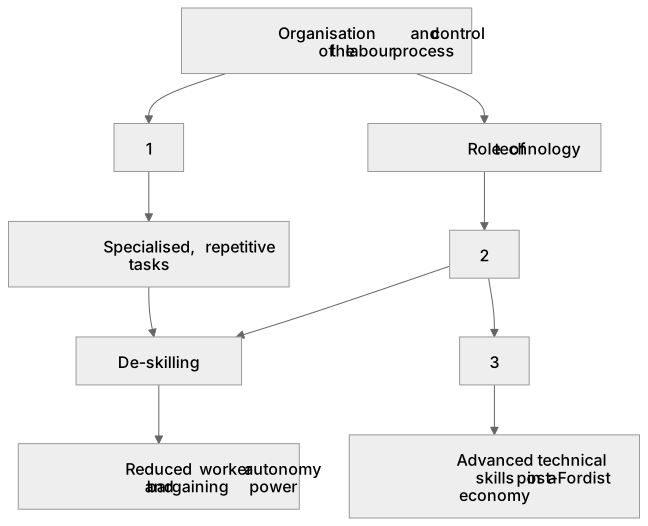
1Box 1
2Box 2
3Box 3
There is more to this lesson
The full lesson goes on to check your understanding and help you earn the marks. Create a free account to carry on, with your progress saved.
A week of Premium from your first lesson · Then the free plan continues · No card, no charge
Test your understanding of Work, Poverty and Welfare: organisation and control of the labour process, including the division of labour, the role of technology, skill and de-skilling
Active recall beats re-reading. Take an instant quiz now to test what you’ve learned and lock it into long-term memory.
A week of Premium from your first lesson · Then the free plan continues · No card, no charge