AQA · A-Level · Sociology
Course version: 7192 · Version from Sept 2015
The significance of work and worklessness for people's lives and life…
Full specification wording
Work, Poverty and Welfare: the significance of work and worklessness for people's lives and life chances, including the effects of globalisation.
Work shapes individuals' identities, social status, and life chances.
Checked against the AQA 7192 specification (opens in a new tab) on .
- Point 5 of 5
- 4 key terms
Study notes
From the checked teaching notes for this specification point.
The idea
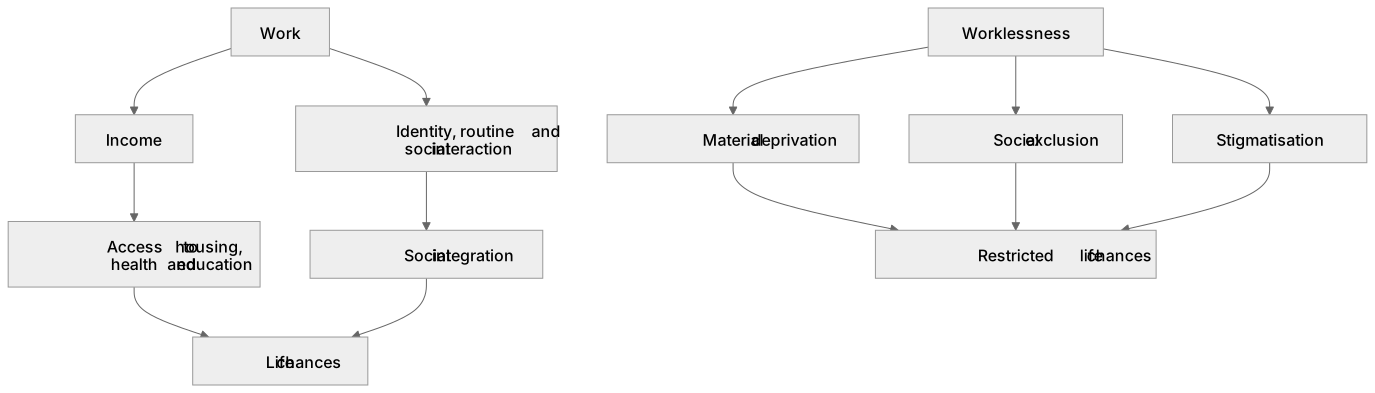
Work shapes individuals' identities, social status, and life chances. It provides income, dictating access to housing, health, and education, while offering social networks and purpose. Conversely, worklessness (unemployment or economic inactivity) often leads to social exclusion, poverty, and negative health outcomes, severely restricting life chances. Globalisation has significantly altered these dynamics. The shift of manufacturing to developing nations has reduced traditional UK working-class jobs, creating a polarised labour market. This features high-paying knowledge roles alongside insecure, low-paid gig economy jobs. Consequently, local employment is vulnerable to international economic shifts, directly impacting life chances.
What earns the marks
- Identify how work provides both manifest functions, such as income, and latent functions, such as identity, routine, and social interaction.
- Explain the impact of worklessness on life chances, including material deprivation, social exclusion, and stigmatisation.
- Analyse the effects of globalisation on the UK labour market, such as deindustrialisation and the expansion of the service sector.
- Evaluate how globalisation has led to a polarised workforce, increasing precarious employment and affecting social mobility.
Common mistakes and how to put them right
Confusing 'worklessness' solely with 'unemployment'.
Put it right: Worklessness includes unemployment but also encompasses economic inactivity, such as long-term sickness, early retirement, or unpaid care work.
Assuming globalisation only has negative effects on work.
Put it right: While globalisation has caused job losses in manufacturing, it has also created new opportunities in technology, finance, and the knowledge economy.
Treating 'life chances' as just financial wealth.
Put it right: Life chances should be defined broadly to include health outcomes, educational attainment, housing quality, and overall well-being.
Exam tips
- Use specific sociological concepts like 'social exclusion', 'precarious labour', and 'polarisation' when discussing the impact of work and worklessness.
- Link the effects of globalisation directly to changes in the UK occupational structure, such as the decline of traditional working-class communities.
- When evaluating life chances, contrast the experiences of different social groups in the contemporary globalised labour market.
Try the lesson
The start of the Work, Poverty and Welfare: the significance of work and worklessness for people's lives and life chances, including the effects of globalisation. lesson, made from checked teaching notes for this specification point.
Have a go first
Which of the following is a widely recognised sociological consequence of long-term worklessness on an individual's life chances?
Listen
Work shapes individuals' identities, social status, and life chances. It provides income, dictating access to housing, health, and education, while offering social networks and purpose. Conversely, worklessness (unemployment or economic inactivity) often leads to social exclusion, poverty, and negative health outcomes, severely restricting life chances. Globalisation has significantly altered these dynamics. The shift of manufacturing to developing nations has reduced traditional UK working-class jobs, creating a polarised labour market. This features high-paying knowledge roles alongside insecure, low-paid gig economy jobs. Consequently, local employment is vulnerable to international economic shifts, directly impacting life chances. A strong answer earns marks for these points. Identify how work provides both manifest functions, such as income, and latent functions, such as identity, routine, and social interaction. Explain the impact of worklessness on life chances, including material deprivation, social exclusion, and stigmatisation. Analyse the effects of globalisation on the UK labour market, such as deindustrialisation and the expansion of the service sector. Evaluate how globalisation has led to a polarised workforce, increasing precarious employment and affecting social mobility. Exam tip: Use specific sociological concepts like 'social exclusion', 'precarious labour', and 'polarisation' when discussing the impact of work and worklessness.
See it
Key words
Say what each word means before you turn the card.
Worklessness
Try answering aloud or in your head before turning the card.
Life chances
Try answering aloud or in your head before turning the card.
Globalisation
Try answering aloud or in your head before turning the card.
Social exclusion
Try answering aloud or in your head before turning the card.
See every definition
- Worklessness
- Unemployment or economic inactivity, which often leads to social exclusion, poverty, and negative health outcomes, severely restricting life chances.
- Life chances
- Access to housing, health, and education, defined broadly to include health outcomes, educational attainment, housing quality, and overall well-being.
- Globalisation
- A process that has significantly altered these dynamics, shifting manufacturing to developing nations and reducing traditional UK working-class jobs.
- Social exclusion
- A consequence of worklessness, alongside poverty and negative health outcomes, that severely restricts life chances.
Label the diagram
Some boxes have lost their names. Pick the right name for each number.
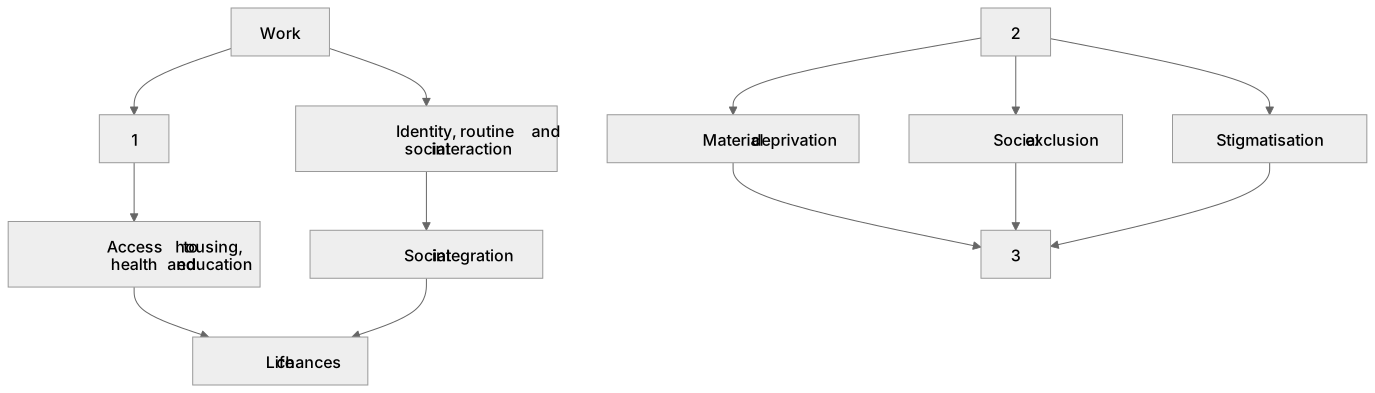
1Box 1
2Box 2
3Box 3
There is more to this lesson
The full lesson goes on to check your understanding and help you earn the marks. Create a free account to carry on, with your progress saved.
A week of Premium from your first lesson · Then the free plan continues · No card, no charge
Test your understanding of Work, Poverty and Welfare: the significance of work and worklessness for people's lives and life chances, including the effects of globalisation.
Active recall beats re-reading. Take an instant quiz now to test what you’ve learned and lock it into long-term memory.
A week of Premium from your first lesson · Then the free plan continues · No card, no charge