Pearson Edexcel · A-Level · Spanish
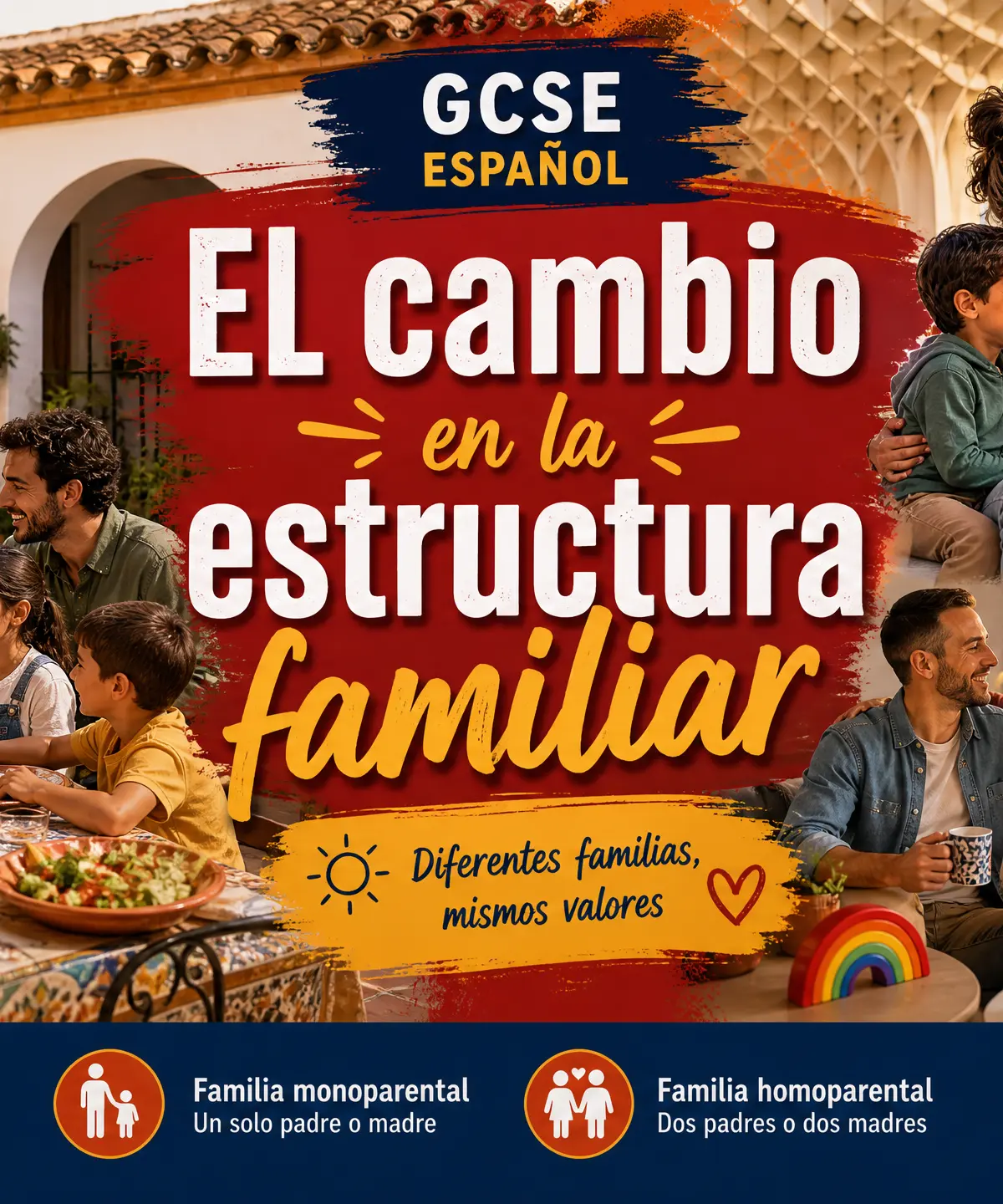
El cambio en la estructura familiar
This topic covers the evolution of family life in Spain, moving from traditional nuclear families to modern diverse structures. Key vocabulary focuses on relationship types and attitudes, while essential grammar includes the subjunctive, pluperfect, and conditional to access higher marks across all four exam skills.
- 14 min read
- 4 worked examples
- 6 practice questions
- 8 key terms
Study Notes
Overview
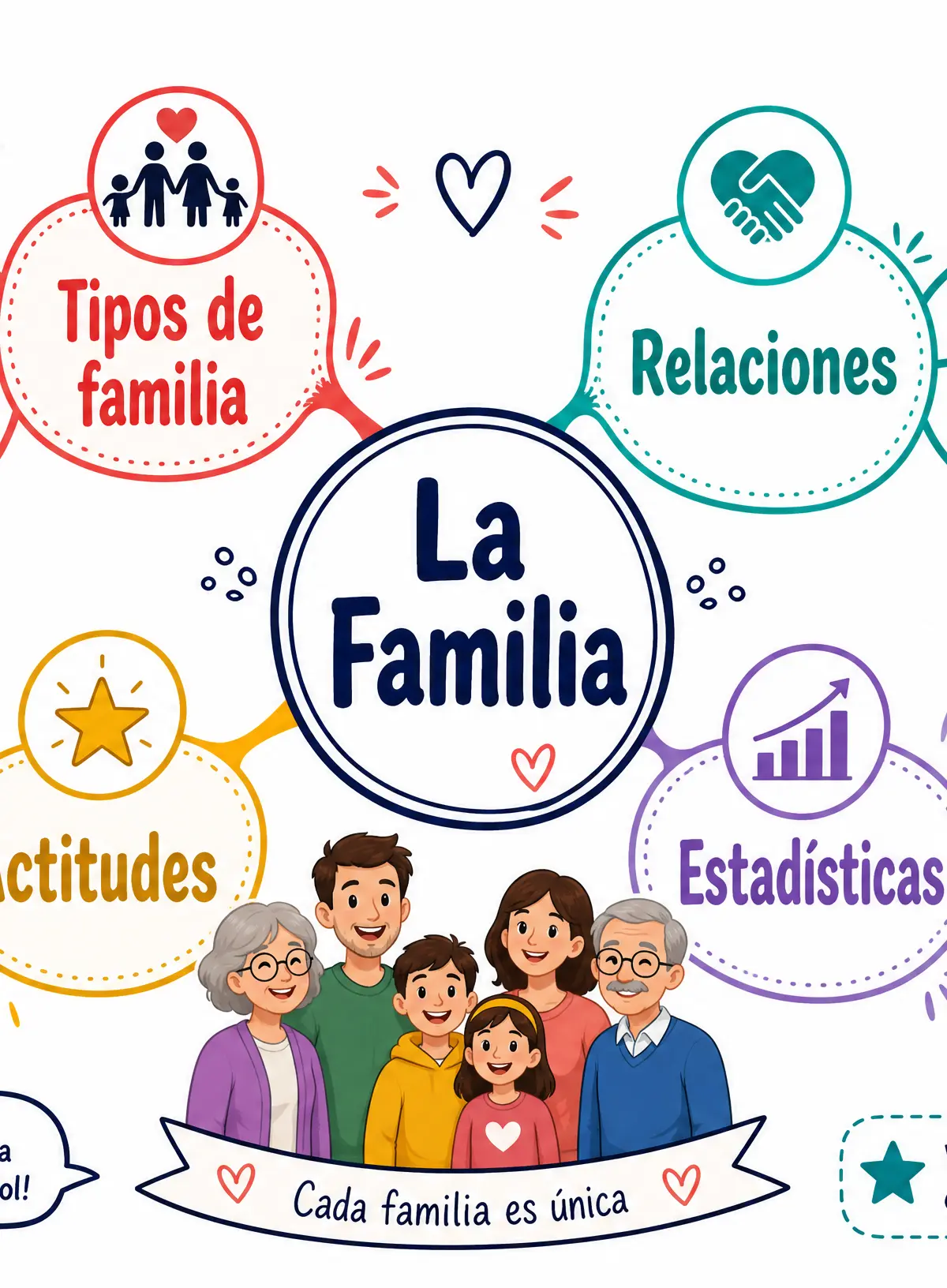
This topic explores the profound social changes in Spain regarding family structures, marriage, and relationships over the past fifty years. For the GCSE exam, this is a high-yield topic that appears across all four skills: Listening, Speaking, Reading, and Writing. Examiners look for your ability to not just describe different family types, but to analyse why these changes have occurred and to express justified opinions using complex grammar. Mastering this topic allows you to demonstrate higher-level language skills, particularly the subjunctive and conditional tenses.
📖 Essential Vocabulary
Tier 1 — Foundation Core
| Spanish | English | Gender | Example Sentence |
|---|---|---|---|
| la familia | the family | f | Mi familia es bastante grande. |
| el padre / la madre | the father / the mother | m/f | Mi madre trabaja en un hospital. |
| los padres | the parents | m | Mis padres están casados. |
| el hermano / la hermana | the brother / the sister | m/f | Tengo un hermano mayor. |
| el abuelo / la abuela | the grandfather / the grandmother | m/f | Mi abuela vive con nosotros. |
| el tío / la tía | the uncle / the aunt | m/f | Mi tía vive en Madrid. |
| el primo / la prima | the cousin | m/f | Juego al fútbol con mis primos. |
| casarse | to get married | - | Mis padres van a casarse el año que viene. |
| separarse | to separate | - | Mis tíos decidieron separarse. |
| divorciarse | to get divorced | - | Es triste cuando las parejas deciden divorciarse. |
| el matrimonio | marriage | m | El matrimonio es importante para algunas personas. |
| soltero / soltera | single | m/f | Mi tío está soltero. |
| tradicional | traditional | m/f | En el pasado, las familias eran más tradicionales. |
| moderno / moderna | modern | m/f | Hoy en día, hay muchas familias modernas. |
| feliz | happy | m/f | Lo más importante es tener una familia feliz. |
Tier 2 — Higher Tier
| Spanish | English | Gender | Example Sentence |
|---|---|---|---|
| la familia monoparental | single-parent family | f | El número de familias monoparentales ha aumentado. |
| la familia homoparental | same-sex parent family | f | España legalizó el matrimonio homoparental en 2005. |
| la familia reconstituida | blended family | f | Vivo en una familia reconstituida porque mi madre se volvió a casar. |
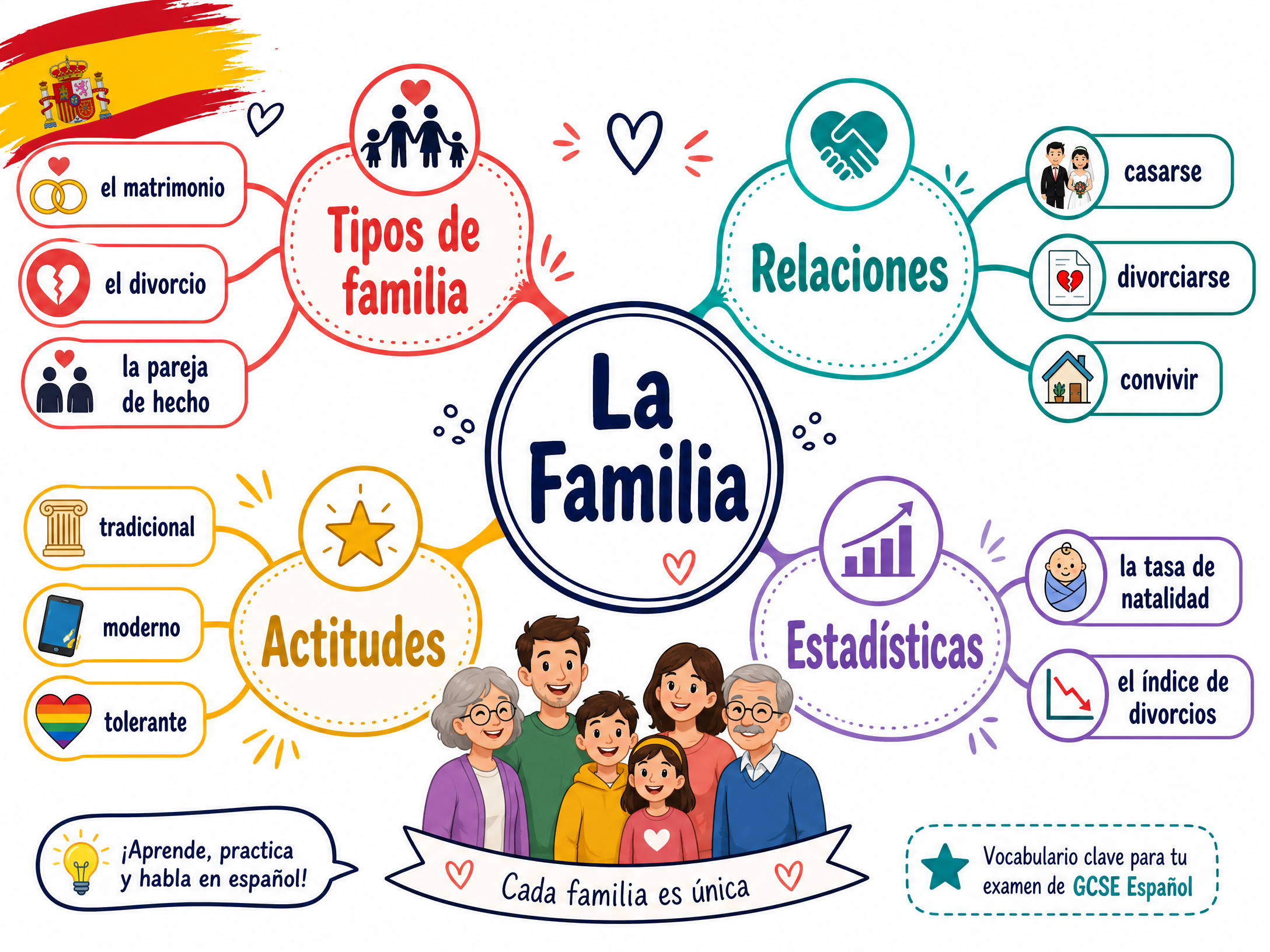
| la pareja de hecho | cohabiting couple / civil partnership | f | Muchos jóvenes prefieren ser una pareja de hecho. |
| convivir | to live together / cohabit | - | Es cada vez más común convivir antes del matrimonio. |
| el índice de divorcios | the divorce rate | m | El índice de divorcios en España es uno de los más altos de Europa. |
| la tasa de natalidad | the birth rate | f | La tasa de natalidad ha bajado drásticamente. |
| igualitario / igualitaria | egalitarian / equal | m/f | Los roles en casa son más igualitarios ahora. |
| anticuado / anticuada | old-fashioned / outdated | m/f | Mi abuelo tiene ideas un poco anticuadas. |
| la brecha generacional | the generation gap | f | A veces hay una brecha generacional entre padres e hijos. |
High-Frequency Words & Phrases
| Phrase | English | Usage Context |
|---|---|---|
| Hoy en día | Nowadays | Used to contrast the present with the past. |
| En el pasado | In the past | Used to introduce imperfect tense descriptions. |
| Cada vez más | More and more | Useful for describing changing trends. |
| A pesar de que | Although / Even though | Excellent connective for balanced arguments. |
| Sin embargo | However | Used to show contrasting opinions. |
| Por un lado... por otro lado | On one hand... on the other hand | Perfect for structuring a balanced writing response. |
| Es evidente que | It is clear that | Strong phrase to introduce an analytical point. |
| En mi opinión | In my opinion | Essential for fulfilling the 'opinions' requirement. |
| Estoy de acuerdo con | I agree with | Useful in speaking and writing to evaluate a statement. |
| No cabe duda de que | There is no doubt that | High-level phrase to introduce a strong conclusion. |
📝 Grammar Focus
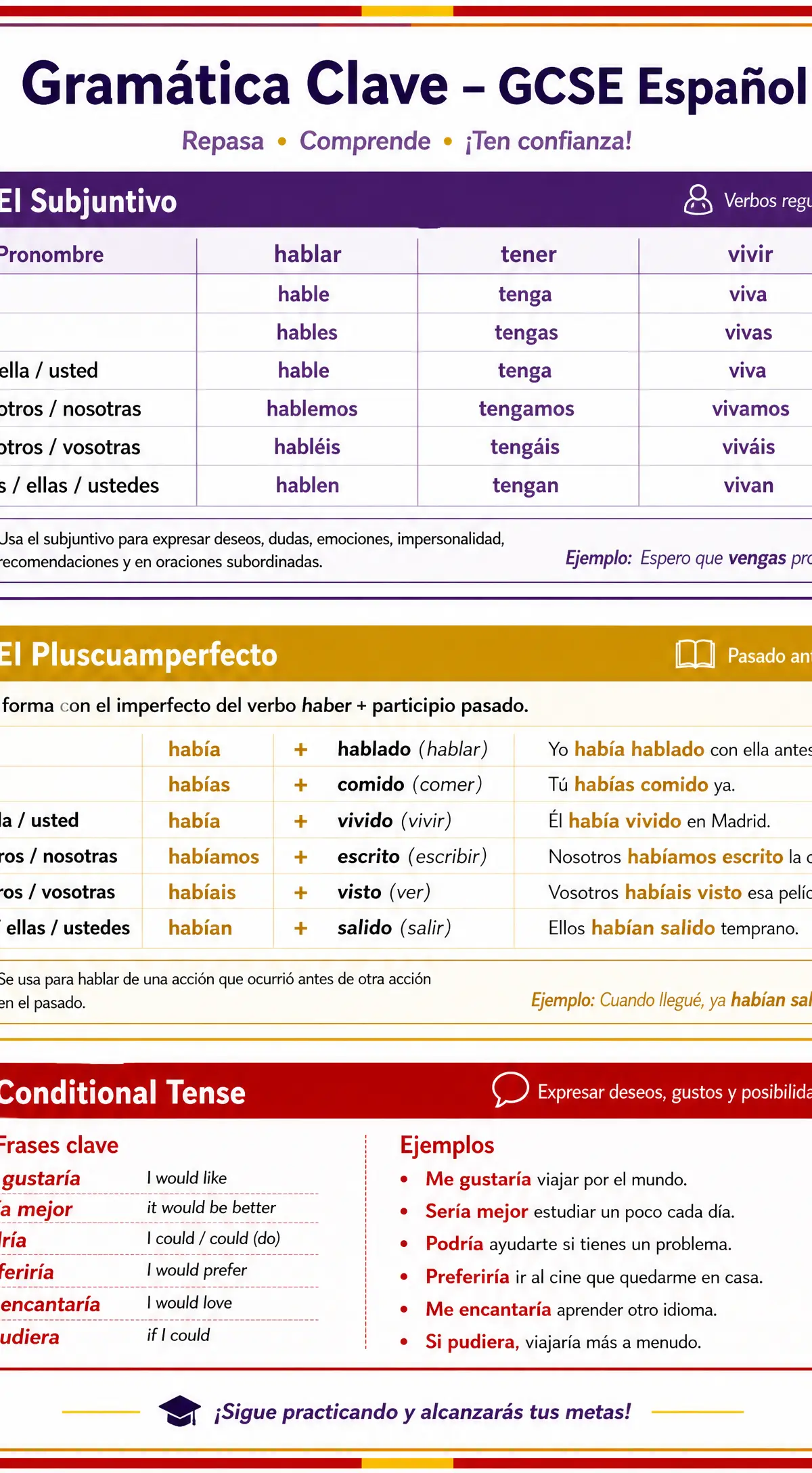
Key Structure 1: El Subjuntivo (The Subjunctive)
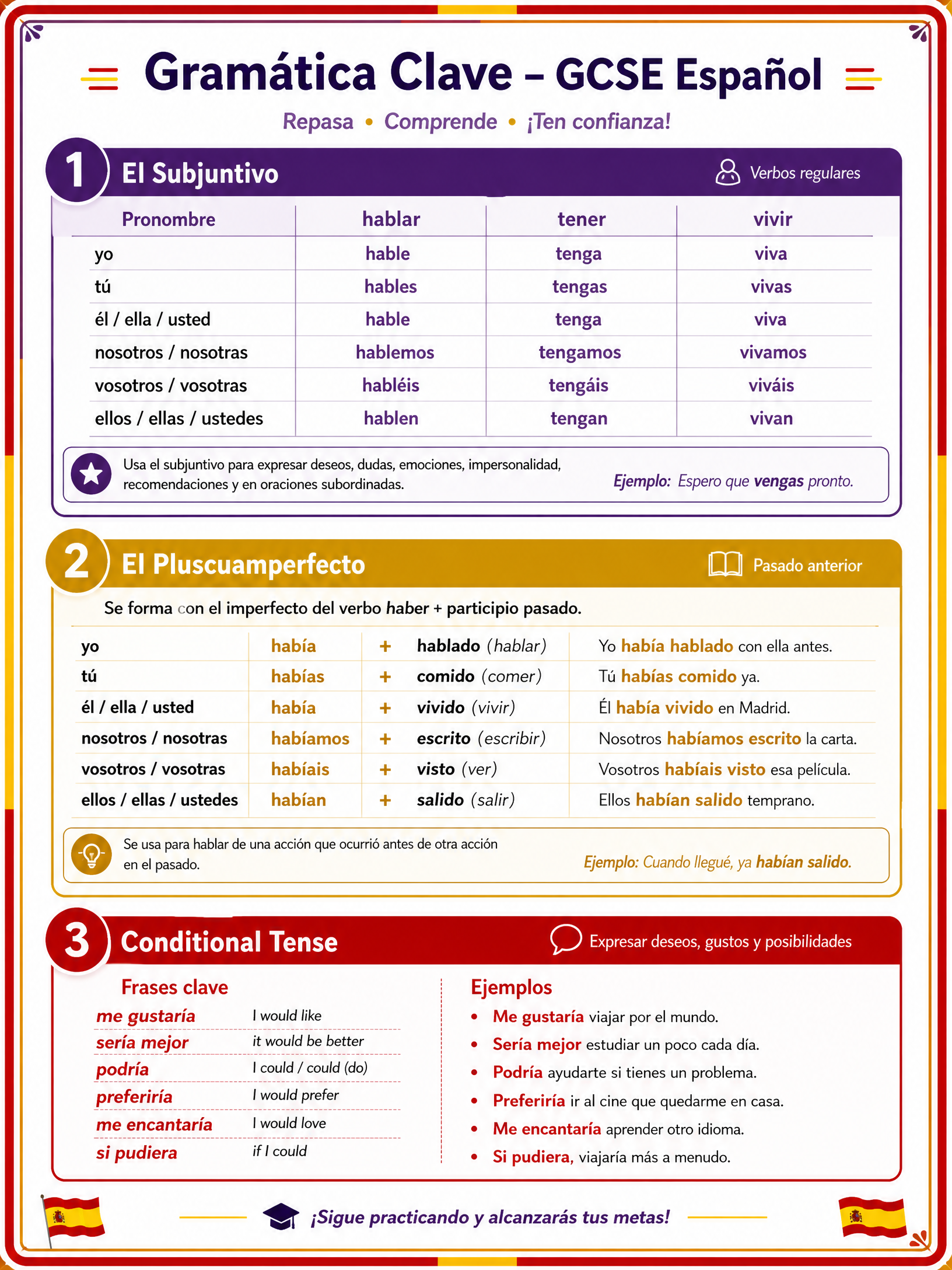
When to use it: The subjunctive is not a tense, but a mood. You must use it after expressions of emotion, doubt, desire, or impersonal phrases. Using it correctly is a surefire way to access the highest mark bands (Grades 7-9).
Conjugation Table (Present Subjunctive)
| Subject | hablar (to speak) | tener (to have) | vivir (to live) |
|---|---|---|---|
| yo | hable | tenga | viva |
| tú | hables | tengas | vivas |
| él/ella/usted | hable | tenga | viva |
| nosotros/as | hablemos | tengamos | vivamos |
| vosotros/as | habléis | tengáis | viváis |
| ellos/ellas/ustedes | hablen | tengan | vivan |
Irregulars to learn: ser (sea), ir (vaya), saber (sepa), haber (haya).
Example: Es importante que la sociedad acepte los nuevos modelos de familia. (It is important that society accepts new family models.)
Key Structure 2: El Pluscuamperfecto (The Pluperfect)
When to use it: To describe an action that happened before another action in the past (the "had done" tense). It shows examiners you can sequence past events sophisticatedly.
Conjugation Table
| Subject | haber (imperfect) | + Past Participle | English |
|---|---|---|---|
| yo | había | hablado | I had spoken |
| tú | habías | comido | You had eaten |
| él/ella/usted | había | vivido | He/she had lived |
| nosotros/as | habíamos | escrito | We had written |
| vosotros/as | habíais | visto | You (pl) had seen |
| ellos/ellas/ustedes | habían | vuelto | They had returned |
Irregulars to learn (Past Participles): escribir (escrito), ver (visto), volver (vuelto), hacer (hecho), decir (dicho).
Example: Antes de 1981, el gobierno no había legalizado el divorcio en España. (Before 1981, the government had not legalised divorce in Spain.)
Key Structure 3: El Condicional (The Conditional)
When to use it: To express what would happen, or to state desires and possibilities. It is essential for giving nuanced opinions and hypothetical situations.
Conjugation Table
| Subject | hablar (to speak) | comer (to eat) | vivir (to live) |
|---|---|---|---|
| yo | hablaría | comería | viviría |
| tú | hablarías | comerías | vivirías |
| él/ella/usted | hablaría | comería | viviría |
| nosotros/as | hablaríamos | comeríamos | viviríamos |
| vosotros/as | hablaríais | comeríais | viviríais |
| ellos/ellas/ustedes | hablarían | comerían | vivirían |
Irregulars to learn (Stems): tener (tendr-), poder (podr-), querer (querr-), hacer (har-), decir (dir-).
Example: Me gustaría tener mi propia familia en el futuro, pero sería difícil sin un buen trabajo. (I would like to have my own family in the future, but it would be difficult without a good job.)
🎧 Listening Skills

What to Expect
You will hear interviews, radio broadcasts, or conversations discussing family life. Topics often include generational differences (e.g., a teenager arguing with a traditional grandparent), statistics about marriage/divorce, or people describing their non-traditional family setups.
Listening Strategies
- Anticipate vocabulary: Before the track plays, read the questions and predict the Spanish words you might hear (e.g., if the question is about "living together", listen for convivir or pareja de hecho).
- Listen for qualifiers: Words like a veces (sometimes), siempre (always), rara vez (rarely), or casi nunca (almost never) completely change the meaning of a statement.
- Watch for tense indicators: Listen for time markers like ayer (yesterday), actualmente (currently), or en el futuro (in the future) to understand when events happen.
Common Listening Traps
- Negatives: Spanish speakers often speak quickly, and the word no can get lost. Pay attention to nunca (never), jamás (never), and nadie (nobody).
- False Friends: Hearing embarazada and thinking "embarrassed" instead of "pregnant".
- Distractors: The speaker might mention multiple options before stating their actual opinion (e.g., "My parents wanted me to get married, but I prefer to cohabit").
🗣️ Speaking Skills
Role Play Scenarios
Scenario 1: Discussing family with a Spanish exchange student.
- You: ¿Cuántas personas hay en tu familia?
- Student: Somos cuatro. Mis padres, mi hermana menor y yo. ¿Y en la tuya?
- You: En mi familia somos tres. Vivo con mi madre y mi abuela. Es una familia monoparental pero muy unida.
Photo Card Practice
Model Photo Card Response (A photo showing a diverse, modern family having dinner):
- Qu 1 (Description): En la foto hay una familia grande comiendo juntos. Parece una familia moderna y diversa. Están sonriendo y parecen muy felices.
- Qu 2 (Opinion): En mi opinión, es maravilloso ver diferentes tipos de familias. Lo más importante no es la estructura, sino el amor y el respeto entre los miembros.
- Qu 3 (Related topic): Creo que en España, las familias son muy unidas y a menudo comen juntos los domingos, lo cual es una buena tradición.
- Qu 4 (Past/Future): Cuando era más joven, mi familia siempre cenaba junta todos los días. En el futuro, me gustaría mantener esa tradición con mis propios hijos.
- Qu 5 (Unpredictable - ¿Crees que es difícil ser padre hoy en día?): Sí, creo que es muy difícil porque la vida es muy cara y los padres tienen que trabajar muchas horas, así que tienen menos tiempo para los niños.
General Conversation Questions
| Question (Spanish) | Model Answer | English Translation |
|---|---|---|
| ¿Cómo es tu familia? | Mi familia es bastante pequeña. Vivo con mis padres y no tengo hermanos. Sin embargo, tengo muchos primos y nos llevamos muy bien. | My family is quite small. I live with my parents and I don't have siblings. However, I have many cousins and we get on very well. |
| ¿Crees que la familia tradicional está desapareciendo? | No creo que esté desapareciendo, pero definitivamente está cambiando. Hoy en día hay más familias monoparentales y parejas de hecho, lo cual refleja una sociedad más moderna. | I don't think it's disappearing, but it is definitely changing. Nowadays there are more single-parent families and cohabiting couples, which reflects a more modern society. |
| ¿Te gustaría casarte en el futuro? | Sí, me gustaría casarme algún día porque creo que el matrimonio ofrece estabilidad. No obstante, primero quiero terminar mis estudios y viajar. | Yes, I would like to get married someday because I think marriage offers stability. However, first I want to finish my studies and travel. |
| ¿Cómo han cambiado las familias en España? | Han cambiado drásticamente. En el pasado, las familias eran muy grandes y tradicionales. Ahora, la tasa de natalidad es muy baja y hay muchos más divorcios. | They have changed drastically. In the past, families were very large and traditional. Now, the birth rate is very low and there are many more divorces. |
| ¿Qué opinas del divorcio? | Pienso que el divorcio es necesario a veces. Es mejor que una pareja se separe si no son felices, en lugar de vivir en un ambiente tóxico para los hijos. | I think divorce is necessary sometimes. It is better for a couple to separate if they are not happy, rather than living in a toxic environment for the children. |
✍️ Writing Skills
Translation Practice
English → Spanish:
| English | Spanish | Key Grammar |
|---|---|---|
| I live in a single-parent family. | Vivo en una familia monoparental. | Present tense, specific vocabulary. |
| In the past, families were larger. | En el pasado, las familias eran más grandes. | Imperfect tense for description in the past. |
| The divorce rate has increased recently. | El índice de divorcios ha aumentado recientemente. | Present perfect tense. |
| It is important that society accepts modern families. | Es importante que la sociedad acepte las familias modernas. | Subjunctive mood after 'es importante que'. |
| If I had the choice, I would get married. | Si tuviera la opción, me casaría. | Imperfect subjunctive + Conditional (Higher tier structure). |
Extended Writing
**Model 90-word response (Foundation):**En mi familia somos cuatro personas: mi madre, mi padre, mi hermano mayor y yo. Me llevo muy bien con mi hermano porque es muy divertido. En mi opinión, la familia es muy importante porque siempre te apoya. El fin de semana pasado, fuimos al cine juntos y fue genial. En el futuro, me gustaría tener mi propia familia, pero primero quiero ir a la universidad y viajar por el mundo. Creo que las familias modernas son diferentes, pero lo importante es ser feliz.
**Model 150-word response (Higher):**La estructura familiar en España ha experimentado cambios profundos en las últimas décadas. En el pasado, la mayoría de las familias eran nucleares y muy tradicionales. Sin embargo, hoy en día, la sociedad es mucho más diversa.
Personalmente, vivo en una familia reconstituida, ya que mis padres se divorciaron cuando yo era pequeña y mi madre se volvió a casar. Me llevo estupendamente con mi padrastro. Es evidente que el índice de divorcios ha aumentado, pero no creo que esto sea necesariamente negativo; es mejor separarse que vivir sin amor.
Es fundamental que la sociedad acepte todos los tipos de familia, ya sean monoparentales o parejas de hecho. En cuanto a mi futuro, me gustaría casarme, pero solo cuando haya terminado mis estudios. Sería ideal encontrar a alguien que comparta mis valores, porque formar una familia es una gran responsabilidad.
Writing Checklist
- ✅ Three tenses used accurately (Past, Present, Future/Conditional).
- ✅ Opinions given and justified with porque or ya que.
- ✅ Complex structures included (e.g., es importante que + subjunctive).
- ✅ Connectives used to link ideas (sin embargo, además, por lo tanto).
- ✅ Adjective agreements checked (gender and number match the noun).
📚 Reading Skills
Key Strategies
- Skim for gist: Read the text quickly first to understand the overall tone. Is the writer traditional or modern? Are they complaining or celebrating?
- Context clues: If you don't know a word, look at the words around it. If a text says "Juan y María decidieron romper su relación", you can guess romper means to break up.
- Read the questions carefully: Sometimes questions contain clues about what to look for in the text.
False Friends & Tricky Words
| Word | Looks Like | Actually Means |
|---|---|---|
| los parientes | parents | relatives (parents = los padres) |
| embarazada | embarrassed | pregnant (embarrassed = avergonzado/a) |
| sensible | sensible | sensitive (sensible = sensato/a) |
| el éxito | exit | success (exit = la salida) |
| comprensivo | comprehensive | understanding (comprehensive = completo/a) |
🌍 Cultural Knowledge
Understanding the cultural context of Spain adds depth to your answers and impresses examiners.
During the Franco dictatorship (1939-1975), Spanish society was heavily influenced by the Catholic Church. Divorce, abortion, and contraception were illegal. The traditional nuclear family was the only acceptable model.
Following the transition to democracy in the late 1970s, Spain modernised rapidly. Divorce was legalised in 1981. In 2005, Spain became the third country in the world to legalise same-sex marriage (el matrimonio igualitario). Today, Spain has one of the lowest birth rates in Europe, partly due to economic factors and youth unemployment, leading many young people to live with their parents until their late 20s or 30s (known as la emancipación tardía). Using these facts in your speaking or writing demonstrates excellent cultural awareness.
Visual Resources
2 diagrams and illustrations
Interactive Diagrams
1 interactive diagram to visualise key concepts
Conceptual Flow Outline
MFL exam approach by skill
Worked Examples
4 worked examples — open one to explore the question and available guidance.
Practice Questions
Test your understanding — click to reveal model answers
Writing: Traduce al español: 'Although marriage is traditional, nowadays many couples prefer to live together without getting married.'
Hint: Use 'Aunque' for although, and remember the infinitive after 'sin'.
Speaking: Describe tu familia y explica cómo te llevas con ellos.
Hint: Use reflexive verbs for relationships (me llevo bien con) and justify your opinion.
Reading: Read the text and answer in English: 'La tasa de natalidad en España es preocupante. Los jóvenes no tienen dinero para comprar una casa, así que retrasan la decisión de tener hijos.' Why is the birth rate worrying?
Hint: Look for the consequence of not having money.
Listening: You hear: 'Antes, las familias eran enormes. Mi abuela tuvo diez hijos. Pero yo solo quiero uno o dos.' What is the difference between the speaker's plans and their grandmother's reality?
Hint: Listen for the numbers.
Writing: Write 90 words about your family. Include: a description of your family, what you did together last weekend, your opinion on marriage, and your plans for the future.
Hint: Ensure you cover all 4 bullet points using 3 different tenses.
Speaking: ¿Cuáles son las ventajas de una familia extensa?
Hint: Think about support, childcare, and shared experiences.