Pearson Edexcel · A-Level · Spanish
Other constructions (hace/hacía, cleft sentences, comparatives, indirect speech)
Mastering advanced Spanish constructions—like hace/hacía for time, cleft sentences for emphasis, comparatives, and indirect speech—is the key to unlocking top grades. This guide equips you with the vocabulary, grammar structures, and exam techniques needed across Listening, Speaking, Reading, and Writing to impress examiners and demonstrate sophisticated language control.
- 13 min read
- 4 worked examples
- 6 practice questions
- 5 key terms
Study Notes
Overview
Welcome to your definitive guide on Advanced Constructions in GCSE Spanish. This topic covers four critical grammar structures: time expressions with hace and hacía, cleft sentences (oraciones escindidas), comparatives and superlatives, and indirect speech (estilo indirecto). Mastering these isn't just about ticking a box; it's about showing the examiner that you have sophisticated control over the language. These structures are heavily rewarded in both the Speaking and Writing exams, as they demonstrate a 'variety of structures'—a key requirement for accessing the highest mark bands (Grades 7-9). They also frequently appear as distractors in Listening and Reading papers, so understanding how they work is essential across all four skills.
📖 Essential Vocabulary
Tier 1 — Foundation Core
| Spanish | English | Gender | Example Sentence |
|---|---|---|---|
| el tiempo | the time/weather | m | Hace mucho tiempo que no te veo. |
| la hora | the hour/time | f | ¿Qué hora es? |
| el año | the year | m | Hace un año que vivo aquí. |
| el mes | the month | m | Fui a España hace un mes. |
| la semana | the week | f | Estudio español desde hace una semana. |
| el día | the day | m | Hace dos días que llueve. |
| bueno | good | - | El libro es muy bueno. |
| malo | bad | - | El tiempo es malo hoy. |
| grande | big/large | - | Mi casa es grande. |
| pequeño | small | - | El coche es pequeño. |
| más | more | - | Quiero más agua, por favor. |
| menos | less | - | Tengo menos dinero que tú. |
| mejor | better | - | Este restaurante es mejor. |
| peor | worse | - | La película fue peor que el libro. |
| decir | to say/tell | - | Él dice la verdad. |
Tier 2 — Higher Tier
| Spanish | English | Gender | Example Sentence |
|---|---|---|---|
| la década | the decade | f | Hace una década que construyeron el puente. |
| el siglo | the century | m | Este castillo fue construido hace un siglo. |
| mayor | older/greater | - | Mi hermano mayor va a la universidad. |
| menor | younger/smaller | - | Soy la hermana menor. |
| tan... como | as... as | - | El tren es tan rápido como el coche. |
| lo que | what/that which | - | Lo que me gusta es la comida. |
| el que / la que | the one who/which | - | La que me ayudó fue mi madre. |
| contar | to tell/recount | - | Me contó que había ido al cine. |
| explicar | to explain | - | Explicó que llegaría tarde. |
| añadir | to add | - | Añadió que estaba muy cansado. |
High-Frequency Words & Phrases
| Phrase | English | Usage Context |
|---|---|---|
| desde hace | for (a period of time) | Used with present tense for ongoing actions. |
| hace... que | it has been... since | Alternative to 'desde hace' for ongoing actions. |
| más de lo que | more than (what) | Used before a clause with a verb (Higher tier). |
| menos de lo que | less than (what) | Used before a clause with a verb (Higher tier). |
| lo mejor es que | the best thing is that | Excellent for introducing justified opinions. |
| lo peor es que | the worst thing is that | Excellent for introducing negative opinions. |
| me dijo que | he/she told me that | Essential for reporting speech in the past. |
| me explicó que | he/she explained that | Adds variety to reporting verbs. |
| es más... que | is more... than | Basic comparative structure. |
| es menos... que | is less... than | Basic comparative structure. |
📝 Grammar Focus
Key Structure 1: Time Expressions with Hace / Hacía
When to use it: To describe how long an action has been happening, or when an action took place in the past.
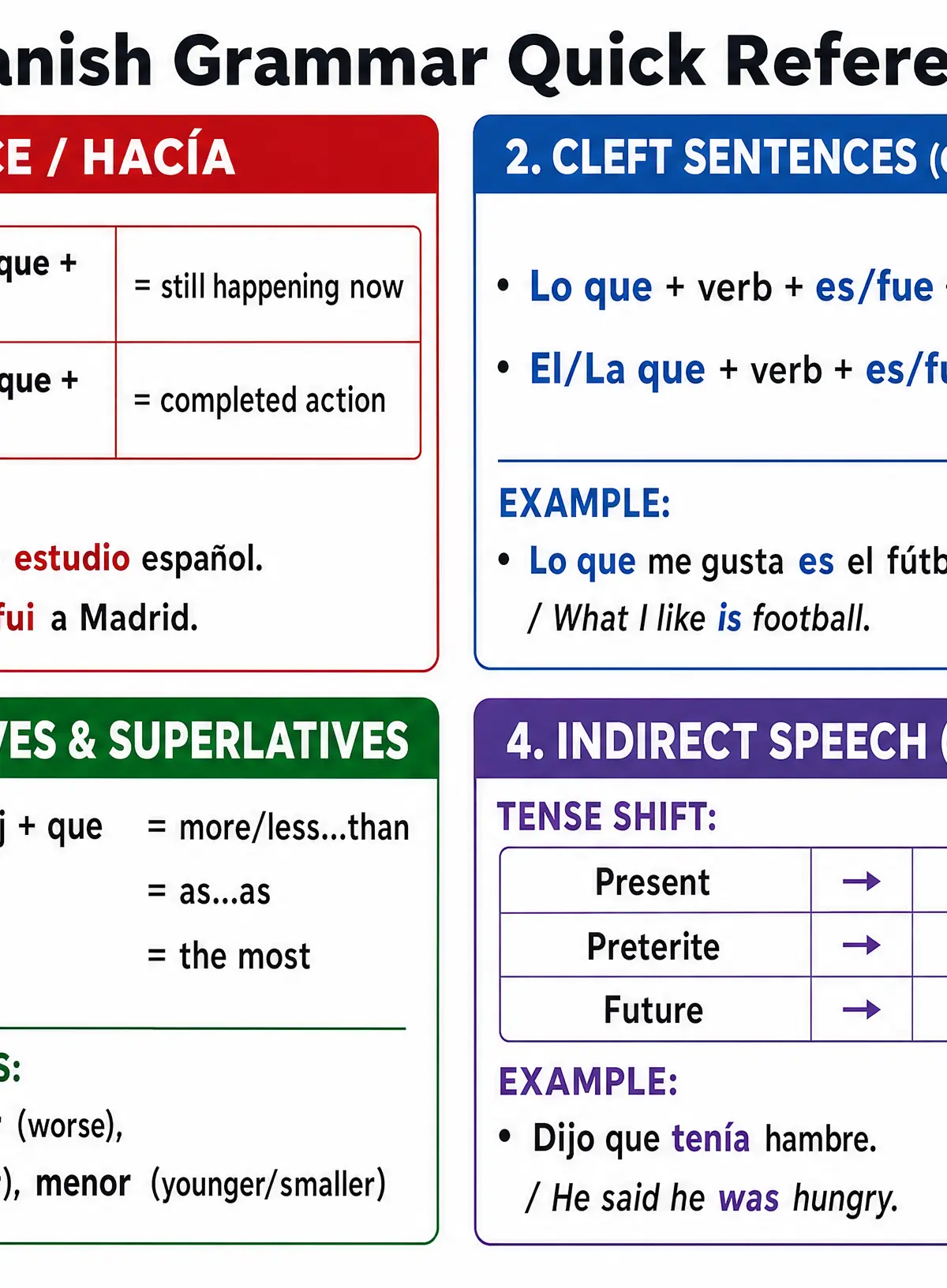
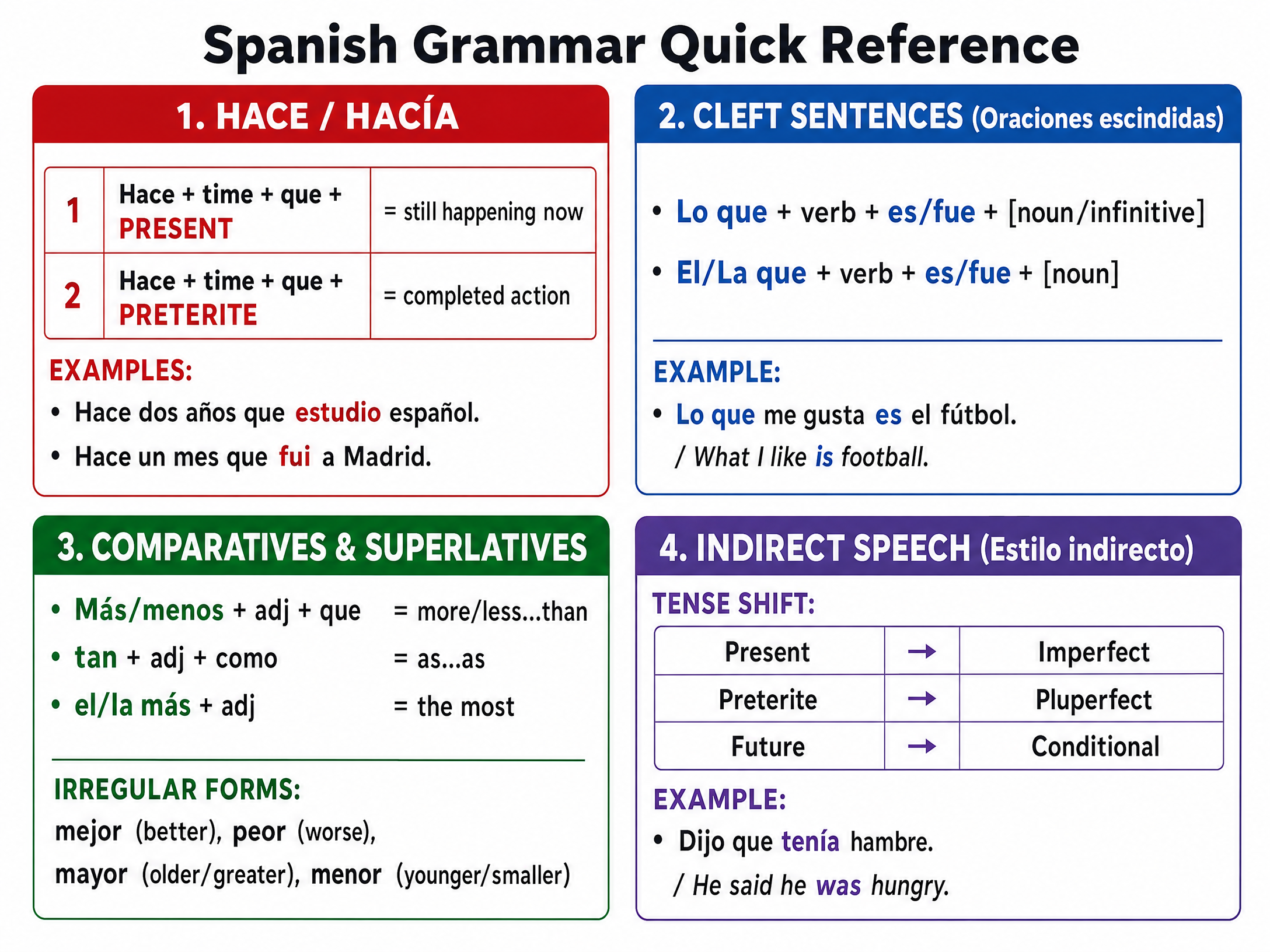
- Hace + time + que + PRESENT TENSE: For actions that started in the past and are STILL happening. (e.g., Hace dos años que estudio español = I have been studying Spanish for two years).
- Hace + time + que + PRETERITE TENSE: For actions that happened and finished in the past. (e.g., Hace un mes que fui a Madrid = I went to Madrid a month ago).
- Hacía + time + que + IMPERFECT TENSE: For actions that had been happening in the past before something else interrupted. (e.g., Hacía tres horas que esperaba cuando llegó el tren = I had been waiting for three hours when the train arrived).
Conjugation Table: Key Verbs used with Hace/Hacía
| Subject | Estudiar (Present) | Ir (Preterite) | Esperar (Imperfect) |
|---|---|---|---|
| yo | estudio | fui | esperaba |
| tú | estudias | fuiste | esperabas |
| él/ella | estudia | fue | esperaba |
| nosotros | estudiamos | fuimos | esperábamos |
| vosotros | estudiáis | fuisteis | esperabais |
| ellos/ellas | estudian | fueron | esperaban |
Key Structure 2: Cleft Sentences (Oraciones escindidas)
When to use it: To place emphasis on a specific part of a sentence. This is a high-level structure that examiners actively look for.
- Formula: Lo que + verb + es/fue + [thing you are emphasizing]
- Example: Instead of saying Me gusta el fútbol (I like football), say Lo que me gusta es el fútbol (What I like is football).
- For people: Use el que or la que depending on gender. (e.g., La que me ayudó fue mi profesora = The one who helped me was my teacher).
Key Structure 3: Comparatives and Superlatives
When to use it: To compare two things or state that something is the most/least.
- Comparatives: más/menos + adjective + que (e.g., El español es más fácil que el alemán).
- Equality: tan + adjective + como (e.g., Soy tan alto como mi hermano).
- Superlatives: definite article (el/la/los/las) + más/menos + adjective. (e.g., Es la ciudad más bonita de España - Note the use of de, not en!).
Irregulars to learn:
- bueno → mejor (better)
- malo → peor (worse)
- grande → mayor (older/greater)
- pequeño → menor (younger/smaller)
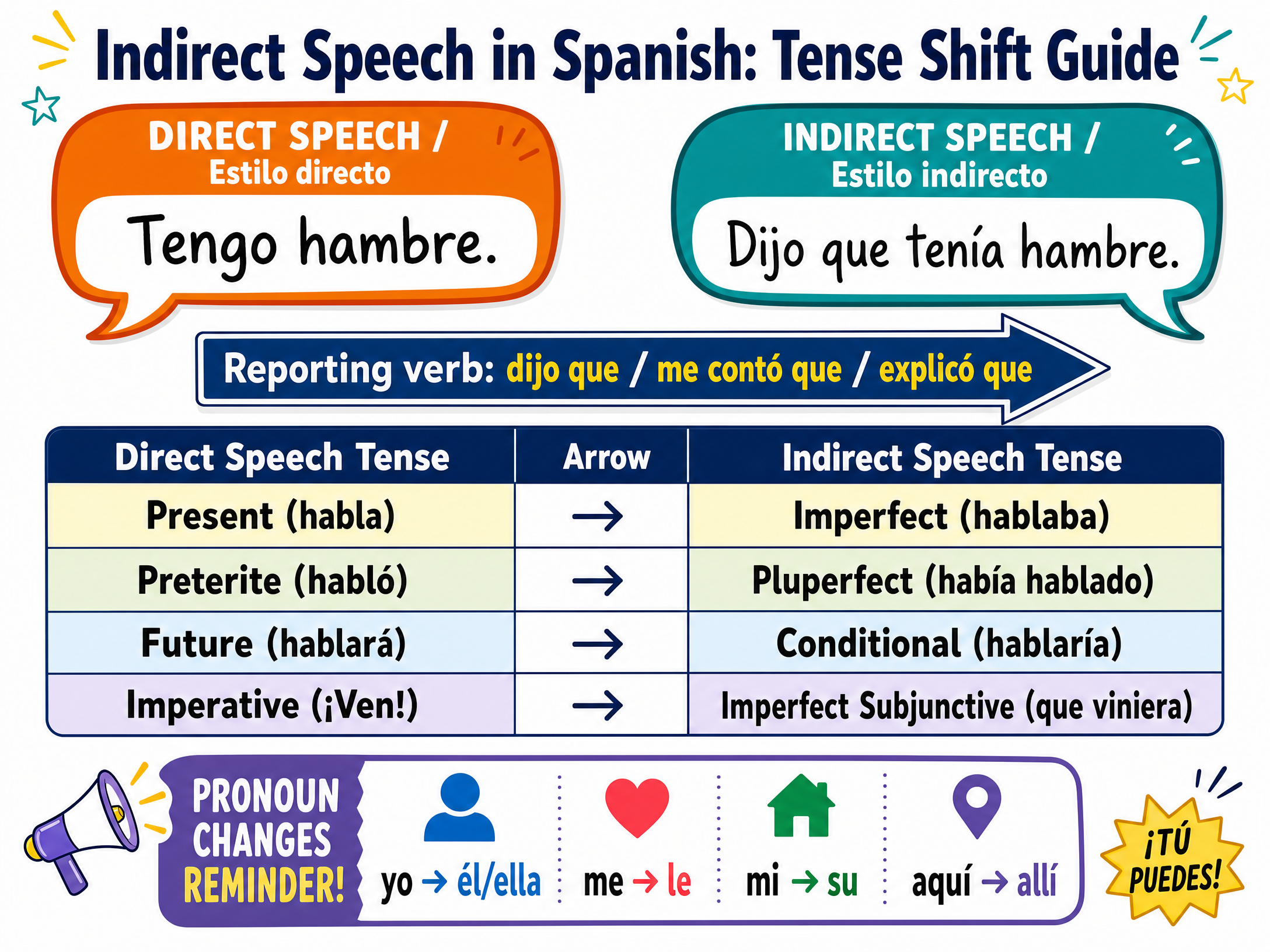
Key Structure 4: Indirect Speech (Estilo indirecto)
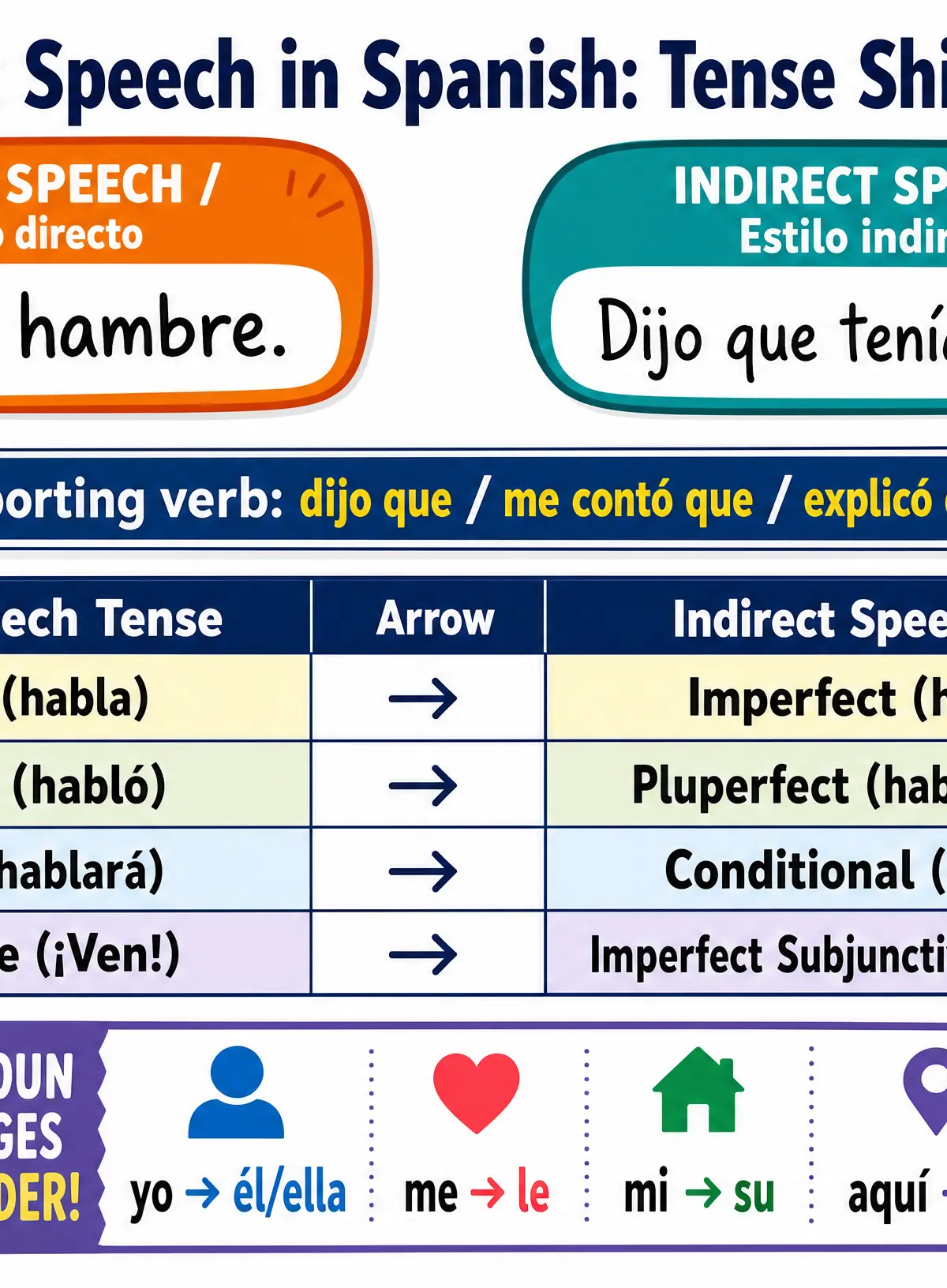
When to use it: To report what someone else said. The tense of the original statement must shift "backwards" in time.
- Present → Imperfect: "Tengo hambre" → Dijo que tenía hambre.
- Preterite → Pluperfect: "Fui al cine" → Me contó que había ido al cine.
- Future → Conditional: "Iré a España" → Explicó que iría a España.
Remember to also change pronouns! (yo → él/ella, me → le, mi → su).
🎧 Listening Skills

What to Expect
In the Listening exam, these structures are often used to test your understanding of timeframes and relationships. You might hear someone comparing two holidays, reporting what a friend told them about a job, or explaining how long they have lived in a city.
Listening Strategies
- Listen for tense markers with 'hace': If you hear hace followed by a present tense verb, the person is still doing the activity. If followed by a preterite verb, the activity is finished. This is a classic trap.
- Catch the 'de' in superlatives: When listening for where something is the "best" or "worst", listen for de (e.g., el mejor del mundo), as it often links to the location.
- Note the reporting verbs: Words like dijo, contó, or explicó signal that you are hearing indirect speech. Pay attention to the tense that follows to understand when the reported action happened.
Common Listening Traps
- Hearing mayor or menor and assuming it means "bigger" or "smaller" physically, when it usually means "older" or "younger" in the context of family members.
- Confusing hace un año (a year ago - finished) with desde hace un año (for a year - ongoing).
🗣️ Speaking Skills
Role Play Scenarios
Scenario 1: At a tourist office
- Examiner: ¿Desde cuándo estás en Madrid?
- You: Hace tres días que estoy en Madrid. Lo que más me gusta es el Palacio Real.
Scenario 2: Talking about school
- Examiner: ¿Qué opinas de tus profesores?
- You: Mi profesor de ciencias es más estricto que mi profesor de inglés, pero el que me ayuda más es el de matemáticas.
Photo Card Practice
Model Photo Card Response (Theme: Holidays):
- Qu 1 (Description): En la foto veo a una familia en la playa. Hace mucho calor.
- Qu 2 (Opinion): Lo que me encanta de la playa es nadar en el mar porque es muy relajante.
- Qu 3 (Related topic): El año pasado, fui a Grecia. Fue el mejor viaje de mi vida.
- Qu 4 (Past/Future): Mi amigo me dijo que iría a Italia el próximo verano.
- Qu 5 (Unpredictable): Prefiero las vacaciones activas porque son más emocionantes que pasar todo el día tomando el sol.
General Conversation Questions
| Question (Spanish) | Model Answer | English Translation |
|---|---|---|
| ¿Cuánto tiempo llevas estudiando español? | Hace tres años que estudio español. Lo que más me gusta es aprender sobre la cultura. | How long have you been studying Spanish? / I have been studying Spanish for three years. What I like most is learning about the culture. |
| ¿Cómo te llevas con tu familia? | Me llevo bien con mi hermana. Es menor que yo, pero es más madura de lo que parece. | How do you get on with your family? / I get on well with my sister. She is younger than me, but she is more mature than she seems. |
| ¿Qué hiciste el fin de semana pasado? | Fui al cine. Mi amigo me dijo que la película era buena, pero fue peor de lo que esperaba. | What did you do last weekend? / I went to the cinema. My friend told me the film was good, but it was worse than I expected. |
| ¿Dónde vives? | Vivo en Londres. Hace diez años que vivo aquí. Es la ciudad más grande de Inglaterra. | Where do you live? / I live in London. I have lived here for ten years. It is the biggest city in England. |
| ¿Qué planes tienes para el futuro? | Mi profesor me explicó que sería útil ir a la universidad, así que estudiaré ciencias. | What are your plans for the future? / My teacher explained to me that it would be useful to go to university, so I will study science. |
✍️ Writing Skills
Translation Practice
English → Spanish:
| English | Spanish | Key Grammar |
|---|---|---|
| I have been playing tennis for two years. | Hace dos años que juego al tenis. | hace + time + que + present |
| What I like most is the food. | Lo que más me gusta es la comida. | Cleft sentence (lo que) |
| My brother is taller than me. | Mi hermano es más alto que yo. | Comparative (más... que) |
| She told me that she was tired. | Me dijo que estaba cansada. | Indirect speech (Present → Imperfect) |
| It is the best restaurant in the city. | Es el mejor restaurante de la ciudad. | Superlative + irregular (mejor) + de |
Extended Writing
**Model 90-word response (Foundation):**Vivo en Manchester. Hace cinco años que vivo aquí. Mi ciudad es muy grande y moderna, pero es más ruidosa que el campo. Lo que más me gusta es el centro comercial porque hay muchas tiendas. El fin de semana pasado, fui al parque con mis amigos. Hacía mucho frío, pero fue divertido. Mi amigo me dijo que el próximo fin de semana iremos al cine. ¡Qué guay!
**Model 150-word response (Higher):**Vivo en una ciudad histórica en el norte de Inglaterra. Hace más de diez años que vivo aquí con mi familia. En mi opinión, mi ciudad es la más hermosa de la región, aunque a veces el clima es peor de lo que me gustaría. Lo que me fascina de mi zona son los museos antiguos.
El mes pasado, visité Madrid durante un intercambio escolar. Hacía tres meses que esperaba ese viaje, y no me decepcionó. La comida española es muchísimo más sabrosa que la comida inglesa. Durante el viaje, mi compañero de intercambio me explicó que la vida en España es muy relajada. Me dijo que normalmente cenaban a las diez de la noche, lo cual me sorprendió mucho.
En el futuro, me encantaría vivir en el extranjero. Mi profesor me contó que sería una experiencia inolvidable, así que espero estudiar en la universidad de Barcelona.
Writing Checklist
- ✅ Used hace with the correct tense (present for ongoing, preterite for finished).
- ✅ Included at least one lo que (cleft sentence) to show emphasis.
- ✅ Checked comparative irregulars (mejor, peor, mayor, menor).
- ✅ Used de (not en) after a superlative.
- ✅ Shifted the tense correctly when reporting speech (dijo que...).
📚 Reading Skills
Key Strategies
When reading complex texts, use a highlighter to identify structural markers. Circle words like hace, lo que, más/menos, and dijo que. This helps you break down long, intimidating sentences into manageable chunks. Pay close attention to the tense of the verb following hace to determine if the action is in the past or present.
False Friends & Tricky Words
| Word | Looks Like | Actually Means |
|---|---|---|
| mayor | mayor | older / greater |
| menor | minor | younger / smaller |
| actual | actual | current / present-day |
| sensible | sensible | sensitive |
| recordar | to record | to remember (often used in indirect speech) |
🌍 Cultural Knowledge
Understanding these grammatical structures enhances your ability to engage with authentic Spanish culture. For instance, when Spanish people talk about their history—such as the Moorish influence in Andalucía or the impact of the Spanish Civil War—they frequently use hace and hacía to locate events in time. Furthermore, Spanish conversation is often highly expressive and passionate; cleft sentences (lo que me encanta es...) are used constantly in daily life to add dramatic emphasis to opinions about food, football, and politics. Incorporating these structures makes your Spanish sound significantly more natural and culturally authentic.
Visual Resources
2 diagrams and illustrations
Interactive Diagrams
1 interactive diagram to visualise key concepts
Conceptual Flow Outline
Decision tree for choosing the correct tense with Hace/Hacía
Worked Examples
4 worked examples — open one to explore the question and available guidance.
Practice Questions
Test your understanding — click to reveal model answers
Translate into Spanish: I have been living in this house for five years.
Hint: Use the 'hace' construction with the present tense.
Rewrite this sentence to emphasize the food using a cleft sentence: Me encanta la comida española.
Hint: Start with 'Lo que...'
Change this direct speech into indirect speech: Mi madre dijo: 'El restaurante es muy caro'.
Hint: Shift the present tense 'es' back to the imperfect.
Translate into Spanish: My brother is older than me, but he is less intelligent.
Hint: Remember the irregular comparative for 'older'.
Translate into English: Hacía dos horas que estudiaba cuando mi amigo llamó.
Hint: This uses 'hacía' with the imperfect tense.
Complete the sentence with the correct preposition: Es el edificio más alto ___ la ciudad.
Hint: Think about the rule for superlatives and locations.