Pearson Edexcel · A-Level · Spanish
La evolución de la sociedad española
This comprehensive topic covers the evolution of Spanish society, focusing on modern families, the world of work, and the impact of tourism. You will master key vocabulary for social issues, learn to contrast the past, present, and future using three tenses, and develop the analytical skills required for top marks in all four GCSE exams.
- 12 min read
- 4 worked examples
- 6 practice questions
- 8 key terms
Study Notes
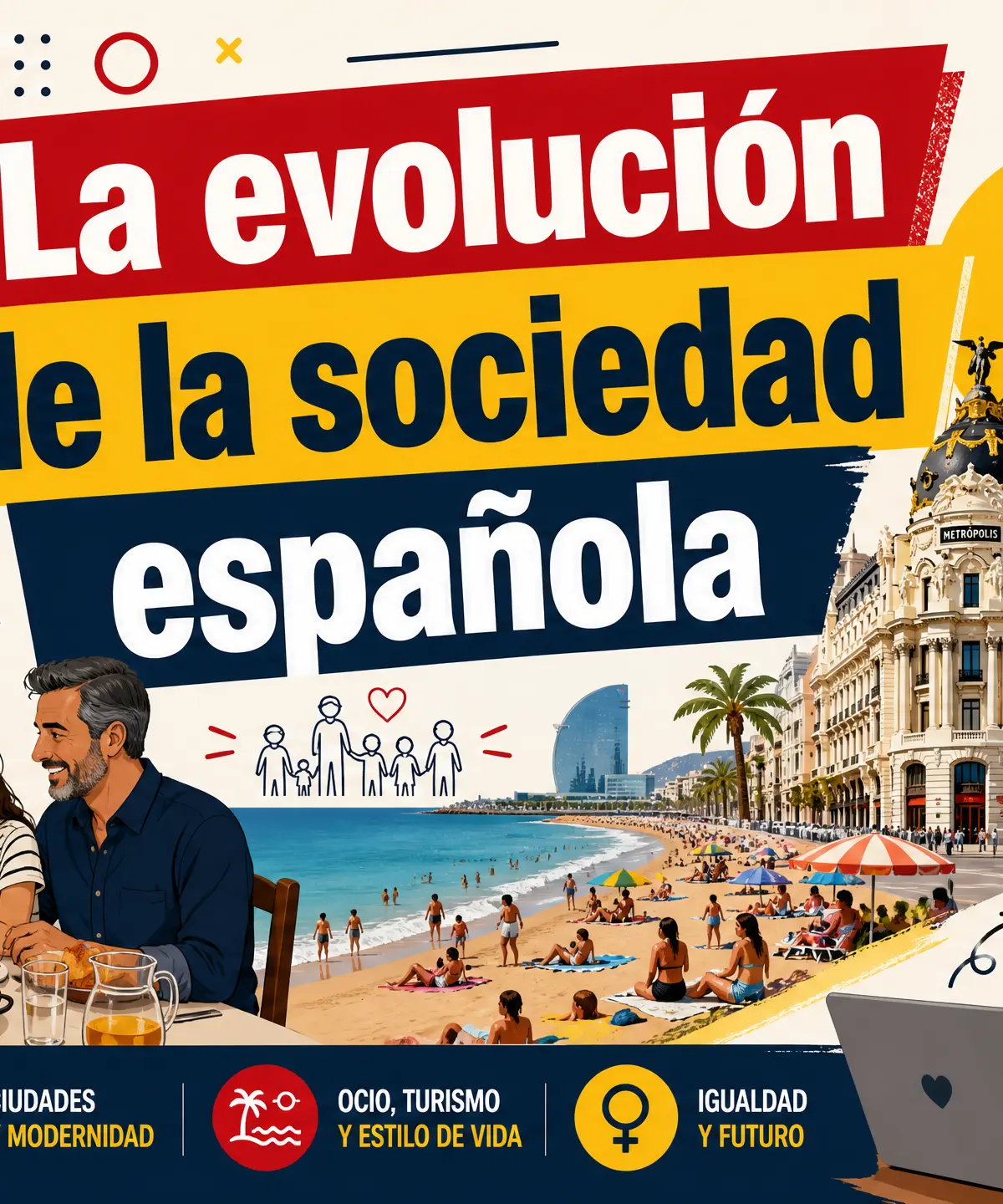
Overview
Welcome to your comprehensive study guide for the GCSE Spanish topic La evolución de la sociedad española (The evolution of Spanish society). This topic is crucial because it covers modern, real-world issues: how families are changing, the reality of the working world, and the massive impact of tourism on Spain.
For the exam, this topic appears across all four skills:
- Listening & Reading: You will encounter texts about modern families, youth unemployment, and sustainable tourism.
- Speaking: You will need to express and justify opinions on social changes during the conversation and photo card tasks.
- Writing: This is a prime topic for the 90-word and 150-word essays, requiring you to use multiple tenses to compare the past, present, and future of Spanish society.
Listen to the topic podcast below for a guided revision session:

📖 Essential Vocabulary
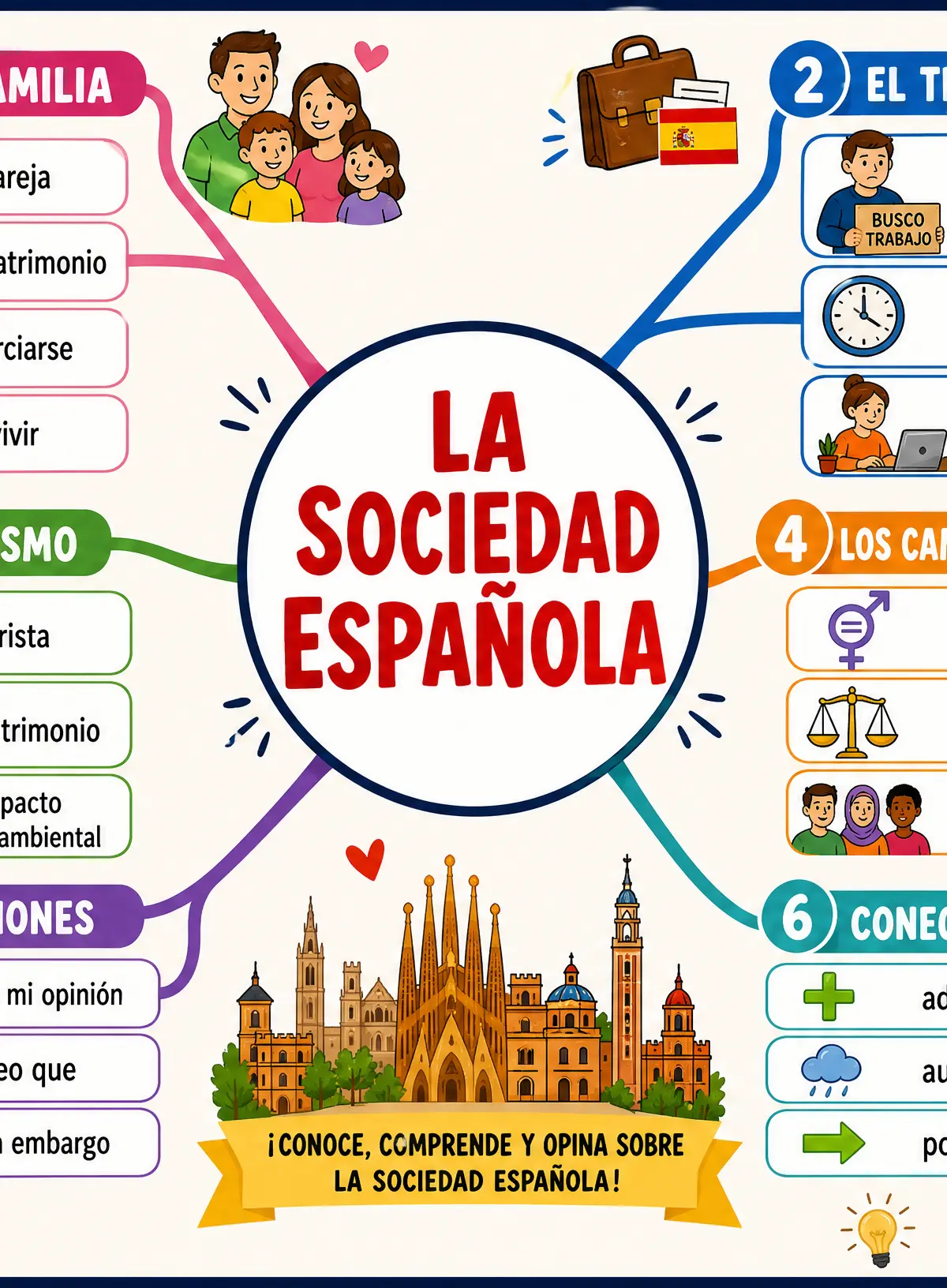
Tier 1 — Foundation Core
| Spanish | English | Gender | Example Sentence |
|---|---|---|---|
| la familia | family | f | Mi familia es muy grande. |
| los padres | parents | m | Mis padres trabajan en Madrid. |
| casarse | to get married | - | Ellos van a casarse en verano. |
| divorciarse | to get divorced | - | Tristemente, van a divorciarse. |
| el trabajo | work/job | m | El trabajo de mi madre es interesante. |
| ganar | to earn/win | - | Quiero ganar mucho dinero. |
| el paro | unemployment | m | El paro es un problema grave. |
| el turista | tourist | m/f | Hay muchos turistas en verano. |
| viajar | to travel | - | Me encanta viajar a España. |
| el hotel | hotel | m | Nos alojamos en un hotel bonito. |
| la playa | beach | f | Pasamos todo el día en la playa. |
| el medio ambiente | environment | m | Debemos proteger el medio ambiente. |
| la mujer | woman | f | La mujer moderna es independiente. |
| el hombre | man | m | El hombre ayuda en casa. |
| cambiar | to change | - | La sociedad va a cambiar mucho. |
Tier 2 — Higher Tier
| Spanish | English | Gender | Example Sentence |
|---|---|---|---|
| el matrimonio | marriage | m | El matrimonio igualitario es legal. |
| convivir | to live together | - | Muchas parejas prefieren convivir sin casarse. |
| la brecha salarial | gender pay gap | f | Todavía existe la brecha salarial en España. |
| la jornada laboral | working day/hours | f | La jornada laboral española es muy larga. |
| el desempleo juvenil | youth unemployment | m | El desempleo juvenil es una crisis actual. |
| a tiempo parcial | part-time | - | Trabajo a tiempo parcial los fines de semana. |
| el impacto medioambiental | environmental impact | m | El turismo masivo tiene un gran impacto medioambiental. |
| el patrimonio cultural | cultural heritage | m | Debemos cuidar nuestro patrimonio cultural. |
| la igualdad de género | gender equality | f | Luchamos por la igualdad de género. |
| la tasa de natalidad | birth rate | f | La tasa de natalidad ha bajado drásticamente. |
High-Frequency Words & Phrases
| Phrase | English | Usage Context |
|---|---|---|
| hoy en día | nowadays | To contrast present with past |
| en el pasado | in the past | To introduce the preterite/imperfect |
| en el futuro | in the future | To introduce the future tense |
| creo que | I believe that | To introduce an opinion |
| desde mi punto de vista | from my point of view | To give a strong, Higher tier opinion |
| sin embargo | however | To contrast two ideas |
| por lo tanto | therefore | To draw a conclusion |
| además | furthermore | To add another point |
| por un lado... por otro lado | on one hand... on the other hand | To weigh up arguments |
| lo bueno / lo malo es que | the good/bad thing is that | To evaluate a situation |
📝 Grammar Focus
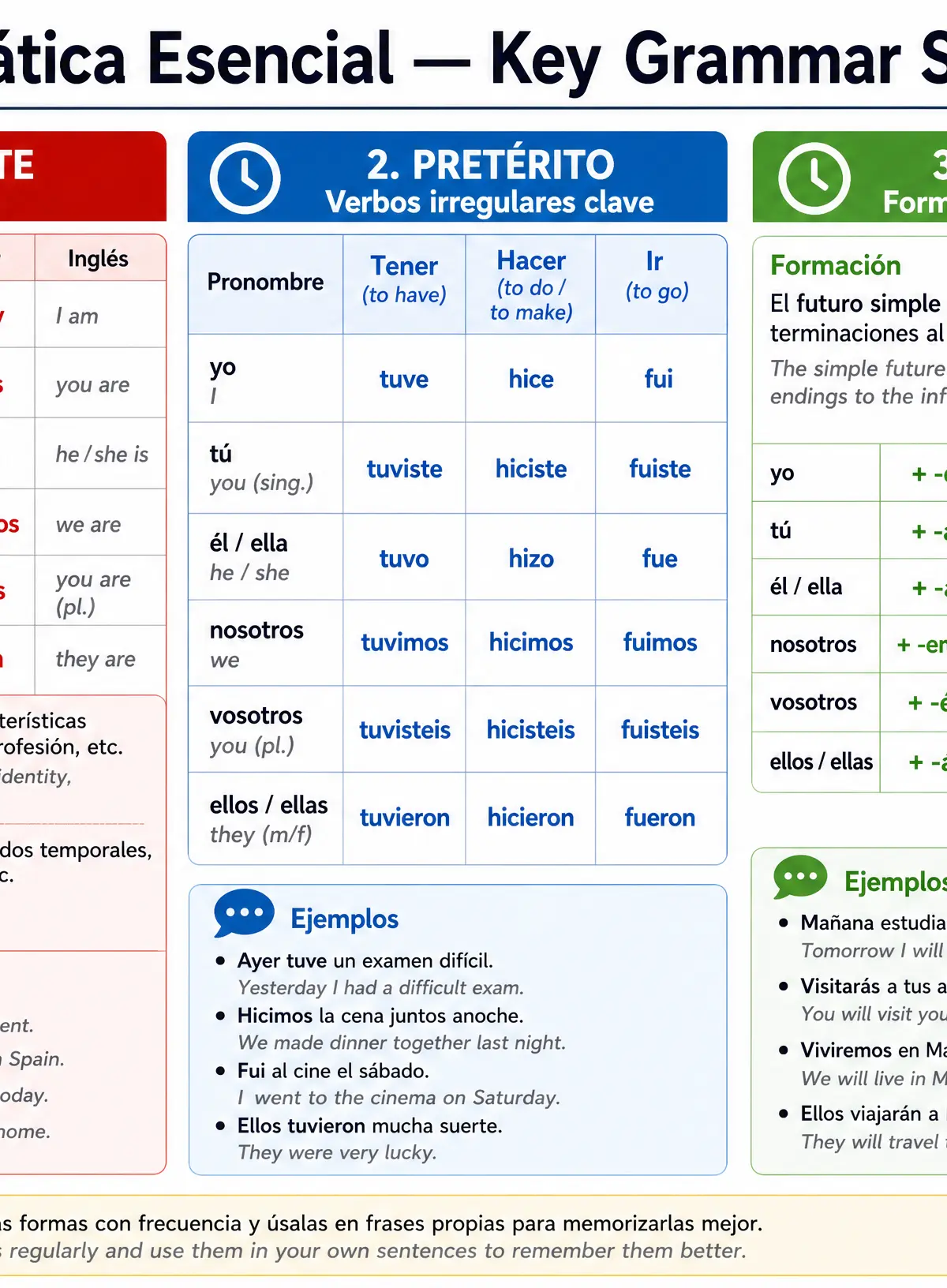
Key Structure 1: Present Tense — Ser vs Estar
When to use it: Use the present tense to describe current societal trends. You must master the difference between ser (permanent identity/characteristics) and estar (temporary states/locations).
Conjugation Table
| Subject | Ser (to be) | Estar (to be) |
|---|---|---|
| yo | soy | estoy |
| tú | eres | estás |
| él/ella/usted | es | está |
| nosotros | somos | estamos |
| vosotros | sois | estáis |
| ellos/ellas/ustedes | son | están |
Irregulars to learn: Both verbs are highly irregular. Remember: SER for STABLE, ESTAR for EMOTION/TEMPORARY.
Key Structure 2: The Preterite Tense (Completed Past)
When to use it: Use this to talk about specific, completed events in the past (e.g., "My parents got married in 2000").
Conjugation Table (Irregular Verbs: ir, tener, hacer)
| Subject | Ir (to go) | Tener (to have) | Hacer (to do/make) |
|---|---|---|---|
| yo | fui | tuve | hice |
| tú | fuiste | tuviste | hiciste |
| él/ella/usted | fue | tuvo | hizo |
| nosotros | fuimos | tuvimos | hicimos |
| vosotros | fuisteis | tuvisteis | hicisteis |
| ellos/ellas/ustedes | fueron | tuvieron | hicieron |
Irregulars to learn: The verb ser (to be) shares the exact same preterite forms as ir (fui, fuiste, etc.).
Key Structure 3: The Simple Future Tense
When to use it: Use this to make predictions about society, families, or tourism in the future. It is formed by keeping the infinitive and adding the endings.
Conjugation Table (Regular: hablar, comer, vivir)
| Subject | Ending | Example (Hablar) |
|---|---|---|
| yo | -é | hablaré |
| tú | -ás | hablarás |
| él/ella/usted | -á | hablará |
| nosotros | -emos | hablaremos |
| vosotros | -éis | hablaréis |
| ellos/ellas/ustedes | -án | hablarán |
Irregulars to learn: tener (tendré), hacer (haré), poder (podré), haber (habrá - there will be).
🎧 Listening Skills
What to Expect
Listening tracks on this topic often feature interviews with young Spaniards discussing their job prospects, or news reports about the impact of tourism on cities like Barcelona. You will hear different regional accents.
Listening Strategies
- Listen for time markers: Words like antes (before), ahora (now), and en el futuro (in the future) tell you which tense is being used, which often changes the answer.
- Watch for negatives and qualifiers: Listen carefully for no, nunca (never), pero (but), and aunque (although). A speaker might say tourism is good, but it causes pollution.
- Note numbers: Pay attention to percentages (e.g., youth unemployment rates) and dates.
Common Listening Traps
- False friends: Hearing actualmente and thinking it means "actually" (it means "currently/nowadays").
- Tense shifts: The question asks what they did (past), but the speaker starts by talking about what they usually do (present) before mentioning the past.
🗣️ Speaking Skills
Role Play Scenarios
Scenario: You are talking to a Spanish exchange student about work and future plans.
- Examiner: ¿En qué trabajan tus padres?
- You: Mi madre es médica y mi padre trabaja en una oficina.
- Examiner: ¿Qué te gustaría hacer en el futuro?
- You: Me gustaría ser ingeniero porque quiero ayudar a la gente y ganar un buen sueldo.
Photo Card Practice
Model Photo Card Response: (A photo showing a crowded beach in Spain)
- Qu 1 (Description): En la foto veo una playa española. Hay mucha gente, especialmente turistas. Hace mucho sol y buen tiempo.
- Qu 2 (Opinion): En mi opinión, la foto muestra el turismo masivo. Creo que es bueno para la economía, pero malo para el medio ambiente.
- Qu 3 (Related topic): Personalmente, prefiero el turismo rural porque es más tranquilo y sostenible.
- Qu 4 (Past): El año pasado, fui de vacaciones a España con mi familia y nos alojamos en un hotel en la costa.
- Qu 5 (Future): En el futuro, espero que haya menos contaminación en las playas españolas.
General Conversation Questions
| Question (Spanish) | Model Answer | English Translation |
|---|---|---|
| ¿Cómo ha cambiado la familia española? | Creo que ha cambiado mucho. Antes, las familias eran muy grandes, pero hoy en día hay más familias pequeñas y más divorcios. | How has the Spanish family changed? (I think it has changed a lot. Before, families were very large, but nowadays there are more small families and more divorces.) |
| ¿Qué opinas del matrimonio? | Desde mi punto de vista, el matrimonio no es esencial. Muchas parejas prefieren convivir porque es más moderno. | What is your opinion on marriage? (From my point of view, marriage is not essential. Many couples prefer to live together because it is more modern.) |
| ¿Es fácil encontrar trabajo para los jóvenes? | No, es muy difícil. El desempleo juvenil es un gran problema en España, por lo tanto muchos jóvenes tienen que emigrar. | Is it easy for young people to find work? (No, it is very difficult. Youth unemployment is a big problem in Spain, therefore many young people have to emigrate.) |
| ¿Cuáles son los efectos del turismo en España? | Lo bueno es que crea empleo. Sin embargo, lo malo es que causa problemas medioambientales y ruido. | What are the effects of tourism in Spain? (The good thing is that it creates employment. However, the bad thing is that it causes environmental problems and noise.) |
| ¿Qué harás tú en el futuro? | En el futuro, iré a la universidad y luego buscaré un buen trabajo a tiempo completo. | What will you do in the future? (In the future, I will go to university and then I will look for a good full-time job.) |
✍️ Writing Skills
Translation Practice
English → Spanish:
| English | Spanish | Key Grammar |
|---|---|---|
| My family is quite small. | Mi familia es bastante pequeña. | Ser + adjective agreement |
| In the past, women didn't work. | En el pasado, las mujeres no trabajaban. | Imperfect tense |
| I think that tourism is very important. | Creo que el turismo es muy importante. | Opinion phrase + ser |
| Last year I went to Spain. | El año pasado fui a España. | Preterite of ir |
| In the future, there will be more equality. | En el futuro, habrá más igualdad. | Future of haber (habrá) |
Extended Writing
**Model 90-word response (Foundation):**En mi opinión, la familia es muy importante. Mi familia es bastante pequeña. Vivo con mis padres y mi hermana. Me llevo bien con mi hermana porque es divertida. Sin embargo, a veces discutimos. En el pasado, las familias españolas eran muy grandes, pero hoy en día son más pequeñas. El año pasado, fui a España de vacaciones con mi familia. Lo pasamos muy bien en la playa. En el futuro, me gustaría casarme y tener dos hijos porque me encantan los niños.
**Model 150-word response (Higher):**La sociedad española ha cambiado drásticamente en las últimas décadas. En primer lugar, la estructura familiar es muy diferente hoy en día. En el pasado, las familias eran numerosas y la mujer normalmente se quedaba en casa. Sin embargo, actualmente, la mayoría de las mujeres trabajan y hay muchas familias monoparentales. Desde mi punto de vista, esto es un cambio positivo porque demuestra que hay más igualdad de género.
Por otro lado, el mundo laboral en España tiene problemas. El desempleo juvenil es altísimo, por lo tanto, muchos jóvenes universitarios tienen que emigrar a otros países para encontrar un trabajo a tiempo completo. Es una situación muy triste.
En cuanto al turismo, es vital para la economía española porque crea miles de puestos de trabajo. No obstante, el turismo masivo tiene un impacto medioambiental devastador. En el futuro, espero que el gobierno fomente el turismo sostenible. Habrá que proteger nuestro patrimonio cultural antes de que sea demasiado tarde.
Writing Checklist
- ✅ Three tenses used: Past (fui, eran), Present (es, vivo), Future (habrá, me gustaría)
- ✅ Opinions with reasons: Creo que... porque...
- ✅ Connectives: sin embargo, por lo tanto, además
- ✅ Adjective agreements: familias numerosas, turismo masivo
📚 Reading Skills
Key Strategies
Read the title and introduction of the text first — this sets the context. Look for cognates (words that look like English) to build your understanding, but beware of false friends. Read the questions carefully to see what specific detail is required (e.g., Who? When? Why?).
False Friends & Tricky Words
| Word | Looks Like | Actually Means |
|---|---|---|
| actualmente | actually | currently / nowadays |
| la firma | firm (company) | signature |
| el éxito | exit | success |
| asistir | to assist | to attend |
| sensible | sensible | sensitive |
🌍 Cultural Knowledge
To access the highest marks, you should demonstrate cultural awareness of the Hispanic world:
- Family changes: Spain legalised same-sex marriage in 2005, making it one of the first countries to do so. The birth rate in Spain is now one of the lowest in Europe.
- Youth Unemployment: The Generación Perdida (Lost Generation) refers to highly educated young Spaniards who cannot find work and often move abroad (the "brain drain" or fuga de cerebros).
- Tourism: Spain is the second most visited country in the world. Cities like Barcelona have seen anti-tourism protests due to rising rent prices and overcrowding caused by holiday apartments.
Visual Resources
2 diagrams and illustrations
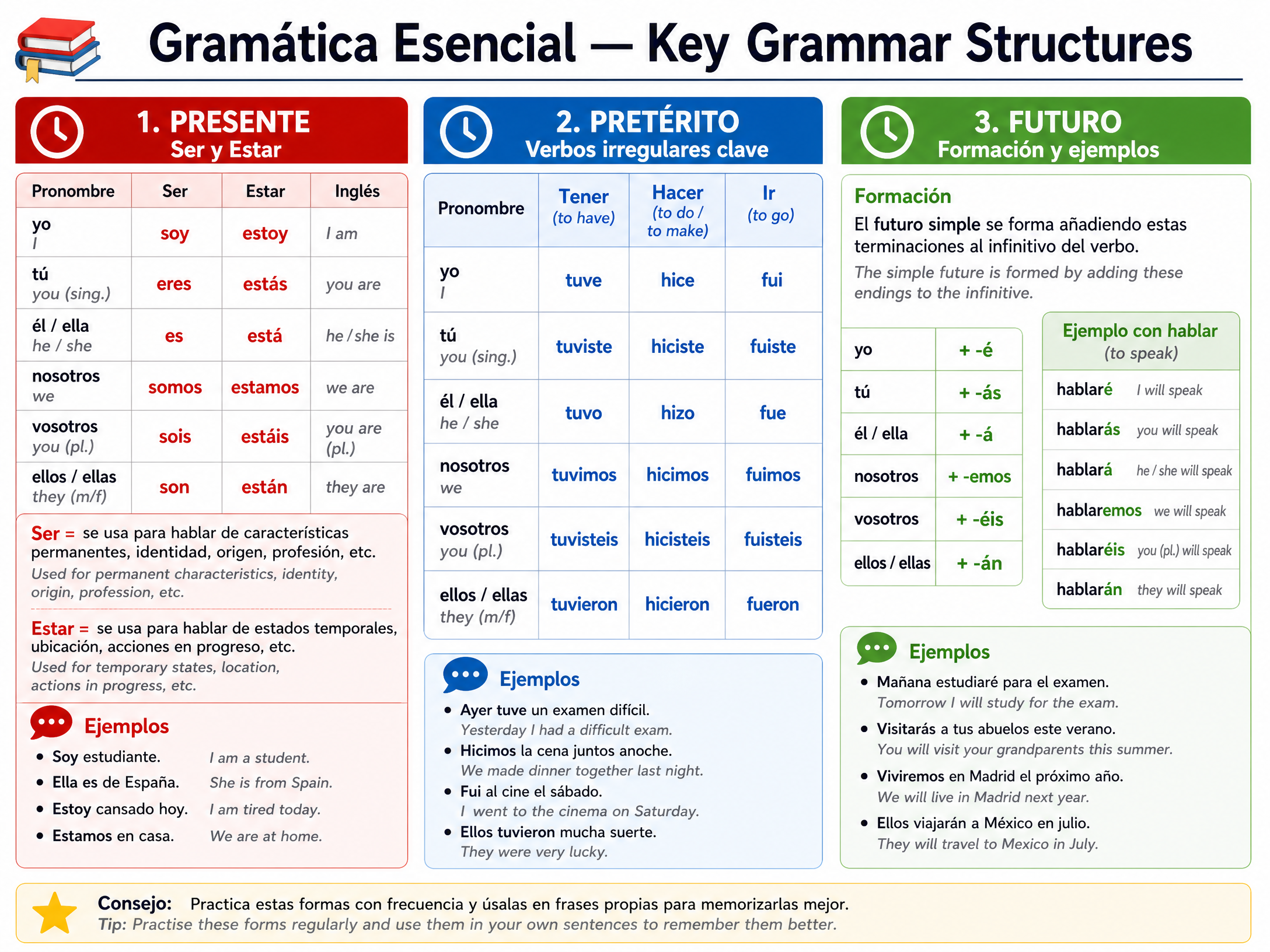
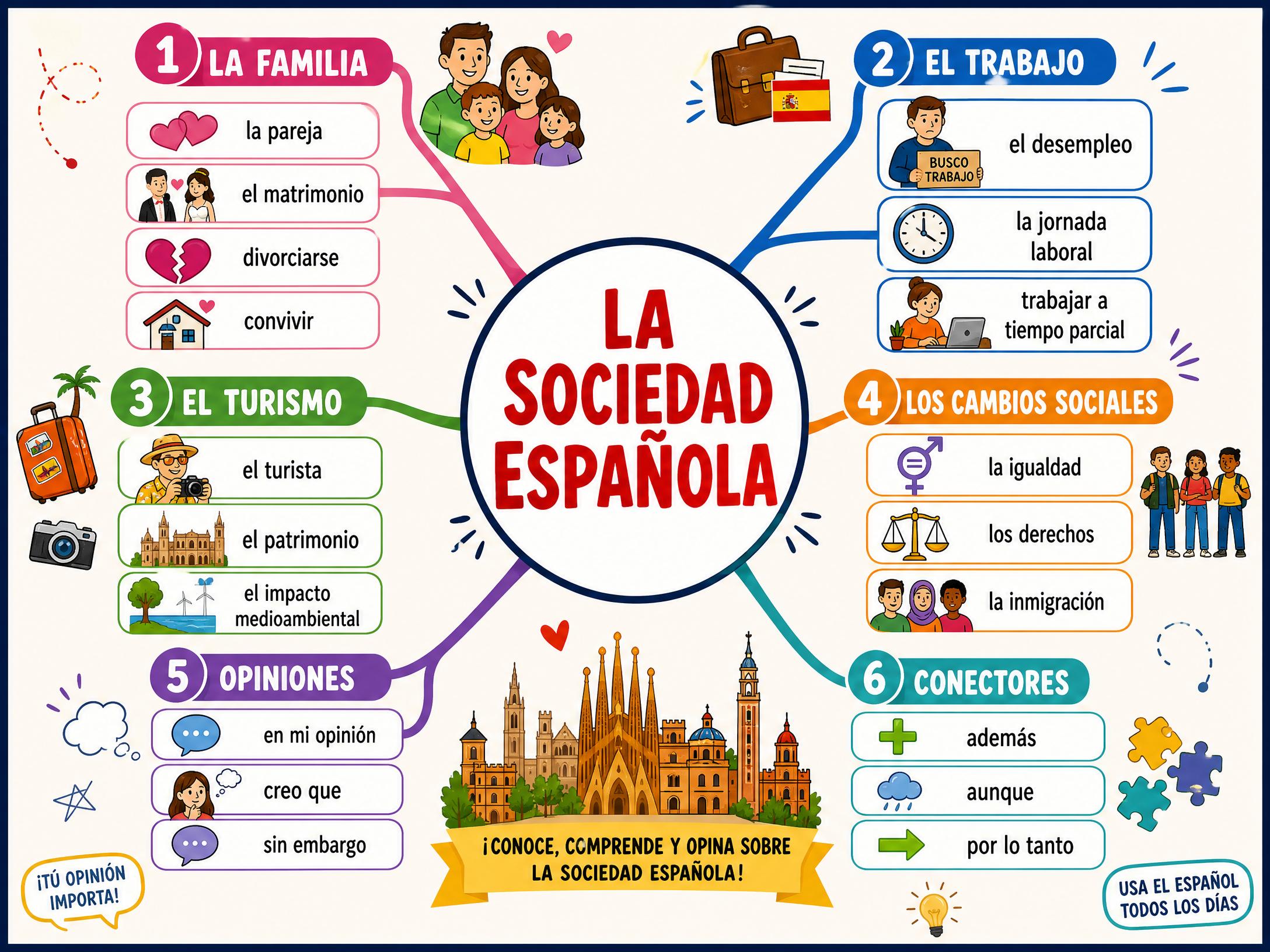
Interactive Diagrams
1 interactive diagram to visualise key concepts
Conceptual Flow Outline
Mind map of the three core sub-themes of Spanish Society
Worked Examples
4 worked examples — open one to explore the question and available guidance.
Practice Questions
Test your understanding — click to reveal model answers
Writing: Traduce al español: 'Nowadays, there are many tourists in Spain. However, in the future, I believe that sustainable tourism will be more popular.'
Hint: Watch out for 'there are' (hay) and 'there will be' (habrá). Remember the connective for 'however'.
Speaking: Describe tu familia. ¿Cómo era en el pasado?
Hint: Use the present tense for now, and the imperfect tense (era, teníamos) for the past.
Reading: Lee el artículo. ¿Cuáles son las dos consecuencias del desempleo juvenil? 'El desempleo juvenil en España alcanza el 30%. Como resultado, muchos jóvenes viven con sus padres hasta los 30 años y otros deciden buscar trabajo en el extranjero.'
Hint: Look for the phrase 'Como resultado' (As a result) to find the consequences.
Writing (90 words): Escribe sobre el mundo laboral. Menciona: el trabajo de tus padres, qué quieres hacer en el futuro, y tu opinión sobre la igualdad.
Hint: Cover all three bullet points. Use present, future, and an opinion phrase.
Listening: Escucha a Pablo. ¿Qué opina del turismo? 'El turismo trae mucho dinero a nuestra ciudad, lo cual es fantástico. No obstante, en verano las calles están demasiado llenas y hay mucha basura en las playas.'
Hint: Listen for the contrast word 'No obstante' (nevertheless/however).
Speaking (Photo Card): ¿Qué ventajas y desventajas tiene vivir en una ciudad grande?
Hint: Use 'por un lado' and 'por otro lado' to structure your answer.