Pearson Edexcel · A-Level · Spanish
El impacto turístico en España
This topic covers the economic, social, and environmental impacts of tourism in Spain. You will learn key vocabulary for jobs, environment, and accommodation, master three tenses for writing, and practice expressing balanced opinions for your speaking exam.
- 12 min read
- 4 worked examples
- 6 practice questions
- 8 key terms
Study Notes
Overview
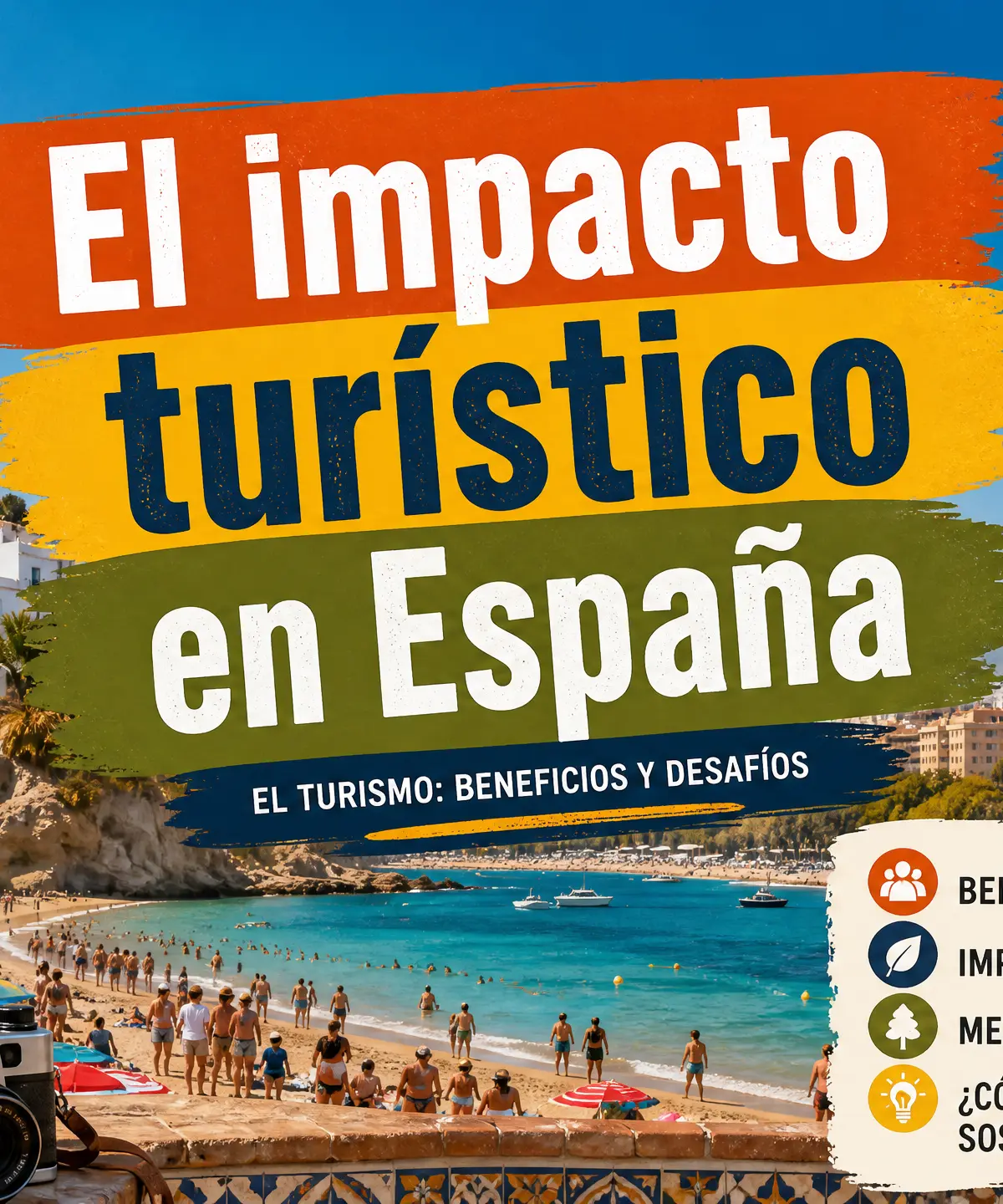
El impacto turístico en España (The impact of tourism in Spain) is a crucial topic that appears across all four GCSE skills. Spain is one of the world's top tourist destinations, receiving over 80 million visitors annually. Examiners expect you to discuss both the positive economic benefits (jobs, infrastructure) and the negative socio-environmental consequences (pollution, overcrowding, rising prices). Mastering this topic requires a strong grasp of topic-specific vocabulary and the ability to justify balanced opinions using complex structures.
📖 Essential Vocabulary
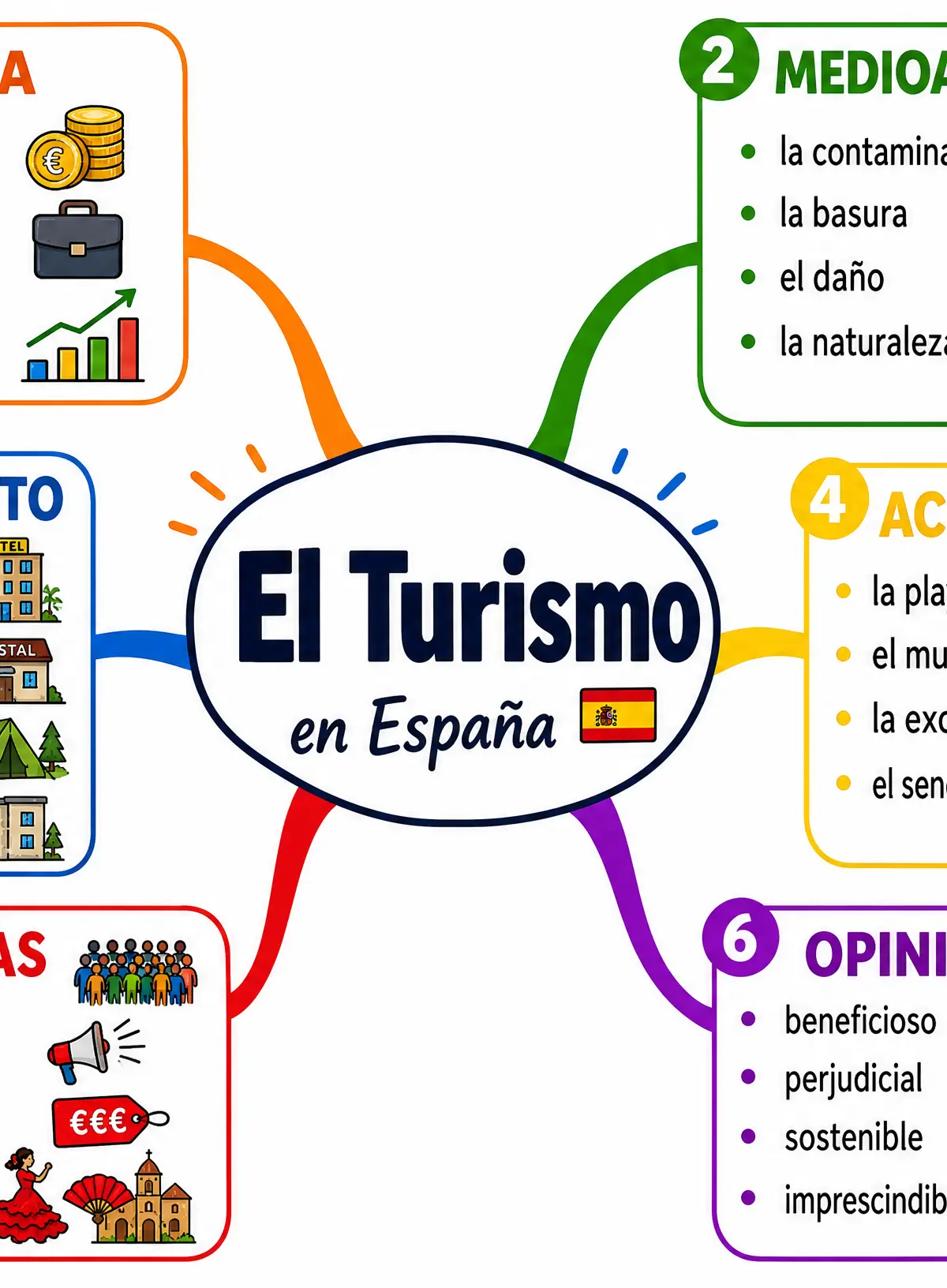
Tier 1 — Foundation Core
| Spanish | English | Gender | Example Sentence |
|---|---|---|---|
| el turismo | tourism | m | El turismo es importante para España. |
| el turista / la turista | tourist | m/f | Hay muchos turistas en la playa. |
| el hotel | hotel | m | Me alojo en un hotel grande. |
| la playa | beach | f | Vamos a la playa todos los días. |
| el dinero | money | m | El turismo trae mucho dinero. |
| el trabajo | work/job | m | Mi hermano tiene un trabajo en un restaurante. |
| el verano | summer | m | En verano hace mucho calor. |
| el viaje | trip/journey | m | El viaje a Madrid fue largo. |
| barato | cheap | adj | El vuelo fue muy barato. |
| caro | expensive | adj | Comer en el centro es caro. |
| la ciudad | city | f | Barcelona es una ciudad bonita. |
| el ruido | noise | m | Hay mucho ruido por la noche. |
| la basura | rubbish | f | Hay demasiada basura en las calles. |
| visitar | to visit | verb | Me gusta visitar monumentos. |
| viajar | to travel | verb | Prefiero viajar en avión. |
Tier 2 — Higher Tier
| Spanish | English | Gender | Example Sentence |
|---|---|---|---|
| los ingresos | revenue/income | m (pl) | Los ingresos del turismo son vitales. |
| la masificación | overcrowding | f | La masificación turística es un problema grave. |
| el medioambiente | environment | m | Tenemos que proteger el medioambiente. |
| la infraestructura | infrastructure | f | El gobierno invierte en infraestructuras. |
| el alojamiento | accommodation | m | El alojamiento es muy caro en verano. |
| sostenible | sustainable | adj | Necesitamos un turismo más sostenible. |
| perjudicial | harmful | adj | El turismo masivo es perjudicial para la costa. |
| beneficioso | beneficial | adj | El turismo es beneficioso para la economía local. |
| el desarrollo | development | m | El turismo ayuda al desarrollo del país. |
| la contaminación | pollution | f | La contaminación aumenta con los vuelos. |
High-Frequency Words & Phrases
| Phrase | English | Usage Context |
|---|---|---|
| por un lado... por otro lado | on the one hand... on the other hand | Structuring a balanced argument |
| sin embargo | however | Introducing a contrasting point |
| debido a | due to / because of | Explaining causes |
| hoy en día | nowadays | Contrasting past and present |
| me parece que | it seems to me that | Introducing an opinion |
| es imprescindible | it is essential | Emphasising importance |
| vale la pena | it's worth it | Recommending something |
| lo bueno es que | the good thing is that | Highlighting positives |
| lo peor es que | the worst thing is that | Highlighting negatives |
| aunque | although | Creating complex sentences |
📝 Grammar Focus
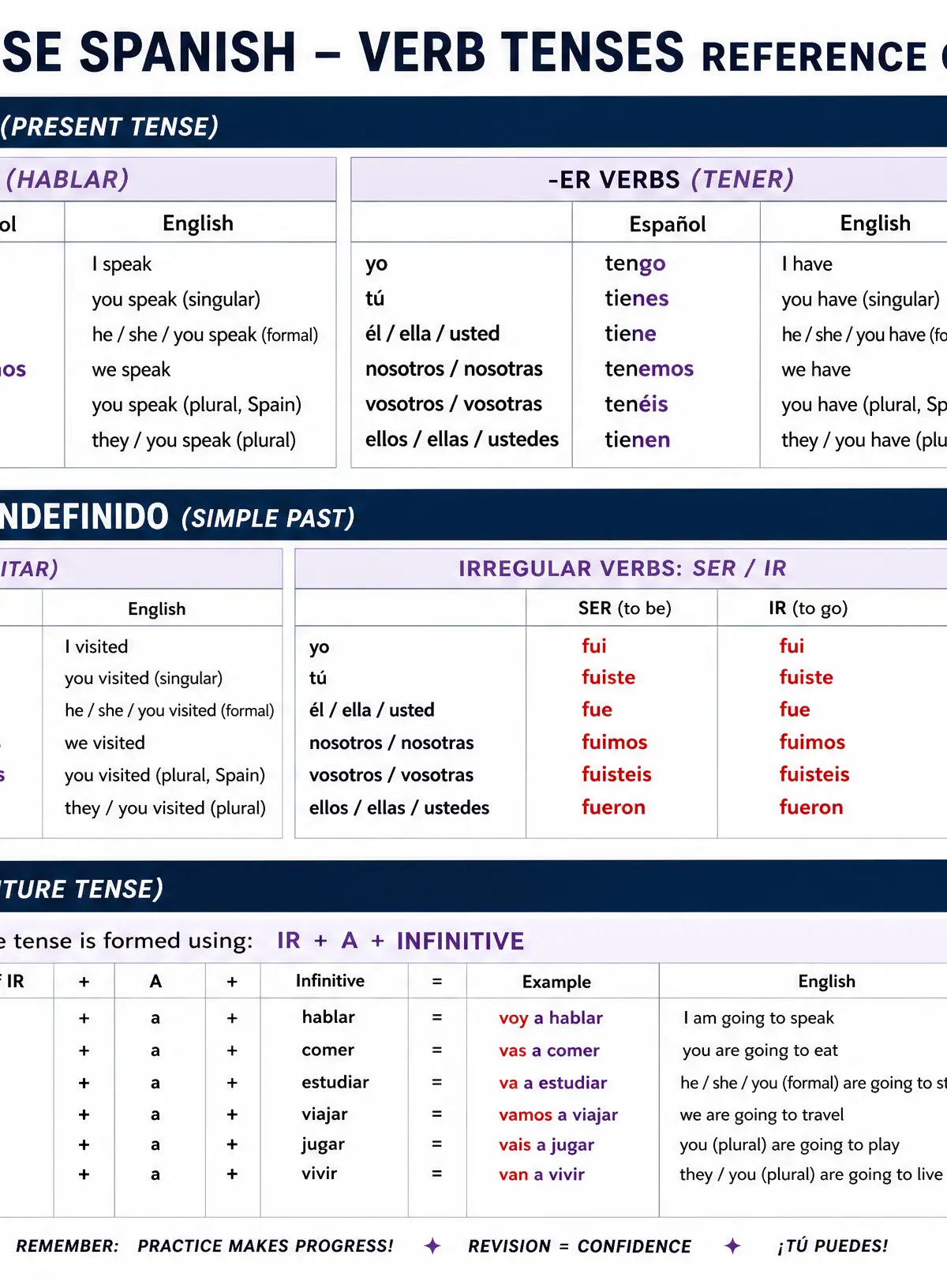
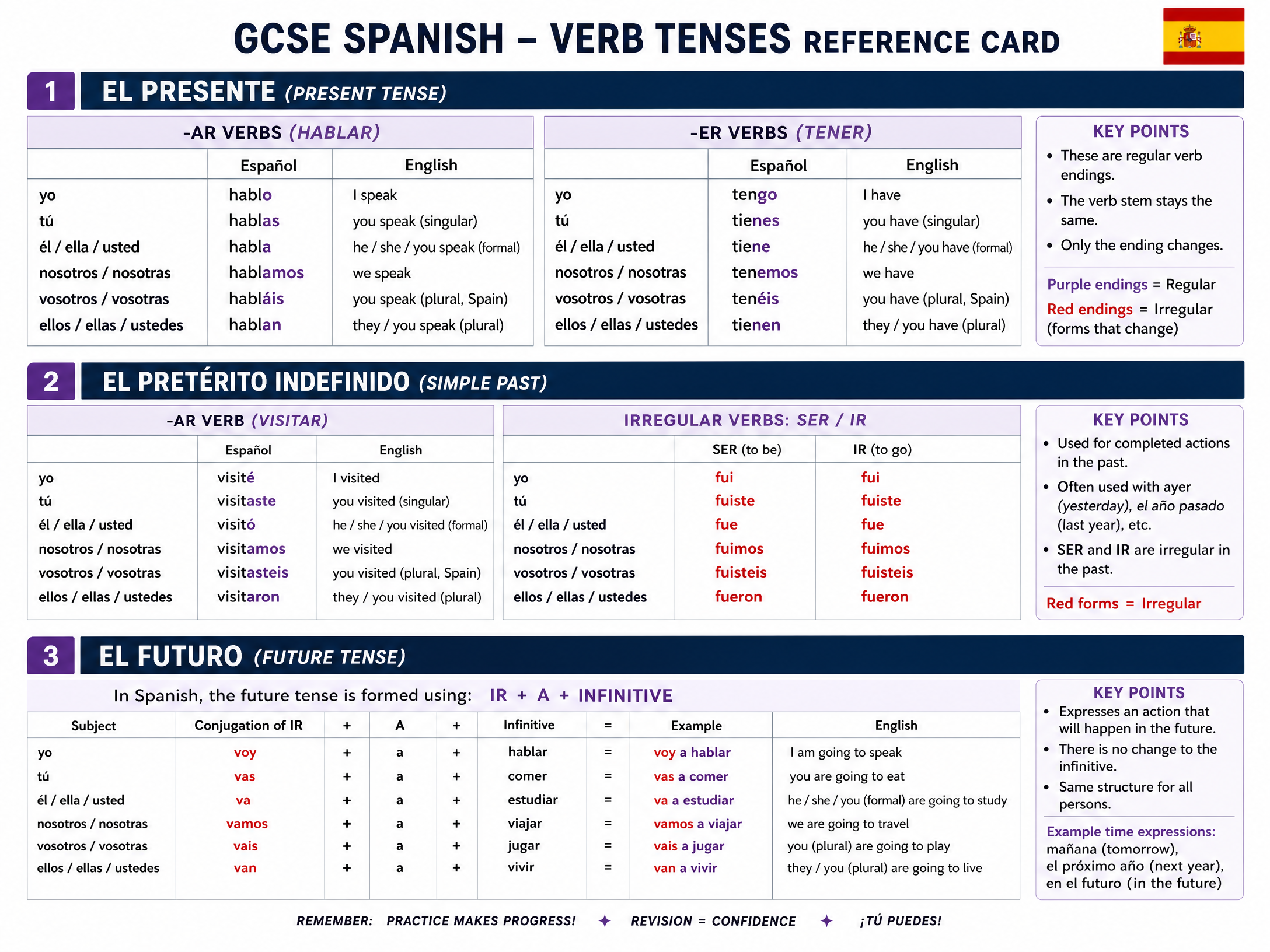
Key Structure 1: El Presente (Present Tense)
When to use it: To describe facts, current situations, and what usually happens. Essential for describing the current state of tourism.
Conjugation Table: Regular Verbs (-ar, -er, -ir)
| Subject | -AR (e.g. viajar) | -ER (e.g. vender) | -IR (e.g. vivir) |
|---|---|---|---|
| yo | viajo | vendo | vivo |
| tú | viajas | vendes | vives |
| él/ella/usted | viaja | vende | vive |
| nosotros/as | viajamos | vendemos | vivimos |
| vosotros/as | viajáis | vendéis | vivís |
| ellos/ellas/ustedes | viajan | venden | viven |
Irregulars to learn: ser (soy, eres, es...), tener (tengo, tienes, tiene...), ir (voy, vas, va...)
Key Structure 2: El Pretérito Indefinido (Simple Past)
When to use it: To describe completed actions in the past. Use it to talk about a specific holiday or past tourism trends.
Conjugation Table: Regular Verbs
| Subject | -AR (e.g. visitar) | -ER/-IR (e.g. salir) | English |
|---|---|---|---|
| yo | visité | salí | I visited / went out |
| tú | visitaste | saliste | you visited / went out |
| él/ella/usted | visitó | salió | he/she visited / went out |
| nosotros/as | visitamos | salimos | we visited / went out |
| vosotros/as | visitasteis | salisteis | you (pl) visited / went out |
| ellos/ellas/ustedes | visitaron | salieron | they visited / went out |
Irregulars to learn: ir/ser (fui, fuiste, fue...), hacer (hice, hiciste, hizo...)
Key Structure 3: El Futuro Próximo (Near Future)
When to use it: To talk about future plans or predictions. Formed with: ir + a + infinitive.
Conjugation Table: ir + a + infinitive
| Subject | Verb Form | English |
|---|---|---|
| yo | voy a viajar | I am going to travel |
| tú | vas a viajar | you are going to travel |
| él/ella/usted | va a viajar | he/she is going to travel |
| nosotros/as | vamos a viajar | we are going to travel |
| vosotros/as | vais a viajar | you (pl) are going to travel |
| ellos/ellas/ustedes | van a viajar | they are going to travel |
🎧 Listening Skills

What to Expect
You will hear interviews with locals, news reports, or tourist announcements discussing the pros and cons of tourism. Expect a mix of tenses and complex opinions.
Listening Strategies
- Listen for qualifiers: Words like un poco (a little), bastante (quite), demasiado (too much) change the meaning completely.
- Note the tense: Is the speaker talking about tourism antes (before), ahora (now), or en el futuro (in the future)? Listen for time markers.
- Identify the speaker's tone: Are they complaining (complaints about noise/prices) or praising (jobs/economy)?
Common Listening Traps
- False Friends: Sensible means sensitive, not sensible. Actual means current, not actual. Largo means long, not large.
- Negatives: Listen carefully for no, nunca (never), tampoco (neither/not either), and nadie (nobody).
🗣️ Speaking Skills
Role Play Scenarios
Scenario: You are talking to a tourist office employee in Spain.
- You: ¿Tienen un mapa de la ciudad, por favor? (Do you have a city map, please?)
- Employee: Sí, aquí tiene. ¿Qué le gustaría visitar? (Yes, here you go. What would you like to visit?)
- You: Me gustaría visitar el museo y la catedral. ¿A qué hora cierran? (I would like to visit the museum and the cathedral. What time do they close?)
Photo Card Practice
Model Photo Card Response:
- Qu 1 (Description): En la foto hay muchos turistas en una playa española. Hace sol y la playa está muy llena. (In the photo there are many tourists on a Spanish beach. It's sunny and the beach is very full.)
- Qu 2 (Opinion): En mi opinión, es bueno para la economía, pero la masificación es un problema grave para los residentes. (In my opinion, it's good for the economy, but overcrowding is a serious problem for residents.)
- Qu 3 (Related topic): El año pasado, fui a España y vi mucha basura en la playa. Fue una lástima. (Last year, I went to Spain and saw a lot of rubbish on the beach. It was a shame.)
- Qu 4 (Past/Future): En el futuro, creo que España necesita promover un turismo más sostenible para proteger el medioambiente. (In the future, I think Spain needs to promote more sustainable tourism to protect the environment.)
- Qu 5 (Unpredictable): Sí, me gustaría trabajar en turismo porque me encanta conocer a gente de otros países. (Yes, I would like to work in tourism because I love meeting people from other countries.)
General Conversation Questions
| Question (Spanish) | Model Answer | English Translation |
|---|---|---|
| ¿Cuáles son las ventajas del turismo? | Lo bueno es que crea muchos puestos de trabajo y mejora la economía local. | The good thing is that it creates many jobs and improves the local economy. |
| ¿Cuáles son las desventajas? | Lo peor es la masificación y la contaminación. Además, los precios suben para los residentes. | The worst thing is overcrowding and pollution. Furthermore, prices rise for residents. |
| ¿Qué hiciste en tus últimas vacaciones? | El año pasado fui a Málaga. Visité monumentos, comí tapas y nadé en el mar. Fue genial. | Last year I went to Malaga. I visited monuments, ate tapas and swam in the sea. It was great. |
| ¿Adónde vas a ir el próximo año? | El próximo verano voy a viajar a Barcelona con mi familia para ver la Sagrada Familia. | Next summer I am going to travel to Barcelona with my family to see the Sagrada Familia. |
| ¿Crees que el turismo es importante? | Sí, es imprescindible porque España depende del dinero de los turistas. | Yes, it is essential because Spain depends on tourists' money. |
✍️ Writing Skills
Translation Practice
English → Spanish:
| English | Spanish | Key Grammar |
|---|---|---|
| Tourism is important. | El turismo es importante. | Present tense, gender agreement |
| It creates many jobs. | Crea muchos empleos. | Present tense, vocabulary |
| Last year I visited Spain. | El año pasado visité España. | Preterite tense (completed past) |
| There is too much rubbish. | Hay demasiada basura. | Quantifier agreement (demasiada/basura) |
| Next year we are going to travel. | El próximo año vamos a viajar. | Near future (ir a + infinitive) |
Extended Writing
**Model 90-word response (Foundation):**Me encanta el turismo en España porque es muy divertido. Normalmente, voy a la costa con mi familia. El turismo es bueno porque crea muchos empleos y hay más dinero. Sin embargo, hay problemas. A veces hay demasiado ruido y mucha basura en las playas. El año pasado, fui a Valencia y me gustó mucho porque hizo buen tiempo. El próximo verano, voy a visitar Madrid porque quiero ver los museos. Creo que el turismo es importante pero necesitamos proteger la naturaleza.
**Model 150-word response (Higher):**Hoy en día, el impacto turístico en España es un tema muy polémico. Por un lado, el turismo es imprescindible para la economía española ya que genera millones de euros y crea innumerables puestos de trabajo en el sector de la hostelería. Lo bueno es que mejora las infraestructuras locales.
Por otro lado, no se puede negar que hay desventajas graves. La masificación turística causa problemas serios para los residentes, como el aumento de los precios de la vivienda y mucha contaminación. El año pasado, visité Barcelona y vi demasiada basura en las calles, lo cual fue decepcionante.
En el futuro, creo que el gobierno va a tener que promover un turismo más sostenible. Es vital que protejamos el medioambiente y la cultura local antes de que sea demasiado tarde. En conclusión, aunque el turismo es beneficioso económicamente, tiene que cambiar.
Writing Checklist
- ✅ Used at least three tenses (Present, Past, Future)
- ✅ Included justified opinions (creo que... porque...)
- ✅ Used complex connectives (sin embargo, aunque, ya que)
- ✅ Checked adjective agreements (gender and number)
- ✅ Included Higher tier vocabulary (imprescindible, masificación)
📚 Reading Skills
Key Strategies
- Read the questions FIRST before reading the text.
- Look for cognates (words that look like English) but beware of false friends.
- Underline time markers (ayer, mañana, a menudo) to understand which tense is being used.
False Friends & Tricky Words
| Word | Looks Like | Actually Means |
|---|---|---|
| la firma | firm | signature |
| el éxito | exit | success |
| recordar | to record | to remember |
| el idioma | idiom | language |
| la letra | letter (mail) | lyrics / handwriting |
🌍 Cultural Knowledge
Spain is the second most visited country in the world, heavily reliant on the "sol y playa" (sun and beach) tourism model, especially in regions like Andalucía, the Balearic Islands, and the Canary Islands. However, there is a growing movement against "turismofobia" (tourism-phobia) in cities like Barcelona and Palma de Mallorca, where locals protest against rising rents caused by holiday apartments (like Airbnb) and the loss of local culture. The Spanish government is currently trying to promote "turismo de interior" (inland tourism) and cultural tourism to spread the economic benefits and reduce coastal overcrowding.
Visual Resources
2 diagrams and illustrations
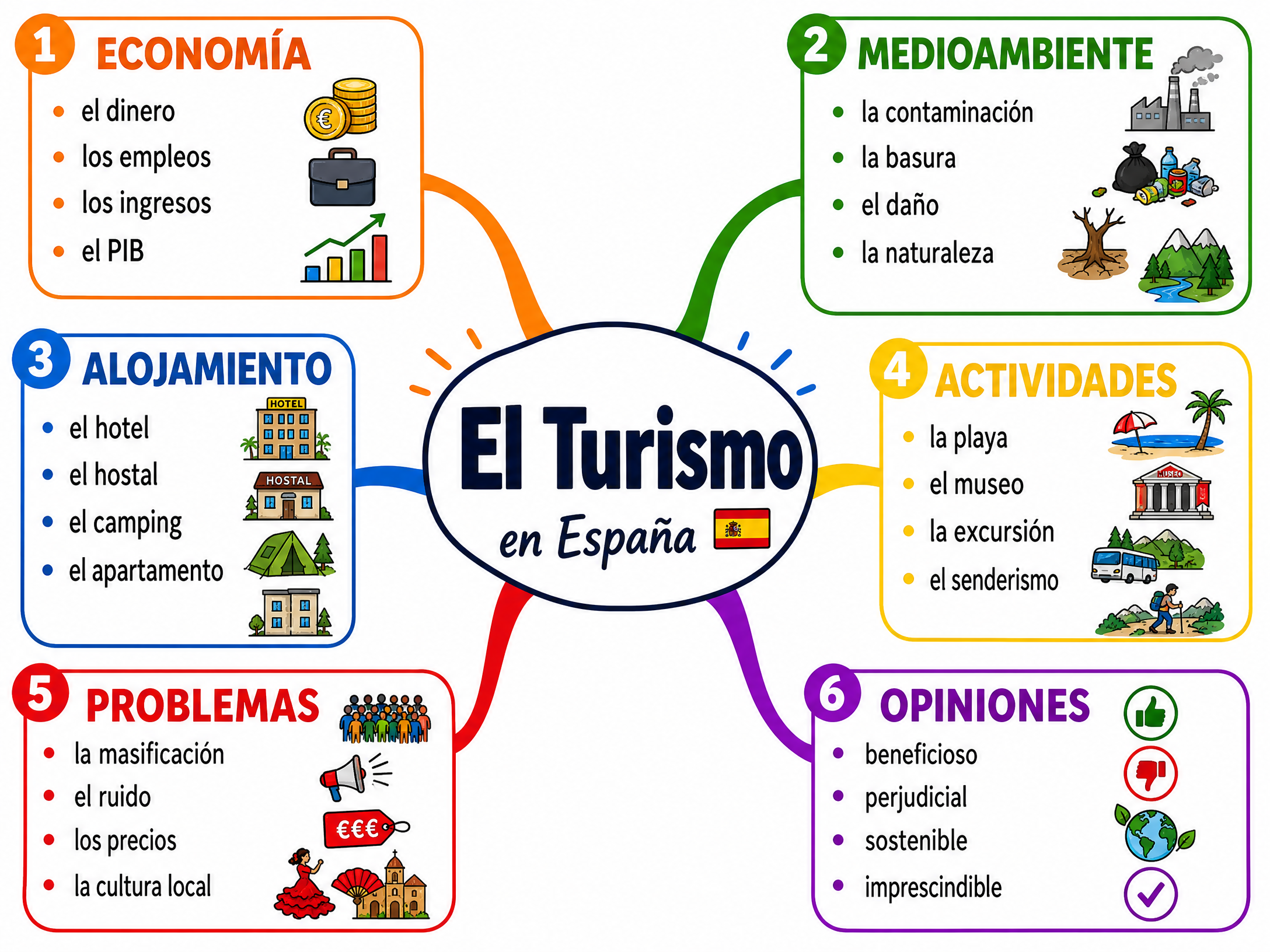
Interactive Diagrams
1 interactive diagram to visualise key concepts
Conceptual Flow Outline
MFL exam approach by skill
Worked Examples
4 worked examples — open one to explore the question and available guidance.
Practice Questions
Test your understanding — click to reveal model answers
Translate into Spanish: 'Tourism is very important because it creates jobs, but it causes pollution.'
Hint: Remember the word for 'jobs' and the connective for 'but'.
Writing: Write 90 words about tourism in your area. Include: what there is for tourists, what you did last weekend, and your opinion on tourism.
Hint: Use 'hay' for what there is, the preterite for last weekend, and 'creo que' for your opinion.
Speaking: ¿Cuáles son las ventajas y desventajas del turismo en tu región?
Hint: Use 'Por un lado' and 'Por otro lado' to structure your answer.
Reading: Lee el artículo. ¿Por qué protesta la gente en Barcelona? 'Miles de personas protestan en Barcelona contra la masificación turística. Afirman que los alquileres han subido un 50% y los jóvenes no pueden vivir en el centro.'
Hint: Look for the reasons after the word 'Afirman que' (They claim that).
Listening: (Transcript: 'El año pasado, España recibió a millones de visitantes. Aunque la economía mejoró, las playas sufrieron daños.') What happened to the beaches last year?
Hint: Listen for the word 'playas' and the verb that follows it.
Translate into English: 'Es imprescindible promover un turismo sostenible para proteger la naturaleza.'
Hint: Watch out for 'imprescindible' and 'sostenible'.