Pearson Edexcel · A-Level · Spanish
Quantifiers and intensifiers (muy, bastante, poco, mucho)
Master the art of expressing quantity and intensity in Spanish with 'muy', 'bastante', 'poco', and 'mucho'. This guide covers essential vocabulary, the crucial grammar rules of agreement, and provides targeted practice across Listening, Speaking, Reading, and Writing skills to help you secure top marks.
- 13 min read
- 4 worked examples
- 6 practice questions
- 8 key terms
Study Notes
Overview
Welcome to your definitive guide on Spanish quantifiers and intensifiers! This topic is a secret weapon for GCSE candidates. While basic vocabulary is important, knowing how to modify words with muy (very), bastante (quite), poco (little), and mucho (a lot) instantly elevates your language from simple statements to nuanced, sophisticated opinions.
Examiners actively look for these structures across all four papers. In the Writing and Speaking exams, using a range of intensifiers helps you hit the 'range of language' criteria. In Reading and Listening, spotting a poco instead of a mucho completely changes the meaning of the text. Let's dive in and master these essential tools.
🎧 Audio Revision
Listen to our comprehensive 10-minute podcast episode covering all the key rules, common traps, and exam strategies for this topic.

📖 Essential Vocabulary
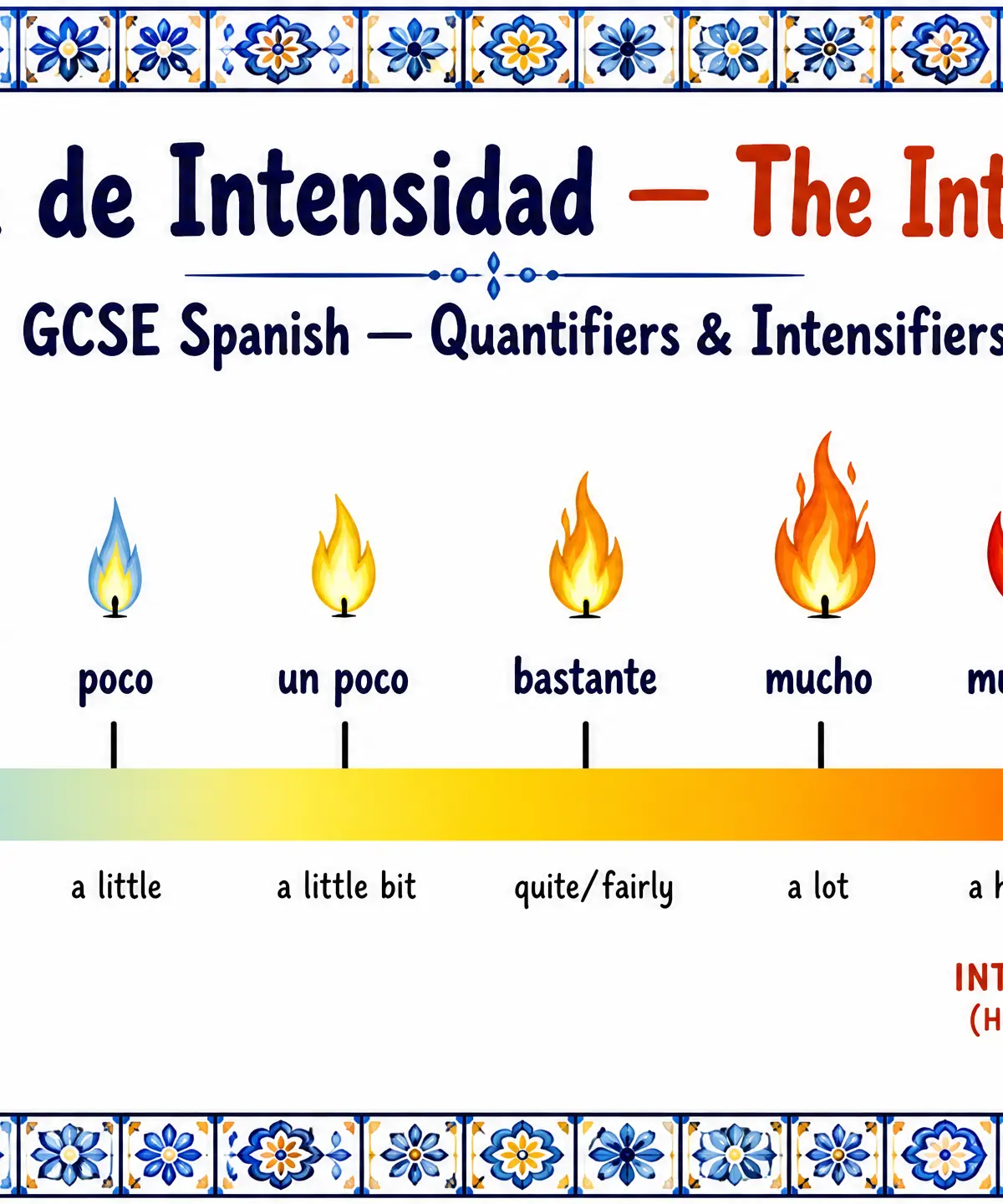
Tier 1 — Foundation Core
| Spanish | English | Gender | Example Sentence |
|---|---|---|---|
| muy | very | invariable | Mi hermano es muy alto. |
| bastante | quite / fairly | invariable | El examen fue bastante difícil. |
| poco | little / few | m/f/pl | Tengo poco tiempo libre. |
| mucho | a lot / much | m/f/pl | Hay mucho tráfico en mi ciudad. |
| demasiado | too much / too many | m/f/pl | Comí demasiada comida. |
| un poco de | a little bit of | invariable | Hablo un poco de español. |
| más | more | invariable | Quiero más agua, por favor. |
| menos | less | invariable | Cuesta menos dinero. |
| nada | nothing / not at all | invariable | No me gusta nada el fútbol. |
| tanto | so much | m/f/pl | Hace tanto calor hoy. |
| tan | so | invariable | El libro es tan aburrido. |
| casi | almost | invariable | Está casi terminado. |
| algo | something / somewhat | invariable | Es algo complicado. |
| todo | all / everything | m/f/pl | Comí toda la pizza. |
| varios | several | m/pl | Tengo varios amigos allí. |
Tier 2 — Higher Tier
| Spanish | English | Gender | Example Sentence |
|---|---|---|---|
| muchísimo | an enormous amount | m/f/pl | Me gusta muchísimo la música pop. |
| extremadamente | extremely | invariable | Es extremadamente importante repasar. |
| totalmente | totally / completely | invariable | Estoy totalmente de acuerdo. |
| verdaderamente | truly / genuinely | invariable | Fue una experiencia verdaderamente inolvidable. |
| apenas | barely / hardly | invariable | Apenas tengo tiempo para mis deberes. |
| suficiente | enough | m/f/pl | No hay suficientes ordenadores en el colegio. |
| cualquier | any | m/f/pl | Puedes elegir cualquier libro. |
| escaso | scarce / very little | m/f/pl | Hay escasas oportunidades de trabajo. |
| abundante | abundant / plenty | m/f/pl | Hay abundantes recursos naturales. |
| sumamente | highly / extremely | invariable | El problema es sumamente grave. |
High-Frequency Words & Phrases
| Phrase | English | Usage Context |
|---|---|---|
| me gusta mucho | I like it a lot | Expressing strong positive opinions (never 'me gusta muy') |
| un poco más | a little more | Requesting or comparing quantities |
| mucho mejor | much better | Comparing two things favorably |
| bastante bien | quite well | Responding to 'how are you' or evaluating performance |
| muy a menudo | very often | Describing high frequency of an action |
| de vez en cuando | from time to time | Describing occasional frequency |
| casi nunca | almost never | Describing very low frequency |
| demasiado caro | too expensive | Giving negative opinions on shopping/holidays |
| tantas cosas | so many things | Emphasizing a large quantity of nouns |
| lo más pronto posible | as soon as possible | Adding urgency to writing tasks |
📝 Grammar Focus
Key Structure 1: Invariable Intensifiers (muy, bastante)
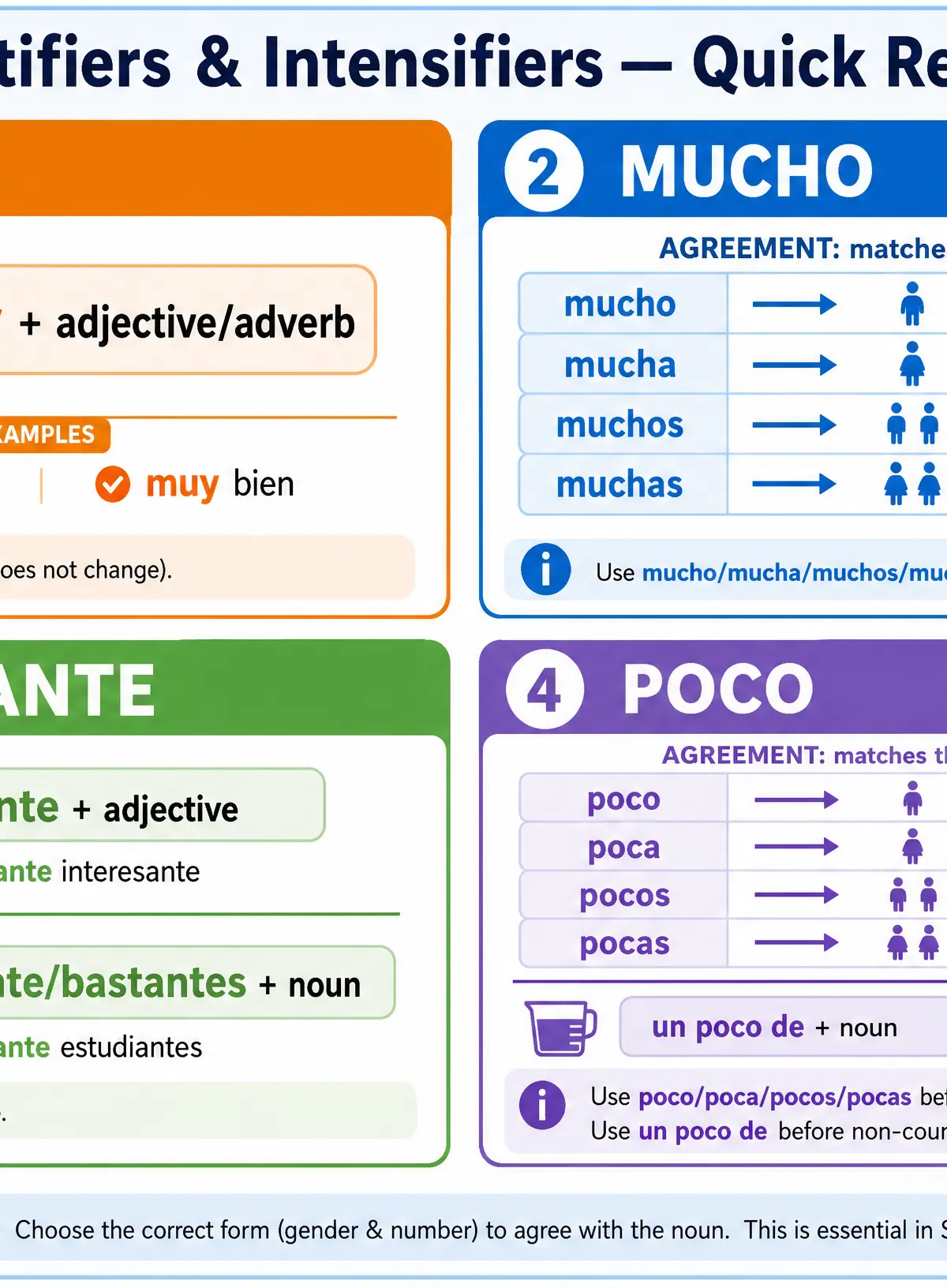
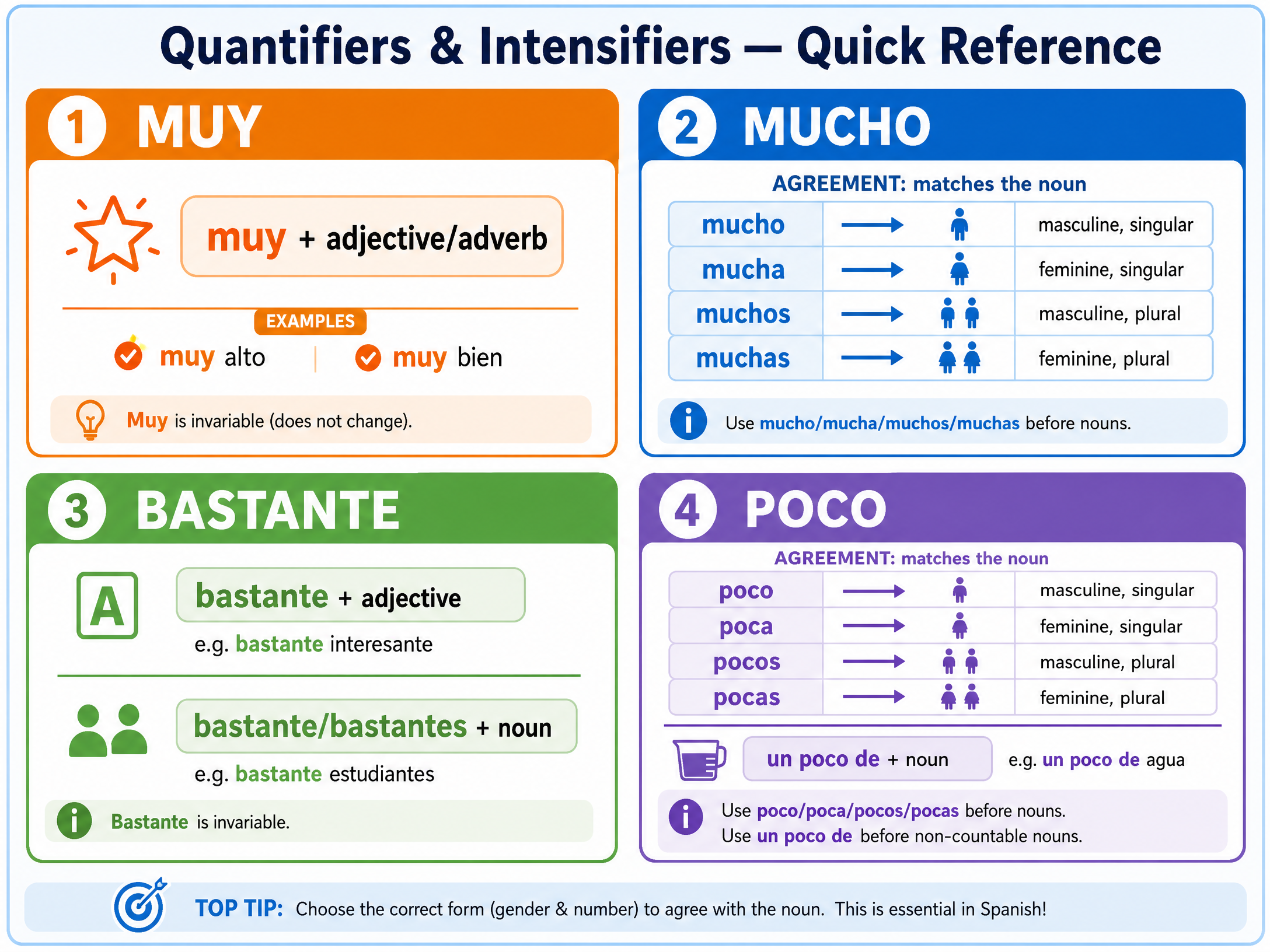
When to use it: Use muy (very) and bastante (quite/fairly) before adjectives and adverbs. These words are invariable, meaning they never change their ending, regardless of whether the word they describe is masculine, feminine, singular, or plural.
Rule Table
| Spanish | Modifies | English Example | Spanish Translation |
|---|---|---|---|
| muy | Adjective (m.sg) | The boy is very tall | El chico es muy alto |
| muy | Adjective (f.pl) | The girls are very tall | Las chicas son muy altas |
| bastante | Adverb | He sings quite well | Él canta bastante bien |
| bastante | Adjective (f.sg) | The house is quite big | La casa es bastante grande |
Critical Rule: You cannot use muy with a verb. You cannot say me gusta muy. You must use mucho (e.g., me gusta mucho).
Key Structure 2: Variable Quantifiers (mucho, poco, demasiado)
When to use it: When mucho (a lot/many), poco (little/few), or demasiado (too much/many) are used as determiners before a noun, they must agree in gender (masculine/feminine) and number (singular/plural) with that noun.
Agreement Table (mucho)
| Noun Type | Form to Use | Example | English |
|---|---|---|---|
| Masculine Singular | mucho | mucho tiempo | a lot of time |
| Feminine Singular | mucha | mucha gente | a lot of people |
| Masculine Plural | muchos | muchos amigos | many friends |
| Feminine Plural | muchas | muchas personas | many people |
Irregulars to learn: Watch out for tricky nouns like el agua (feminine but uses el in singular) and el problema (masculine). It is mucha agua and muchos problemas.
Key Structure 3: Mucho as an Adverb
When to use it: When mucho is used to modify a verb (an action), it acts as an adverb. In this case, it is invariable and always stays as mucho, regardless of who is doing the action.
Usage Table
| Subject | Verb | Adverb | English |
|---|---|---|---|
| Yo | estudio | mucho | I study a lot |
| Ella | trabaja | mucho | She works a lot |
| Nosotros | comemos | mucho | We eat a lot |
| Ellas | hablan | mucho | They speak a lot |
🎧 Listening Skills
What to Expect
In the listening exam, quantifiers are often used as distractors. You might hear a speaker discussing how much they like something, or how often they do an activity. The difference between a correct and incorrect answer often hinges on catching a poco versus a mucho.
Listening Strategies
- Listen for qualifiers: Pay attention to the words immediately preceding adjectives. Did they say the hotel was bonito (nice), muy bonito (very nice), or poco bonito (not very nice)?
- Watch for negatives: A common trap is combining a negative with a strong quantifier. No me gusta mucho means 'I don't like it much' (mild dislike), whereas no me gusta nada means 'I don't like it at all' (strong dislike).
- Identify the noun: If you hear muchas, listen carefully for the feminine plural noun that follows it to understand exactly what there is a lot of.
Common Listening Traps
- Poco vs. Un poco: Hearing hablo poco francés means the speaker struggles with French (negative). Hearing hablo un poco de francés means they can speak some French (positive). Examiners test this subtle difference frequently.
- Demasiado: Students often mistake demasiado (too much) for just meaning 'a lot'. If someone says es demasiado caro, it's a negative criticism (too expensive), not a compliment.
🗣️ Speaking Skills
Role Play Scenarios
Scenario 1: At a restaurant
- Examiner: ¿Qué vas a tomar de postre? (What are you going to have for dessert?)
- Candidate: No tengo mucha hambre, así que solo quiero un poco de helado, por favor. (I don't have much hunger, so I just want a little bit of ice cream, please.)
Scenario 2: Buying a ticket
- Examiner: ¿Qué te parece el precio del billete? (What do you think of the ticket price?)
- Candidate: Pienso que es demasiado caro. ¿Hay un descuento para estudiantes? (I think it is too expensive. Is there a student discount?)
Photo Card Practice
Model Photo Card Response:
- Qu 1 (Description): En la foto hay muchas personas en una plaza. Hace mucho sol y parece que hace bastante calor.
- Qu 2 (Opinion): En mi opinión, es una escena muy animada. Me gusta muchísimo porque la gente parece feliz.
- Qu 3 (Related topic): Normalmente, en mi ciudad hay poco que hacer, así que me gustaría vivir en un lugar con tantas actividades.
- Qu 4 (Past/Future): El año pasado fui a un festival similar y comí demasiada comida deliciosa.
- Qu 5 (Unpredictable): Creo que es sumamente importante celebrar las tradiciones locales para mantener la cultura.
General Conversation Questions
| Question (Spanish) | Model Answer | English Translation |
|---|---|---|
| ¿Te gusta tu instituto? | Sí, me gusta mucho porque los profesores son muy simpáticos, pero hay demasiados deberes. | Yes, I like it a lot because the teachers are very nice, but there is too much homework. |
| ¿Qué haces en tu tiempo libre? | Normalmente leo bastante, pero últimamente tengo poco tiempo libre porque estudio muchísimo. | Normally I read quite a lot, but lately I have little free time because I am studying a huge amount. |
| ¿Cómo es tu ciudad? | Mi ciudad es bastante grande y hay muchas tiendas, pero hay muy poco transporte público. | My city is quite big and there are many shops, but there is very little public transport. |
| ¿Qué hiciste el fin de semana pasado? | Fui al cine con varios amigos. La película fue extremadamente aburrida, así que no me gustó nada. | I went to the cinema with several friends. The film was extremely boring, so I didn't like it at all. |
| ¿Es importante aprender idiomas? | Sí, es sumamente importante porque te da muchas oportunidades para trabajar en el extranjero. | Yes, it is highly important because it gives you many opportunities to work abroad. |
✍️ Writing Skills
Translation Practice
English → Spanish:
| English | Spanish | Key Grammar |
|---|---|---|
| The test is very difficult. | El examen es muy difícil. | Invariable muy before adjective. |
| I have a lot of friends. | Tengo muchos amigos. | Muchos agreeing with masculine plural noun. |
| She studies a lot. | Ella estudia mucho. | Invariable mucho modifying a verb. |
| We speak a little bit of Spanish. | Hablamos un poco de español. | Un poco de before uncountable noun. |
| There is too much pollution. | Hay demasiada contaminación. | Demasiada agreeing with feminine singular noun. |
Extended Writing
**Model 90-word response (Foundation):**Vivo en un pueblo bastante pequeño en Inglaterra. Me gusta mucho mi pueblo porque es muy tranquilo y hay muchos parques bonitos. Sin embargo, hay un problema: hay pocas tiendas para los jóvenes. El fin de semana pasado, fui a la ciudad con mis amigos. Compramos muchas cosas y comimos demasiado. Fue muy divertido. En el futuro, me gustaría vivir en una ciudad grande porque habrá más oportunidades de trabajo y muchísimas cosas que hacer.
**Model 150-word response (Higher):**Actualmente, resido en un barrio bastante pintoresco en las afueras de la ciudad. Lo que me gusta muchísimo de mi zona es que es extremadamente segura y hay abundantes espacios verdes. No obstante, tiene sus desventajas; por ejemplo, hay demasiada contaminación acústica debido al tráfico y el transporte público es sumamente ineficaz.
El mes pasado, mi instituto organizó un viaje a Madrid. Fue una experiencia verdaderamente inolvidable. Visitamos muchos monumentos históricos y practicamos bastante español. Aunque tenía poco dinero, logré comprar varios recuerdos para mi familia. Comimos tapas muy a menudo y me encantaron, aunque algunas eran un poco picantes.
En el futuro, tengo la intención de estudiar en el extranjero. Creo que es vital conocer otras culturas, ya que te proporciona muchísimas ventajas en el mercado laboral. Espero tener suficiente dinero para viajar por todo el mundo.
Writing Checklist
- ✅ Used muy before adjectives, NEVER before verbs.
- ✅ Checked agreement for mucho/mucha/muchos/muchas before nouns.
- ✅ Included at least one sophisticated intensifier (e.g., muchísimo, demasiado, extremadamente).
- ✅ Used un poco de correctly before uncountable nouns.
📚 Reading Skills
Key Strategies
When reading texts, highlight or underline every quantifier you see. They are crucial signposts for the author's opinion. A review saying a hotel is bastante bueno is a mixed review (quite good, but not great), whereas muy bueno is a strong recommendation. Pay special attention to poco — it often reverses the expected meaning of a sentence without using the word no.
False Friends & Tricky Words
| Word | Looks Like | Actually Means |
|---|---|---|
| bastante | bastard | quite / fairly / enough |
| largo | large | long (not large — large is grande) |
| éxito | exit | success (not exit — exit is salida) |
| poco | pock | little / few |
🌍 Cultural Knowledge
In Spanish-speaking cultures, communication styles are often expressive and passionate. You will frequently hear native speakers using strong intensifiers like muchísimo, súper, or adding the suffix -ísimo/a to adjectives (e.g., buenísimo instead of muy bueno). When expressing enthusiasm about food, festivals, or experiences, using these stronger intensifiers makes your Spanish sound much more authentic and culturally attuned than relying solely on muy.
Visual Resources
2 diagrams and illustrations
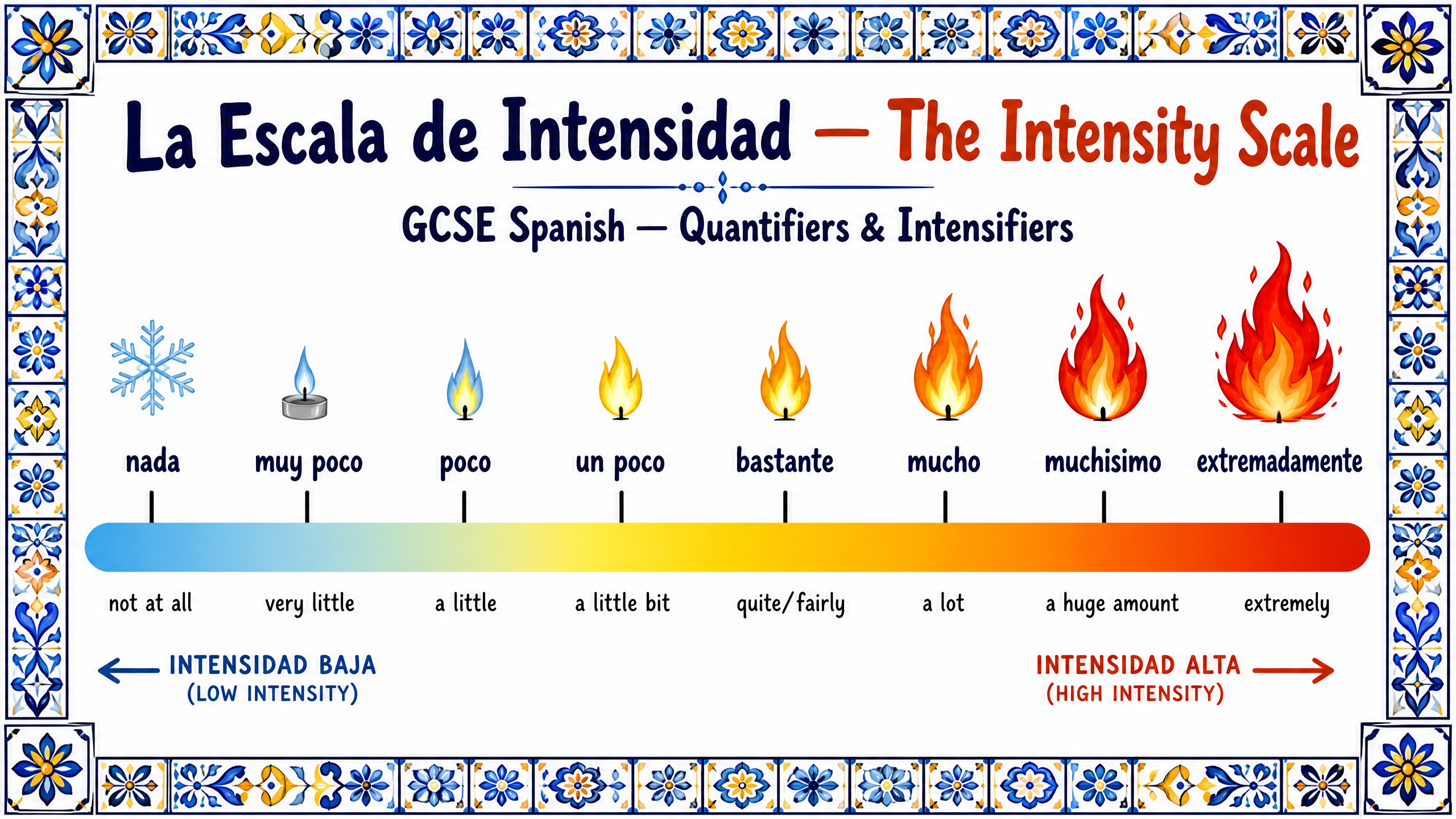
Interactive Diagrams
1 interactive diagram to visualise key concepts
Conceptual Flow Outline
Decision tree for choosing and agreeing quantifiers
Worked Examples
4 worked examples — open one to explore the question and available guidance.
Practice Questions
Test your understanding — click to reveal model answers
Translate the following sentence into Spanish: 'I like Spanish a lot because it is very interesting.'
Hint: Remember which word to use with the verb 'like' and which to use with the adjective 'interesting'.
Fill in the blanks with the correct form of 'mucho': Hay _______ personas en la fiesta y hace _______ calor.
Hint: Check the gender and number of 'personas'. 'Calor' is masculine singular.
Write a 90-word paragraph about your school. You must include your opinion, what you study, and use at least three different intensifiers/quantifiers.
Hint: Plan your paragraph: Introduction, subjects, opinions with intensifiers.
Translate into Spanish: 'There are too many cars in my city, so there is a lot of pollution.'
Hint: Pay attention to the gender of 'contaminación'.
Reading comprehension: Read the sentence and answer in English. 'Tengo poco dinero, así que compro muy poca ropa.' Why doesn't the person buy much clothes?
Hint: What does 'poco dinero' mean?
Speaking (Conversation): ¿Qué te gusta hacer en tu tiempo libre?
Hint: Use quantifiers to describe how often you do things or how much you like them.