Pearson Edexcel · A-Level · Spanish
Negation
Mastering Spanish negation is essential for scoring highly in your GCSEs. This topic covers the vital structures needed to say 'no', express 'never', and use the tricky double negative rule correctly, which examiners specifically look for in writing and speaking.
- 12 min read
- 4 worked examples
- 6 practice questions
- 8 key terms
Study Notes

Overview
Negation in Spanish is one of those grammatical areas where direct translation from English will almost certainly lose you marks. English usually relies on a single negative word, whereas Spanish frequently demands a 'double negative' structure. Understanding how to correctly place words like nunca (never), nada (nothing), and nadie (nobody) around the verb is crucial. This topic appears across all four papers. In listening and reading, missing a negative word can completely alter your comprehension of a text. In speaking and writing, accurately using complex negative structures (like ni... ni or tampoco) is a fantastic way to demonstrate grammatical range and secure higher marks.
🎧 Audio Revision: The Negation Podcast
Listen to our expert tutor explain the core concepts, common traps, and test your knowledge with a quick-fire quiz!

📖 Essential Vocabulary
Tier 1 — Foundation Core
| Spanish | English | Gender | Example Sentence |
|---|---|---|---|
| no | no / not | n/a | No me gusta el pescado. |
| nunca | never | n/a | Nunca voy a la biblioteca. |
| nada | nothing / anything | n/a | No tengo nada en mi mochila. |
| nadie | nobody / anyone | n/a | No hay nadie en la clase. |
| tampoco | neither / not either | n/a | A mí tampoco me gusta. |
| ningún | no / not any (masc. sing.) | m | No tengo ningún hermano. |
| ninguna | no / not any (fem. sing.) | f | No hay ninguna piscina. |
| jamás | never | n/a | Jamás como carne. |
| ni | nor / not even | n/a | No tengo lápiz ni bolígrafo. |
| sin | without | n/a | Prefiero el agua sin gas. |
| dejar de | to stop (doing something) | n/a | He dejado de fumar. |
| todavía no | not yet | n/a | Todavía no he terminado. |
| ya no | no longer / not anymore | n/a | Ya no juego al tenis. |
| de ninguna manera | no way / by no means | n/a | ¡De ninguna manera voy a ir! |
| ni siquiera | not even | n/a | Ni siquiera me miró. |
Tier 2 — Higher Tier
| Spanish | English | Gender | Example Sentence |
|---|---|---|---|
| ni... ni... | neither... nor... | n/a | No quiero ni té ni café. |
| a nadie | to nobody (personal a) | n/a | No conozco a nadie aquí. |
| nada más | nothing else / anymore | n/a | No quiero nada más, gracias. |
| en absoluto | absolutely not / not at all | n/a | No estoy de acuerdo en absoluto. |
| para nada | not at all | n/a | Esa película no me gustó para nada. |
| ninguno de los dos | neither of the two | m | Ninguno de los dos es mi amigo. |
| nunca jamás | never ever | n/a | Nunca jamás volveré a ese hotel. |
| por ningún lado | nowhere / not anywhere | n/a | No encuentro mis llaves por ningún lado. |
| que yo sepa no | not that I know of | n/a | ¿Viene María? Que yo sepa no. |
| sin falta | without fail | n/a | Tienes que estar allí sin falta. |
High-Frequency Words & Phrases
| Phrase | English | Usage Context |
|---|---|---|
| ¡Qué va! | No way! / Nonsense! | Speaking: Reacting strongly to a statement. |
| Para nada | Not at all | Speaking/Writing: Emphasizing a negative opinion. |
| Todavía no | Not yet | Speaking: When asked if you have done something. |
| Ya no | Not anymore | Writing: Contrasting past and present habits. |
| Ni hablar | No way / Out of the question | Speaking: Refusing an idea. |
| A mí tampoco | Me neither | Speaking: Agreeing with a negative statement. |
| De ninguna manera | By no means | Writing: Strong disagreement in an essay. |
| Ni idea | No idea | Speaking: When you don't know the answer. |
| Nunca se sabe | You never know | Speaking: Expressing uncertainty about the future. |
| Sin duda | Without a doubt | Writing: Emphasizing a point (technically positive meaning, uses negative word 'sin'). |
📝 Grammar Focus
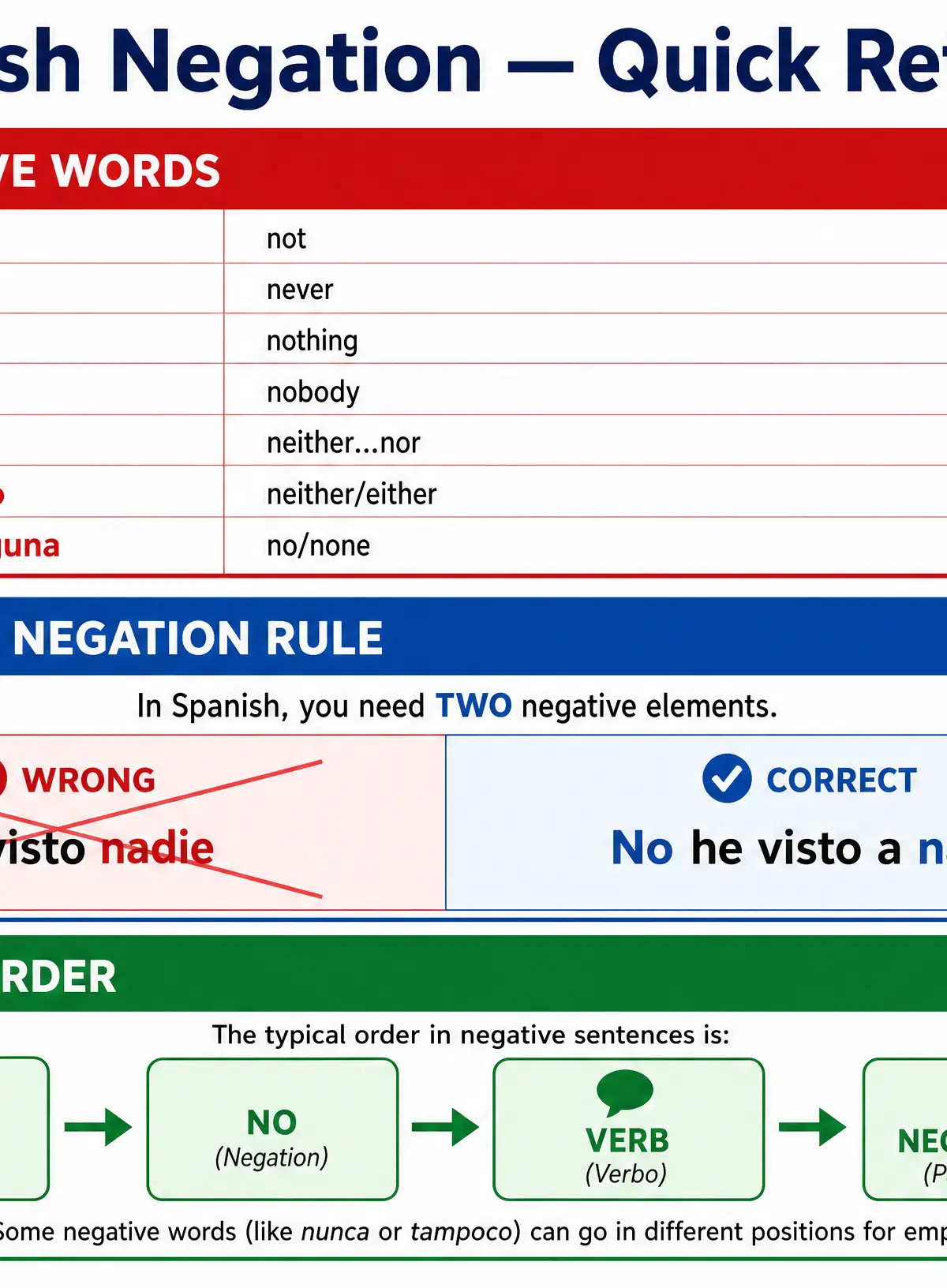
Key Structure 1: The Basic Negative (No + Verb)
When to use it: This is the most fundamental rule. To make a sentence negative in Spanish, place the word no immediately before the conjugated verb. You cannot separate the no from the verb with a subject pronoun.
Conjugation Table (Example with 'Comer' - Present Tense)
| Subject | Verb Form | English |
|---|---|---|
| yo | no como | I don't eat |
| tú | no comes | you don't eat |
| él/ella/usted | no come | he/she/you (form) doesn't eat |
| nosotros/as | no comemos | we don't eat |
| vosotros/as | no coméis | you (pl) don't eat |
| ellos/ellas/ustedes | no comen | they/you (pl form) don't eat |
Irregulars to learn: This rule applies to all verbs, regular and irregular. e.g., No soy (I am not), No voy (I don't go), No tengo (I don't have).
Key Structure 2: The Double Negative Rule
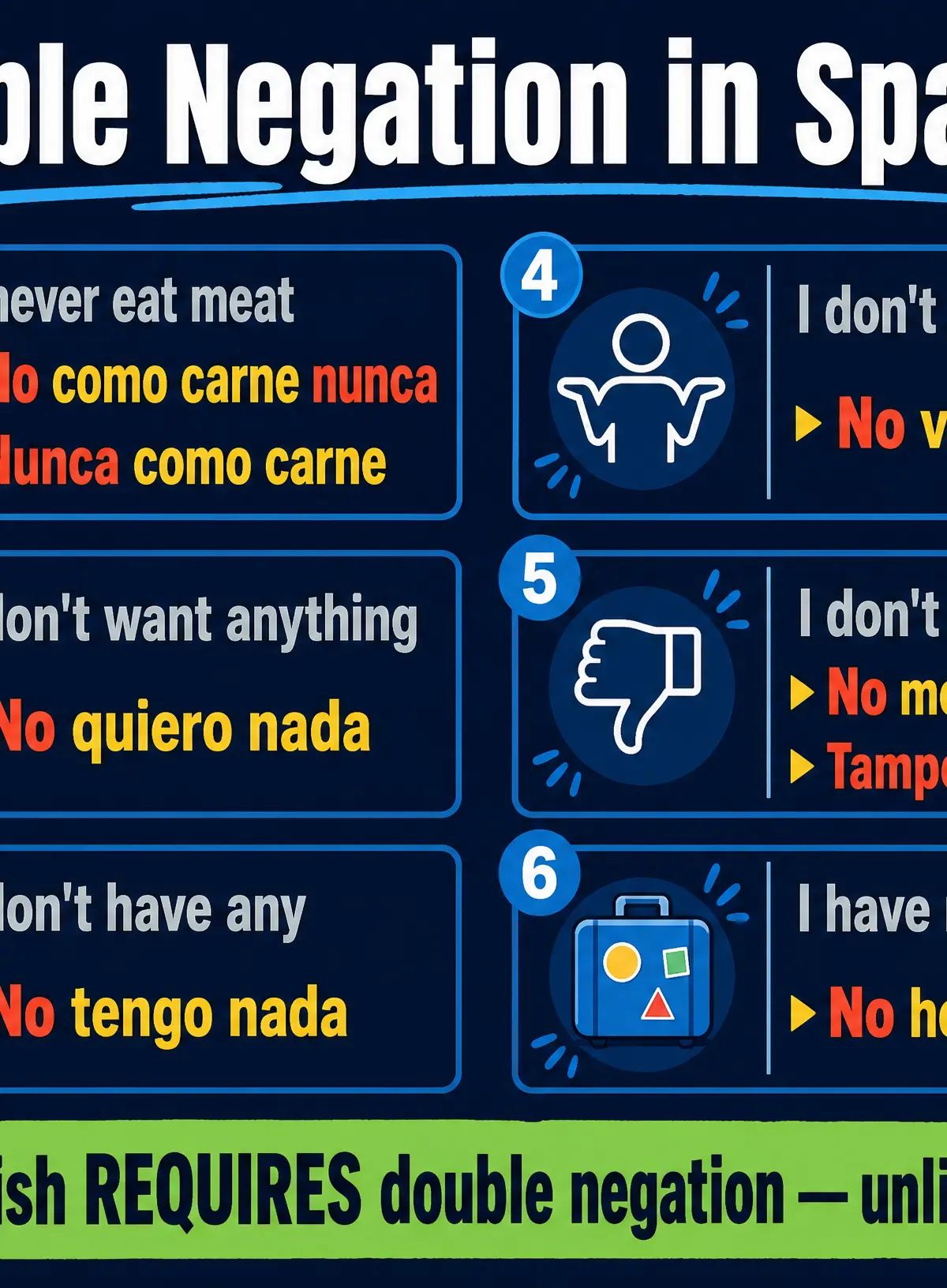
When to use it: When using negative words like nunca (never), nada (nothing), or nadie (nobody), Spanish often requires a double negative.
The Rule: If the negative word comes after the verb, you MUST put no before the verb.
- No como nunca. (I never eat. - literally: I don't eat never.)
- No veo a nadie. (I don't see anyone. - literally: I don't see nobody.)
However, if the negative word comes before the verb, the no is dropped.
- Nunca como. (I never eat.)
- Nadie sabe. (Nobody knows.)
Key Structure 3: Ningún and Ninguna (Adjectives)
When to use it: When saying 'no' or 'not any' before a noun. These words must agree in gender with the noun they describe. They are almost always used in the singular.
- No tengo ningún problema. (I don't have any problem - masculine singular)
- No hay ninguna piscina. (There isn't any swimming pool - feminine singular)
Note: Ninguno drops the 'o' and adds an accent to become ningún before a masculine singular noun.
🎧 Listening Skills
What to Expect
In the listening exam, negation is frequently used as a distractor. You might hear a long, positive-sounding sentence that is entirely reversed by a small no or nunca hidden within it. Questions often test your ability to distinguish between someone saying they used to do something versus they never do it.
Listening Strategies
- Listen for the 'no' before the verb: It's short and can be spoken quickly. Train your ear to catch that tiny syllable before the main action word.
- Watch out for ya no vs todavía no: Ya no means they used to do it but have stopped. Todavía no means they haven't done it yet, but probably will. This is a classic trap.
- Note the tone: Often, a speaker's tone will drop or sound dismissive when using strong negatives like para nada or ¡qué va!
Common Listening Traps
- Tampoco: If a speaker says A mí tampoco, they are agreeing with a negative statement. If the question asks "Does Juan like the film?", and he replies A mí tampoco, the answer is "No".
- Nadie vs Nada: They sound similar when spoken quickly. Listen for the 'i' in nadie (people) versus the broader 'a' in nada (things).
🗣️ Speaking Skills
Role Play Scenarios
Scenario 1: At a restaurant
Examiner: ¿Qué vas a tomar de postre? (What are you going to have for dessert?)
Candidate: No quiero nada, gracias. Tampoco tengo hambre. (I don't want anything, thanks. I'm not hungry either.)
Scenario 2: Tourist office
Examiner: ¿Hay un museo cerca de aquí? (Is there a museum near here?)
Candidate: Lo siento, no hay ningún museo en este pueblo. (I'm sorry, there isn't any museum in this town.)
Photo Card Practice
Model Photo Card Response:
- Qu 1 (Description): En la foto hay tres personas, pero no están contentas. Nadie está sonriendo. (In the photo there are three people, but they are not happy. Nobody is smiling.)
- Qu 2 (Opinion): En mi opinión, la comida rápida es mala. No es ni sana ni deliciosa. (In my opinion, fast food is bad. It is neither healthy nor delicious.)
- Qu 3 (Related topic): Normalmente como en casa porque nunca voy a restaurantes. (Normally I eat at home because I never go to restaurants.)
- Qu 4 (Past/Future): El fin de semana pasado no hice nada especial. (Last weekend I didn't do anything special.)
- Qu 5 (Unpredictable): No estoy seguro, pero creo que sí. (I'm not sure, but I think so.)
General Conversation Questions
| Question (Spanish) | Model Answer | English Translation |
|---|---|---|
| ¿Qué haces en tu tiempo libre? | Normalmente leo, pero nunca juego a los videojuegos porque no me gustan nada. | Normally I read, but I never play video games because I don't like them at all. |
| ¿Te gusta tu instituto? | No mucho. No hay ninguna piscina y tampoco tenemos ordenadores nuevos. | Not much. There isn't any swimming pool and we don't have new computers either. |
| ¿Qué hiciste ayer? | La verdad es que no hice nada. Me quedé en casa porque llovía. | The truth is I didn't do anything. I stayed at home because it was raining. |
| ¿Vas a ir a la universidad? | Todavía no lo sé. Quizás busque un trabajo primero. | I don't know yet. Maybe I will look for a job first. |
| ¿Qué opinas de fumar? | Creo que es un hábito terrible. Jamás fumaría. | I think it's a terrible habit. I would never ever smoke. |
✍️ Writing Skills
Translation Practice
English → Spanish:
| English | Spanish | Key Grammar |
|---|---|---|
| I don't play football. | No juego al fútbol. | Basic 'no' before verb. |
| I never do my homework. | Nunca hago mis deberes. / No hago nunca mis deberes. | Double negation options. |
| I don't see anyone. | No veo a nadie. | Double negation + personal 'a'. |
| There isn't any park. | No hay ningún parque. | Agreement with 'ningún' (masc. sing.). |
| I don't like tea or coffee. | No me gusta ni el té ni el café. | Use of 'ni... ni' structure. |
Extended Writing
**Model 90-word response (Foundation):**Me encanta mi ciudad porque hay muchas cosas que hacer. Sin embargo, no me gusta el centro porque es muy ruidoso. Normalmente voy al cine con mis amigos, pero nunca vamos al teatro. El fin de semana pasado, fuimos a la playa, pero no nadamos porque hacía frío. En el futuro, me gustaría vivir en España, pero todavía no hablo bien el idioma. Mi hermano dice que es aburrido, pero a mí no me parece nada aburrido.
**Model 150-word response (Higher):**Vivo en un pueblo bastante pequeño en las afueras de Londres. Lo bueno es que es tranquilo, pero lo malo es que no hay nada para los jóvenes. No tenemos ni polideportivo ni bolera, lo cual es muy frustrante. De hecho, casi nadie de mi edad quiere quedarse a vivir aquí en el futuro.
El verano pasado, fui de vacaciones a Valencia con mi familia. ¡Fue increíble! Nunca había visto una ciudad tan hermosa. Comimos paella todos los días y, aunque a mi hermana no le gustó nada, a mí me encantó. Tampoco hizo mal tiempo; hizo sol todos los días.
En cuanto a mi futuro, todavía no he decidido qué quiero estudiar en la universidad. Mis padres quieren que sea médico, pero de ninguna manera quiero trabajar en un hospital. Preferiría ser periodista porque me encanta escribir.
Writing Checklist
- ✅ Have I put no directly before the verb?
- ✅ If I used nada, nunca, or nadie after the verb, did I remember the double negative (no before the verb)?
- ✅ Did I use the personal a with nadie when it's the object of the verb (e.g., No veo a nadie)?
- ✅ Did I check that ningún/ninguna agrees with the noun it describes?
- ✅ Have I included at least one complex negative structure (like ni... ni or tampoco) to impress the examiner?
📚 Reading Skills
Key Strategies
- Highlight the negatives: When reading a text, physically underline or highlight words like no, nunca, nadie, and tampoco. They completely flip the meaning of the sentence.
- Context is key for ya no: If you see ya no (no longer), recognize that the text is making a comparison between a past habit and a present reality.
- Look out for sino: This means 'but rather' and often follows a negative statement. e.g., No fui a Francia, sino a Italia. (I didn't go to France, but rather to Italy.)
False Friends & Tricky Words
| Word | Looks Like | Actually Means |
|---|---|---|
| Nada | Nothing (but looks like 'nada' - he/she swims) | Nothing / Anything |
| Jamás | Pyjamas (sounds a bit like it) | Never |
| Tampoco | Tampa (place) / Poco (a little) | Neither / Not either |
🌍 Cultural Knowledge
In Spanish-speaking cultures, directness in conversation is often more acceptable than in English. While British English speakers might soften a refusal with "I'm not sure I can make it," Spanish speakers will comfortably use a direct No, no puedo ir (No, I can't go) without it being considered rude.
Furthermore, the double negative, which is considered poor grammar in English (e.g., "I ain't got nothing"), is the absolute standard of correct, educated Spanish. Embracing the double negative is key to sounding authentic and fluent.
Visual Resources
2 diagrams and illustrations
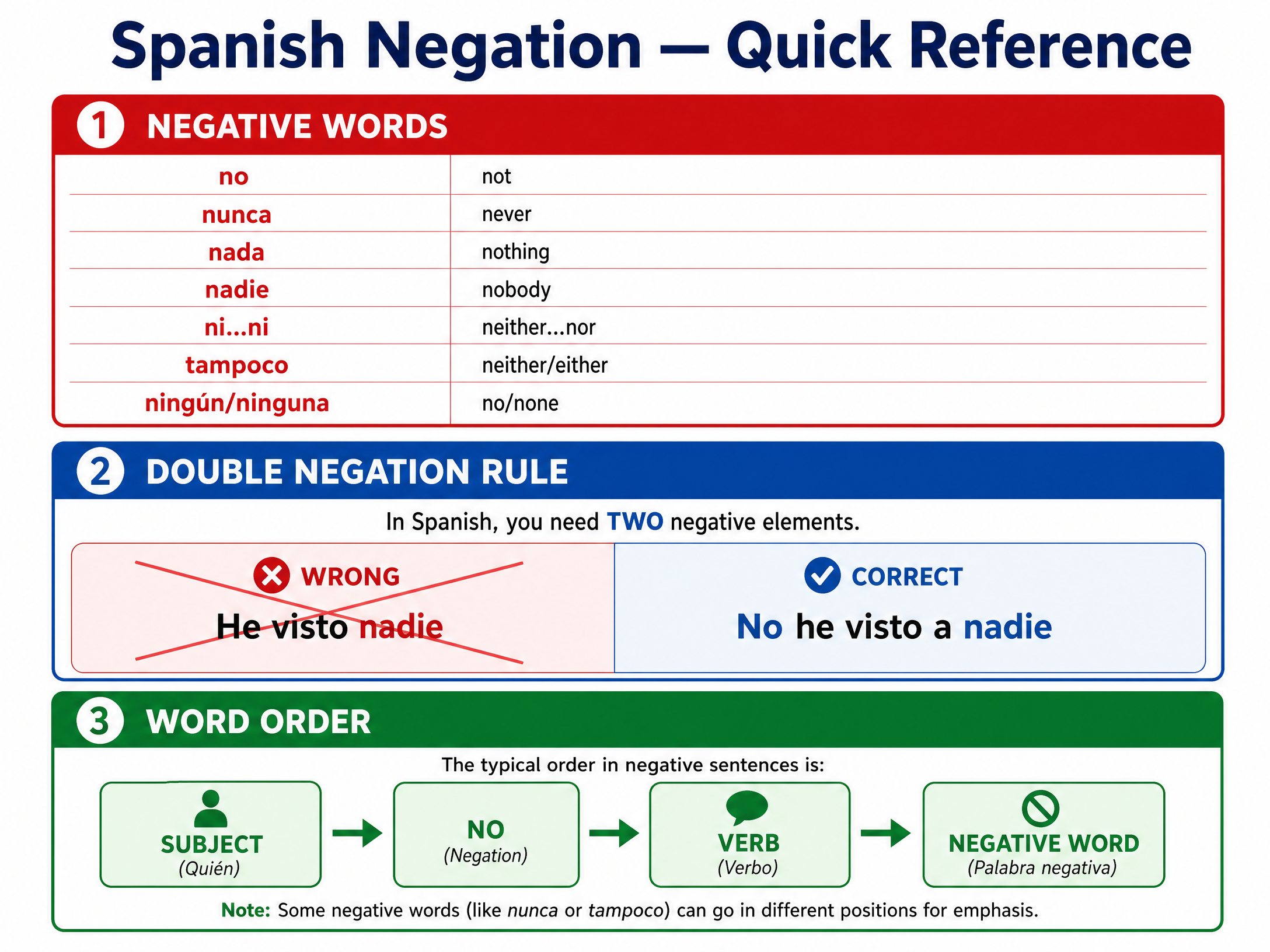
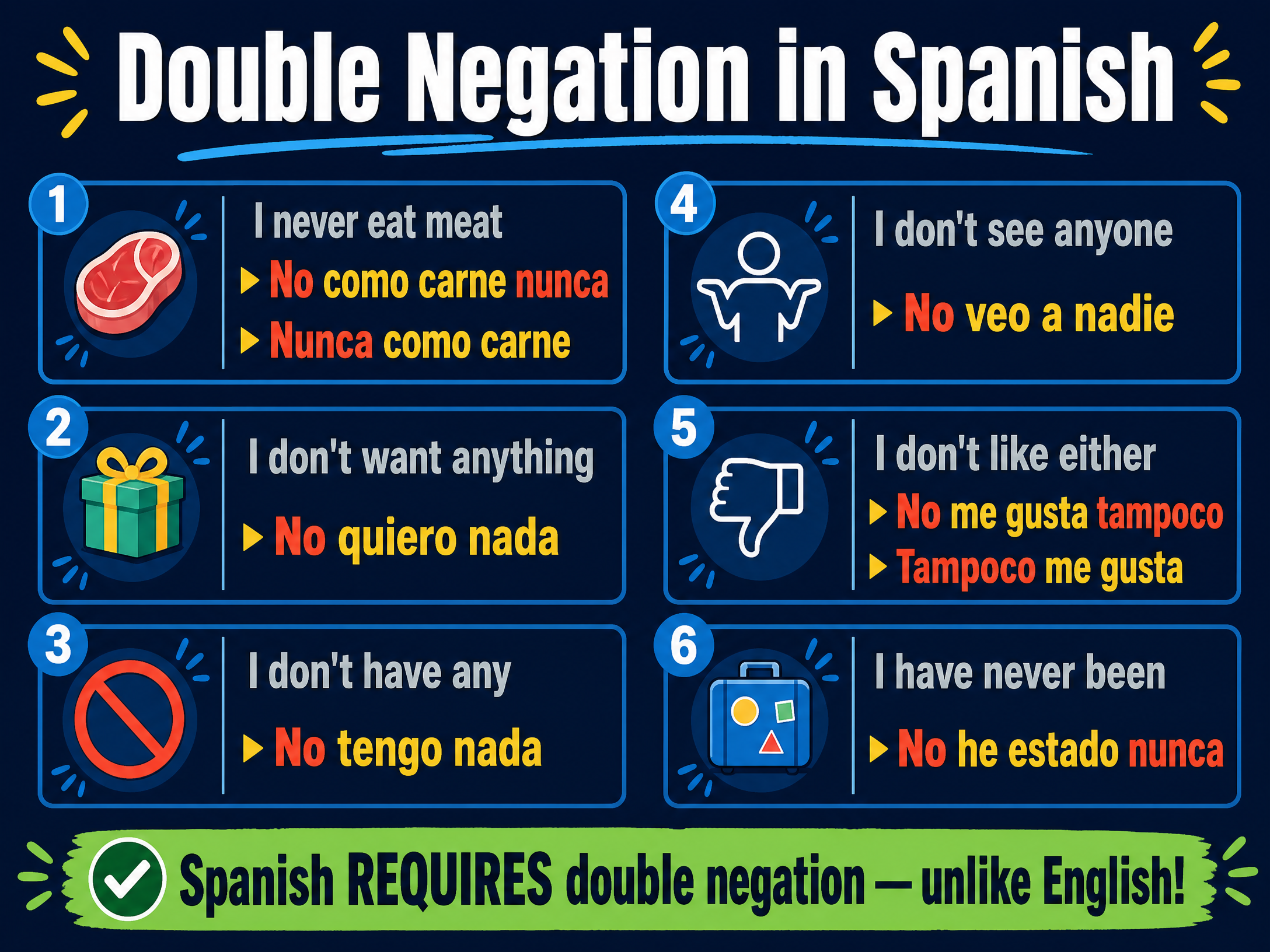
Interactive Diagrams
1 interactive diagram to visualise key concepts
Conceptual Flow Outline
The Double Negation Decision Tree
Worked Examples
4 worked examples — open one to explore the question and available guidance.
Practice Questions
Test your understanding — click to reveal model answers
Translate into Spanish: I don't have any brothers or sisters.
Hint: Think about the word for 'any' and make sure it agrees with the noun.
Translate into Spanish: Nobody lives in that house anymore.
Hint: You need the word for 'nobody' and the phrase for 'anymore/no longer'. Think about word order.
Reading: Lee el texto. ¿Por qué no le gusta el hotel a Pablo? 'El hotel era terrible. No había piscina y la comida no era nada buena. Tampoco había wifi en las habitaciones.'
Hint: Look for the three negative points he makes.
Writing (90 words): Escribe sobre tu dieta. Incluye: lo que comes normalmente, lo que no comes nunca, y tu opinión sobre la comida sana.
Hint: Make sure to use 'nunca' correctly. If it goes after the verb, you need 'no' before the verb.
Speaking (Photo Card): ¿Qué no hay en la foto?
Hint: Use 'no hay' and try to add 'ningún' or 'ninguna'.
Writing (Translation): Translate: I have never visited Spain, but I want to go.
Hint: Use the perfect tense (I have visited) with 'nunca'.