Algebra — Eduqas GCSE Mathematics
This course is being built. Notes are AI-generated until checked.
Test yourself on Algebra with EDUQAS GCSE practice questions.
A week of Premium from your first lesson · Then the free plan continues · No card, no charge
Algebra explained
The Number topic covers the fundamental arithmetic and structural properties of mathematics, including integers, decimals, fractions, and negative numbers.
Read the full explanation
It extends to advanced concepts such as prime factorisation, standard form, surds, and limits of accuracy, providing the essential foundation for all other mathematical areas.
Watch and listen
Listen: Algebra audio lesson
Read the full guide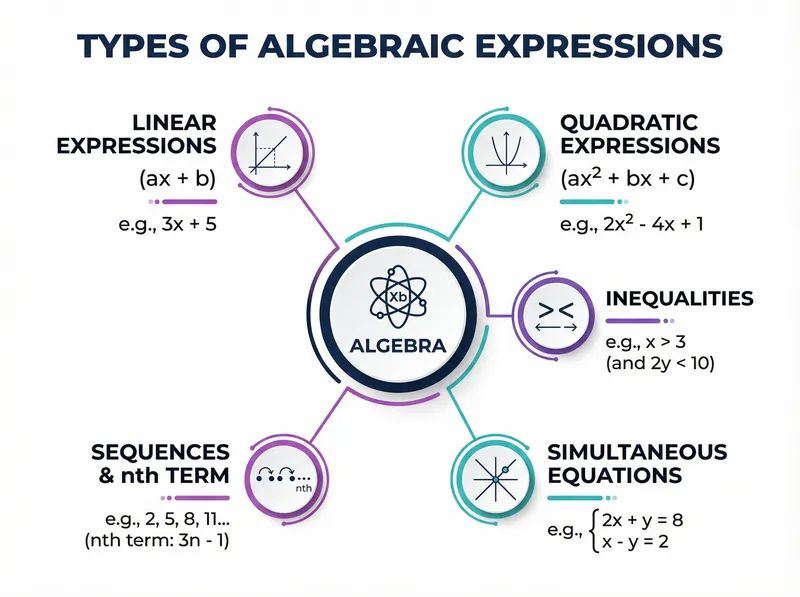
Interactive Diagrams
1 interactive diagram to visualise key concepts
Conceptual Flow Outline
Decision flowchart for solving quadratic equations.
What to demonstrate
- Correct application of the order of operations (BIDMAS/BODMAS).
- Accurate use of formal written methods for the four operations.
- Correct identification and use of prime factors, HCF, and LCM.
Show all 6 objectives
- Precise rounding to specified decimal places or significant figures.
- Correct manipulation of standard form and surds.
- Accurate calculation of upper and lower bounds in limits of accuracy problems.
Algebra flashcards
Card 1 of 12
Algebra
Algebra exam tips
Topic Overview
Algebra is the branch of mathematics that uses letters and symbols to represent numbers and quantities in equations and expressions. In the WJEC GCSE Mathematics curriculum, algebra is a core component that builds on arithmetic and extends into problem-solving, pattern recognition, and logical reasoning. You'll encounter topics such as simplifying expressions, solving linear and quadratic equations, working with inequalities, and understanding functions and graphs. Mastery of algebra is essential not only for your GCSE exams but also for further study in mathematics, science, and engineering, as it provides the language to model real-world situations.
Algebra is not just about manipulating symbols; it's about developing a systematic approach to solving problems. You'll learn to translate word problems into algebraic equations, manipulate expressions using the laws of indices, factorise quadratics, and rearrange formulas. These skills are tested across all three GCSE papers (non-calculator and calculator) and appear in both foundation and higher tiers. A strong grasp of algebra will also support your work in other topics like geometry (e.g., using formulas for area and volume) and statistics (e.g., calculating mean from a frequency table).
In the WJEC specification, algebra is divided into several key areas: expressions and formulae, equations and inequalities, sequences, and graphs. You'll need to be confident with basic operations (addition, subtraction, multiplication, division of algebraic terms), expanding brackets, factorising, solving equations (including those with unknowns on both sides), and plotting linear and quadratic graphs. Higher tier students will also tackle simultaneous equations, algebraic fractions, and more complex quadratics. Regular practice and a methodical approach are the keys to success.
Key Concepts
- →Simplifying expressions: Collect like terms (e.g., 3x + 5x = 8x) and use the distributive law to expand brackets (e.g., 2(3x + 4) = 6x + 8).
- →Solving linear equations: Use inverse operations to isolate the variable, performing the same operation on both sides (e.g., 2x + 3 = 11 → 2x = 8 → x = 4).
- →Factorising: Write an expression as a product of its factors, including common factors (e.g., 6x² + 9x = 3x(2x + 3)) and quadratics (e.g., x² + 5x + 6 = (x+2)(x+3)).
- →Working with sequences: Find the nth term of linear sequences (e.g., 3, 5, 7, 9... has nth term 2n+1) and recognise simple quadratic sequences.
- →Graphs of linear and quadratic functions: Plot points from a table of values, interpret gradient and y-intercept, and solve equations graphically.
Marking Points
- Correct application of the order of operations (BIDMAS/BODMAS).
- Accurate use of formal written methods for the four operations.
- Correct identification and use of prime factors, HCF, and LCM.
- Precise rounding to specified decimal places or significant figures.
- Correct manipulation of standard form and surds.
- Accurate calculation of upper and lower bounds in limits of accuracy problems.
Examiner Tips
- 💡Always show working out, as method marks are awarded even if the final answer is incorrect.
- 💡Check if the question requires an exact answer (e.g., in terms of pi or surds) or a rounded decimal.
- 💡Use estimation to check the reasonableness of your calculated answers.
- 💡For non-calculator papers, practice mental arithmetic and formal written methods regularly.
- 💡Read the question carefully to identify if it asks for significant figures or decimal places.
- 💡Show every step of your working, even if you can do it mentally. Marks are awarded for correct methods, so if you make a small arithmetic slip, you can still get method marks. For example, when solving 2x + 5 = 13, write '2x = 13 - 5' then '2x = 8' then 'x = 4'.
- 💡Check your solutions by substituting them back into the original equation. This is a quick way to catch errors. For instance, if you solve x + 3 = 7 and get x = 4, check: 4 + 3 = 7, correct.
- 💡For graph questions, use a sharp pencil and plot points accurately. Label the axes and the graph (e.g., 'y = 2x + 1'). If you're asked to solve an equation graphically, draw the line and read the x-coordinate of the intersection point carefully.
Common Mistakes
- Incorrect handling of negative numbers during addition, subtraction, or multiplication.
- Failure to follow the correct order of operations.
- Misinterpreting place value when working with very large or very small numbers.
- Rounding prematurely during multi-step calculations, leading to inaccurate final answers.
- Confusing the rules for upper and lower bounds.
- Misapplying the order of operations: Students often incorrectly simplify 3(x + 2) as 3x + 2 instead of 3x + 6. Remember to multiply every term inside the bracket by the term outside.
- Forgetting to change the sign when moving terms across the equals sign: For example, in 2x + 5 = 3x - 2, moving the 3x to the left should give 2x - 3x + 5 = -2, not 2x + 3x + 5 = -2. Always perform the inverse operation.
- Confusing factorising with expanding: When factorising, you are putting brackets in; when expanding, you are removing them. Check by expanding your factorised answer to see if you get back the original expression.