Ratio, proportion and rates of change — Eduqas GCSE Mathematics
This course is being built. Notes are AI-generated until checked.
Test yourself on Ratio, proportion and rates of change with EDUQAS GCSE practice questions.
A week of Premium from your first lesson · Then the free plan continues · No card, no charge
Ratio, proportion and rates of change explained
The Number topic covers the fundamental arithmetic and structural properties of mathematics, including integers, decimals, fractions, and negative numbers.
Read the full explanation
It extends to advanced concepts such as prime factorisation, standard form, surds, and limits of accuracy, providing the essential foundation for all other mathematical areas.
Watch and listen
Listen: Ratio, proportion and rates of change audio lesson
Read the full guide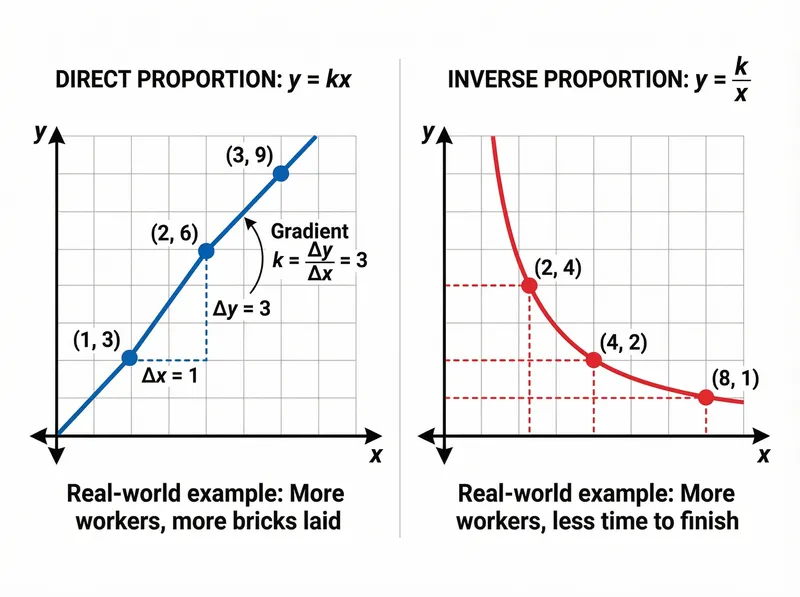
Interactive Diagrams
1 interactive diagram to visualise key concepts
Conceptual Flow Outline
Decision flowchart for tackling ratio and proportion problems.
What to demonstrate
- Correct application of the order of operations (BIDMAS/BODMAS).
- Accurate use of formal written methods for the four operations.
- Correct identification and use of prime factors, HCF, and LCM.
Show all 6 objectives
- Precise rounding to specified decimal places or significant figures.
- Correct manipulation of standard form and surds.
- Accurate calculation of upper and lower bounds in limits of accuracy problems.
Ratio, proportion and rates of change exam tips
Topic Overview
Ratio, proportion and rates of change is a fundamental topic in GCSE Mathematics that explores the relationships between quantities. Ratios compare two or more quantities, showing how much of one thing there is compared to another. Proportion deals with the equality of two ratios, often used to solve problems involving scaling, sharing, and converting between units. Rates of change, such as speed, density, and unit pricing, describe how one quantity changes in relation to another. This topic is essential for real-world applications like cooking, map reading, currency exchange, and interpreting graphs.
In the WJEC GCSE specification, this topic appears across both Foundation and Higher tiers. You will encounter direct and inverse proportion, best buys, scale factors, and conversion graphs. Understanding these concepts allows you to solve problems efficiently, whether calculating the cost of items in a sale, determining travel times, or interpreting real-life graphs. Mastery of ratio and proportion is also crucial for success in other areas of maths, such as algebra, geometry, and statistics.
This topic is not just about memorising formulas; it's about developing a sense of multiplicative reasoning. You'll learn to recognise proportional relationships, use unitary methods, and apply the constant of proportionality. By the end of this topic, you should be confident in solving problems involving sharing in a given ratio, finding missing values in proportional situations, and interpreting rates of change from graphs and tables.
Key Concepts
- →Simplifying ratios: Divide all parts of the ratio by their highest common factor (e.g., 12:8 simplifies to 3:2).
- →Sharing in a given ratio: Add the parts of the ratio to find the total number of shares, then divide the total amount by this sum to find the value of one share.
- →Direct proportion: As one quantity increases, the other increases at the same rate (e.g., cost of apples per kg). Use the unitary method or cross-multiplication.
- →Inverse proportion: As one quantity increases, the other decreases (e.g., speed and time for a fixed distance). Recognise that the product of the two quantities is constant.
- →Rates of change: Interpret gradients of straight-line graphs as rates (e.g., speed from a distance-time graph, cost per item from a conversion graph).
Marking Points
- Correct application of the order of operations (BIDMAS/BODMAS).
- Accurate use of formal written methods for the four operations.
- Correct identification and use of prime factors, HCF, and LCM.
- Precise rounding to specified decimal places or significant figures.
- Correct manipulation of standard form and surds.
- Accurate calculation of upper and lower bounds in limits of accuracy problems.
Examiner Tips
- 💡Always show working out, as method marks are awarded even if the final answer is incorrect.
- 💡Check if the question requires an exact answer (e.g., in terms of pi or surds) or a rounded decimal.
- 💡Use estimation to check the reasonableness of your calculated answers.
- 💡For non-calculator papers, practice mental arithmetic and formal written methods regularly.
- 💡Read the question carefully to identify if it asks for significant figures or decimal places.
- 💡Always show your working clearly, especially when using the unitary method. Examiners award method marks even if your final answer is wrong.
- 💡When dealing with ratios, check if the question asks for the ratio in its simplest form. If not specified, it's good practice to simplify anyway.
- 💡For proportion problems, identify whether it's direct or inverse by considering real-world logic. For example, more workers should take less time (inverse), while more hours worked means more pay (direct).
Common Mistakes
- Incorrect handling of negative numbers during addition, subtraction, or multiplication.
- Failure to follow the correct order of operations.
- Misinterpreting place value when working with very large or very small numbers.
- Rounding prematurely during multi-step calculations, leading to inaccurate final answers.
- Confusing the rules for upper and lower bounds.
- Mistake: Thinking that ratios are the same as fractions. Correction: A ratio compares parts to parts, while a fraction compares a part to a whole. For example, a ratio of 2:3 means there are 2 parts of one thing and 3 of another, not that one quantity is 2/3 of the total.
- Mistake: Adding or subtracting ratios instead of multiplying or dividing. Correction: Ratios are multiplicative. If a recipe for 4 people uses 200g flour, for 8 people you multiply by 2, not add 200g.
- Mistake: Confusing direct and inverse proportion. Correction: In direct proportion, doubling one quantity doubles the other. In inverse proportion, doubling one halves the other. Check by seeing if the product (for inverse) or quotient (for direct) is constant.