Number — Eduqas GCSE Mathematics
This course is being built. Notes are AI-generated until checked.
Test yourself on Number with EDUQAS GCSE practice questions.
A week of Premium from your first lesson · Then the free plan continues · No card, no charge
Number explained
The Number topic covers the fundamental arithmetic and structural properties of mathematics, including integers, decimals, fractions, and negative numbers.
Read the full explanation
It extends to advanced concepts such as prime factorisation, standard form, surds, and limits of accuracy, providing the essential foundation for all other mathematical areas.
Watch and listen
Listen: Number audio lesson
Read the full guide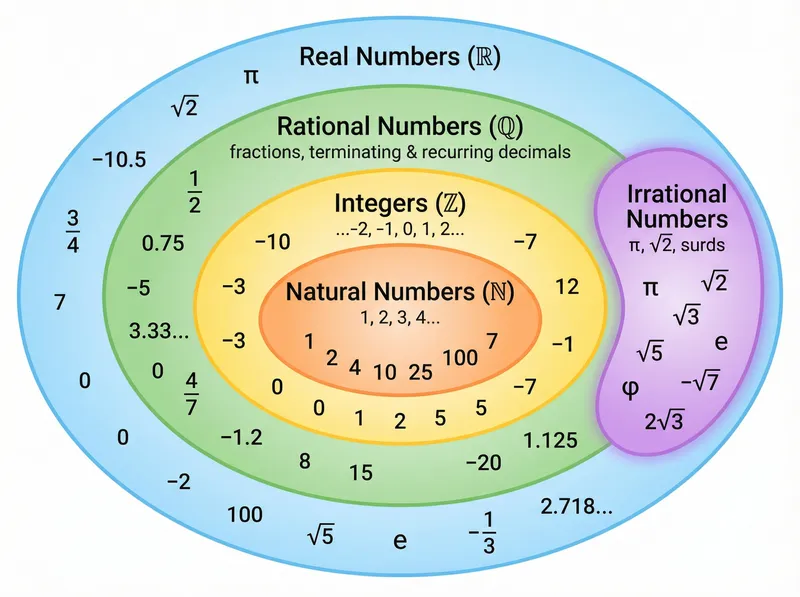
What to demonstrate
- Correct application of the order of operations (BIDMAS/BODMAS).
- Accurate use of formal written methods for the four operations.
- Correct identification and use of prime factors, HCF, and LCM.
Show all 6 objectives
- Precise rounding to specified decimal places or significant figures.
- Correct manipulation of standard form and surds.
- Accurate calculation of upper and lower bounds in limits of accuracy problems.
Number exam tips
Topic Overview
Number is a foundational topic in WJEC GCSE Mathematics, covering the properties and operations of numbers that underpin all other areas of maths. This includes understanding place value, the four operations (addition, subtraction, multiplication, division), fractions, decimals, percentages, ratio, proportion, and standard form. Mastering Number is essential for success in topics like algebra, geometry, and statistics, as it provides the numerical fluency needed to solve problems efficiently.
In the WJEC GCSE, Number is assessed across both Foundation and Higher tiers, with questions ranging from basic arithmetic to complex multi-step problems involving real-life contexts such as finance, measurement, and data interpretation. Students must be confident in mental and written calculations, as well as using calculators appropriately. The topic also introduces key concepts like factors, multiples, primes, indices, and surds (Higher tier), which are crucial for developing mathematical reasoning.
Why does Number matter? Beyond exams, numerical skills are vital for everyday life—managing money, interpreting statistics, and making informed decisions. In the WJEC curriculum, Number is often the first topic taught, and a strong grasp here builds confidence and competence for more advanced work. By mastering Number, students not only improve their exam performance but also develop a lifelong skill set.
Key Concepts
- →Place value and the four operations: Understand the value of digits in numbers and perform addition, subtraction, multiplication, and division accurately with integers, decimals, and fractions.
- →Fractions, decimals, and percentages: Convert between these forms and use them to solve problems involving proportion, increase/decrease, and reverse percentages.
- →Ratio and proportion: Simplify ratios, divide quantities in a given ratio, and solve problems using unitary method or direct/inverse proportion.
- →Indices and standard form: Use index laws (including negative and fractional indices on Higher tier) and write large/small numbers in standard form (e.g., 3.2 × 10^5).
- →Factors, multiples, primes, and prime factorisation: Find HCF and LCM using prime factorisation, and understand the unique prime factorisation theorem.
Marking Points
- Correct application of the order of operations (BIDMAS/BODMAS).
- Accurate use of formal written methods for the four operations.
- Correct identification and use of prime factors, HCF, and LCM.
- Precise rounding to specified decimal places or significant figures.
- Correct manipulation of standard form and surds.
- Accurate calculation of upper and lower bounds in limits of accuracy problems.
Examiner Tips
- 💡Always show working out, as method marks are awarded even if the final answer is incorrect.
- 💡Check if the question requires an exact answer (e.g., in terms of pi or surds) or a rounded decimal.
- 💡Use estimation to check the reasonableness of your calculated answers.
- 💡For non-calculator papers, practice mental arithmetic and formal written methods regularly.
- 💡Read the question carefully to identify if it asks for significant figures or decimal places.
- 💡Always show your working: Even if you make a calculation error, you can still earn method marks. For multi-step problems, write down each step clearly.
- 💡Check your calculator mode: Ensure your calculator is in the correct mode (e.g., degrees for trigonometry, but for Number, just ensure it's set to standard arithmetic). Use the fraction button for fraction answers.
- 💡Read the question carefully: Look for keywords like 'estimate', 'exact', 'give your answer as a fraction', or 'in its simplest form'. These tell you exactly what the examiner expects.
Common Mistakes
- Incorrect handling of negative numbers during addition, subtraction, or multiplication.
- Failure to follow the correct order of operations.
- Misinterpreting place value when working with very large or very small numbers.
- Rounding prematurely during multi-step calculations, leading to inaccurate final answers.
- Confusing the rules for upper and lower bounds.
- Misconception: Multiplying by 0.1 makes a number smaller. Correction: Multiplying by 0.1 is the same as dividing by 10, so it does make the number smaller (e.g., 5 × 0.1 = 0.5). Students often confuse this with multiplying by 10.
- Misconception: When adding fractions, you add the numerators and denominators. Correction: You only add the numerators when the denominators are the same. If denominators differ, find a common denominator first (e.g., 1/3 + 1/4 = 4/12 + 3/12 = 7/12).
- Misconception: A percentage increase of 10% followed by a 10% decrease returns to the original value. Correction: A 10% increase multiplies by 1.1, then a 10% decrease multiplies by 0.9, giving 1.1 × 0.9 = 0.99, so the final value is 1% less than the original.