Geometry and measures — Eduqas GCSE Mathematics
This course is being built. Notes are AI-generated until checked.
Test yourself on Geometry and measures with EDUQAS GCSE practice questions.
A week of Premium from your first lesson · Then the free plan continues · No card, no charge
Geometry and measures explained
The Number topic covers the fundamental arithmetic and structural properties of mathematics, including integers, decimals, fractions, and negative numbers.
Read the full explanation
It extends to advanced concepts such as prime factorisation, standard form, surds, and limits of accuracy, providing the essential foundation for all other mathematical areas.
Watch and listen
Listen: Geometry and measures audio lesson
Read the full guide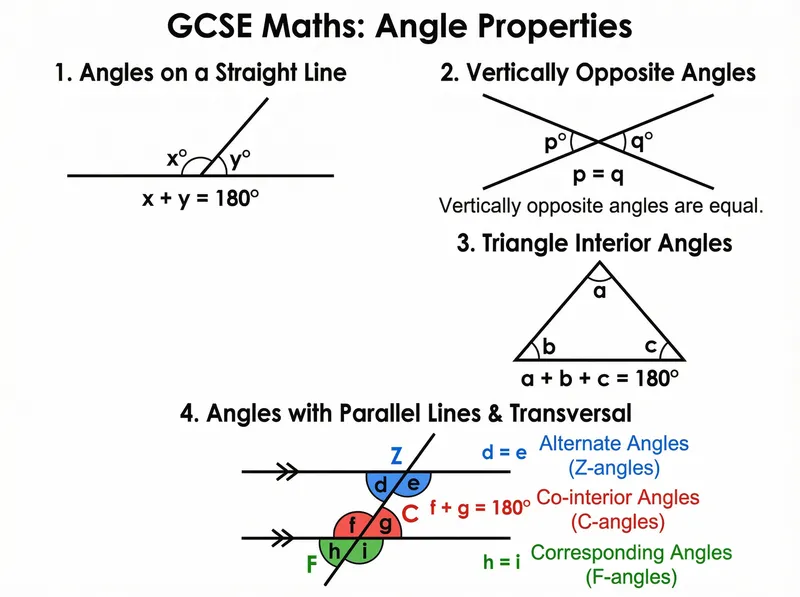
Interactive Diagrams
1 interactive diagram to visualise key concepts
Conceptual Flow Outline
Decision tree for right-angled triangle problems
What to demonstrate
- Correct application of the order of operations (BIDMAS/BODMAS).
- Accurate use of formal written methods for the four operations.
- Correct identification and use of prime factors, HCF, and LCM.
Show all 6 objectives
- Precise rounding to specified decimal places or significant figures.
- Correct manipulation of standard form and surds.
- Accurate calculation of upper and lower bounds in limits of accuracy problems.
Geometry and measures exam tips
Topic Overview
Geometry and measures is a core strand of the WJEC GCSE Mathematics syllabus, covering properties of shapes, angles, transformations, and measurement. This topic is fundamental because it develops spatial reasoning and the ability to quantify the physical world, skills essential for fields like engineering, design, and science. You'll explore 2D and 3D shapes, their properties, and how to calculate lengths, areas, and volumes, as well as angles in parallel lines, polygons, and circles.
Mastering geometry and measures is not just about memorising formulas; it's about understanding relationships and applying logical reasoning. For example, knowing that the interior angles of a triangle sum to 180° helps you solve for missing angles in complex diagrams. This topic also connects to algebra (e.g., using equations to find unknown angles) and ratio (e.g., scale factors in similar shapes). In the WJEC exam, geometry questions often appear in both non-calculator and calculator papers, so strong foundational knowledge is vital for achieving a good grade.
Throughout this topic, you'll learn to use precise mathematical language (e.g., 'vertically opposite angles are equal') and to present clear, step-by-step reasoning. The skills you develop here—such as constructing geometric proofs and interpreting scale drawings—are directly applicable to real-world problems like planning a garden layout or understanding architectural blueprints. By the end, you should feel confident tackling questions on area, volume, Pythagoras' theorem, trigonometry, and circle theorems.
Key Concepts
- →Angle rules: angles on a straight line sum to 180°, angles around a point sum to 360°, vertically opposite angles are equal, and corresponding/alternate angles in parallel lines.
- →Properties of 2D shapes: triangles (scalene, isosceles, equilateral, right-angled), quadrilaterals (square, rectangle, parallelogram, rhombus, trapezium, kite), and polygons (sum of interior angles = (n-2)×180°).
- →Area and perimeter formulas: rectangles (A=lw), triangles (A=½bh), circles (A=πr², circumference=2πr), and compound shapes (split into simpler shapes).
- →Volume and surface area of 3D shapes: prisms (volume = area of cross-section × length), cylinders, cones, spheres, and pyramids.
- →Transformations: translation (vector), reflection (mirror line), rotation (centre, angle, direction), and enlargement (scale factor, centre).
Marking Points
- Correct application of the order of operations (BIDMAS/BODMAS).
- Accurate use of formal written methods for the four operations.
- Correct identification and use of prime factors, HCF, and LCM.
- Precise rounding to specified decimal places or significant figures.
- Correct manipulation of standard form and surds.
- Accurate calculation of upper and lower bounds in limits of accuracy problems.
Examiner Tips
- 💡Always show working out, as method marks are awarded even if the final answer is incorrect.
- 💡Check if the question requires an exact answer (e.g., in terms of pi or surds) or a rounded decimal.
- 💡Use estimation to check the reasonableness of your calculated answers.
- 💡For non-calculator papers, practice mental arithmetic and formal written methods regularly.
- 💡Read the question carefully to identify if it asks for significant figures or decimal places.
- 💡Always show your working: even if you make a calculation error, you can earn method marks. For example, in a trigonometry question, write the ratio (e.g., sin θ = opposite/hypotenuse) before substituting numbers.
- 💡Check units: ensure all measurements are in the same units before calculating area or volume. Convert if necessary (e.g., 1 m = 100 cm, so 1 m² = 10,000 cm²).
- 💡For circle theorems, draw a diagram and label all given angles and lengths. Use the theorem name (e.g., 'angle at the centre is twice the angle at the circumference') to justify your steps.
Common Mistakes
- Incorrect handling of negative numbers during addition, subtraction, or multiplication.
- Failure to follow the correct order of operations.
- Misinterpreting place value when working with very large or very small numbers.
- Rounding prematurely during multi-step calculations, leading to inaccurate final answers.
- Confusing the rules for upper and lower bounds.
- Confusing area and perimeter: area is the space inside a 2D shape (square units), while perimeter is the distance around (linear units). For example, a rectangle with length 5 cm and width 3 cm has area 15 cm² but perimeter 16 cm.
- Thinking all triangles have a right angle: only right-angled triangles have a 90° angle. In other triangles, use the sine/cosine rules or angle sum property.
- Assuming corresponding angles are equal only when lines are parallel: this is true only if the lines are parallel. If not, you cannot assume equality.