2D Islam - Section A: Sources of wisdom and authority — AQA A-Level Religious Studies
2D Islam - Section A: Sources of wisdom and authority explained
2D Islam - Section A: Sources of wisdom and authority covers 3 specification points, including Its nature and authority; Muslim beliefs about… and The status of Muhammad as Khatam an-Nabiyyin….
Read the full explanation
Open a point below for its explanation and revision guidance.
The Qur’an: its nature and authority; Muslim beliefs about the revelation and compilation of the the Qur’an; the importance of the Arabic text and how this is reflected in the treatment and use of the Qur’an in worship and in everyday life; translation as interpretation and the importance of trustworthy interpretation of the Qur’an.
This source-of-wisdom topic covers four linked ideas. First, the nature and authority of the Qur'an as the revealed word of God, which grounds its status in Muslim belief. Second, Muslim beliefs about how it was revealed and then compiled into the text Muslims use. Third, the importance of the Arabic text and how that importance shows in the treatment and use of the Qur'an in worship and everyday life, for example recitation in prayer and handling with respect. Fourth, translation as interpretation, so that a rendering into another language is understood as a human interpretation rather than the Qur'an itself, which makes trustworthy interpretation important. A multiple-choice question will test accurate recall and understanding of one of these points, so read each option against the exact idea being asked about.
The Prophet: the status of Muhammad as Khatam an-Nabiyyin (seal of the Prophets) and his significance for Muslims today; different views about the nature and value of hadiths as sources of knowledge of the sayings and actions of Muhammad.
This topic asks you to explain two linked ideas. First, Khatam an-Nabiyyin, the title 'seal of the Prophets' given to Muhammad, teaches that prophethood is closed with him and that no further prophet will come after him; Muslims therefore treat his message as final and complete, and his example as the model for how to live. Second, you must weigh different views on hadiths, the reports of Muhammad's sayings and actions. Some Muslims value sound hadiths highly as a source of knowledge of the Sunnah and of how to apply the Qur'an; others stress that hadiths were transmitted by human chains of narrators, so they must be checked for reliability and are not equal to the Qur'an. A good answer distinguishes the status of Muhammad from the status of the reports about him.
Imams: the authority of the Imams in Shi’a Islam.
This topic asks you to explain why Shi'a Muslims regard the Imams as authoritative guides. In Shi'a Islam the Imams are understood as divinely appointed leaders after the Prophet, descended from his family through Ali, and are held to be preserved from error in matters of guidance, so their teaching is treated as a reliable guide to the Qur'an and the Sunnah. Their authority is therefore religious and interpretive rather than merely political. You should be able to explain what this authority rests on, how it shapes Shi'a belief and practice, and why Sunni Muslims, who do not accept this doctrine of divinely appointed Imams, differ. Keep the focus on the authority of the Imams as a source of wisdom and authority.
Watch and listen
Visual Resources
1 diagram and illustration
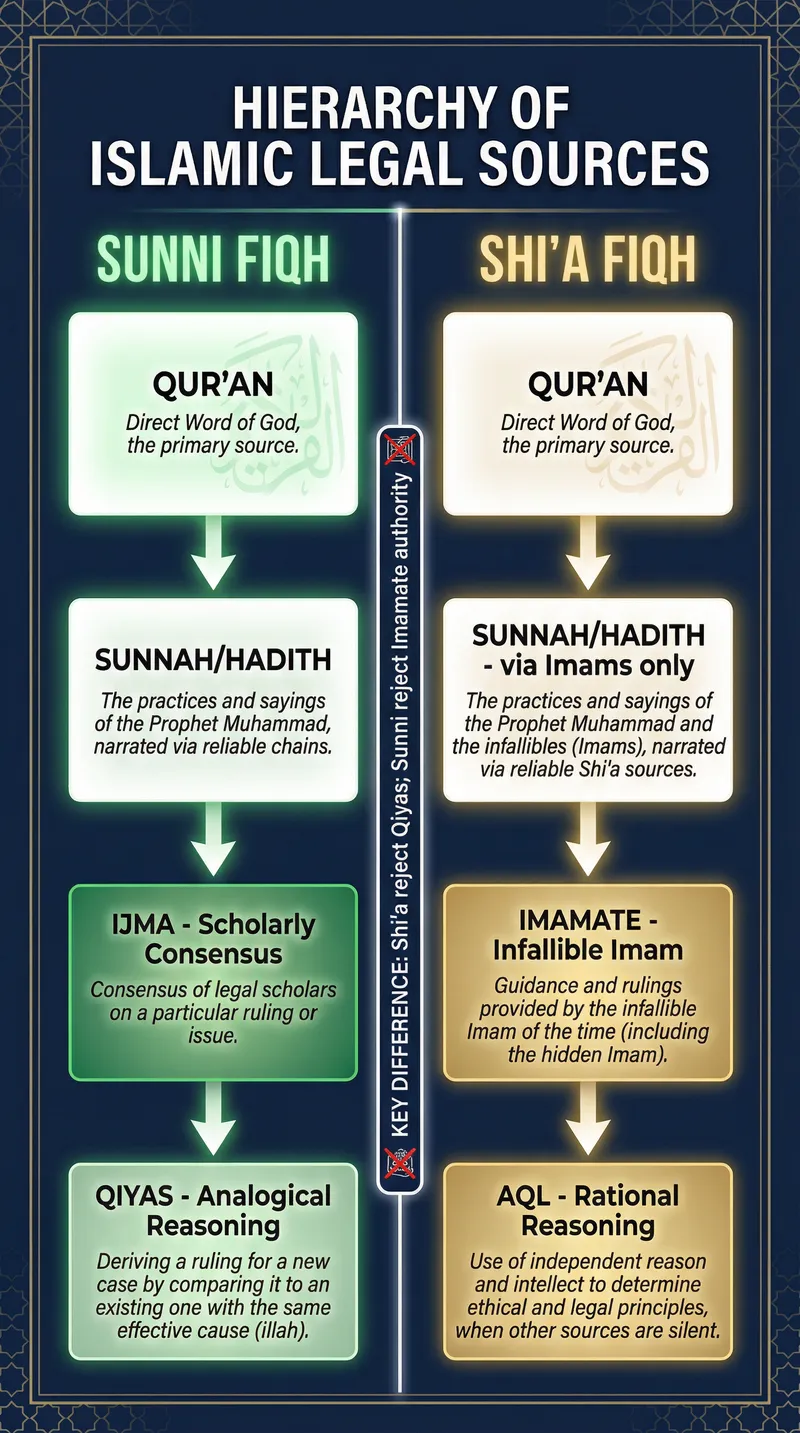
Interactive Diagrams
1 interactive diagram to visualise key concepts
Conceptual Flow Outline
Hierarchy of Islamic Sources of Authority: Sunni and Shi'a paths from the Qur'an
Your focus
- Explain the nature and authority of the Qur'an in Muslim belief.
- Describe Muslim beliefs about the revelation and compilation of the Qur'an.
- Explain the importance of the Arabic text and why trustworthy interpretation of the Qur'an matters.
Show all 9 objectives
- Explain the meaning of Khatam an-Nabiyyin and its significance for Muslims today.
- Describe how hadiths report the sayings and actions of Muhammad.
- Compare different views about the nature and value of hadiths as sources of knowledge.
- Explain the basis of the authority of the Imams in Shi'a Islam.
- Describe how the Imams' authority guides Shi'a understanding of the Qur'an and Sunnah.
- Contrast Shi'a and Sunni views on religious authority after the Prophet.
2D Islam - Section A: Sources of wisdom and authority exam tips
Marking Points
- Identifies the Qur'an as the revealed word of God and explains that this grounds its authority for Muslims.
- Describes Muslim beliefs about the revelation of the Qur'an and about its compilation into the text used today.
- Explains why the Arabic text is important and how that importance shows in worship and everyday life.
- Explains that a translation is an interpretation rather than the Qur'an itself, so trustworthy interpretation matters.
- Explains that Khatam an-Nabiyyin means Muhammad is the final prophet, so no prophet comes after him.
- States that Muslims today treat Muhammad's message as complete and his example as a guide for daily life.
- Distinguishes the authority of the Qur'an from the authority of hadiths as reports of Muhammad's sayings and actions.
- Outlines a view that sound hadiths are valuable sources of knowledge of the Sunnah and of applying the Qur'an.
- Outlines a view that hadiths were transmitted through human chains of narrators and so require checking for reliability.
- Explains that Shi'a Muslims regard the Imams as divinely appointed leaders after the Prophet.
- States that the Imams are understood to be preserved from error in their guidance.
- Explains that the Imams' authority is religious and interpretive, guiding understanding of the Qur'an and Sunnah.
- Contrasts the Shi'a doctrine of the Imams' authority with the Sunni position, which does not accept divinely appointed Imams.
Examiner Tips
- 💡Read the stem carefully to see which of the four ideas is being tested before judging the options.
- 💡Eliminate options that misdescribe the status of a translation or merge revelation with compilation.
- 💡Check that your chosen option matches the exact wording of the idea in the stem, not just a related idea.
- 💡Read the question stem carefully to see whether it asks about Muhammad's status, about hadiths, or about both.
- 💡Use the exact term Khatam an-Nabiyyin and give its meaning rather than only naming it.
- 💡When comparing views on hadiths, name the criterion of reliability rather than simply saying some accept and some reject them.
- 💡Define what an Imam means in Shi'a Islam before explaining the basis of his authority.
- 💡Link the authority of the Imams to how Shi'a Muslims understand the Qur'an and Sunnah.
- 💡Use a clear contrast with Sunni belief to show understanding of why the doctrine matters.
Common Mistakes
- Treats a translation as identical to the Qur'an; recognise that a translation is a human interpretation of the Arabic text.
- Confuses revelation with compilation; keep the giving of the revelation distinct from the later gathering of the text.
- Assumes the Arabic text matters only for scholars; recognise its role in worship and everyday life for ordinary Muslims.
- Confuses the seal of the Prophets with the idea that Muhammad wrote the Qur'an; keep the focus on final prophethood and the revealed message.
- Treats every hadith as equally reliable; distinguish sound reports from weak or disputed ones.
- Equates hadiths with the Qur'an in authority; explain that hadiths are reports about Muhammad and are assessed differently.
- Treats the Imams as prophets; explain that they are authoritative guides and not recipients of new revelation.
- Describes the Imams only as political rulers; include their religious and interpretive authority.
- Assumes all Muslims accept the Imams' authority in the same way; note the distinctively Shi'a doctrine.