AQA · A-Level · Business
Course version: 7132 · Version from Sept 2023
Internal and external influences on corporate objectives and decisions (to…
Full specification wording
Mission, corporate objectives, functional objectives and strategy: Internal and external influences on corporate objectives and decisions (to include: Influences on corporate objectives should include the pressures for short termism, business ownership, the external and internal environment.)
Corporate objectives are the medium term, measurable goals for the whole business, growth, market share, profit, cash flow, survival, diversification or cost efficiency, and they move when…
- Point 2 of 7
- 4 key terms
Study notes
From the teaching notes for this specification point.
The idea
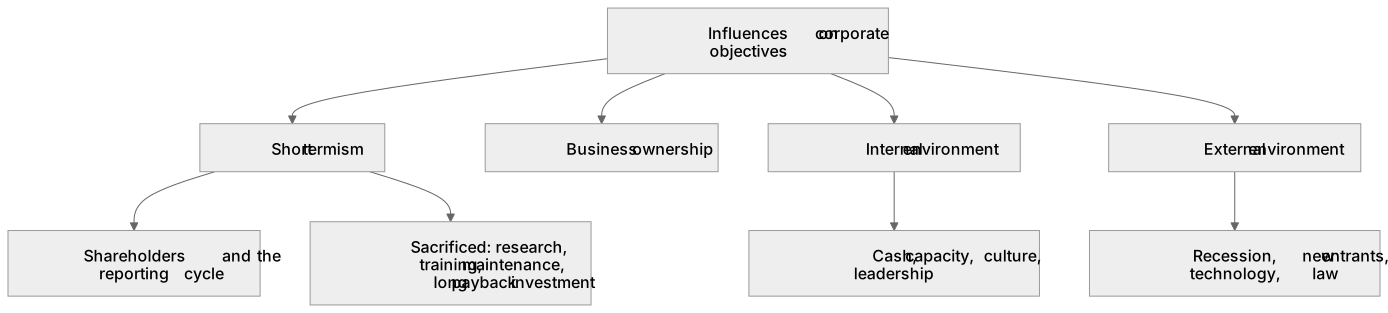
Corporate objectives are the medium term, measurable goals for the whole business, growth, market share, profit, cash flow, survival, diversification or cost efficiency, and they move when something pushes them. Short termism is the pressure markers reward most: reporting to the City every few months and paying bonuses on this year's share price makes managers cut research, training and maintenance that would only repay years later. Ownership sets what is even possible, since a family firm can chase independence while a listed company facing a takeover has to lift its share price. The internal environment, cash, capacity, culture and leadership, decides what the firm can attempt; the external environment, recession, new entrants, technology and law, decides what it must attempt.
What earns the marks
- Stating the objective in a form that can be measured and dated, such as lifting revenue by a fifth within three years, because an aim with no number cannot be judged against the decision that followed.
- Explaining short termism as a mechanism rather than a label: who applies the pressure, shareholders and the reporting cycle, and what gets sacrificed, research, training, maintenance and long payback investment.
- Tying ownership to the objective, so a private limited company, a plc, a charity and a family business are shown wanting different things from the same market.
- Using the internal evidence in the case, a cash shortage, spare capacity or a new leader, alongside the external evidence, and then saying which one actually forced the change.
- Judging durability, since an objective changed by a temporary shock is likely to be reversed while one changed by a structural shift in the market has to stay.
Common mistakes and how to put them right
Defining short termism and stopping, so the answer never names who applies the pressure or what spending is given up to satisfy it.
Answering with functional objectives, a sales target or a recruitment plan, when the question is about goals for the whole business.
Claiming external influences always dominate, when a cash rich business can ignore a downturn that forces a heavily borrowed rival to change course.
Treating a mission statement as a corporate objective because it appears in the same appendix.
Exam tips
- This is prime territory for the longest essay on the paper, where two influences argued in depth and weighed against each other beat six listed.
- Objectives normally change in the case at a named moment, so find that moment in the stimulus and explain it; that is where the application marks sit.
- If the command is assess or evaluate, finish on which influence mattered most for this business and say what would have to be true for that verdict to change.
Try the lesson
The start of the Mission, corporate objectives, functional objectives and strategy: Internal and external influences on corporate objectives and decisions (to include: Influences on corporate objectives should include the pressures for short termism, business ownership, the external and internal environment.) lesson, made from teaching notes for this specification point.
Have a go first
Which one of the following is an internal influence on a company's corporate objectives?
Listen
Corporate objectives are the medium term, measurable goals for the whole business, growth, market share, profit, cash flow, survival, diversification or cost efficiency, and they move when something pushes them. Short termism is the pressure markers reward most: reporting to the City every few months and paying bonuses on this year's share price makes managers cut research, training and maintenance that would only repay years later. Ownership sets what is even possible, since a family firm can chase independence while a listed company facing a takeover has to lift its share price. The internal environment, cash, capacity, culture and leadership, decides what the firm can attempt; the external environment, recession, new entrants, technology and law, decides what it must attempt. A strong answer earns marks for these points. Stating the objective in a form that can be measured and dated, such as lifting revenue by a fifth within three years, because an aim with no number cannot be judged against the decision that followed. Explaining short termism as a mechanism rather than a label: who applies the pressure, shareholders and the reporting cycle, and what gets sacrificed, research, training, maintenance and long payback investment. Tying ownership to the objective, so a private limited company, a plc, a charity and a family business are shown wanting different things from the same market. Using the internal evidence in the case, a cash shortage, spare capacity or a new leader, alongside the external evidence, and then saying which one actually forced the change. Exam tip: This is prime territory for the longest essay on the paper, where two influences argued in depth and weighed against each other beat six listed.
See it
Key words
Say what each word means before you turn the card.
short termism
Try answering aloud or in your head before turning the card.
ownership
Try answering aloud or in your head before turning the card.
internal environment
Try answering aloud or in your head before turning the card.
external environment
Try answering aloud or in your head before turning the card.
See every definition
- short termism
- The pressure from shareholders and the reporting cycle that makes managers cut research, training and maintenance which would only repay years later.
- ownership
- What sets what is even possible, since a family firm can chase independence while a listed company facing a takeover has to lift its share price.
- internal environment
- Cash, capacity, culture and leadership, which decide what the firm can attempt.
- external environment
- Recession, new entrants, technology and law, which decide what the firm must attempt.
Label the diagram
Some boxes have lost their names. Pick the right name for each number.
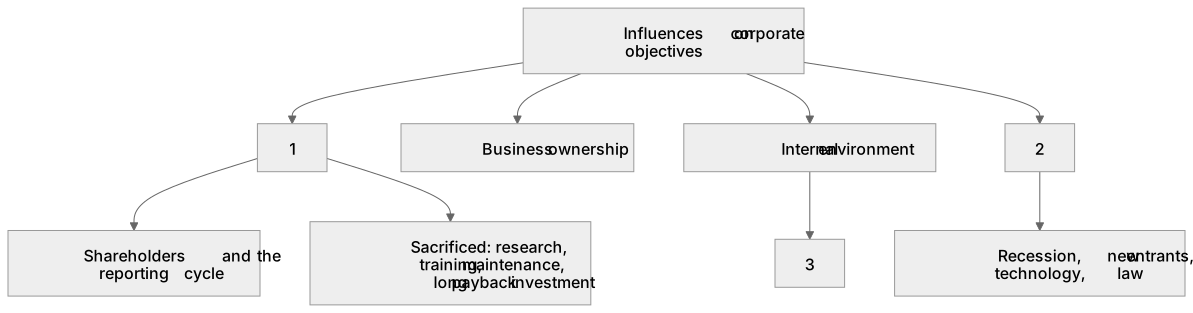
1Box 1
2Box 2
3Box 3
There is more to this lesson
The full lesson goes on to check your understanding and help you earn the marks. Create a free account to carry on, with your progress saved.
A week of Premium from your first lesson · Then the free plan continues · No card, no charge
Test your understanding of Mission, corporate objectives, functional objectives and strategy: Internal and external influences on corporate objectives and decisions (to include: Influences on corporate objectives should include the pressures for short termism, business ownership, the external and internal environment.)
Active recall beats re-reading. Take an instant quiz now to test what you’ve learned and lock it into long-term memory.
A week of Premium from your first lesson · Then the free plan continues · No card, no charge