AQA · A-Level · Business
Course version: 7132 · Version from Sept 2023
Why businesses set objectives
Full specification wording
Understanding the nature and purpose of business: Why businesses set objectives
Targets exist to turn intent into something that can be delegated, measured and reviewed.
- Point 3 of 4
- 4 key terms
Study notes
From the teaching notes for this specification point.
The idea
Targets exist to turn intent into something that can be delegated, measured and reviewed. They give a direction everyone can pull in, so the marketing plan and the capacity plan are not solving different problems. They allow managers to be held to account, because actual performance can be set against what was promised. They support motivation, since Drucker's management by objectives assumes people work harder towards a figure they helped to set. They also signal credibility to a bank deciding whether to lend. The trap is that a target changes behaviour in ways nobody intended, so a volume target can be met by discounting until the margin vanishes, and a rigid annual figure set before a recession or a cost spike drives decisions that no longer make sense. The useful ones are specific, measurable and reviewed.
What earns the marks
- Giving several distinct purposes: direction and coordination, control and review, motivation, and communication to outside parties such as lenders and investors.
- Applying the SMART test, in particular naming the measure and the deadline that make a target reviewable.
- Explaining coordination concretely, for example an expansion target telling operations to plan capacity while marketing plans promotion.
- Linking targets to motivation through participation, since a figure imposed from above is less likely to be owned by the staff who have to hit it.
- Recognising dysfunctional effects, where hitting the measured figure damages something unmeasured such as quality, service or margin.
- Judging in context, noting that a target fixed for a long period loses value when the external environment moves quickly.
Common mistakes and how to put them right
Answering by listing types of target instead of explaining why any are set at all, which is what the question asks.
Saying targets motivate staff without a mechanism, when the credit is for explaining participation, recognition or a link to reward.
Reciting SMART as a checklist rather than using it to criticise the target printed in the case study.
Ignoring the cost, in management time to set, monitor and revise, and in the systems needed to measure anything at all.
Exam tips
- Expect an explain question early in a data response, where two developed reasons score better than five listed ones.
- If the case study prints a target, test it against SMART and say what is missing, which is easy analysis with clear application.
- Keep a sceptical line ready for evaluation: a target is only useful if the firm can measure it and is willing to act on what the measurement says.
Try the lesson
The start of the Understanding the nature and purpose of business: Why businesses set objectives lesson, made from teaching notes for this specification point.
Have a go first
Why do businesses generally set objectives?
Listen
Targets exist to turn intent into something that can be delegated, measured and reviewed. They give a direction everyone can pull in, so the marketing plan and the capacity plan are not solving different problems. They allow managers to be held to account, because actual performance can be set against what was promised. They support motivation, since Drucker's management by objectives assumes people work harder towards a figure they helped to set. They also signal credibility to a bank deciding whether to lend. The trap is that a target changes behaviour in ways nobody intended, so a volume target can be met by discounting until the margin vanishes, and a rigid annual figure set before a recession or a cost spike drives decisions that no longer make sense. The useful ones are specific, measurable and reviewed. A strong answer earns marks for these points. Giving several distinct purposes: direction and coordination, control and review, motivation, and communication to outside parties such as lenders and investors. Applying the SMART test, in particular naming the measure and the deadline that make a target reviewable. Explaining coordination concretely, for example an expansion target telling operations to plan capacity while marketing plans promotion. Linking targets to motivation through participation, since a figure imposed from above is less likely to be owned by the staff who have to hit it. Exam tip: Expect an explain question early in a data response, where two developed reasons score better than five listed ones.
See it

Key words
Say what each word means before you turn the card.
Direction and coordination
Try answering aloud or in your head before turning the card.
Control and performance review
Try answering aloud or in your head before turning the card.
Motivation and participation
Try answering aloud or in your head before turning the card.
Unintended effects of targets
Try answering aloud or in your head before turning the card.
See every definition
- Direction and coordination
- Targets give a direction everyone can pull in, so the marketing plan and the capacity plan are not solving different problems.
- Control and performance review
- Managers can be held to account because actual performance can be set against what was promised.
- Motivation and participation
- People work harder towards a figure they helped to set, as assumed by Drucker's management by objectives.
- Unintended effects of targets
- A target changes behaviour in ways nobody intended, so a volume target can be met by discounting until the margin vanishes.
Label the diagram
Some boxes have lost their names. Pick the right name for each number.
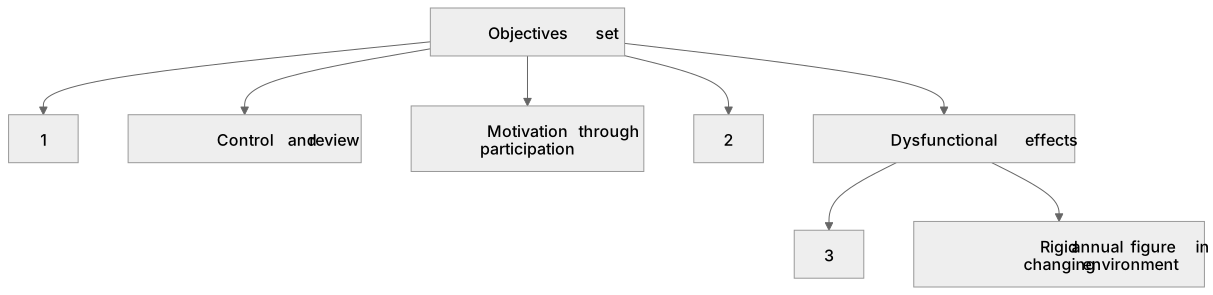
1Box 1
2Box 2
3Box 3
There is more to this lesson
The full lesson goes on to check your understanding and help you earn the marks. Create a free account to carry on, with your progress saved.
A week of Premium from your first lesson · Then the free plan continues · No card, no charge
Test your understanding of Understanding the nature and purpose of business: Why businesses set objectives
Active recall beats re-reading. Take an instant quiz now to test what you’ve learned and lock it into long-term memory.
A week of Premium from your first lesson · Then the free plan continues · No card, no charge