AQA · GCSE · Business
Course version: 8132 · Version from Sept 2017
Ethical and environmental considerations
Master the delicate balance between ethical responsibility, environmental sustainability, and profit maximization. This study guide breaks down exactly how examiners want you to analyse the costs and benefits of doing the 'right thing' in business.
- Point 12 of 13
- 5 min read
- 3 worked examples
- 5 practice questions
- 4 key terms
Study Notes
Overview
In modern business, making a profit is no longer the only objective. Businesses face increasing pressure from stakeholders to act ethically and minimise their environmental impact. However, doing the 'right thing' often comes with increased costs. This topic explores the fundamental tension between ethics, sustainability, and profit. Examiners consistently test your ability to evaluate this trade-off. They don't just want you to describe environmental problems; they want you to analyse how responding to these problems impacts a business's bottom line and long-term success.
Ethical Behaviour in Business
Definition: Acting in ways that stakeholders consider to be fair and honest.
The Ethics-Profit Trade-Off
 Open full-size image (opens in a new tab)
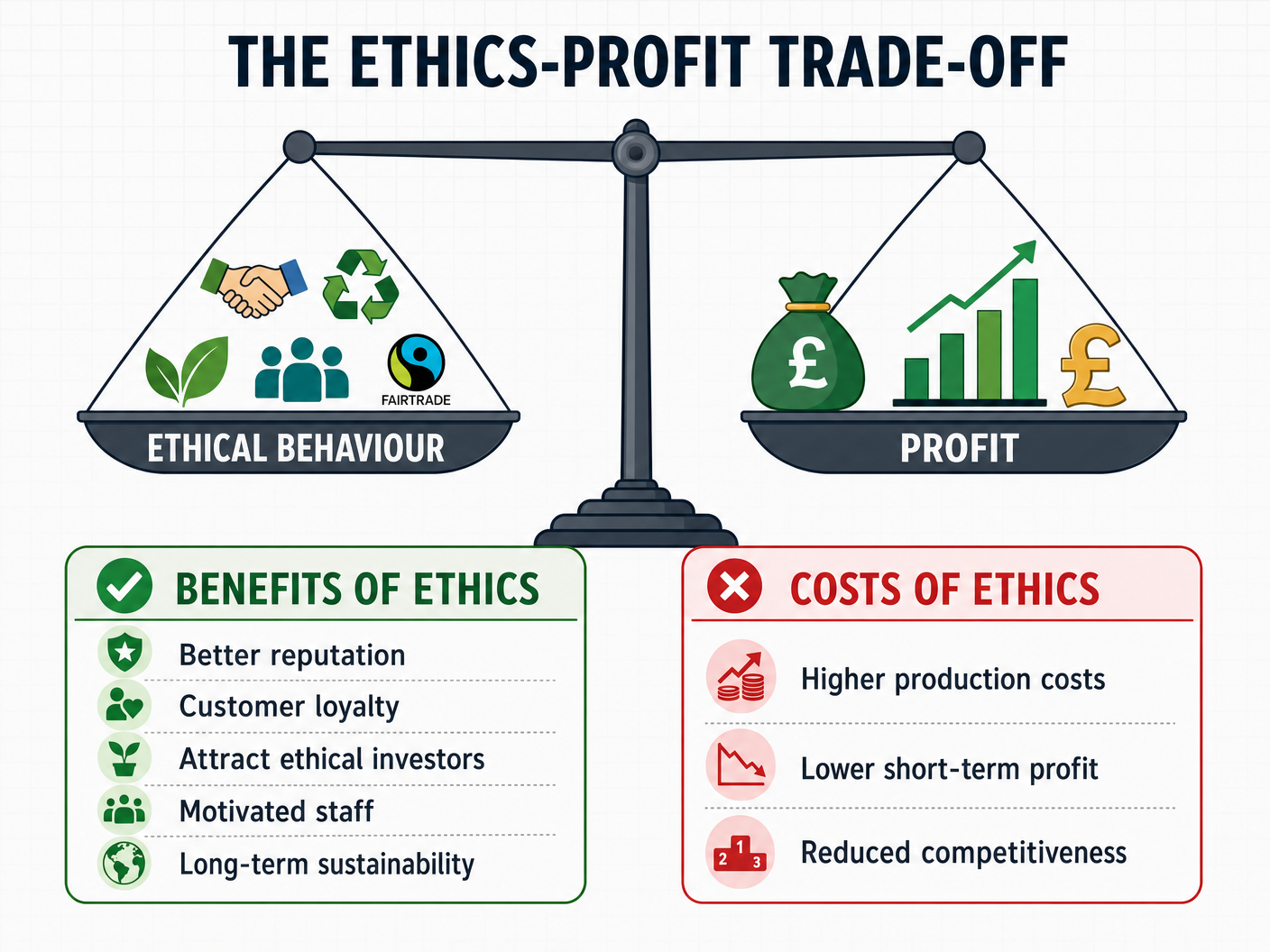
Behaving ethically involves a constant trade-off with profit. While ethical decisions often reduce short-term profit due to higher costs, they can lead to long-term financial benefits.
Costs of Ethical Behaviour:
- Higher production costs: Sourcing fair trade materials or paying above minimum wage increases expenses.
- Lower short-term profit: Increased costs reduce the profit margin on each item sold.
- Reduced competitiveness: If competitors do not act ethically, they may be able to offer lower prices.
Benefits of Ethical Behaviour:
- Better reputation: Enhances brand image and attracts positive PR.
- Customer loyalty: Consumers are increasingly willing to pay a premium for ethical products.
- Attract ethical investors: Many investors actively seek out socially responsible companies.
- Motivated staff: Employees often prefer working for companies that align with their personal values, reducing staff turnover.
Ethical Responsibilities to Stakeholders
 Open full-size image (opens in a new tab)
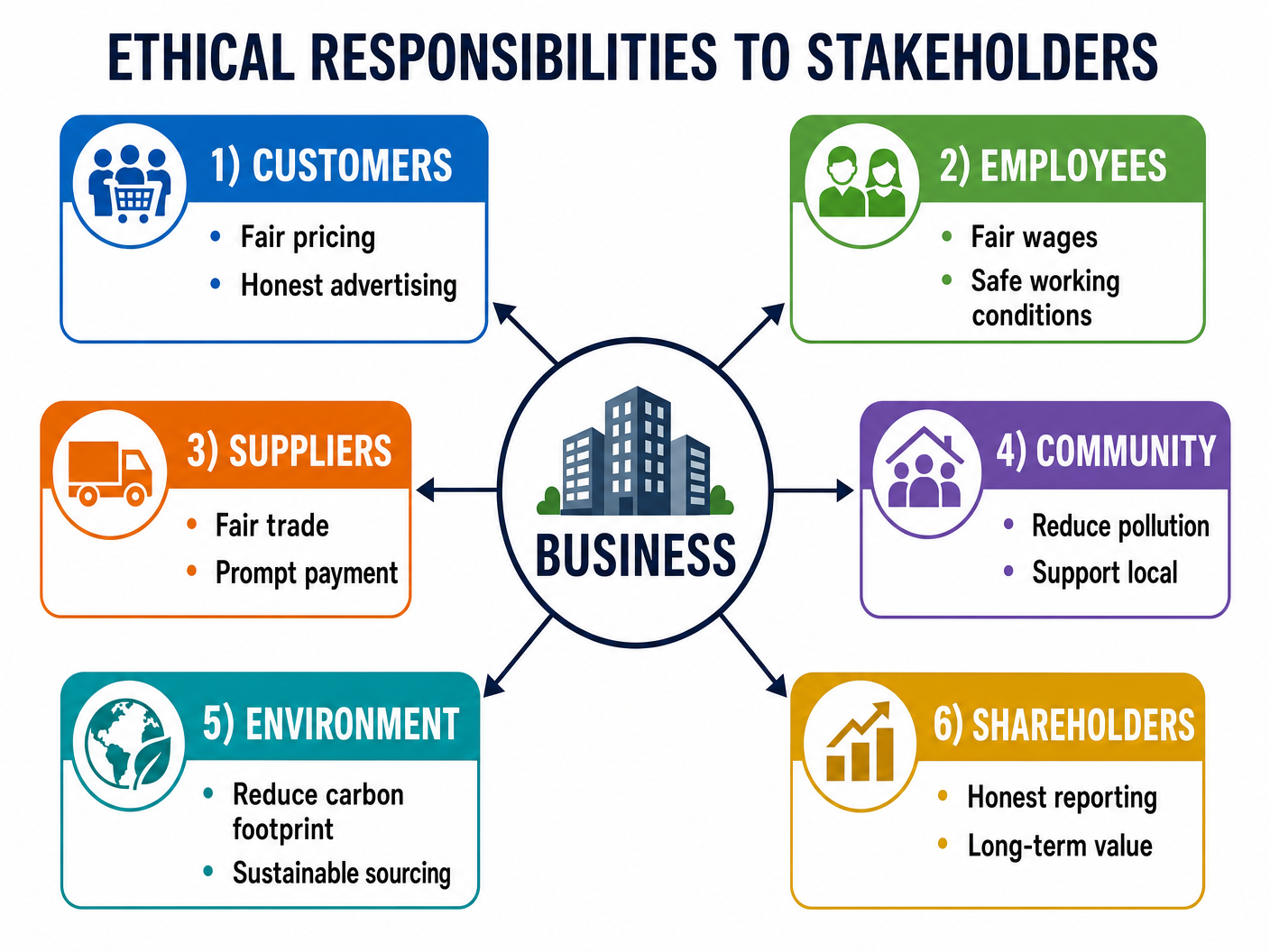
Businesses must consider various stakeholder groups when making ethical decisions:
- Customers: Honest advertising, fair pricing, and safe products.
- Employees: Fair wages, safe working conditions, and equal opportunities.
- Suppliers: Prompt payment and fair contract terms.
- Local Community: Minimising disruption, providing local employment, and supporting community initiatives.
Environmental Impacts of Business Activity
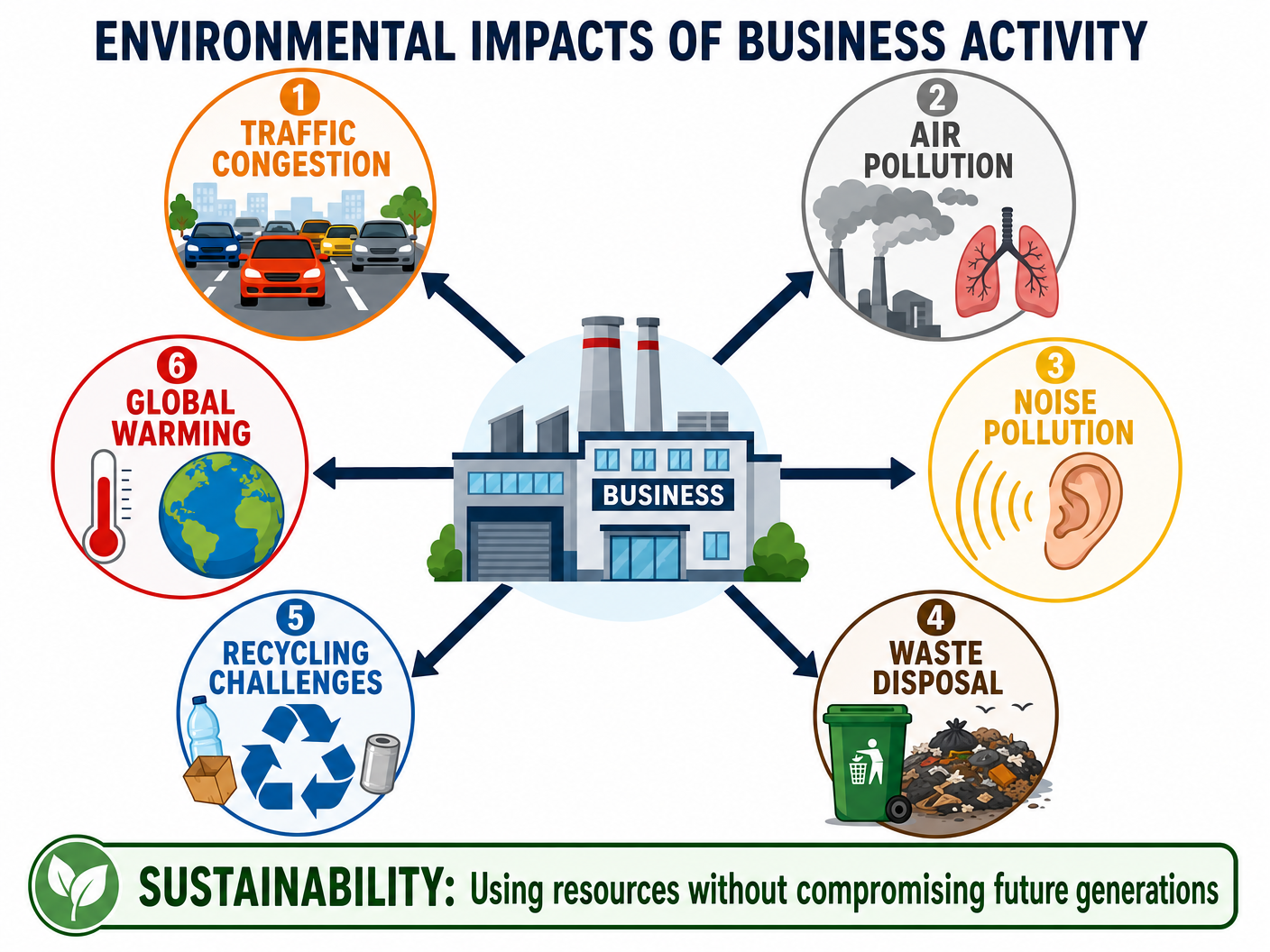
Business operations inevitably affect the natural environment. Candidates must be able to identify specific impacts and explain how businesses can mitigate them.
 Open full-size image (opens in a new tab)
Key Environmental Issues
- Traffic Congestion: Delivery vehicles and employee commutes increase traffic, causing delays and frustration for local communities.
- Air and Noise Pollution: Manufacturing processes and transport emit harmful gases (e.g., CO2) and generate noise that disturbs residents.
- Waste Disposal: Businesses generate significant waste, much of which ends up in landfill, creating environmental hazards.
- Recycling: There is increasing pressure to use recyclable materials and implement effective recycling processes within the business.
- Global Warming: The emission of greenhouse gases contributes to long-term climate change.
- Use of Scarce Resources: Over-reliance on non-renewable resources (like fossil fuels) depletes global reserves.
Sustainability
Definition: Meeting the needs of the present without compromising the ability of future generations to meet their own needs.
The Sustainability-Profit Trade-Off
Similar to ethics, sustainability involves a trade-off. Transitioning to sustainable practices (e.g., installing solar panels, using biodegradable packaging) requires significant capital investment and often increases ongoing operational costs.
However, both businesses and consumers are increasingly accepting greater environmental responsibility. A business that ignores sustainability risks damaging its reputation, losing customers to 'greener' competitors, and facing potential government fines or regulations in the future.
Listen to our revision podcast for a deep dive into these concepts and how to apply them in the exam:
Try the lesson
The start of the Ethical and environmental considerations lesson, made from teaching notes for this specification point.
Have a go first
Which of the following best describes global warming?
Listen
Global warming is the long-term increase in Earth's average temperature, largely caused by greenhouse gas emissions such as carbon dioxide (CO₂) and methane (CH₄) from burning fossil fuels, deforestation and agriculture. For businesses, it creates both pressures and opportunities. Pressures include government regulations, carbon taxes, higher energy costs and changing consumer preferences for low-carbon products. Opportunities include developing sustainable products, improving energy efficiency and building a green reputation. For example, a manufacturer may invest in solar panels to reduce CO₂ emissions; this lowers energy bills and may attract environmentally conscious customers, but requires upfront capital. A strong answer earns marks for these points. Defines global warming as the long-term rise in global temperatures caused by increased greenhouse gas emissions. Identifies human activities that contribute to global warming, such as burning fossil fuels, deforestation and industrial processes. Explains how global warming affects businesses through regulation, carbon taxes, changing consumer demand and supply chain disruption. Analyses business responses to global warming, such as reducing emissions, using renewable energy or developing sustainable products. A common slip: Confusing global warming with ozone depletion. Instead, global warming is caused by greenhouse gases trapping heat, while ozone depletion is caused by chemicals such as CFCs destroying ozone. Exam tip: Link global warming to a specific business context, such as a factory facing a carbon tax or a retailer responding to demand for eco-friendly goods.
See it

Key words
Say what each word means before you turn the card.
Global warming
Try answering aloud or in your head before turning the card.
Greenhouse gases
Try answering aloud or in your head before turning the card.
Business response
Try answering aloud or in your head before turning the card.
Regulation
Try answering aloud or in your head before turning the card.
See every definition
- Global warming
- The long-term increase in Earth's average temperature, largely caused by greenhouse gas emissions.
- Greenhouse gases
- Gases such as carbon dioxide (CO₂) and methane (CH₄) released from burning fossil fuels, deforestation and agriculture.
- Business response
- How firms may respond to global warming, such as reducing emissions, using renewable energy or developing sustainable products.
- Regulation
- Government rules that create pressures on businesses in relation to global warming.
Label the diagram
Some boxes have lost their names. Pick the right name for each number.

1Box 1
2Box 2
3Box 3
There is more to this lesson
The full lesson goes on to check your understanding and help you earn the marks. Create a free account to carry on, with your progress saved.
A week of Premium from your first lesson · Then the free plan continues · No card, no charge
Worked Examples
3 worked examples — open one to explore the question and available guidance.
Practice Questions
Try the question, then reveal an answer plan or example response
State two environmental impacts of business activity. (2 marks)
Hint: Think about what comes out of factory chimneys or delivery lorries.
Explain how acting ethically can affect a business's ability to recruit staff. (3 marks)
Hint: Think about why you would want to work for a 'good' company.
A fast-fashion retailer is facing criticism for the amount of waste its clothing creates in landfill. It is considering introducing a recycling scheme where customers can return old clothes for a discount. Analyse the impact of introducing this scheme on the retailer. (6 marks)
Hint: Provide one positive impact (reputation/sales) and one negative impact (costs/logistics).
Evaluate whether the government should introduce stricter environmental regulations on manufacturing businesses. (9 marks)
Hint: Consider the impact on the environment/society versus the impact on business competitiveness and survival.
A supermarket chain wants to improve its ethical image. It is deciding between two options: Option 1: Guaranteeing all suppliers are paid a fair trade price. Option 2: Donating 5% of its annual profits to local community charities. Recommend which option the supermarket should choose. Justify your answer. (12 marks)
Hint: Analyse the pros and cons of both options, then make a clear choice and explain *why* it is better than the alternative.
Ready to test yourself interactively?
Active recall beats reading alone. Answer questions on Ethical and environmental considerations with instant AI scoring and mark scheme guidance.
A week of Premium from your first lesson · Then the free plan continues · No card, no charge
Exam technique
How to turn what you know into marks
How to approach the question
Always look for the specific business context in the question. Underline the type of business and any data provided (e.g., '15% cost increase').
How to structure your answer
- Analyse questions
- Provide a balanced view (one positive, one negative). Trace the chain of reasoning all the way to the impact on profit, revenue, or market share.
- Explain questions
- BLT: Because, Leading to, Therefore. State your point, explain *because*..., which *leads to*..., *therefore* the impact on the business is...
- Evaluate questions
- Point for -> Point against -> Judgement. Your judgement MUST answer the specific question asked and introduce a new deciding factor (e.g., short-term vs long-term).
Timing
Approximately 1 minute per mark. Spend 2-3 minutes planning 9 or 12 mark questions.
Common pitfalls
- Describing an environmental problem (like global warming) without explaining how it affects the *business*.
- Stating that ethical behaviour 'loses money' without clarifying that this is usually a *short-term* effect due to higher costs.
- Failing to make a clear decision in the conclusion of an evaluation question.
What the command words want
- Analyse
- Examine the causes and effects in detail, usually looking at both sides. (6 marks)
- Explain
- Make a point and develop it with a linked consequence. (3 marks)
- State/Identify
- Give a simple fact or term. No explanation needed. (1 mark)
- Evaluate/Recommend
- Weigh up the arguments and provide a justified conclusion based on the context. (9-12 marks)
Test your understanding of Ethical and environmental considerations
Active recall beats re-reading. Take an instant quiz now to test what you’ve learned and lock it into long-term memory.
A week of Premium from your first lesson · Then the free plan continues · No card, no charge