AQA · GCSE · Business
Course version: 8132 · Version from Sept 2017
The economic climate on businesses
The economic climate dictates the 'weather' in which businesses operate. Understanding how interest rates and employment levels affect consumer spending and business costs is crucial for achieving top marks in your GCSE Business exam.
- Point 7 of 8
- 3 min read
- 3 worked examples
- 5 practice questions
- 2 key terms
Study Notes
Overview
 Open full-size image (opens in a new tab)
The economic climate refers to the overall state of the economy and how it impacts both businesses and consumers. For GCSE Business, examiners expect you to understand two major economic indicators: interest rates and employment levels. This topic is historically significant because economic crashes (like the 2008 financial crisis) or booms fundamentally change how businesses operate. Examiners are not looking for complex macroeconomic theory; instead, they want you to explain the chain of consequence — how a change in the wider economy directly affects a business's costs, its customers' spending habits, and the decisions made across the four functional areas (Operations, Human Resources, Marketing, and Finance).
Interest Rates
What are Interest Rates?
Definition: The cost of borrowing money or the reward for saving it, set by the Bank of England.
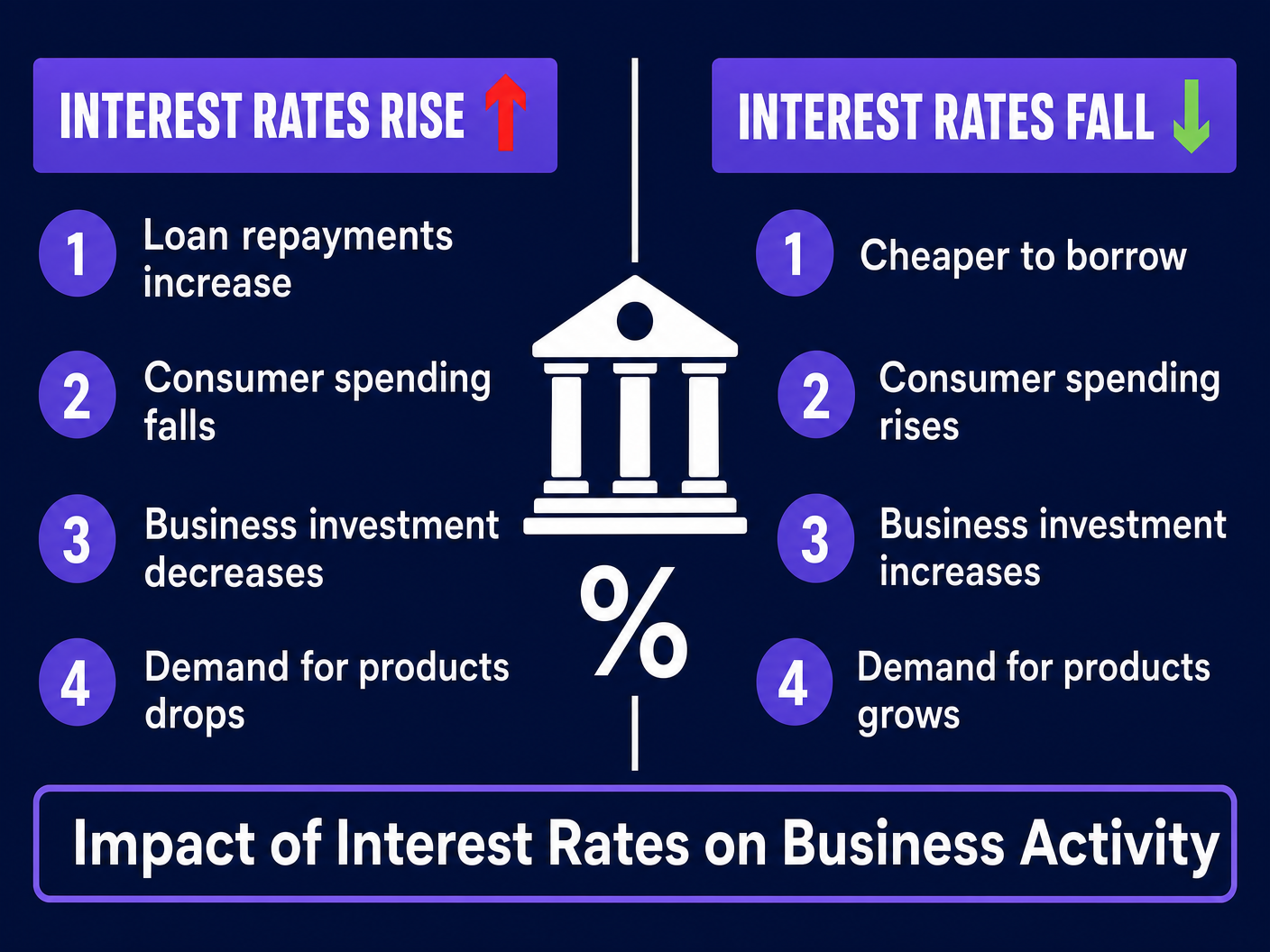
Why it matters: Interest rates affect both a business's direct costs (loan repayments) and its customers' disposable income (mortgage/loan repayments).
Specific Knowledge: The Bank of England base rate influences the rates high street banks charge. Even a 0.5% rise can significantly impact business cash flow.
 Open full-size image (opens in a new tab)
Employment Levels
High Employment vs High Unemployment
Definition: The percentage of the working-age population who have jobs.
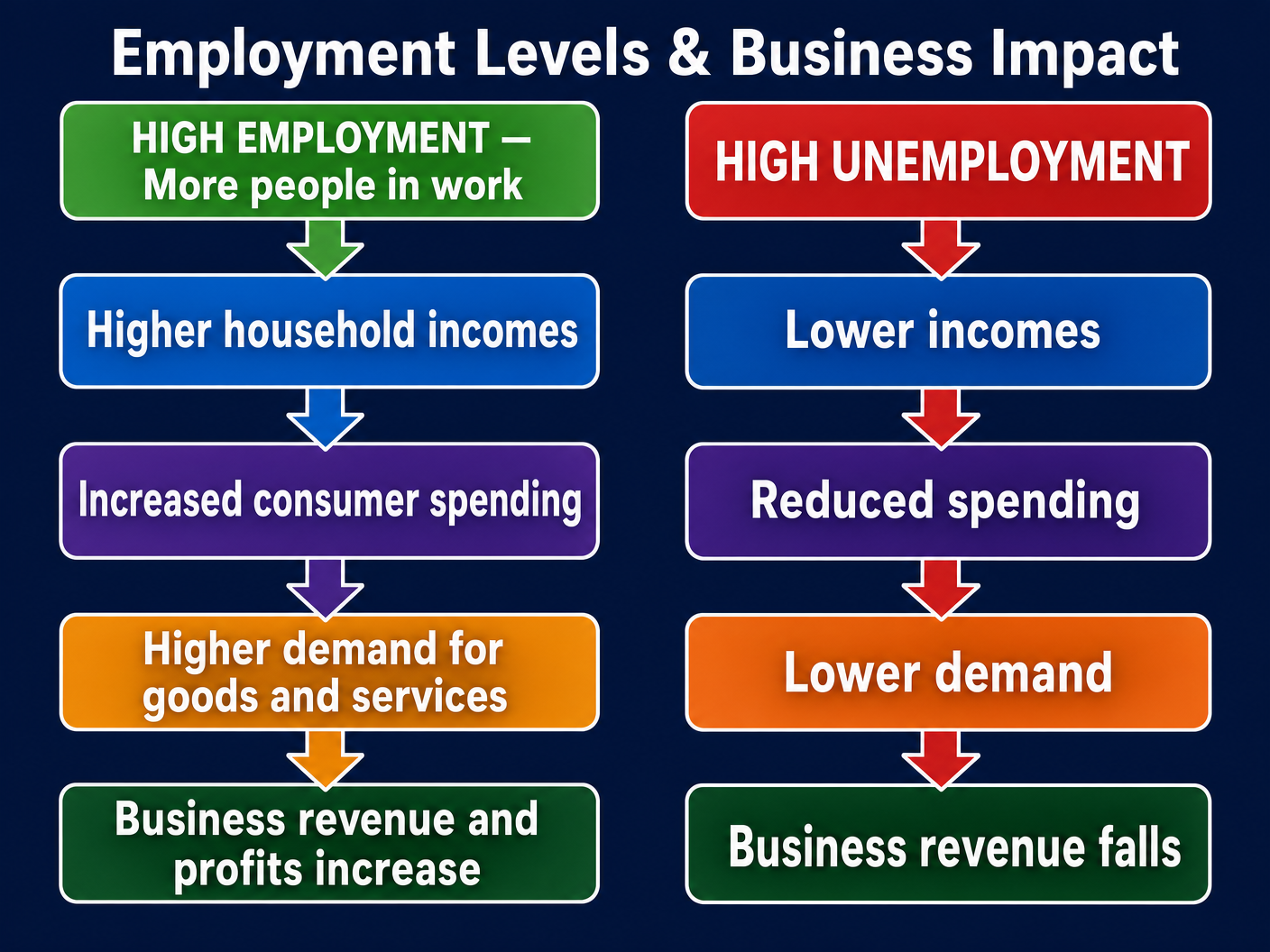
Why it matters: Employment levels dictate how much disposable income exists in the economy, which directly drives consumer spending and demand for products.
Specific Knowledge: High employment leads to increased demand for normal goods (e.g., holidays, branded clothes). High unemployment can actually increase demand for inferior goods (e.g., budget supermarket lines).
 Open full-size image (opens in a new tab)
Impact on Functional Areas
Finance
Must manage cash flow carefully when interest rates rise, as loan repayments increase and revenue may fall due to reduced consumer spending.
Marketing
Must adapt the marketing mix (the 4Ps). In a recession, they may focus on competitive pricing and promotions. In a boom, they may launch premium products.
Human Resources (HR)
In times of high employment, HR struggles to recruit and may need to increase wages to attract staff. In times of high unemployment, recruitment is easier but redundancies may be necessary to cut costs.
Operations
May need to scale back production if demand falls, to avoid stockpiling unsold goods. Investment in new machinery may be delayed if borrowing costs (interest rates) are high.
Try the lesson
The start of the The economic climate on businesses lesson, made from teaching notes for this specification point.
Have a go first
What is meant by consumer spending?
Listen
Consumer spending is the total amount households spend on goods and services. It depends on income, employment, confidence and interest rates: when people feel secure and borrowing is cheap, spending tends to rise, and when incomes fall or confidence drops, spending falls as households save or repay debt. For a business, rising consumer spending usually means higher sales and possible expansion, while falling spending can mean lower revenue, excess stock and cost cutting. Spending also shifts between markets, so a recession may boost budget retailers but harm luxury sellers. Example: a café near a factory sees lunch sales fall when workers are made redundant. A strong answer earns marks for these points. Defines consumer spending as household expenditure on goods and services, linking it to income and confidence. Explains factors that change spending, including employment, wages, interest rates and consumer confidence. Shows the effect on businesses: higher spending can raise sales and encourage expansion, while lower spending can reduce revenue and force cost cuts. Analyses that spending patterns differ between markets, so some businesses gain while others lose during the same economic change. A common slip: Confusing consumer spending with business investment. Instead, consumer spending is household expenditure, while investment is spending by firms on capital. Exam tip: Link spending changes to a specific effect on the case business, such as sales revenue, stock levels or staffing.
Key words
Say what each word means before you turn the card.
Consumer spending
Try answering aloud or in your head before turning the card.
Consumer confidence
Try answering aloud or in your head before turning the card.
See every definition
- Consumer spending
- The total amount households spend on goods and services, which depends on income, employment, confidence and interest rates.
- Consumer confidence
- How secure people feel, which affects spending: when confidence drops, spending falls as households save or repay debt.
There is more to this lesson
The full lesson goes on to check your understanding and help you earn the marks. Create a free account to carry on, with your progress saved.
A week of Premium from your first lesson · Then the free plan continues · No card, no charge
Interactive Diagrams
1 interactive diagram to visualise key concepts
Conceptual Flow Outline
The chain of impact when interest rates rise
Worked Examples
3 worked examples — open one to explore the question and available guidance.
Practice Questions
Try the question, then reveal an answer plan or example response
Explain how a fall in unemployment could affect the Human Resources department of a manufacturing business. (4 marks)
Hint: Think about the supply of workers available when unemployment is low.
Analyse the impact of a significant increase in interest rates on a house building company. (6 marks)
Hint: Think about both the cost to the builder AND the ability of customers to buy houses.
State two possible impacts on a business if consumer incomes fall. (2 marks)
Hint: Just state the impacts, do not explain them.
Explain one reason why a business might decide to expand during an economic boom. (3 marks)
Hint: What happens to consumer confidence and spending during a boom?
Evaluate the impact of a recession on a budget supermarket chain. (9 marks)
Hint: Remember the difference between normal and inferior goods.
Ready to test yourself interactively?
Active recall beats reading alone. Answer questions on The economic climate on businesses with instant AI scoring and mark scheme guidance.
A week of Premium from your first lesson · Then the free plan continues · No card, no charge
Exam technique
How to turn what you know into marks
How to approach the question
Always identify the 'Command Word', the 'Economic Factor', and the 'Business Context' in the question.
How to structure your answer
- Essay questions
- Introduction → Paragraph 1 (One side) → Paragraph 2 (Other side) → Conclusion with a clear judgement.
- Source questions
- Apply your answer directly to the case study business provided. Do not use generic examples.
- Explain questions
- BLT: Because (state reason), Leading to (the consequence), Therefore (the impact on the business).
Timing
Approximately 1 minute per mark, plus planning time for 9 and 12-mark questions.
Common pitfalls
- Explaining macroeconomic theory instead of business impacts.
- Failing to mention 'disposable income' when discussing consumer spending.
- Forgetting that lower interest rates make saving less attractive.
What the command words want
- Analyse
- Show a multi-stage chain of reasoning (e.g., Factor → Consumer behaviour → Business revenue → Business profit).
- Explain
- Make a point and develop it with a linked consequence.
- State/Identify
- Short, direct answer. No explanation needed.
- Evaluate/Discuss
- Look at both sides (pros and cons) and reach a justified conclusion.
Watch or listen (optional)
Test your understanding of The economic climate on businesses
Active recall beats re-reading. Take an instant quiz now to test what you’ve learned and lock it into long-term memory.
A week of Premium from your first lesson · Then the free plan continues · No card, no charge