AQA · GCSE · Business
Course version: 8132 · Version from Sept 2017
The purpose and nature of businesses
This study guide introduces the fundamental purpose of business activity, the role of enterprise, and the dynamic nature of the business environment. It covers the core reasons for starting a business, the basic factors of production, the distinction between goods and services, and the crucial concept of opportunity cost. Mastering this topic is essential as it underpins everything else you will study in GCSE Business.
- Point 7 of 14
- 5 min read
- 3 worked examples
- 5 practice questions
- 4 key terms
Study Notes
Overview
This topic forms the foundation of your GCSE Business studies. It explores the fundamental questions of why businesses exist, what resources they need to operate, and how they fit into the wider economy. Examiners expect candidates to not only define key terms like 'opportunity cost' and 'factors of production', but also to apply them to real-world business scenarios. A strong grasp of the dynamic nature of business—how external changes force businesses to adapt—is crucial for accessing the higher mark bands in longer, analytical questions.
The Purpose of Business
At its core, a business is an organisation that provides goods or services to satisfy customer needs and wants.
- Needs: Essential items required for survival (e.g., food, water, basic clothing, shelter).
- Wants: Desires that are not essential for survival but improve the quality of life (e.g., designer clothes, smartphones, holidays).
Businesses exist to close the gap between limited resources and unlimited human wants. People start businesses for various reasons, including to make a profit, to be their own boss, to fulfil a gap in the market, or to pursue a personal passion.
The Four Factors of Production
To produce goods and services, businesses require resources, known as the factors of production. Examiners frequently test candidates' ability to identify and classify these resources.
- Land: Natural resources provided by the earth (e.g., oil, water, minerals, physical space).
- Labour: The human effort, skills, and knowledge contributed by workers.
- Capital: Man-made resources used to produce other goods and services (e.g., machinery, tools, buildings, vehicles). Note: In this context, capital refers to physical assets, not just money.
- Enterprise: The drive and innovation required to combine the other three factors, take risks, and start a business.
The Role of the Entrepreneur
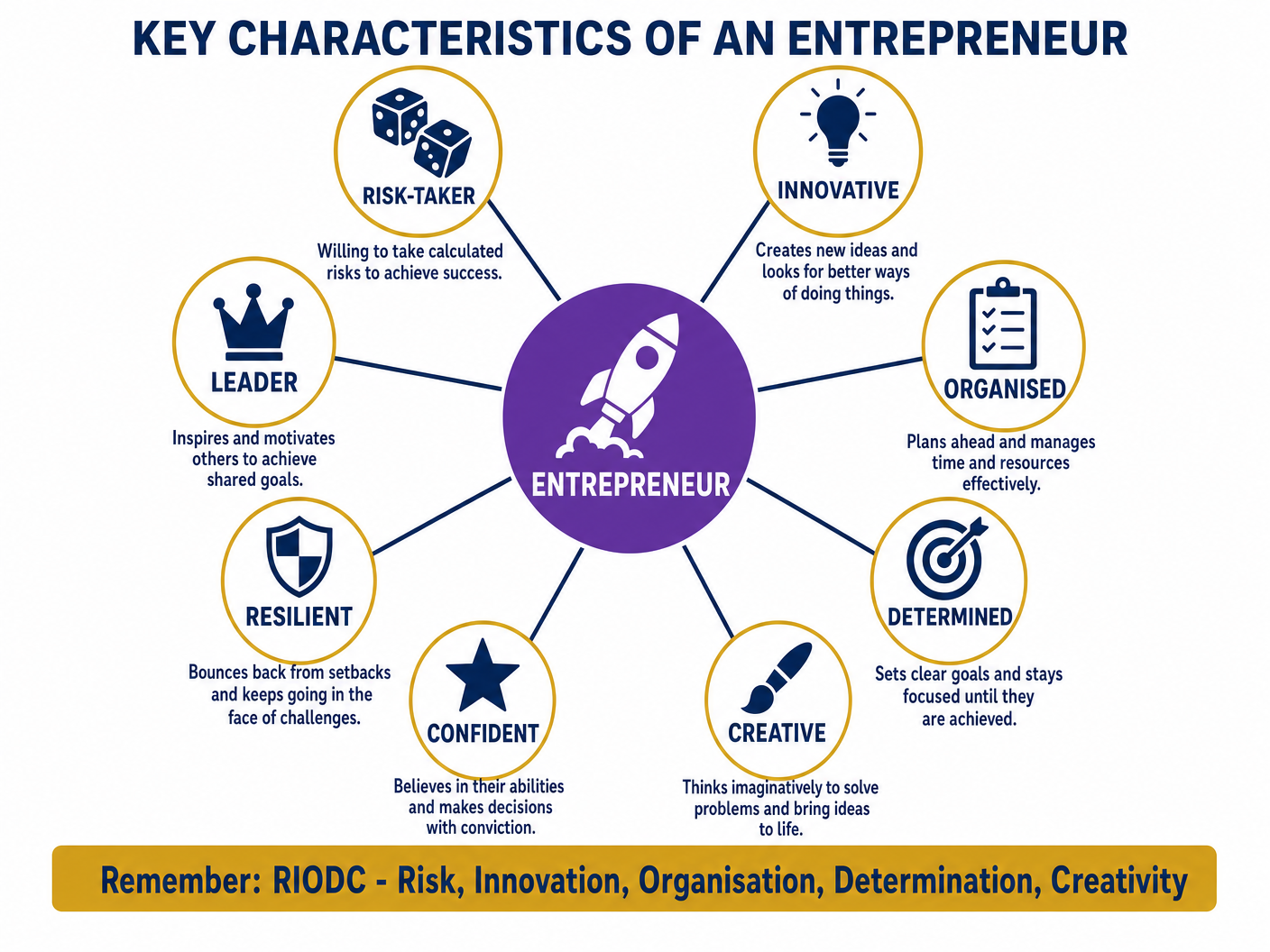
An entrepreneur is an individual who organises the factors of production, takes on financial risk, and aims to make a profit. They are the driving force behind new business ventures.
 Open full-size image (opens in a new tab)
Key characteristics of successful entrepreneurs include:
- Risk-taking: Willingness to invest time and money with no guarantee of success.
- Innovation: Creating new ideas or finding better ways to do things.
- Organisation: Effectively coordinating resources.
- Determination: Persisting through challenges and setbacks.
The Three Sectors of Industry
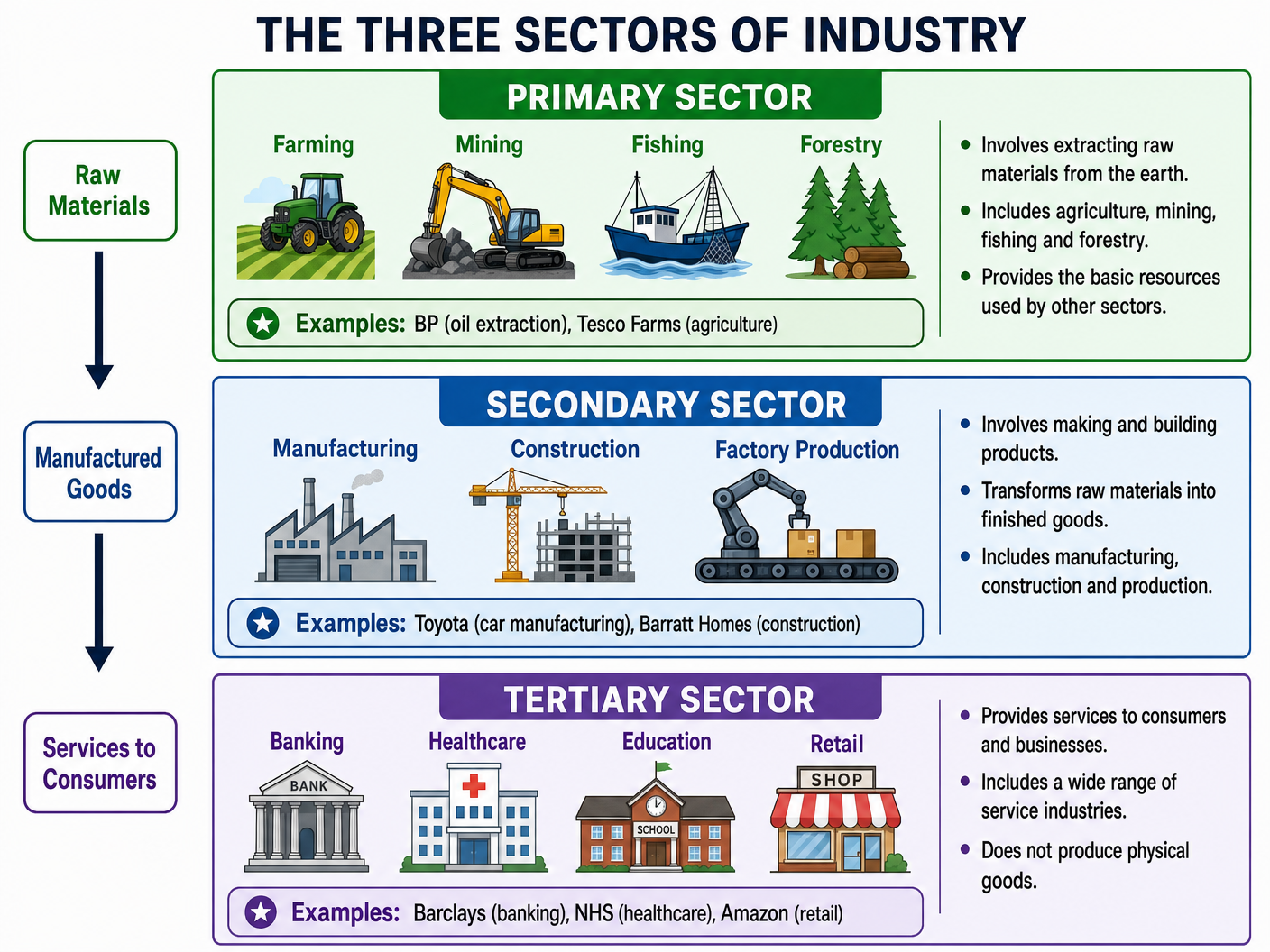
All business activity can be categorised into three main sectors. Understanding the flow from raw materials to finished services is vital.
 Open full-size image (opens in a new tab)
- Primary Sector: Involves extracting or harvesting raw materials from nature (e.g., farming, mining, fishing, forestry).
- Secondary Sector: Involves manufacturing, construction, and processing raw materials into finished goods (e.g., car manufacturing, house building).
- Tertiary Sector: Involves providing services to consumers and other businesses (e.g., banking, retail, healthcare, education).
Opportunity Cost
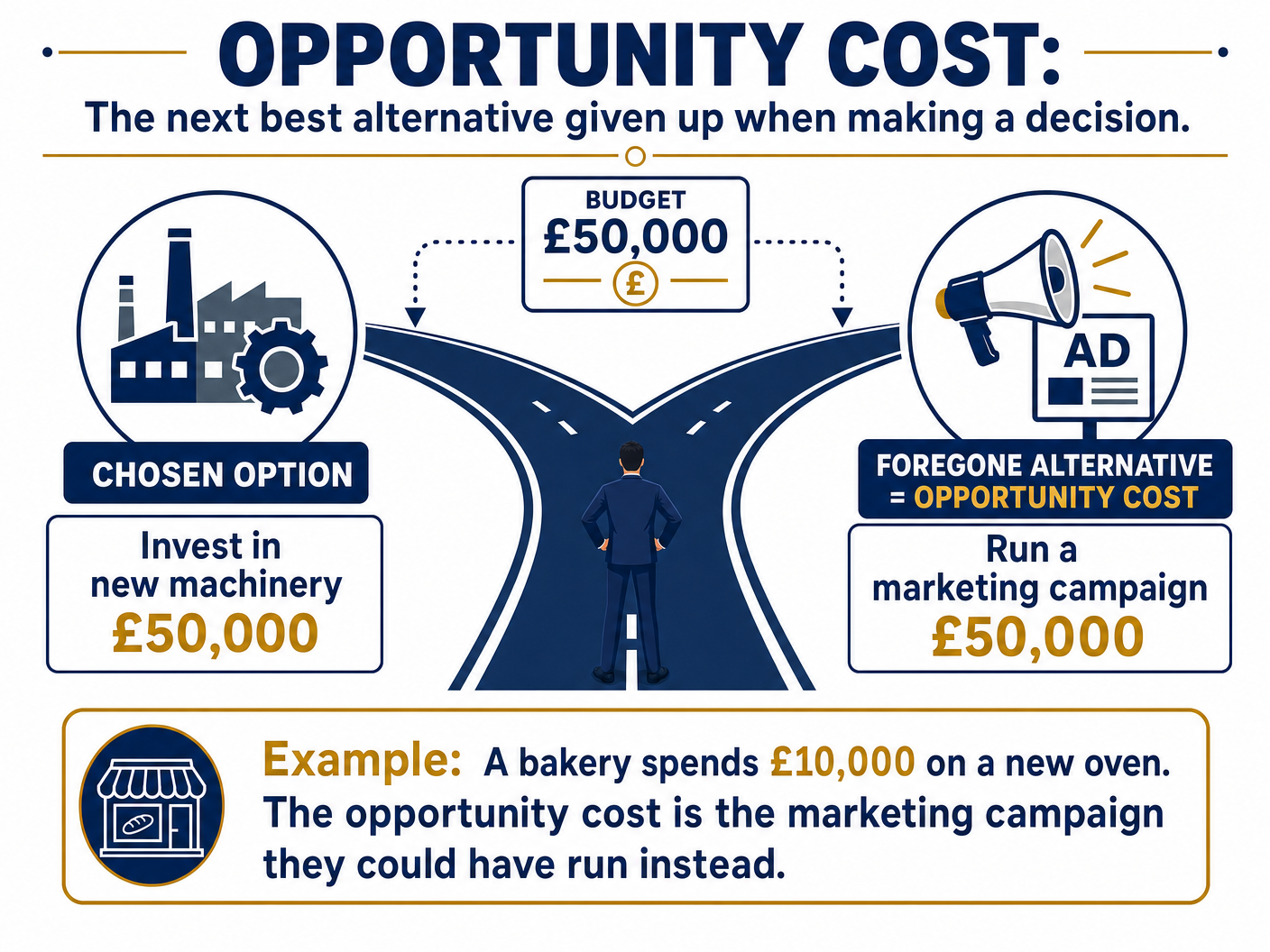
Opportunity cost is a fundamental economic and business concept. It is defined as the next best alternative given up when making a decision.
 Open full-size image (opens in a new tab)
Whenever a business (or an individual) chooses to allocate resources to one option, they must sacrifice the benefits of the alternative option. For example, if a business spends £50,000 on new machinery, the opportunity cost might be the marketing campaign they could have run with that money.
The Dynamic Business Environment
Businesses do not operate in a vacuum; they exist in a dynamic (constantly changing) environment. External factors force businesses to adapt or risk failure. These changes include:
- Technological Change: Advances in technology (e.g., e-commerce, automation) change how businesses produce and sell.
- Economic Change: Fluctuations in the economy (e.g., inflation, recession) affect consumer spending power.
- Legal Change: New laws and regulations (e.g., minimum wage increases, environmental standards) impact business operations.
- Social/Environmental Change: Shifting consumer attitudes (e.g., demand for sustainable products) require businesses to adjust their offerings.
Podcast Summary
Listen to our comprehensive 10-minute podcast covering all the core concepts, common mistakes, and exam tips for this topic.
Try the lesson
The start of the The purpose and nature of businesses lesson, made from teaching notes for this specification point.
Have a go first
Which of the following is a service rather than a good?
Listen
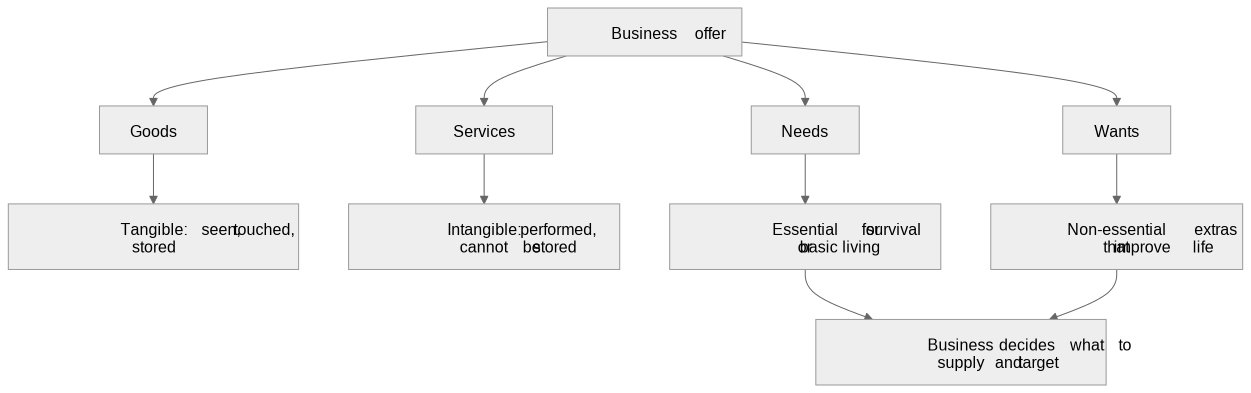
Goods are tangible products you can see, touch and store, such as a smartphone or a loaf of bread; services are intangible activities performed for a customer, such as a haircut or a bus journey, and cannot be stored. Needs are essentials required for survival or basic living, such as food, water, shelter and warmth; wants are desirable extras that improve life but are not essential, such as a games console or a holiday. A single purchase can satisfy both: a sandwich meets the need for food, while choosing a premium brand reflects a want. Businesses must decide whether to supply goods, services or both, and whether to target needs or wants, because this shapes costs, pricing and customer base. A strong answer earns marks for these points. Defines goods as tangible physical products that can be seen, touched, stored and owned, with a relevant example such as a mobile phone or a loaf of bread. Defines services as intangible activities provided by a person or business, such as a haircut or bus journey, and explains that they are consumed as they are performed and cannot be stored. States that needs are essential for survival or basic living, giving examples such as food, water, shelter and warmth. States that wants are non-essential desires that improve comfort or enjoyment, giving examples such as a games console or a holiday. A common slip: Treating every want as a need. Instead, testing whether the item is essential for survival or basic living, and if not, classify it as a want. Exam tip: Use the words tangible and intangible when defining goods and services, then add a short example to secure the definition.
See it
Key words
Say what each word means before you turn the card.
Goods
Try answering aloud or in your head before turning the card.
Services
Try answering aloud or in your head before turning the card.
Needs
Try answering aloud or in your head before turning the card.
Wants
Try answering aloud or in your head before turning the card.
See every definition
- Goods
- Tangible products that can be seen, touched and stored, such as a smartphone or a loaf of bread.
- Services
- Intangible activities performed for a customer, such as a haircut or a bus journey, which cannot be stored.
- Needs
- Essentials required for survival or basic living, such as food, water, shelter and warmth.
- Wants
- Desirable extras that improve life but are not essential, such as a games console or a holiday.
Label the diagram
Some boxes have lost their names. Pick the right name for each number.
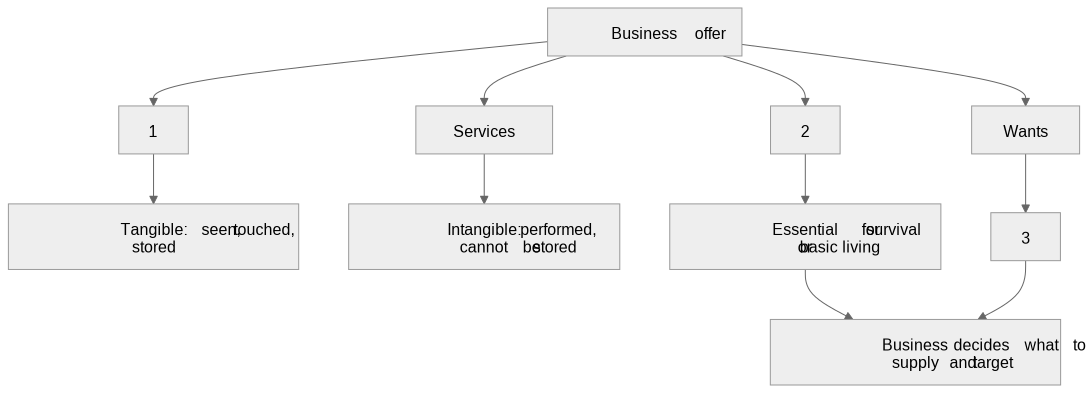
1Box 1
2Box 2
3Box 3
There is more to this lesson
The full lesson goes on to check your understanding and help you earn the marks. Create a free account to carry on, with your progress saved.
A week of Premium from your first lesson · Then the free plan continues · No card, no charge
Worked Examples
3 worked examples — open one to explore the question and available guidance.
Practice Questions
Try the question, then reveal an answer plan or example response
State two factors of production. (2 marks)
Hint: Think of the acronym LLCE.
Explain one reason why a person might decide to start their own business. (3 marks)
Hint: State the reason, then explain the benefit it brings to the individual.
A clothing manufacturer has a budget of £20,000. They can either upgrade their sewing machines or increase the wages of their factory workers. They choose to upgrade the sewing machines. Explain the opportunity cost of this decision. (3 marks)
Hint: Define opportunity cost and explicitly name what they gave up.
Discuss the impact on a high street retailer if the business environment becomes more dynamic due to rapid technological change. (6 marks)
Hint: Look at both the positive opportunities and the negative threats of technological change.
Classify the following businesses into the correct sector of industry: A) A dairy farm, B) A car assembly plant, C) A firm of accountants. (3 marks)
Hint: Remember Nature, Make, Serve.
Ready to test yourself interactively?
Active recall beats reading alone. Answer questions on The purpose and nature of businesses with instant AI scoring and mark scheme guidance.
A week of Premium from your first lesson · Then the free plan continues · No card, no charge
Exam technique
How to turn what you know into marks
How to approach the question
Always look for the command word (State, Explain, Discuss, Evaluate) and the context (the specific business scenario provided).
How to structure your answer
- Discuss questions
- Provide a balanced argument looking at both sides (e.g., advantages and disadvantages) before reaching a conclusion.
- Explain questions
- Use the PEEL structure: Point, Evidence (context), Explanation, Link.
- Evaluate questions
- Similar to discuss, but requires a stronger, justified final judgement based on the evidence presented in your answer.
Timing
Approximately 1 minute per mark.
Common pitfalls
- Confusing 'Capital' (machinery/equipment) with just 'money'.
- Giving vague definitions of opportunity cost without specifying the actual alternative given up in the scenario.
- Failing to link the characteristics of an entrepreneur to the actual success or survival of the business.
What the command words want
- Discuss
- Build a two-sided argument. Look at the impacts from different perspectives.
- Explain
- Make a point and develop it with reasoning ('because...', 'this leads to...'). Use context if provided.
- Evaluate
- Weigh up the arguments and provide a supported final judgement.
- State/Identify
- Provide a brief, clear answer without explanation. (1 mark)
Watch or listen (optional)
Test your understanding of The purpose and nature of businesses
Active recall beats re-reading. Take an instant quiz now to test what you’ve learned and lock it into long-term memory.
A week of Premium from your first lesson · Then the free plan continues · No card, no charge