AQA · GCSE · Business
Course version: 8132 · Version from Sept 2017
The role of procurement
Master the crucial role of procurement in modern business operations. This guide covers stock management strategies (JIT vs JIC), supplier selection factors, and how effective supply chain management drives efficiency and reduces unit costs—essential knowledge for high-mark GCSE Business answers.
- Point 7 of 21
- 4 min read
- 3 worked examples
- 5 practice questions
- 4 key terms
Study Notes
Overview
Procurement is the lifeblood of any successful business operation. It is the process by which a business acquires the goods, services, and raw materials it needs to function. For your GCSE exam, examiners expect you to understand that procurement is not merely about finding the cheapest supplier. It is a strategic balancing act involving price, quality, and reliability. Effective procurement directly impacts a business's unit costs, its ability to meet customer demand, and its overall efficiency.
This topic requires you to evaluate different approaches to stock management, specifically Just in Time (JIT) and Just in Case (JIC). You must be able to analyse why a business might choose one over the other based on its specific context. Furthermore, understanding the wider supply chain and how procurement decisions ripple through it is key to accessing the highest mark bands in extended writing questions.
Listen to our revision podcast to consolidate your understanding:
Key Concepts
Stock Management Strategies
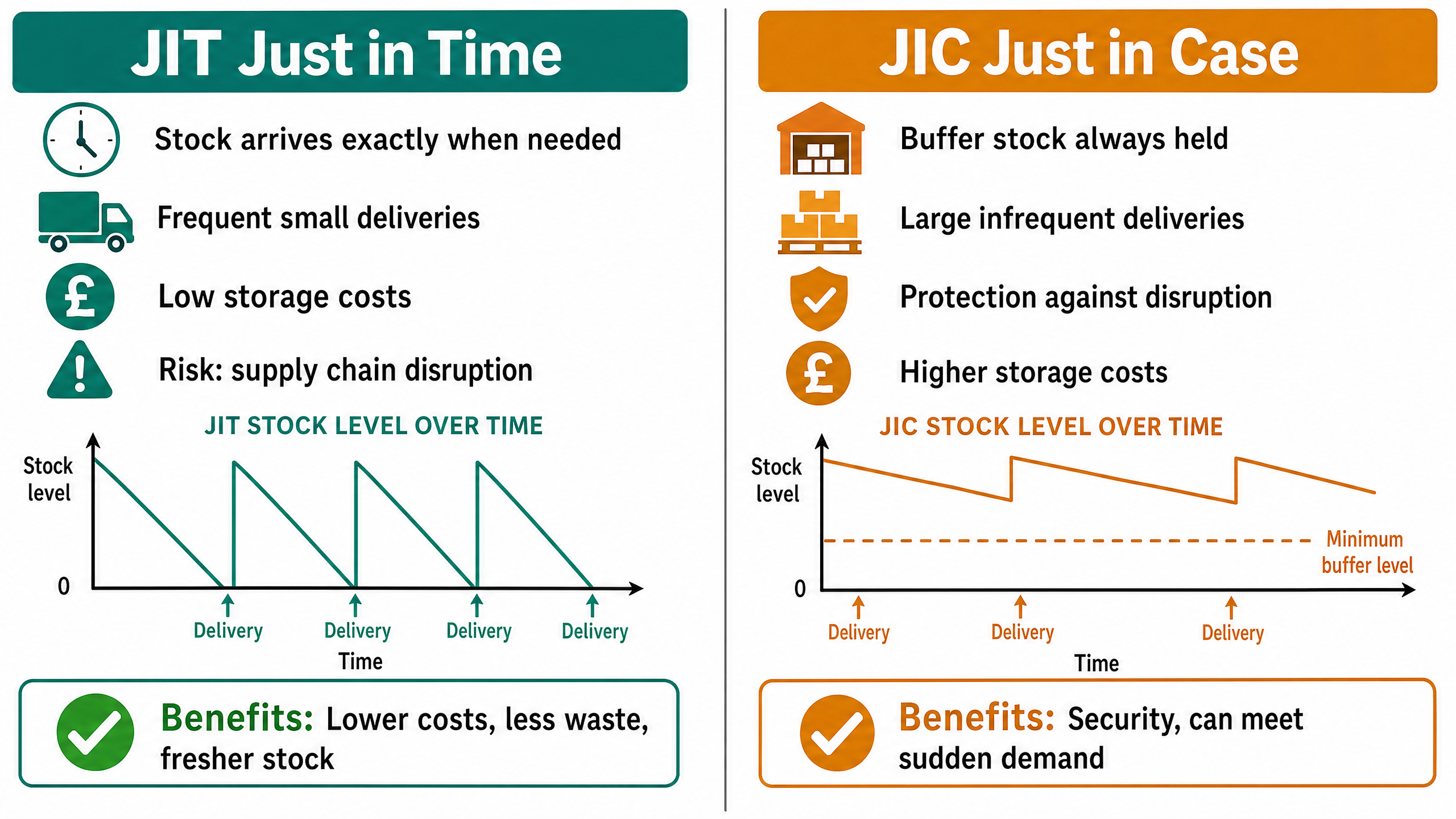
Businesses must decide how much stock to hold. Holding too much ties up cash and incurs storage costs; holding too little risks halting production or failing to meet customer demand. There are two primary strategies:
**Just in Time (JIT)**With JIT, a business holds virtually no buffer stock. Materials arrive exactly when they are needed on the production line, and finished goods are dispatched immediately to customers.
- Benefits: Dramatically reduces storage costs, minimizes waste (especially for perishable goods), and improves cash flow since money isn't tied up in inventory.
- Drawbacks: Highly vulnerable to supply chain disruptions. If a delivery is late, production stops immediately. It requires extremely reliable suppliers.
**Just in Case (JIC)**With JIC, a business deliberately holds buffer stock—extra inventory kept in reserve to protect against unforeseen circumstances.
- Benefits: Provides security against supply chain failures or sudden spikes in customer demand. The business can always meet orders.
- Drawbacks: Higher holding costs (warehouse space, security, insurance). Risk of stock becoming obsolete, damaged, or perishing.
 Open full-size image (opens in a new tab)
Supplier Selection
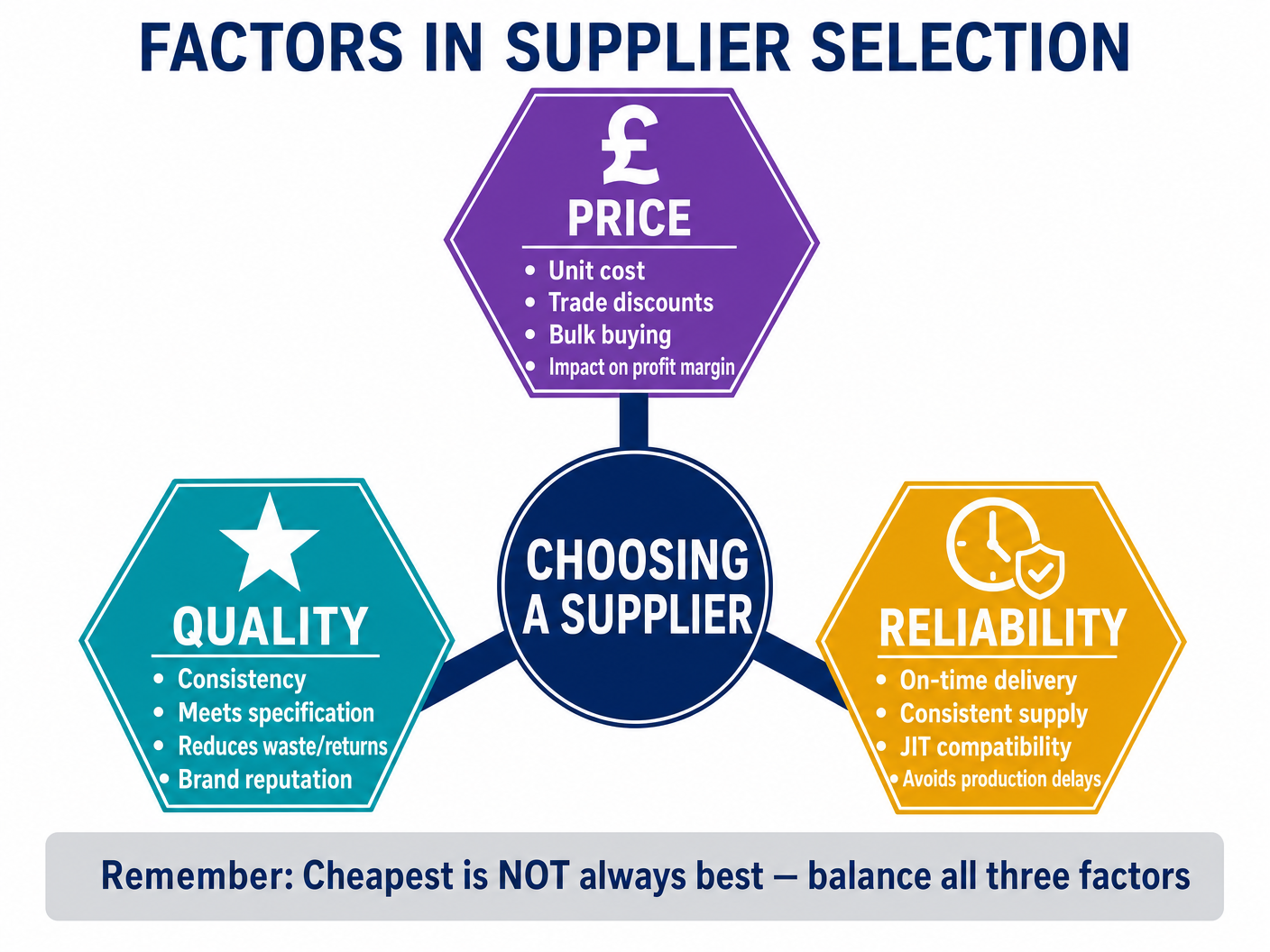
Choosing the right supplier is a critical procurement decision. Examiners frequently ask candidates to evaluate supplier choices based on three key factors:
- Price: Businesses aim to minimize costs to maximize profit margins or offer competitive prices to customers. However, the cheapest option is often not the best overall choice.
- Quality: The quality of raw materials directly affects the quality of the finished product. Poor quality inputs lead to higher defect rates, increased returns, and damage to the brand's reputation.
- Reliability: A supplier must deliver on time and in full. This is especially critical for businesses operating a JIT system, where unreliability can halt production.
 Open full-size image (opens in a new tab)
Supply Chain Management and Efficiency
The supply chain encompasses all the stages involved in producing and delivering a product, from raw material extraction to the final consumer. Effective supply chain management means streamlining this process. Good procurement improves efficiency by ensuring smooth operations, reducing waste, and lowering unit costs. Conversely, poor procurement leads to delays, increased costs, and dissatisfied customers.
Try the lesson
The start of the The role of procurement lesson, made from teaching notes for this specification point.
Have a go first
Which factor describes how quickly a supplier can deliver ordered stock to a business?
Listen
Procurement means sourcing the raw materials, components, equipment and services a business needs. When choosing between suppliers, a business weighs several factors. Price matters, but so does quality: cheap components that fail raise returns and damage reputation. Reliability covers delivering the right quantity on time, so production is not halted. Flexibility is the supplier's willingness to adjust order sizes or timings. A supplier's location affects lead times, transport cost and currency risk. Payment terms and credit periods influence cash flow. A business may also consider a supplier's ethical and environmental record, and whether to use one supplier or several. For example, a bakery comparing flour suppliers might accept a higher price for guaranteed next-day delivery and consistent quality, because a stoppage costs more than the price difference. A strong answer earns marks for these points. Identifies relevant factors such as price, quality, reliability, flexibility, location, payment terms, ethical and environmental record, and single versus multiple sourcing. Explains how a named factor affects the business, for example unreliable delivery halts production and delays customer orders. Applies factors to the context given, for example a just-in-time manufacturer prioritising reliability over lowest price. Analyses trade-offs, for example a lower price may bring poorer quality, higher wastage or slower delivery. A common slip: Listing factors without linking them to consequences. Instead, explaining the effect on cost, quality, output or reputation. Exam tip: Read the case study and name the specific supplier factors it mentions before writing.
See it

Key words
Say what each word means before you turn the card.
Procurement
Try answering aloud or in your head before turning the card.
Reliability
Try answering aloud or in your head before turning the card.
Flexibility
Try answering aloud or in your head before turning the card.
Payment terms
Try answering aloud or in your head before turning the card.
See every definition
- Procurement
- Sourcing the raw materials, components, equipment and services a business needs.
- Reliability
- Delivering the right quantity on time, so production is not halted.
- Flexibility
- The supplier's willingness to adjust order sizes or timings.
- Payment terms
- Terms and credit periods that influence cash flow.
Label the diagram
Some boxes have lost their names. Pick the right name for each number.

1Box 1
2Box 2
3Box 3
There is more to this lesson
The full lesson goes on to check your understanding and help you earn the marks. Create a free account to carry on, with your progress saved.
A week of Premium from your first lesson · Then the free plan continues · No card, no charge
Worked Examples
3 worked examples — open one to explore the question and available guidance.
Practice Questions
Try the question, then reveal an answer plan or example response
State two factors a business should consider when choosing a supplier. (2 marks)
Hint: Think of the P.Q.R. acronym.
Explain one reason why a supermarket might choose to use a Just in Case (JIC) stock management system. (3 marks)
Hint: What happens if a supermarket runs out of popular items?
Evaluate whether a small, bespoke furniture maker should switch from a Just in Case (JIC) to a Just in Time (JIT) stock management system. (9 marks)
Hint: Consider the nature of 'bespoke' (custom-made) furniture and the cost of storing expensive wood.
Explain how effective procurement can lower a business's unit costs. (3 marks)
Hint: Think about bulk buying or reducing waste.
Analyse the importance of quality when a smartphone manufacturer is selecting a supplier for its batteries. (6 marks)
Hint: What happens if a smartphone battery is of poor quality?
Ready to test yourself interactively?
Active recall beats reading alone. Answer questions on The role of procurement with instant AI scoring and mark scheme guidance.
A week of Premium from your first lesson · Then the free plan continues · No card, no charge
Exam technique
How to turn what you know into marks
How to approach the question
Always highlight the name and type of business in the question scenario. Every point you make must relate back to that specific business context.
How to structure your answer
- Analyse questions
- Focus on the chain of consequences. Show how a change in one area (e.g., supplier reliability) ripples through to affect another (e.g., unit costs or customer satisfaction).
- Explain questions
- Make your point, then use connective phrases like 'This leads to...' or 'As a result...' to develop the explanation fully.
- Evaluate questions
- Provide one side of the argument (in context), provide the counter-argument (in context), and finish with a clear 'Overall...' conclusion that justifies which factor is most important.
Timing
Approximately 1 minute per mark, leaving time at the end to review longer answers.
Common pitfalls
- Confusing JIT (Just in Time) with JIC (Just in Case).
- Assuming that finding the cheapest supplier is always the best procurement decision.
- Giving generic advantages of JIT without applying them to the specific business mentioned in the case study.
What the command words want
- Analyse
- Examine the detailed consequences of a business decision or event.
- Explain
- Give a reason and develop it. Show cause and effect.
- State / Identify
- Provide a brief, factual answer. No explanation needed.
- Evaluate / Recommend
- Look at both sides (pros and cons), apply to the context, and make a final judgement.
Test your understanding of The role of procurement
Active recall beats re-reading. Take an instant quiz now to test what you’ve learned and lock it into long-term memory.
A week of Premium from your first lesson · Then the free plan continues · No card, no charge