Pearson Edexcel · GCSE · Combined Science
Conservation of energy
Master the fundamental rule of physics: energy cannot be created or destroyed, only transferred. This topic is the bedrock of GCSE Physics and guarantees calculation marks in your exam if you know your equations and energy stores.
- 4 min read
- 3 worked examples
- 5 practice questions
- 6 key terms
Study Notes

Overview
The Conservation of Energy is the most important principle in all of GCSE Physics. It states that energy can never be created or destroyed, only transferred from one store to another. This topic is vital because it underpins almost everything else you will study in Combined Science, from electricity to forces.
In your exam, you can expect to be tested on identifying energy stores, describing transfers, and crucially, calculating values like kinetic energy, gravitational potential energy, and efficiency. Examiners frequently test your ability to apply these concepts to real-world scenarios, like a falling ball, a moving car, or a boiling kettle.
🎧 Listen to the Topic Podcast:
Key Concepts
Concept 1: Energy Stores
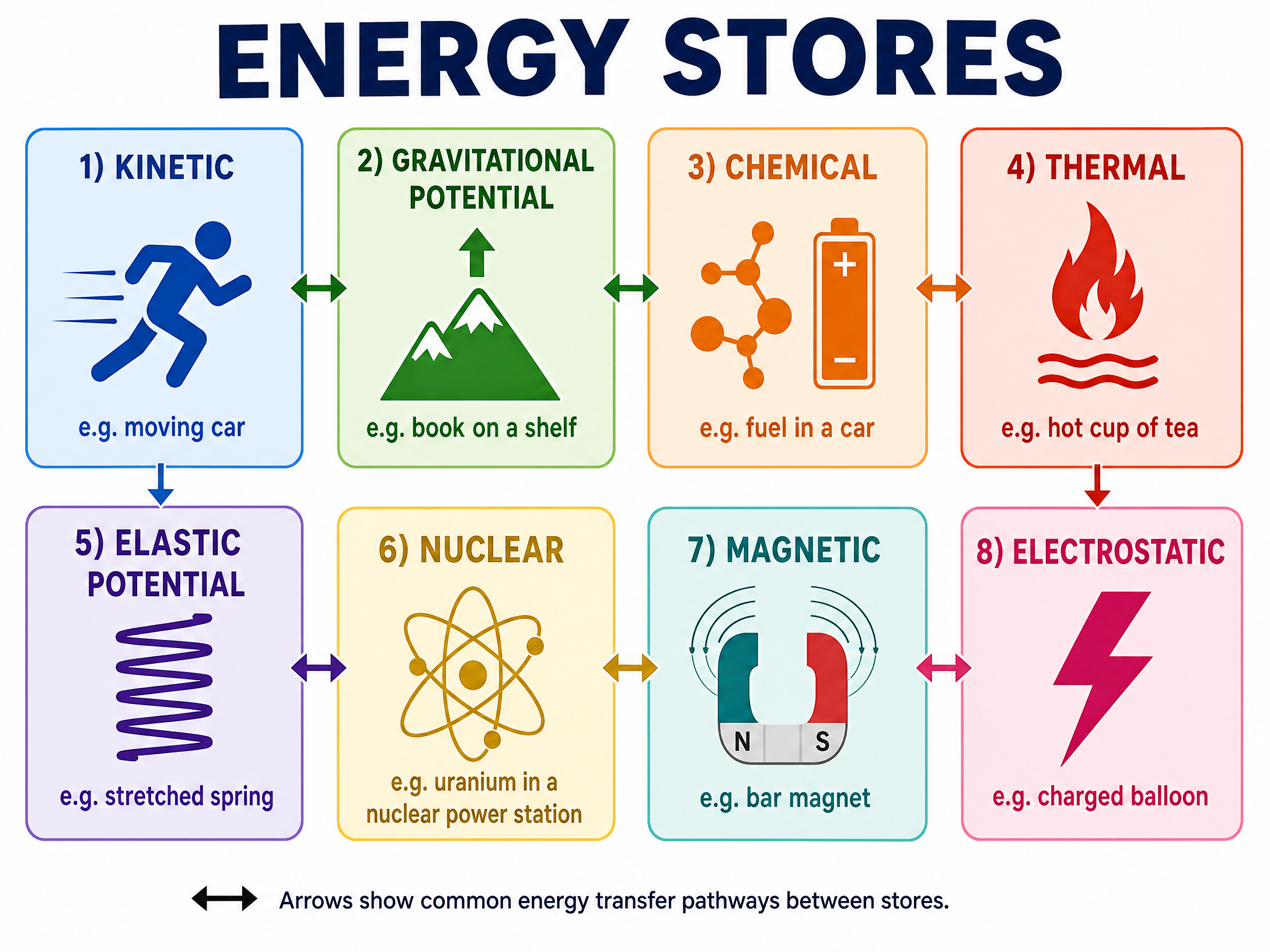
Think of energy as money and the stores as different bank accounts. The money (energy) can be moved between accounts (transfers), but the total amount of money always stays the same. There are 8 main energy stores you need to know:
- Kinetic: Anything moving has energy in its kinetic store.
- Gravitational Potential (GPE): Anything raised above the ground has energy in its GPE store.
- Chemical: Anything that can release energy by a chemical reaction (food, fuels, batteries).
- Thermal (Internal): Any object — the hotter it is, the more energy it has in this store.
- Elastic Potential: Anything stretched or compressed, like a spring.
- Magnetic: Two magnets that attract or repel each other.
- Electrostatic: Two charges that attract or repel each other.
- Nuclear: Atomic nuclei release energy from this store in nuclear reactions.

Concept 2: Energy Transfers
Energy is transferred between stores via four main pathways:
- Mechanically: A force acting on an object (e.g., pushing, pulling, stretching).
- Electrically: A charge moving through a potential difference (e.g., current in a circuit).
- By Heating: Energy transferred from a hotter object to a colder object.
- By Radiation: Energy transferred by waves (e.g., light or sound).
Example: When you drop a ball, energy is transferred mechanically (by the gravitational force) from the ball's gravitational potential energy store to its kinetic energy store.
Concept 3: Closed Systems and Dissipation
A closed system is a system where neither matter nor energy can enter or leave. The net change in the total energy of a closed system is always zero.
However, in the real world, most systems are not perfectly closed. When energy is transferred, some of it is always transferred to a less useful store (usually the thermal store of the surroundings). We say this energy has been dissipated.
Examiner Tip: Never say energy is "lost". Always use the word "dissipated" or say it is "transferred to the thermal store of the surroundings".
Mathematical Relationships

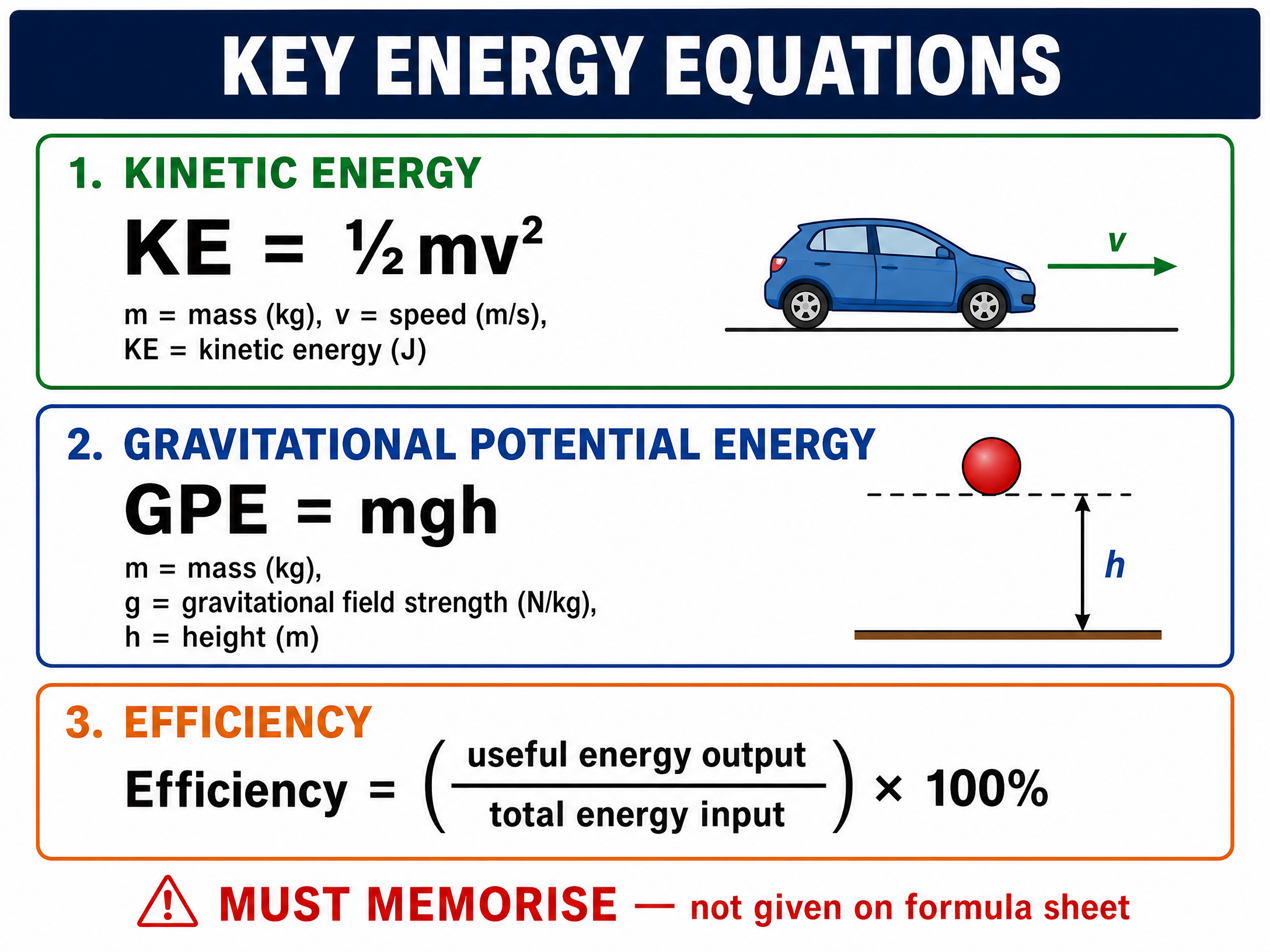
You must memorise these three equations. They are not given to you in the exam.
1. Kinetic Energy (KE)
E_k = \frac{1}{2} m v^2
Where:
- E_k = Kinetic Energy (Joules, J)
- m = mass (kilograms, kg)
- v = speed (metres per second, m/s)
2. Gravitational Potential Energy (GPE)
E_p = m g h
Where:
- E_p = Gravitational Potential Energy (Joules, J)
- m = mass (kilograms, kg)
- g = gravitational field strength (Newtons per kilogram, N/kg). On Earth, g = 9.8 N/kg.
- h = height (metres, m)
3. Efficiency
\text{Efficiency} = \frac{\text{Useful output energy transfer}}{\text{Total input energy transfer}}
Efficiency can be given as a decimal (between 0 and 1) or a percentage (between 0% and 100%).
Practical Applications: Reducing Unwanted Energy Transfers
Engineers constantly try to increase efficiency by reducing dissipated energy. You need to know two main methods:
- Lubrication: Oil or grease reduces friction between moving parts (like bike gears). This reduces the energy transferred mechanically to the thermal store of the surroundings.
- Thermal Insulation: Materials with low thermal conductivity (like loft insulation or double glazing) reduce the rate of energy transfer by heating to the surroundings.
Interactive Diagrams
2 interactive diagrams to visualise key concepts
Conceptual Flow Outline
Energy transfer diagram for an electric motor showing useful transfer and dissipation.
Conceptual Flow Outline
Flowchart showing how efficiency is calculated from energy inputs and outputs.
Worked Examples
3 worked examples — open one to explore the question and available guidance.
Practice Questions
Test your understanding — click to reveal model answers
State the Law of Conservation of Energy. [2 marks]
Hint: Think about what can and cannot happen to energy.
A cyclist with a mass of 60 kg rides a bicycle with a mass of 10 kg at a speed of 8 m/s. Calculate the total kinetic energy. [3 marks]
Hint: Don't forget to combine the masses before calculating.
A kettle is used to heat water. It is supplied with 40,000 J of electrical energy. 32,000 J is transferred to the thermal store of the water. Calculate the efficiency of the kettle and explain what happens to the wasted energy. [4 marks]
Hint: Calculate efficiency first, then use the key 'D' word to explain the wasted energy.
Explain how lubricating the chain of a bicycle increases its efficiency. [3 marks]
Hint: Think about the forces involved and which specific energy store the wasted energy goes to.
A roller coaster car of mass 800 kg is stationary at the top of a 45 m drop. It falls and reaches a speed of 25 m/s at the bottom. Calculate the amount of energy dissipated to the surroundings during the fall. (g = 9.8 N/kg) [5 marks]
Hint: Calculate the GPE at the top. Calculate the KE at the bottom. The difference between them is the dissipated energy.