Pearson Edexcel · GCSE · Combined Science
Ecosystems and material cycles
Master the intricate balance of life and the environment with this comprehensive guide to Ecosystems and Material Cycles. You'll learn essential fieldwork techniques like quadrats and transects, and discover how carbon and nitrogen cycle through the living world—skills guaranteed to earn you top marks.
- 6 min read
- 3 worked examples
- 5 practice questions
- 6 key terms
Study Notes

Overview
Welcome to Topic 9: Ecosystems and Material Cycles. This topic forms a crucial part of your Combined Science GCSE, bringing together concepts from across biology to show how organisms interact with each other and their environment. You will explore the delicate balance of ecosystems, learn how to measure populations using practical fieldwork techniques, and understand the vital chemical cycles that sustain life on Earth.
Examiners frequently test this topic through data interpretation questions, asking you to analyse graphs or tables from fieldwork. You will also be expected to demonstrate a deep understanding of the required practicals involving quadrats and belt transects. Furthermore, mastering the carbon and nitrogen cycles is essential, as these often feature in extended six-mark questions requiring logical, step-by-step explanations. Let's dive in and secure those marks.
Key Concepts
Concept 1: Ecosystems, Biotic, and Abiotic Factors
An ecosystem is the interaction of a community of living organisms (biotic) with the non-living (abiotic) parts of their environment. To survive and reproduce, organisms require a supply of materials from their surroundings and from the other living organisms there.
Abiotic factors are non-living variables. These include:
- Light intensity (affects the rate of photosynthesis)
- Temperature (affects enzyme activity)
- Moisture levels (essential for survival)
- Soil pH and mineral content (affects plant growth)
- Wind intensity and direction
- Carbon dioxide levels for plants
- Oxygen levels for aquatic animals
Biotic factors are living variables. These include:
- Availability of food
- New predators arriving
- New pathogens (diseases)
- One species outcompeting another so the numbers are no longer sufficient to breed
Example: If a new, aggressive weed is introduced to a meadow, it may outcompete native daisies for light and soil minerals (biotic factor), leading to a decrease in the daisy population.
Concept 2: Fieldwork Techniques (Core Practical)
To understand ecosystems, ecologists need to know the distribution and abundance of organisms. Because counting every single organism is usually impossible, we use sampling techniques.

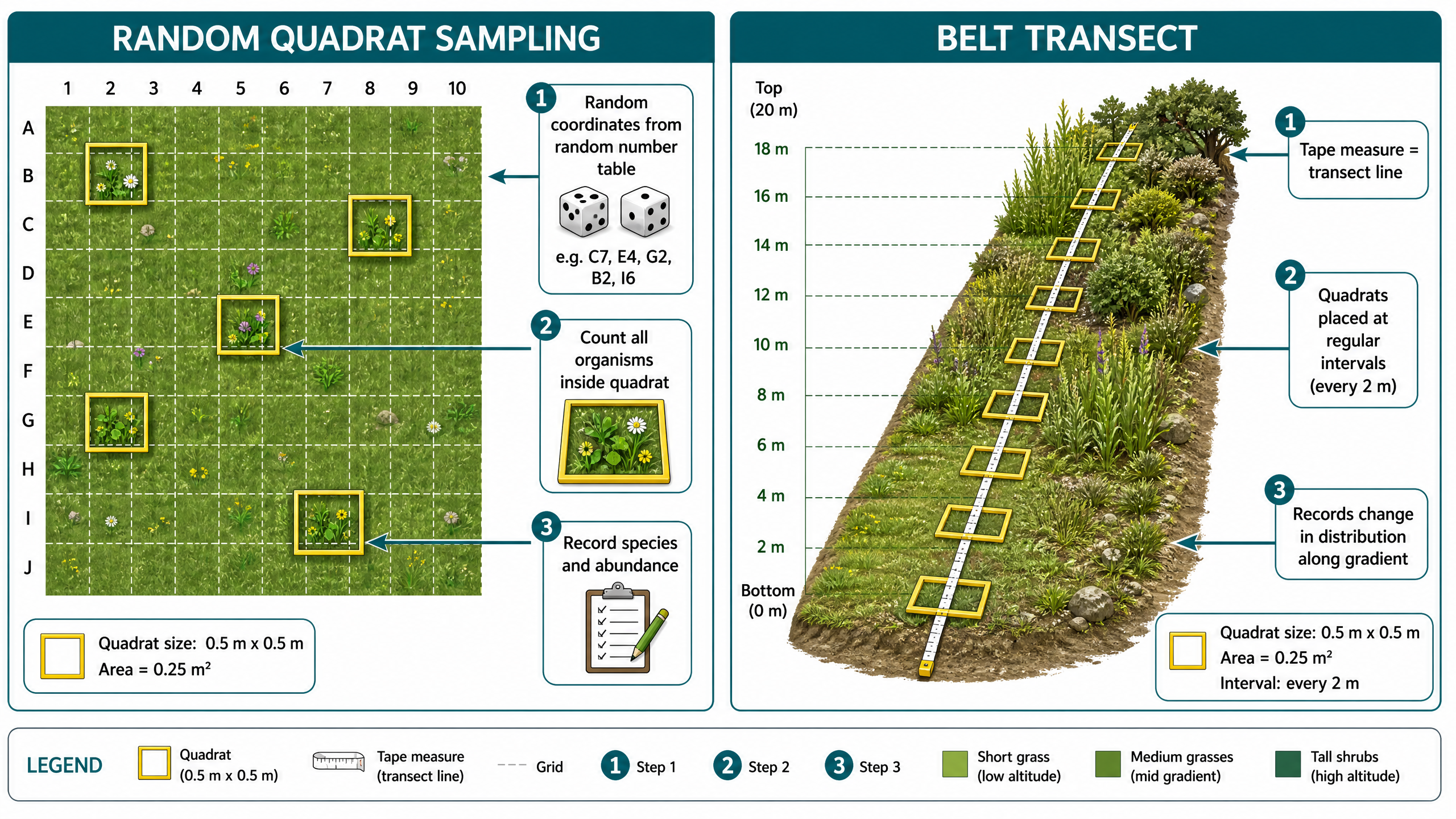
Quadrats for AbundanceA quadrat is a square frame (usually 0.25\text{ m}^2) used to sample a specific area. To avoid bias and ensure the sample is representative, quadrats must be placed randomly. This is typically done by laying out a grid using tape measures and generating random coordinates using a random number table or calculator.
Belt Transects for DistributionWhen investigating how the distribution of organisms changes along a gradient (e.g., moving away from a tree into an open field), a belt transect is used. A tape measure is laid out along the gradient, and quadrats are placed at regular intervals along this line to record the species present.
Concept 3: The Carbon Cycle
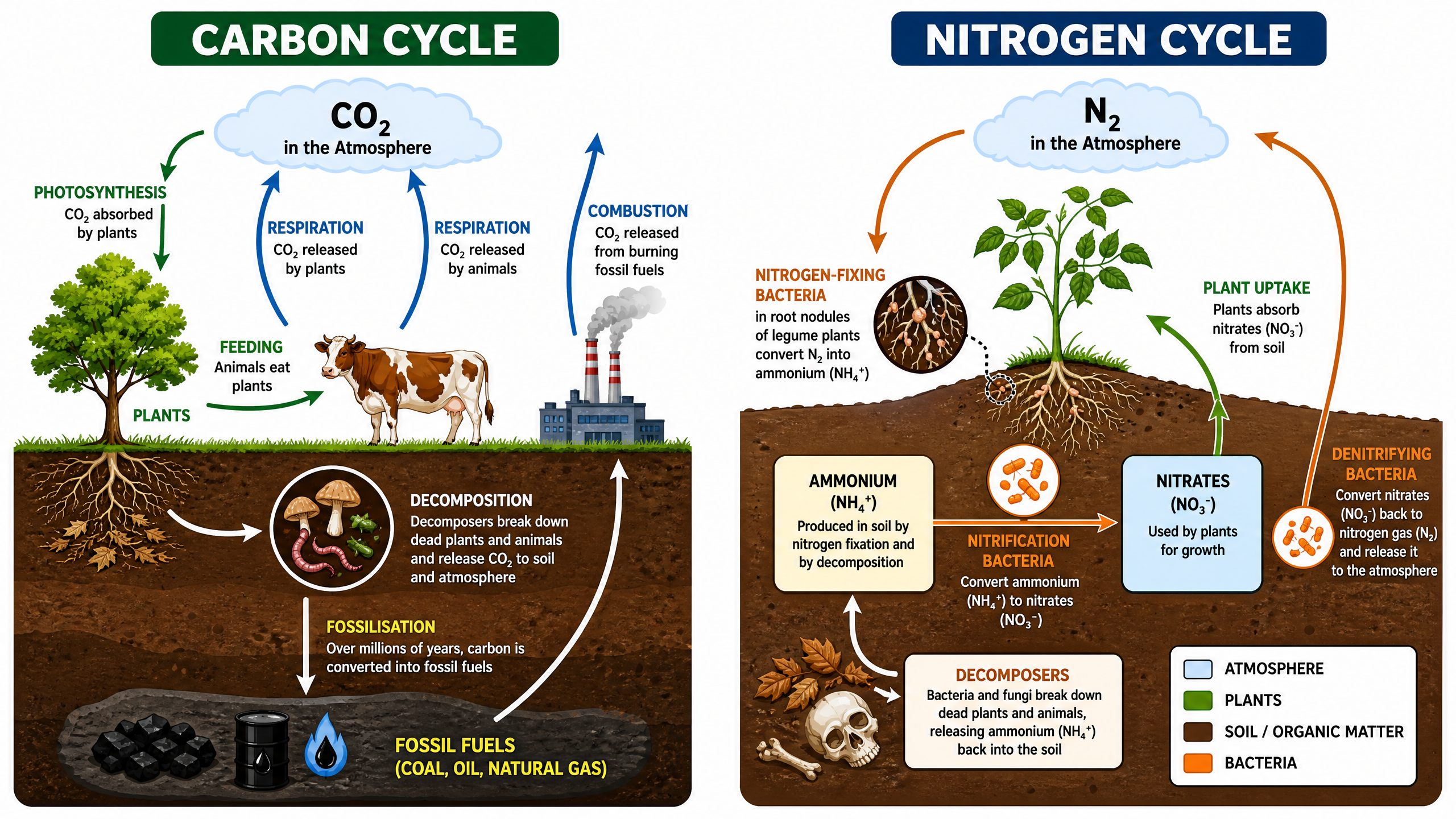
The carbon cycle describes how carbon moves from the atmosphere, through various organisms, and back to the atmosphere. It is a continuous cycle driven by key biological and chemical processes.
- Photosynthesis: Green plants and algae remove CO_2 from the atmosphere to make glucose.
- Feeding: Carbon is passed along food chains when animals eat plants or other animals.
- Respiration: All living organisms respire, returning CO_2 to the atmosphere.
- Decomposition: When organisms die, microorganisms (bacteria and fungi) break down their bodies, respiring and releasing CO_2.
- Combustion: Burning fossil fuels (which contain carbon from ancient organisms) releases CO_2 back into the atmosphere.
Concept 4: The Nitrogen Cycle
Nitrogen is crucial for making proteins and DNA. Although the air is 78% nitrogen gas (N_2), most organisms cannot use it directly. The nitrogen cycle relies heavily on different types of bacteria to convert nitrogen into usable forms.

- Nitrogen-fixing bacteria: Convert N_2 gas from the air into nitrates in the soil. They can be free-living in the soil or live in root nodules of legume plants.
- Decomposers: Break down proteins in dead organisms and urea in animal waste into ammonia.
- Nitrifying bacteria: Convert ammonia into nitrites, and then into nitrates (which plants absorb through their roots).
- Denitrifying bacteria: Convert nitrates back into N_2 gas. This happens in waterlogged, anaerobic soil and is detrimental to plant growth.
Podcast Revision
Listen to this 12-minute revision podcast covering the core concepts, common mistakes, and a quick-fire quiz to test your knowledge.
Mathematical/Scientific Relationships
Estimating Population Size
When using quadrats, you must be able to scale up your sample to estimate the total population of an area.
\text{Estimated Population} = \frac{\text{Total Area}}{\text{Area of one quadrat}} \times \text{Mean number of organisms per quadrat}
When to use: Use this formula when you have taken multiple random quadrat samples and need to find the total population of a species in a field or habitat.
Practical Applications
Understanding these cycles is crucial for modern agriculture. Farmers use knowledge of the nitrogen cycle to improve crop yields by adding nitrate fertilisers or planting legumes (like clover) to naturally increase soil nitrates via nitrogen-fixing bacteria. Furthermore, understanding the carbon cycle is central to the global effort to combat climate change, as human activities like deforestation and combustion disrupt the natural balance.
Visual Resources
2 diagrams and illustrations
Interactive Diagrams
2 interactive diagrams to visualise key concepts
Conceptual Flow Outline
The Carbon Cycle: showing the flow of carbon between the atmosphere, biosphere, and geosphere.
Conceptual Flow Outline
Step-by-step process for random sampling using quadrats.
Worked Examples
3 worked examples — open one to explore the question and available guidance.
Practice Questions
Test your understanding — click to reveal model answers
A student wants to estimate the number of buttercups in a 10m x 10m school playing field. Describe a method they could use to obtain a reliable estimate. (4 marks)
Hint: Think about how to avoid bias and what equipment you need.
Explain why waterlogged soils often result in poor plant growth, with reference to the nitrogen cycle. (3 marks)
Hint: What type of conditions are in waterlogged soil, and which bacteria thrive there?
State two abiotic factors that could affect the distribution of a plant species on a hillside. (2 marks)
Hint: Abiotic means non-living.
Explain the role of decomposers in the carbon cycle. (3 marks)
Hint: What do they break down, and what chemical process do they perform?
Compare the use of a continuous belt transect with an interrupted belt transect. (4 marks)
Hint: Think about accuracy versus time/effort.