Pearson Edexcel · GCSE · Combined Science
Light and the electromagnetic spectrum
Master the invisible waves that shape our world! This guide breaks down the electromagnetic spectrum and the core practical on refraction, equipping you with the exact knowledge, formulas, and exam techniques needed to secure top marks.
- 4 min read
- 3 worked examples
- 5 practice questions
- 6 key terms
Study Notes
Overview

Welcome to Topic 5: Light and the Electromagnetic Spectrum. This topic is a cornerstone of GCSE Combined Science because it explains how energy travels across the universe without needing a medium. You will learn about the seven types of electromagnetic (EM) waves, their properties, their uses, and their dangers. You will also dive deep into the behaviour of visible light, specifically how it refracts (bends) when moving between different materials like air and glass.
Examiners love this topic because it blends factual recall (like the order of the EM spectrum) with practical skills (like tracing ray diagrams) and mathematical application (using the wave equation). It connects heavily to the broader 'Waves' topic and underpins much of modern technology, from the WiFi connecting your devices to the X-rays used in hospitals.
Key Concepts
Concept 1: The Electromagnetic Spectrum
Electromagnetic waves are transverse waves that transfer energy from a source to an absorber. Crucially, they do not need particles to travel, meaning they can travel through the vacuum of space. All EM waves travel at the exact same speed in a vacuum: 3.0 × 10⁸ m/s (300 million metres per second).
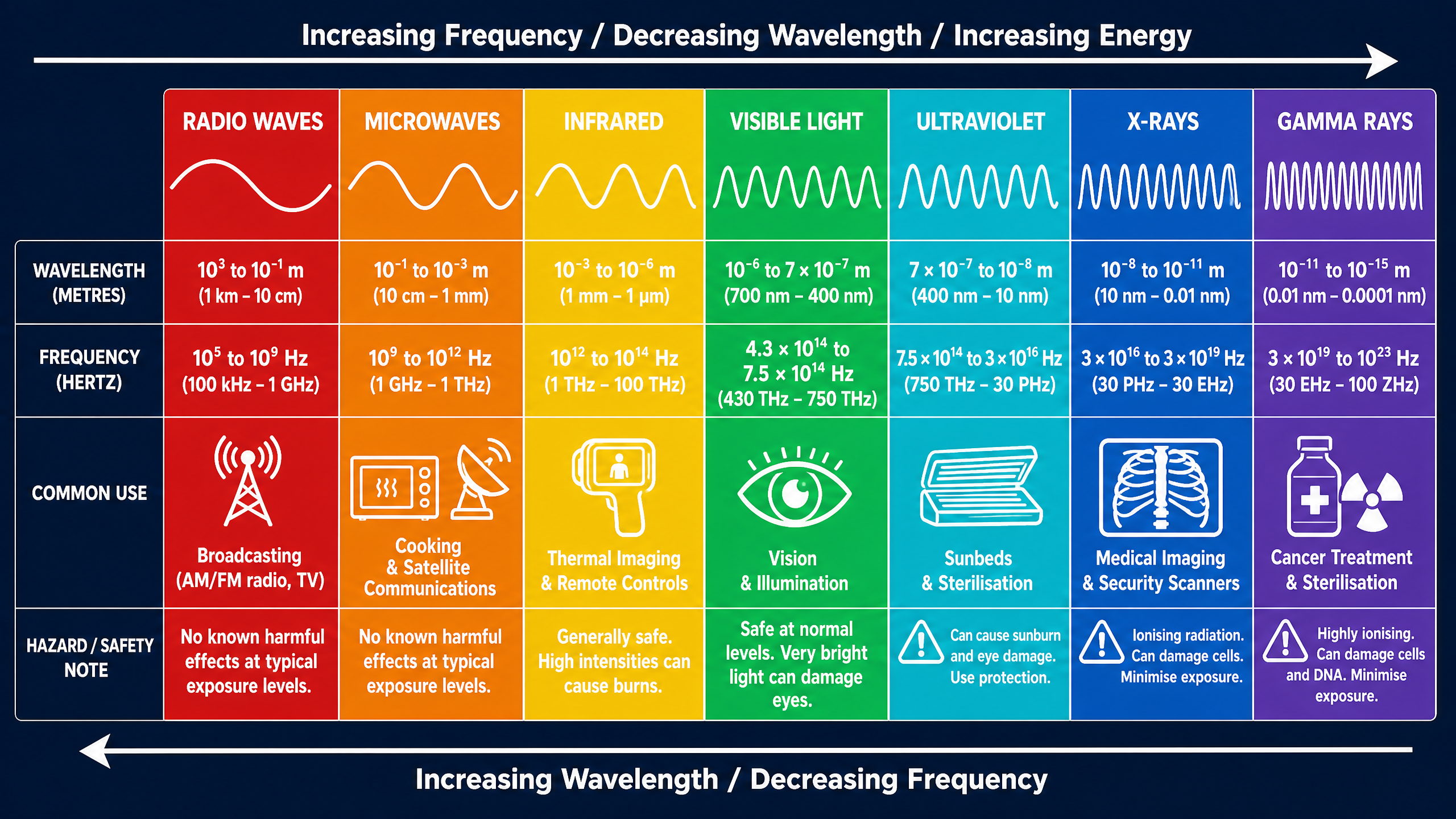
The electromagnetic spectrum is the continuous range of these waves, grouped by their wavelength and frequency. As you move along the spectrum from radio waves to gamma rays, the wavelength decreases, the frequency increases, and the energy transferred increases.

The Trend:
- Radio Waves: Longest wavelength, lowest frequency, lowest energy.
- Gamma Rays: Shortest wavelength, highest frequency, highest energy.
Concept 2: Refraction of Light
Refraction is the change in direction of a wave as it crosses the boundary between two different media (materials). This happens because the wave changes speed.
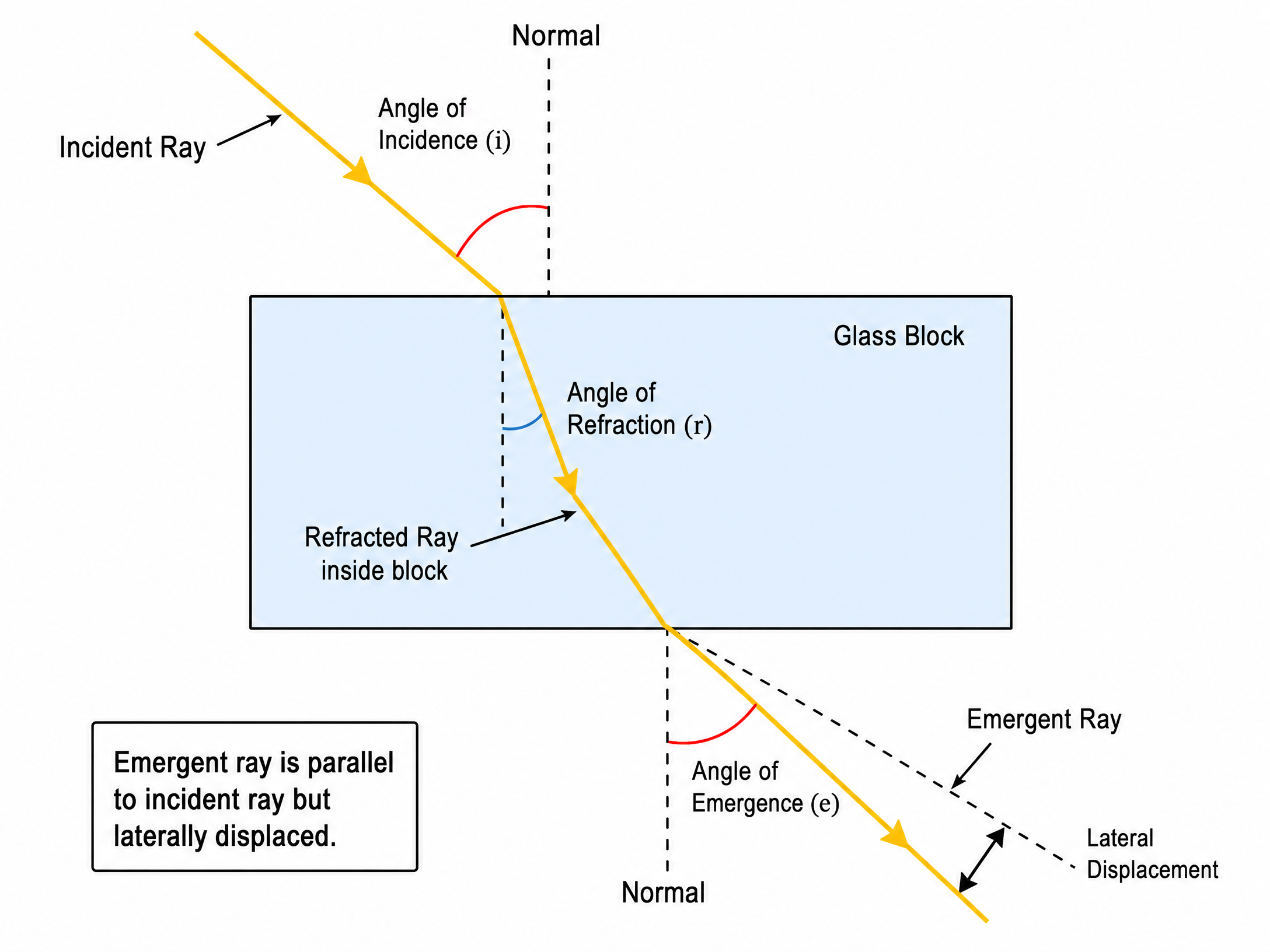
When a light ray travels from a less dense medium (like air) into a more optically dense medium (like glass), it slows down. Because one side of the wavefront hits the boundary and slows down before the other, the ray bends towards the normal.
When the light ray leaves the glass and enters the air again, it speeds up and bends away from the normal.

**The Normal Line:**This is an imaginary dashed line drawn at exactly 90° (perpendicular) to the boundary surface at the point where the light ray hits it. All angles must be measured from the normal, not from the surface of the block.
Mathematical/Scientific Relationships
The Wave Equation
The most important equation in this topic connects wave speed, frequency, and wavelength:
v = f × λ
- v = wave speed in metres per second (m/s). For EM waves in a vacuum, this is always 3.0 × 10⁸ m/s.
- f = frequency in Hertz (Hz).
- λ (lambda) = wavelength in metres (m).
(Must memorise: This equation is not always provided on the formula sheet.)
Practical Applications
Required Practical: Investigating Refraction
This core practical requires you to trace the path of a light ray through a rectangular glass block.
Apparatus: Ray box, single slit, rectangular glass block, plain paper, sharp pencil, ruler, protractor.
Method:
- Place the glass block on the paper and carefully trace around it.
- Use the ray box to shine a narrow beam of light at the block at an angle.
- Mark two dots on the incident ray (the ray entering the block) and two dots on the emergent ray (the ray leaving the block).
- Remove the block and use a ruler to draw the incident and emergent rays through your dots.
- Draw a straight line connecting the point where the ray entered the block to the point where it left. This is the refracted ray inside the block.
- Draw dashed normal lines at 90° to the surface at both the point of incidence and the point of emergence.
- Use a protractor to measure the angle of incidence (i) and the angle of refraction (r).
**Expected Results:**The angle of refraction inside the block will be smaller than the angle of incidence. The emergent ray will be parallel to the incident ray, but laterally displaced (shifted to the side).
Visual Resources
2 diagrams and illustrations
Interactive Diagrams
2 interactive diagrams to visualise key concepts
Conceptual Flow Outline
Flowchart explaining when refraction causes a change in direction.
Conceptual Flow Outline
The Electromagnetic Spectrum trend.
Worked Examples
3 worked examples — open one to explore the question and available guidance.
Practice Questions
Test your understanding — click to reveal model answers
State the speed of electromagnetic waves in a vacuum.
Hint: It's a very large number, often written in standard form.
A student investigates refraction using a glass block. They measure the angle of incidence as 40°. Explain why the angle of refraction will be less than 40°.
Hint: Think about what happens to the speed of light as it enters the glass.
Ultraviolet waves have a wavelength of 300 nm (3.0 × 10⁻⁷ m). Calculate their frequency. Give the unit. (Speed of light = 3.0 × 10⁸ m/s)
Hint: Use the wave equation and rearrange for frequency.
Describe two differences between radio waves and gamma rays.
Hint: Think about the trends across the EM spectrum.
Explain how the student should accurately trace the path of the light ray through the glass block in the required practical.
Hint: Detail the specific steps taken with the pencil and the block.