Pearson Edexcel · GCSE · Combined Science
Magnetism and the motor effect
Master the invisible forces that power our modern world. This topic covers the fundamentals of magnetism, magnetic fields, and how the interaction between electricity and magnetism creates the motor effect—a concept essential for your GCSE Physics exam.
- 5 min read
- 3 worked examples
- 5 practice questions
- 6 key terms
Study Notes

Overview
Welcome to Topic 12: Magnetism and the Motor Effect. This is a foundational topic in Combined Science Physics that explains how invisible magnetic fields interact with electric currents to produce motion. From the simple compass to the massive electric motors driving modern electric vehicles, the principles you learn here are at work all around us.
Examiners love this topic because it tests your ability to apply rules (like Fleming's Left-Hand Rule) in three dimensions, draw precise diagrams, and use mathematical formulas. It connects heavily to your earlier work on electricity and circuits, as you'll see how current flowing through a wire creates its own magnetic field. Expect questions ranging from simple recall of magnetic poles to complex 6-mark calculations involving the force equation.
Key Concepts
Concept 1: Permanent and Induced Magnets
A permanent magnet produces its own magnetic field all the time. It cannot be easily turned off. A bar magnet is the classic example.
An induced magnet is a material that becomes a magnet only when it is placed in an existing magnetic field. When you remove it from the magnetic field, it quickly loses most or all of its magnetism. Iron is a magnetically soft material, making it an excellent induced magnet, whereas steel is magnetically hard and retains magnetism, making it suitable for permanent magnets.
The Golden Rule of Magnetism:
- Like poles repel (North repels North; South repels South).
- Unlike poles attract (North attracts South).
Concept 2: Magnetic Fields
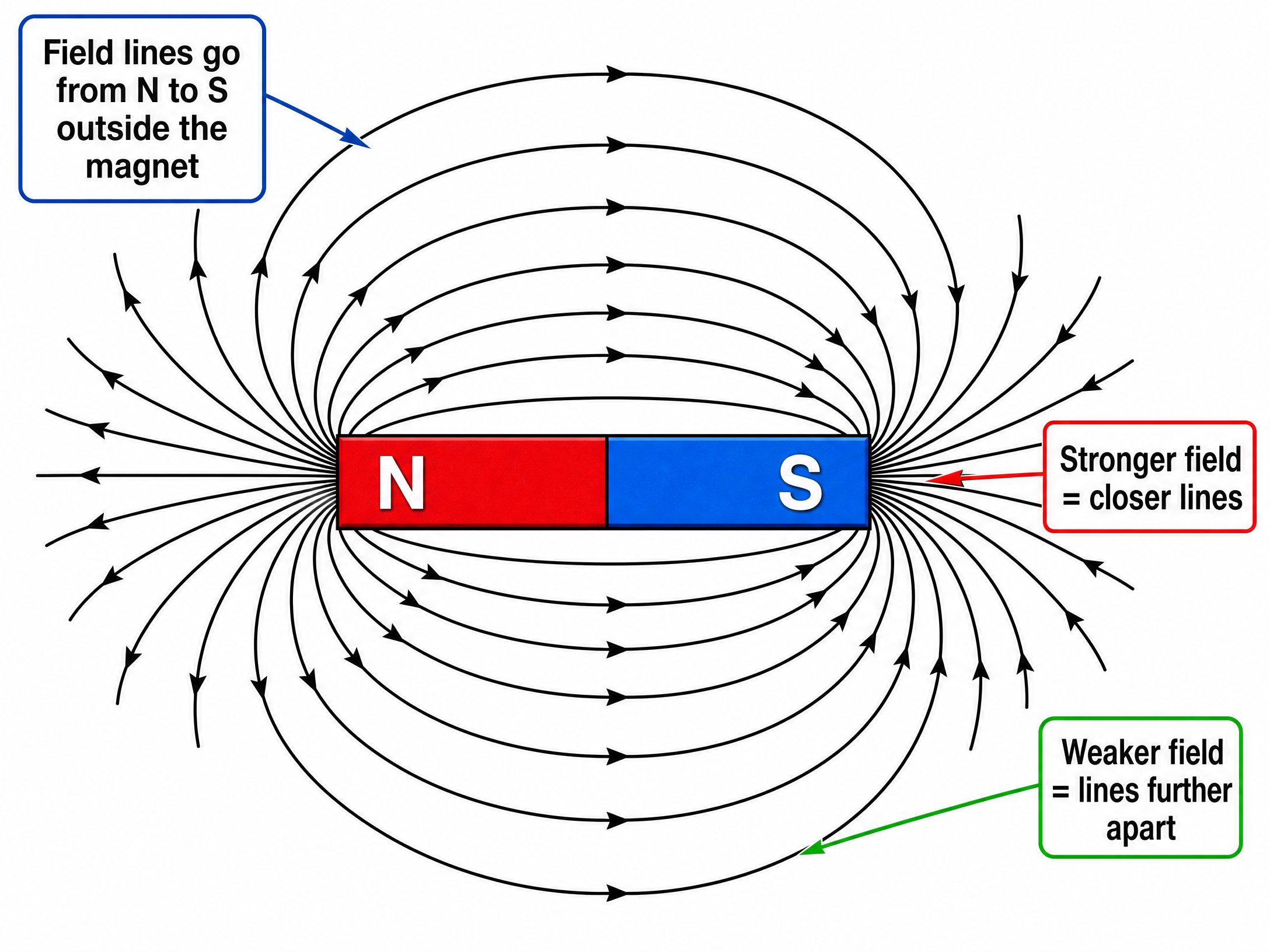
The region around a magnet where a force acts on another magnet or on a magnetic material (iron, steel, cobalt, nickel) is called the magnetic field.

When drawing magnetic field lines, you must follow these examiner rules:
- Field lines always go from North to South outside the magnet. You must draw arrows to show this.
- The lines never cross each other.
- The closer the lines are together, the stronger the magnetic field. The field is strongest at the poles.
Concept 3: The Magnetic Effect of a Current
When a current flows through a conducting wire, a magnetic field is produced around the wire. For a straight wire, the field consists of concentric circles centred on the wire. The strength of the magnetic field depends on the current through the wire and the distance from the wire.
If you coil the wire into a shape called a solenoid, the magnetic field becomes much stronger. The magnetic field inside a solenoid is strong and uniform. Outside the solenoid, the magnetic field is just like that of a bar magnet. You can increase the strength of an electromagnet (a solenoid with an iron core) by increasing the current or adding more turns to the coil.
Concept 4: The Motor Effect
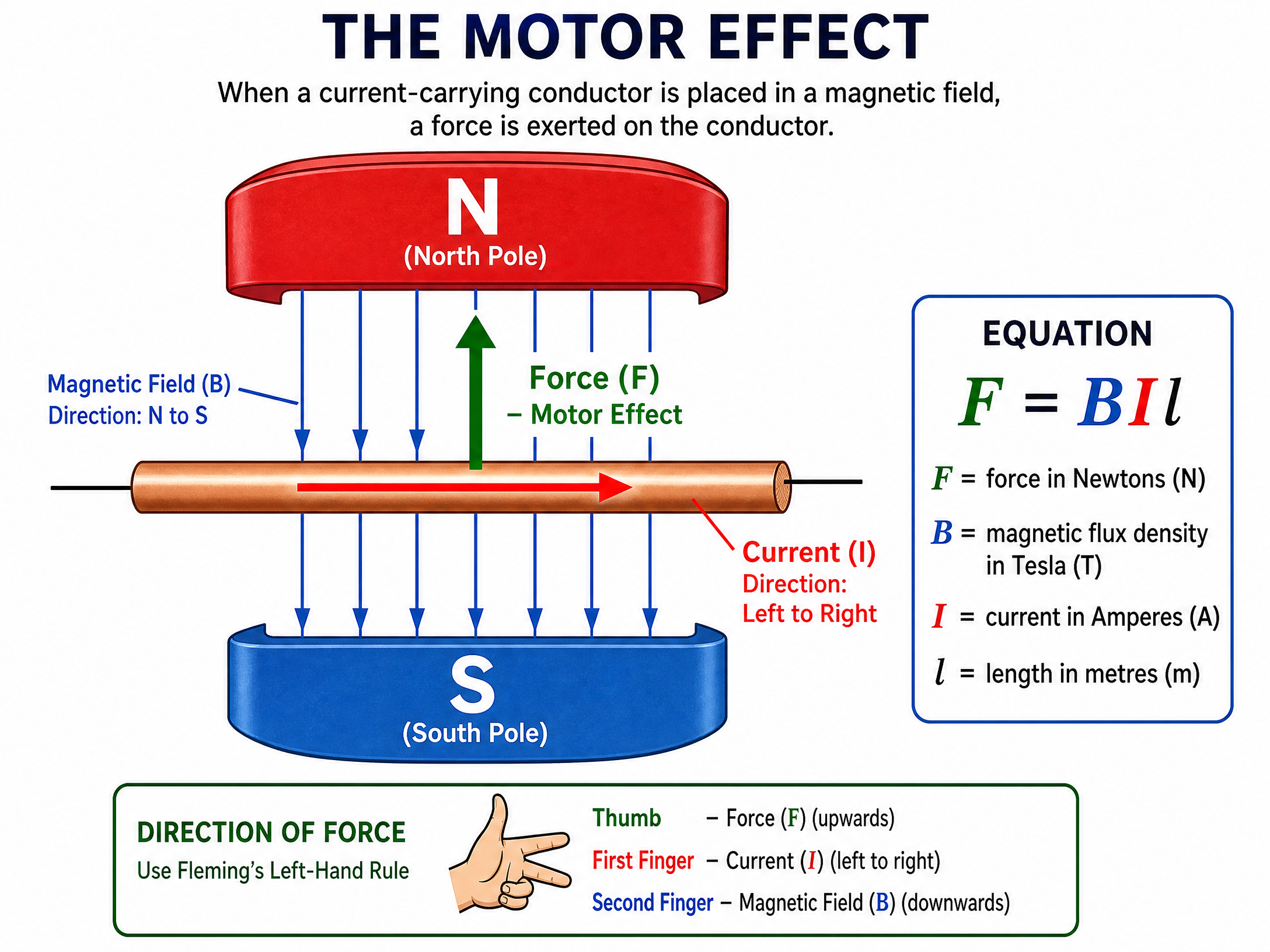
When a conductor carrying a current is placed in a magnetic field, the magnet producing the field and the conductor exert a force on each other. This is called the motor effect.

Why does this happen? The magnetic field around the current-carrying wire interacts with the magnetic field of the permanent magnet.
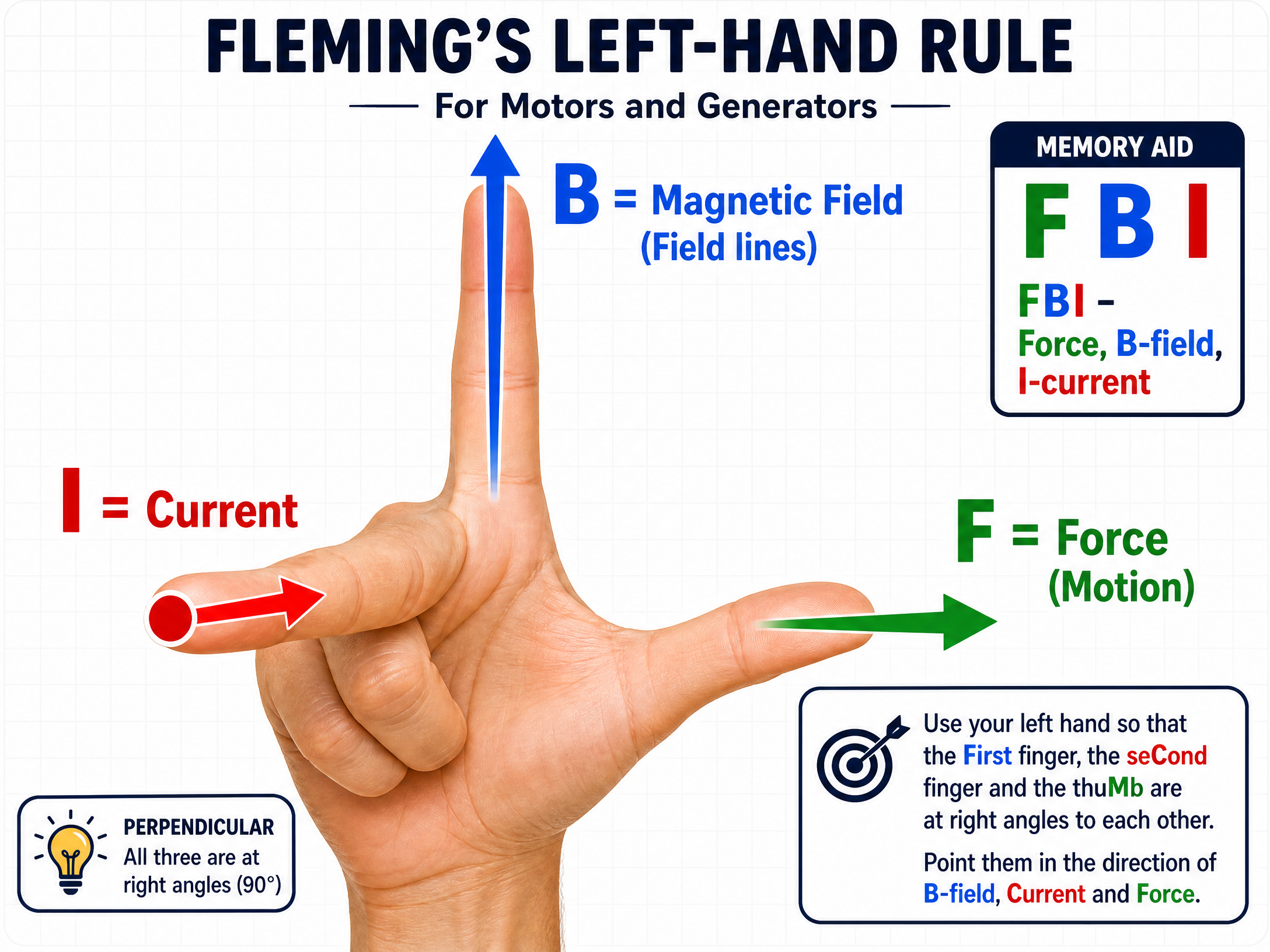
To determine the direction of the force, you must use Fleming's Left-Hand Rule.

Hold your left hand so your thumb, first finger, and second finger are all at right angles (perpendicular) to each other.
- First finger = Magnetic Field (points from North to South)
- seCond finger = Current (points in the direction of conventional current, positive to negative)
- thuMb = Motion / Force (the direction the wire will move)
Note: If the conductor is parallel to the magnetic field, it will not experience a force.
Mathematical/Scientific Relationships
The size of the force acting on a conductor in a magnetic field can be calculated using the equation:
F = B × I × lWhere:
- F = Force in Newtons (N)
- B = Magnetic flux density in Tesla (T) (This is the strength of the magnetic field)
- I = Current in Amperes (A)
- l = Length of the conductor in the magnetic field in metres (m)
This formula is usually provided on the physics equation sheet, but you must know how to rearrange it and ensure all units are correct before calculating.
Practical Applications
**Plotting a Magnetic Field (Required Practical skill)**You can map the magnetic field of a bar magnet using a plotting compass:
- Place a bar magnet on a piece of paper and draw around it.
- Place a plotting compass near the North pole of the magnet.
- Mark the position of the compass needle point (North) with a pencil dot.
- Move the compass so the tail (South) of the needle is on the dot you just made.
- Mark the new position of the needle point with another dot.
- Repeat this until you reach the South pole of the magnet.
- Join the dots with a smooth curve and add an arrow pointing from North to South.
Visual Resources
3 diagrams and illustrations
Interactive Diagrams
2 interactive diagrams to visualise key concepts
Conceptual Flow Outline
The sequence of events leading to the motor effect.
Conceptual Flow Outline
The behaviour of an induced magnet.
Worked Examples
3 worked examples — open one to explore the question and available guidance.
Practice Questions
Test your understanding — click to reveal model answers
State the rule for the attraction and repulsion of magnetic poles.
Hint: Think about what happens when you put two North poles together versus a North and a South.
A student has a steel paperclip and an iron nail. Explain why iron is a better material for the core of an electromagnet than steel.
Hint: Think about the terms 'magnetically soft' and 'magnetically hard'.
A 40 cm length of wire is placed in a magnetic field of 0.05 T. The wire experiences a force of 0.06 N. Calculate the current flowing through the wire.
Hint: You need to rearrange the formula F = BIl to solve for I. Don't forget to convert your length!
Explain how a solenoid can be used to create a strong, uniform magnetic field.
Hint: What happens to the magnetic fields of individual loops of wire when they are coiled together?
Under what condition will a current-carrying conductor in a magnetic field experience zero force?
Hint: Think about the angle between the wire and the magnetic field lines.