Pearson Edexcel · A-Level · Design and Technology
Part 1: Identifying and outlining possibilities for design
This topic covers the fundamental performance characteristics of materials, which is essential knowledge for making justified design decisions. Understanding these properties enables you to select the right material for a specific product and secure top marks in your GCSE Design and Technology exams.
- 5 min read
- 3 worked examples
- 4 practice questions
- 6 key terms
Study Notes
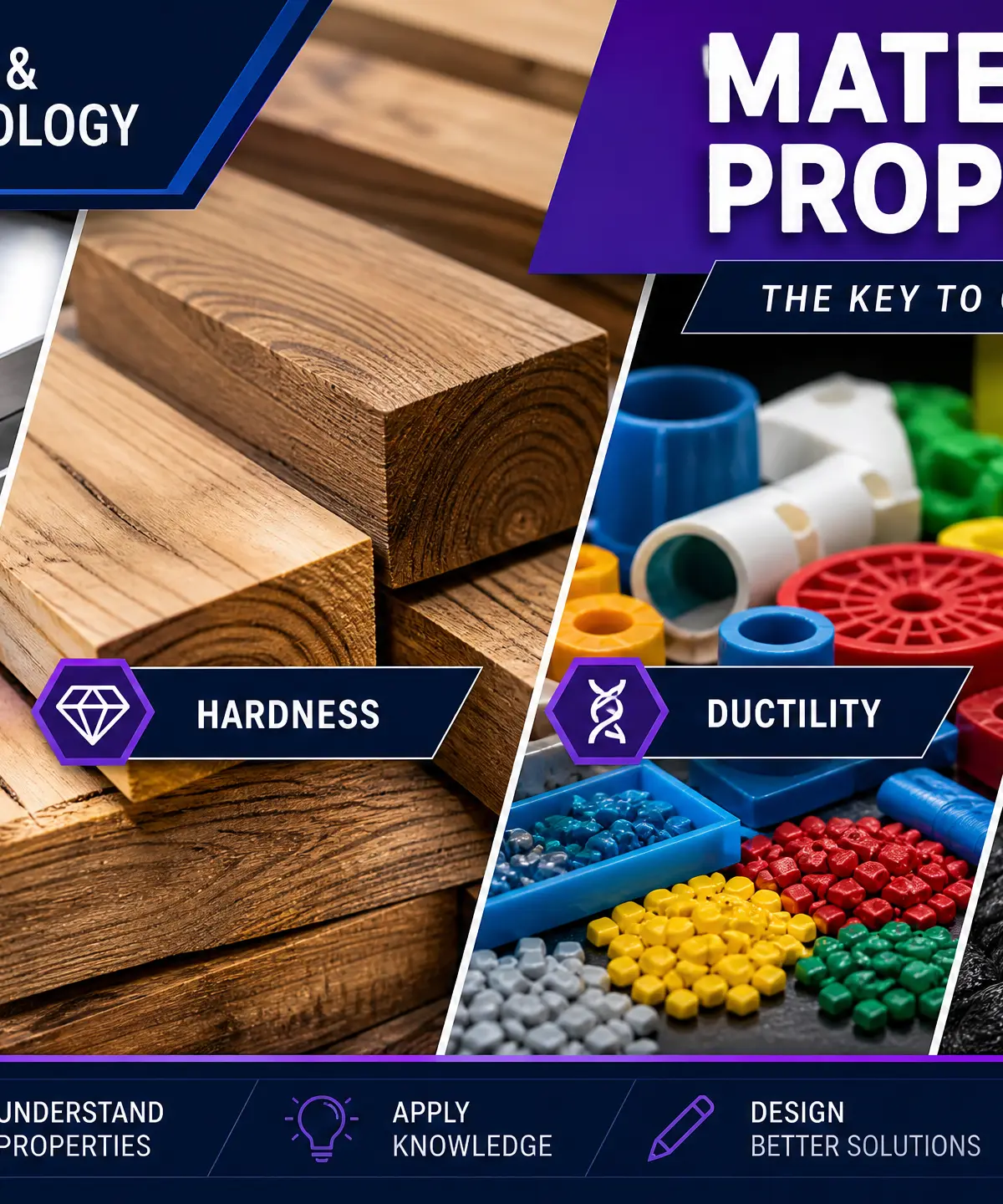
Overview
Understanding material properties is the foundation of good design. In GCSE Design and Technology, examiners don't just want to know what a product is made of; they want to know why. Performance characteristics—how a material behaves under different conditions—dictate whether a product will succeed or fail in its intended environment. This section covers the core properties of woods, metals, polymers, smart and modern materials, papers, boards, textiles, and composites.

Key Knowledge & Theory
Core Concepts: The 10 Essential Properties
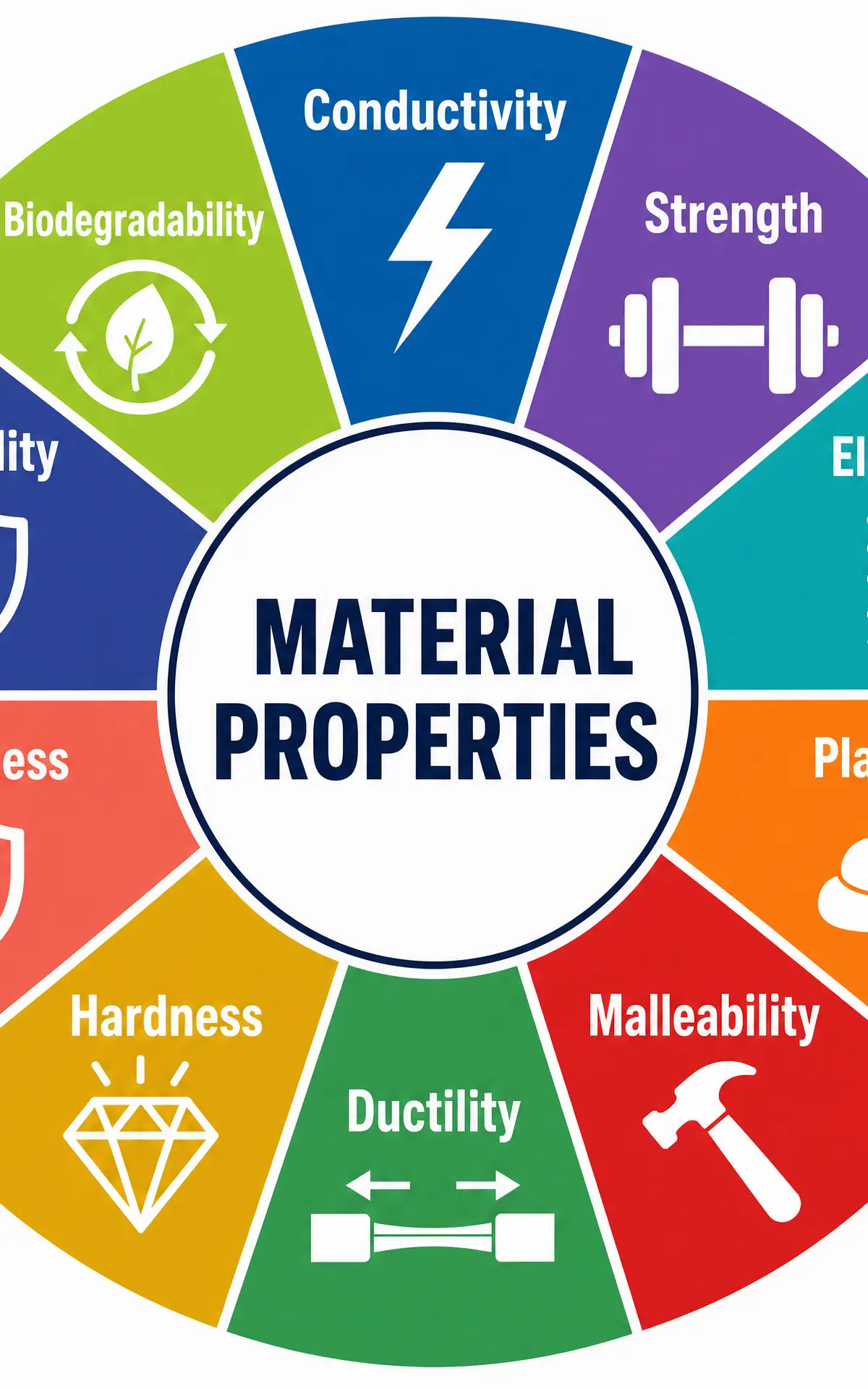
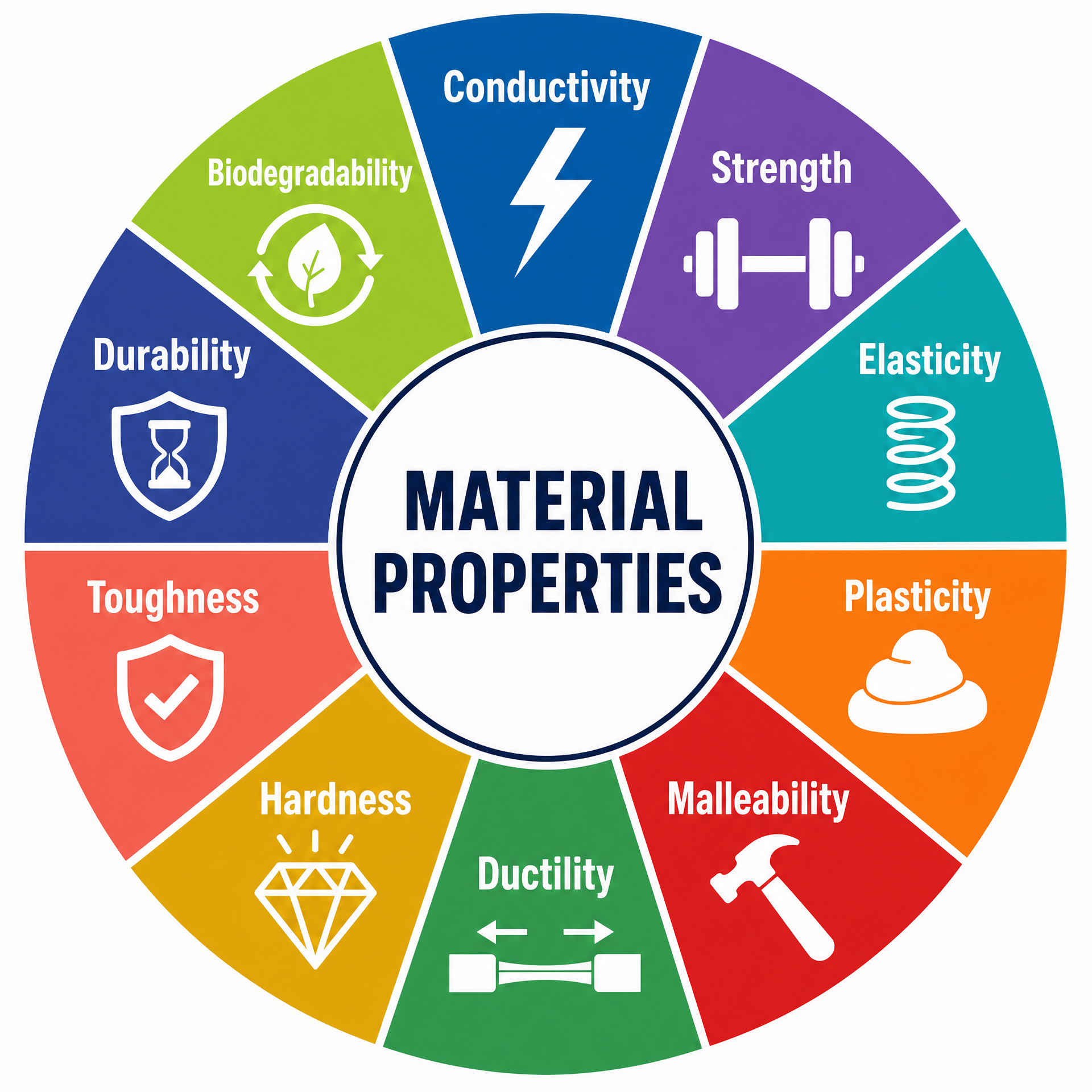
To discriminate effectively between materials, you must master these ten performance characteristics:
- Conductivity: The ability to allow heat or electricity to pass through. Metals are typically excellent conductors; polymers and woods are good insulators.
- Strength: The ability to withstand an applied force without breaking. Always specify the type: tensile (pulling), compressive (squashing), or flexural (bending).
- Elasticity: The ability to return to its original shape after a force is removed (e.g., a rubber band).
- Plasticity: The ability to be permanently deformed without breaking. Crucial for forming processes like pressing and moulding.
- Malleability: The ability to be hammered, rolled, or pressed into thin sheets without cracking (e.g., aluminium foil).
- Ductility: The ability to be drawn out into a wire or thin rod without breaking (e.g., copper wire).
- Hardness: The ability to resist scratching, indentation, and surface wear (e.g., diamond, hardened steel).
- Toughness: The ability to absorb energy and resist fracturing under a sudden impact. A tough material deforms rather than shatters.
- Durability: The ability to withstand wear, decay, and deterioration over time, especially in outdoor environments.
- Biodegradability: The ability to be broken down naturally by microorganisms (e.g., natural wood vs. synthetic polymers).
Technical Vocabulary
- Performance Characteristics: The specific properties that define how a material behaves.
- Tensile/Compressive/Flexural: The specific directions of force applied to test strength.
- Brittle: The opposite of tough; a material that shatters under impact (e.g., glass) even if it is hard.
- Smart Materials: Materials whose physical properties change in response to an input (e.g., temperature, light).
Practical Skills
Techniques & Processes: Material Selection
When designing, follow this process to select materials:
- Analyse the Brief: What environment will the product be used in? What forces will it face?
- Identify Required Properties: Does it need to be lightweight but tough? Does it need high thermal conductivity?
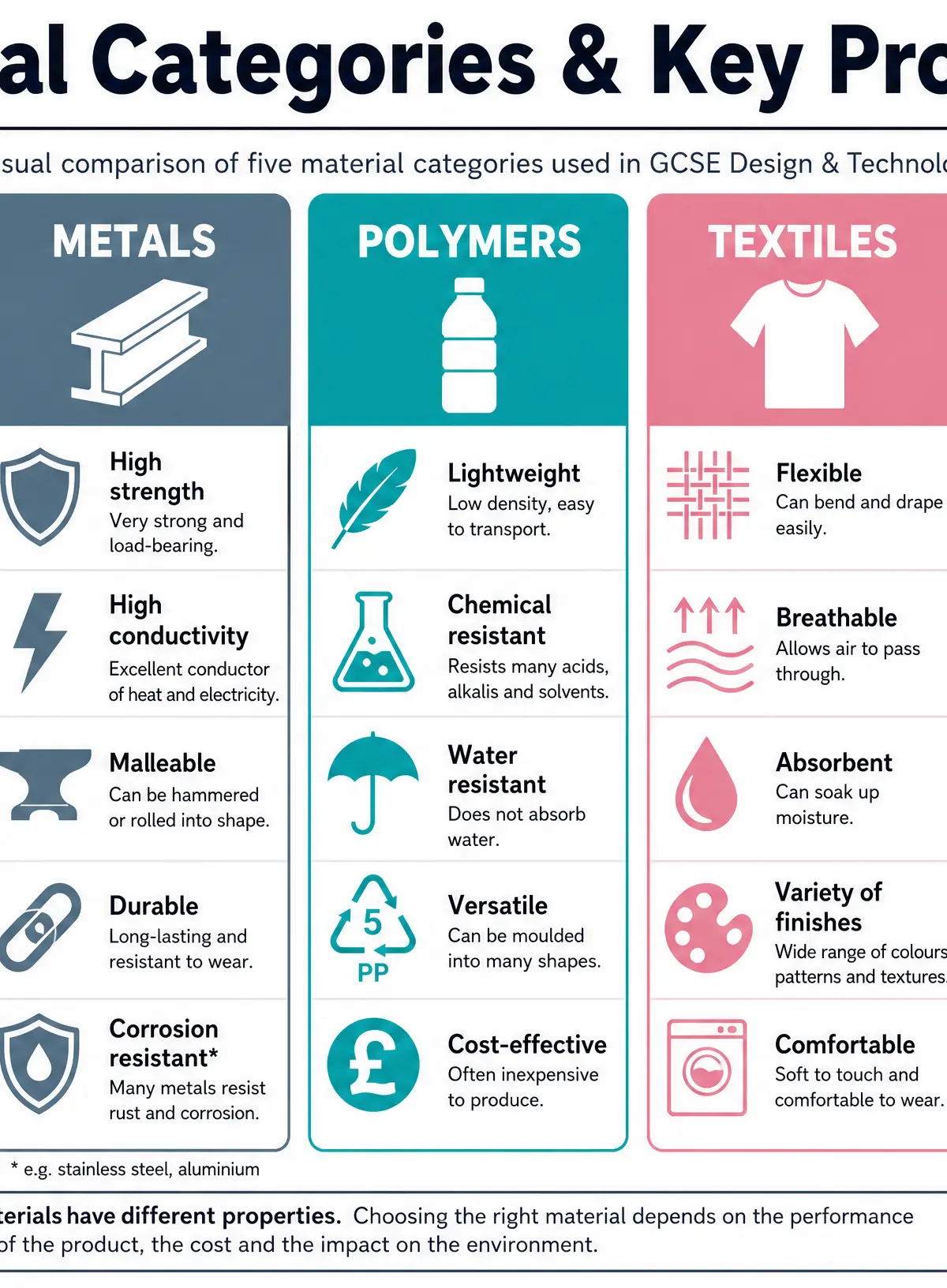
- Cross-Reference Material Categories: Compare the properties of metals, polymers, and composites against your requirements.
- Evaluate Sustainability: Consider biodegradability and the lifecycle of the material.
Portfolio/Coursework Guidance
Assessment Criteria
Examiners look for justified decision-making in your coursework. If you choose High Impact Polystyrene (HIPS) for a casing, you must explicitly state that you chose it for its toughness and plasticity (ease of vacuum forming), rather than just saying "it looks good."
Building a Strong Portfolio
- Annotation is Key: Every time you mention a material in your design developments, attach a performance characteristic to it.
- Testing: Document physical tests of materials (e.g., testing the flexural strength of different woods) to evidence your selection process.
Exam Component
Written Exam Knowledge
The written paper will heavily test your ability to apply scientific knowledge of material properties to specific products. You will frequently be asked to evaluate why a specific material was chosen over an alternative.
Exam Strategy
Use the Name, Define, Apply structure for extended answers:
- Name the property (e.g., Toughness).
- Define it briefly (e.g., ability to resist impact).
- Apply it to the product (e.g., prevents the helmet from shattering when dropped).
Visual Resources
2 diagrams and illustrations
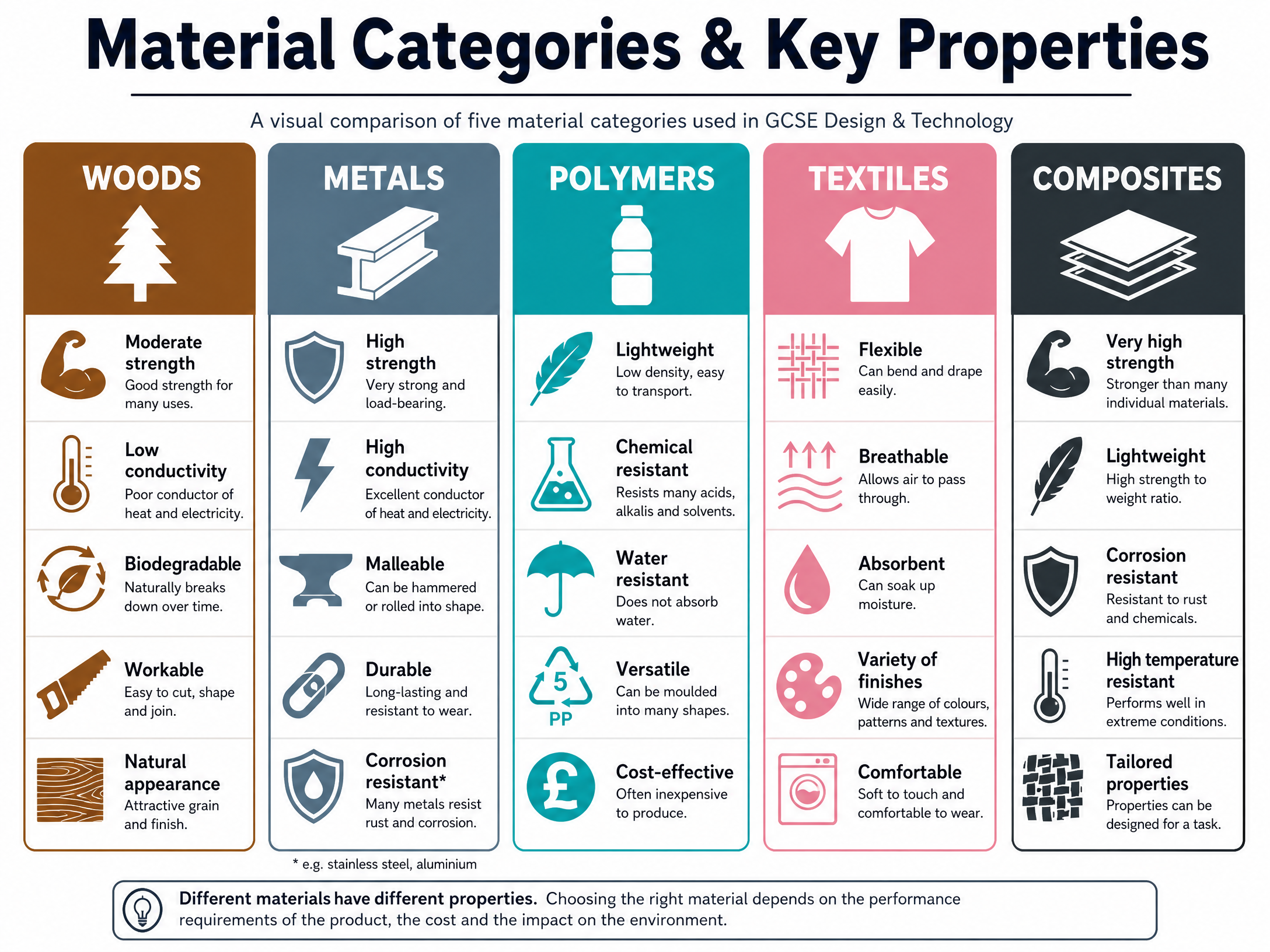
Interactive Diagrams
1 interactive diagram to visualise key concepts
Conceptual Flow Outline
The Material Selection Process
Worked Examples
3 worked examples — open one to explore the question and available guidance.
Practice Questions
Test your understanding — click to reveal model answers
Identify the property that allows a material to be drawn into a wire.
Hint: Remember the 'D for Drawing' memory hook.
Explain why high carbon steel is used to make the blade of a chisel. (2 marks)
Hint: What does a chisel do to other materials? What property is needed to resist wear?
A designer is choosing a material for a children's outdoor climbing frame. Evaluate the use of High Density Polyethylene (HDPE) for this product. (4 marks)
Hint: Think about the environment (outdoor) and the users (children). What properties are essential?
Compare the performance characteristics of aluminium and acrylic when used for the outer casing of a mobile phone. (6 marks)
Hint: Address strength, weight, impact resistance, and heat conductivity for both materials.