Pearson Edexcel · A-Level · Design and Technology
Topic 10: Current legislation
This topic covers the essential performance characteristics of materials—from conductivity and strength to durability and biodegradability. Understanding these properties is crucial for making appropriate material selections in both your written exam and your NEA coursework.
- 6 min read
- 3 worked examples
- 3 practice questions
- 6 key terms
Study Notes
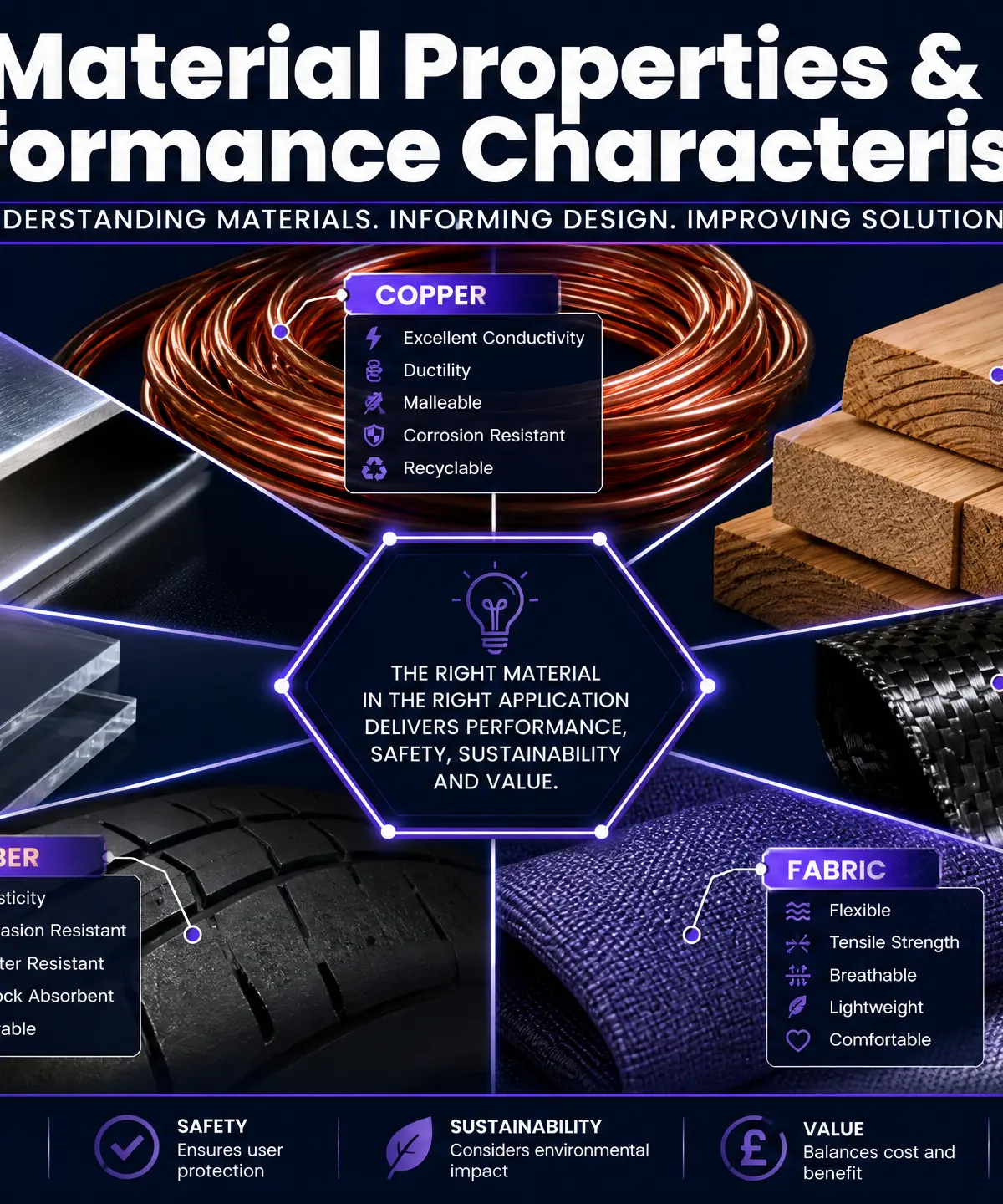
Overview
In Design and Technology, materials are never chosen at random. Every material has a specific set of performance characteristics that dictate how it behaves under different conditions. Understanding these properties allows designers to discriminate between materials and select the most appropriate one for a specific application. This topic covers the core terminology you must use when justifying material choices in your exam answers and your Non-Exam Assessment (NEA) portfolio.
Key Knowledge & Theory
The 'Magnificent Ten' Core Concepts
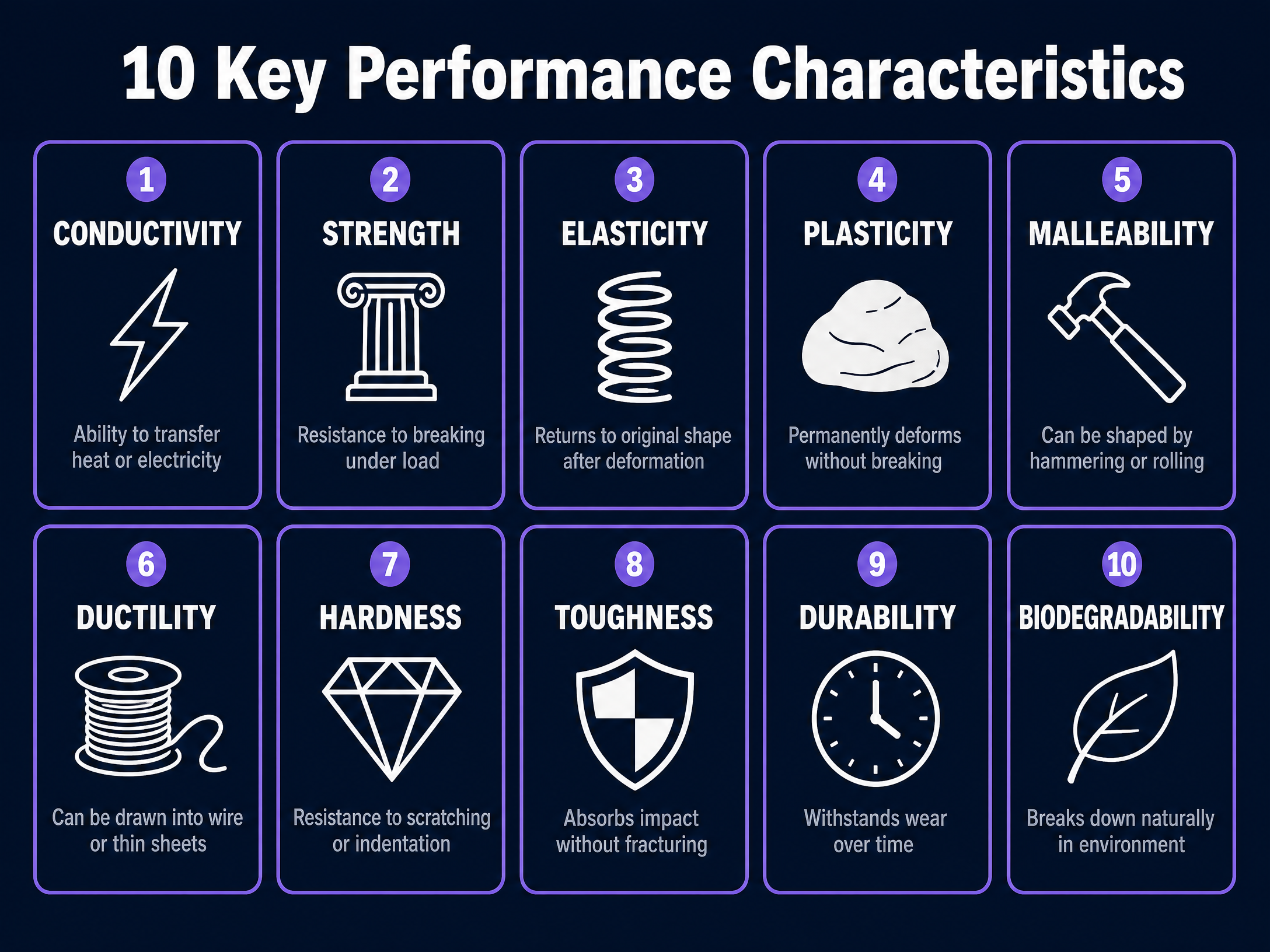
You must be able to define and apply the following ten performance characteristics:
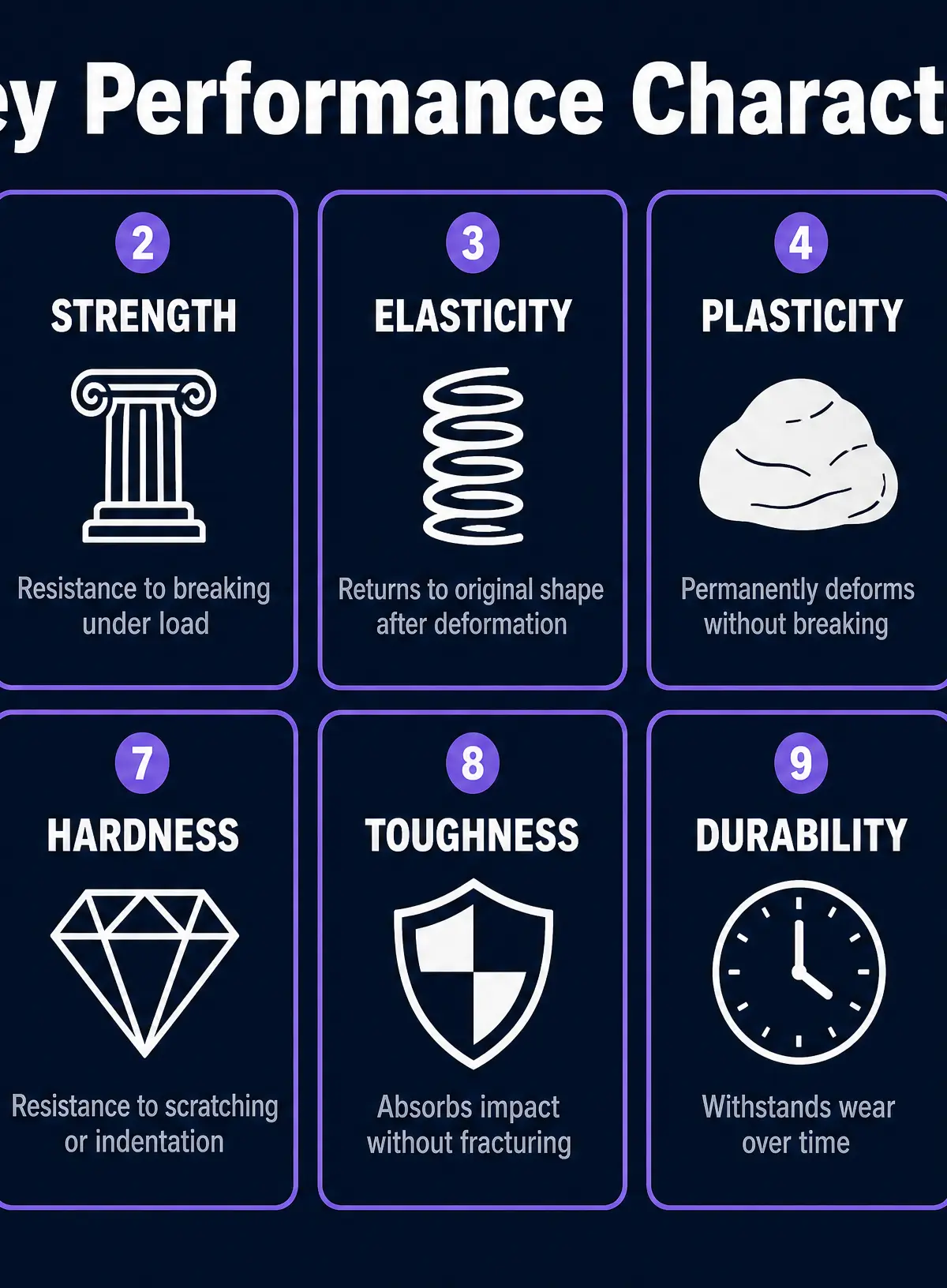
- Conductivity: The ability of a material to transfer heat or electrical current. Metals like copper are excellent conductors, while polymers are typically insulators.
- Strength: The ability of a material to withstand applied loads without breaking. This includes tensile strength (pulling), compressive strength (squashing), and shear strength (sliding forces).
- Elasticity: The ability of a material to return to its original shape and size after a deforming force has been removed (e.g., rubber).
- Plasticity: The ability of a material to permanently deform without breaking when subjected to a force. It retains its new shape once the force is removed.
- Malleability: A specific type of plasticity; the ability to be permanently deformed in all directions by compression (e.g., hammering or rolling) without cracking.
- Ductility: The ability to be drawn or stretched out into a thin wire or thread without breaking (e.g., copper wire).
- Hardness: The ability of a material to resist scratching, wear, tear, and indentation. High-carbon steel is much harder than mild steel.
- Toughness: The ability of a material to absorb impact energy without fracturing. A tough material can take a sudden shock (e.g., mild steel).
- Durability: The ability of a material to withstand wear, pressure, or damage over a long period of use, maintaining its functional characteristics.
- Biodegradability: The ability of a material to be broken down naturally by microorganisms in the environment (e.g., timber, cotton).
Material Categories
| Material Category | Key Properties | Common Examples | Typical Applications |
|---|---|---|---|
| Woods (Timber) | Good strength-to-weight ratio, workable, biodegradable, insulator | Oak (Hardwood), Pine (Softwood), MDF (Manufactured Board) | Furniture, construction, model making |
| Metals | High strength, ductile, malleable, good conductors | Mild Steel (Ferrous), Aluminium (Non-ferrous), Brass (Alloy) | Car bodies, electrical wiring, structural beams |
| Polymers | Lightweight, water-resistant, insulators, often plastic | Acrylic (Thermoplastic), Epoxy Resin (Thermosetting) | Casings, packaging, adhesives |
| Composites | Combined properties (e.g., high strength + low weight) | Carbon Fibre Reinforced Polymer (CFRP), GRP | Aerospace, sports equipment, boat hulls |
| Smart Materials | Properties change in response to external stimuli | Shape Memory Alloys (Nitinol), Thermochromic pigments | Medical stents, temperature indicators |
Practical Skills
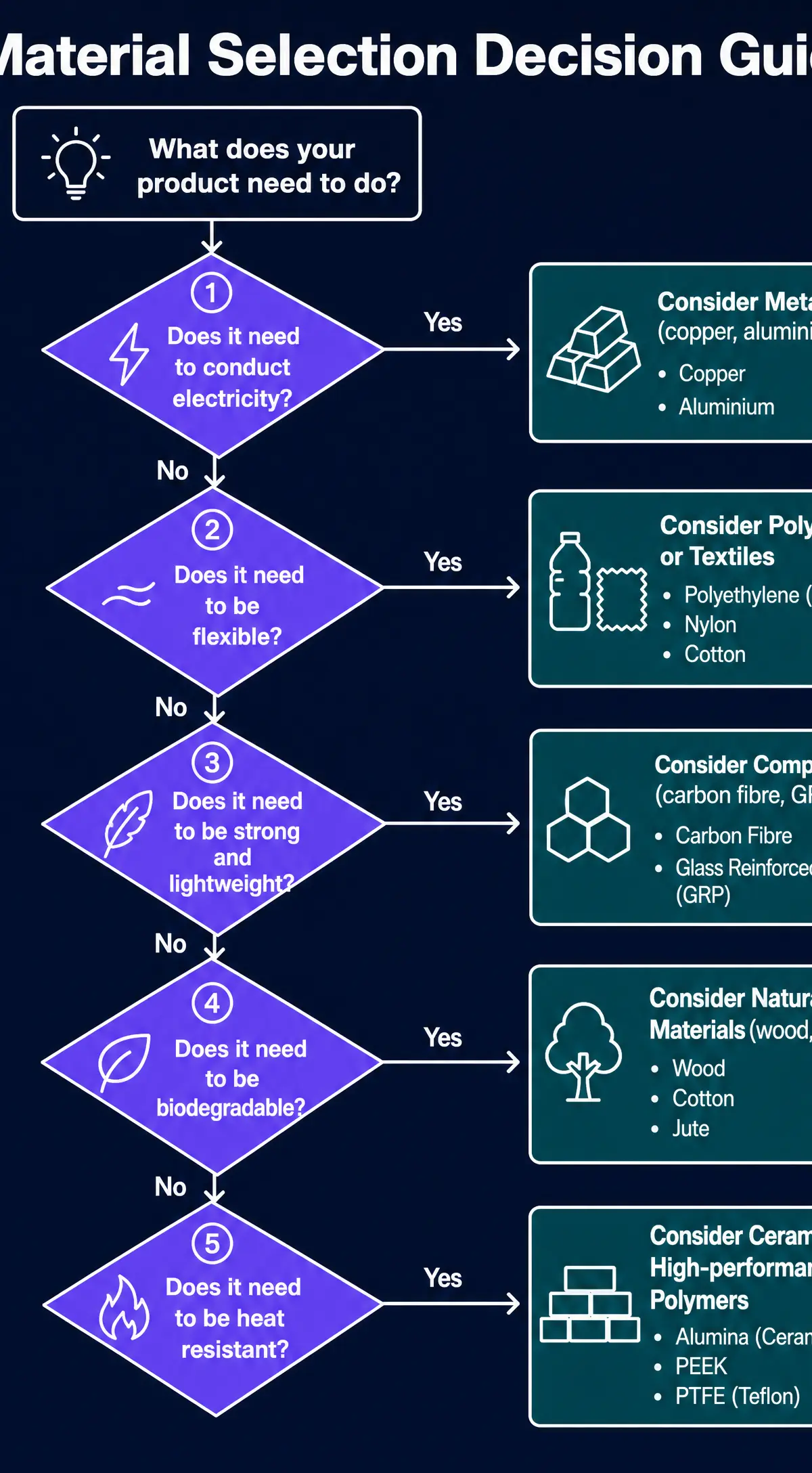
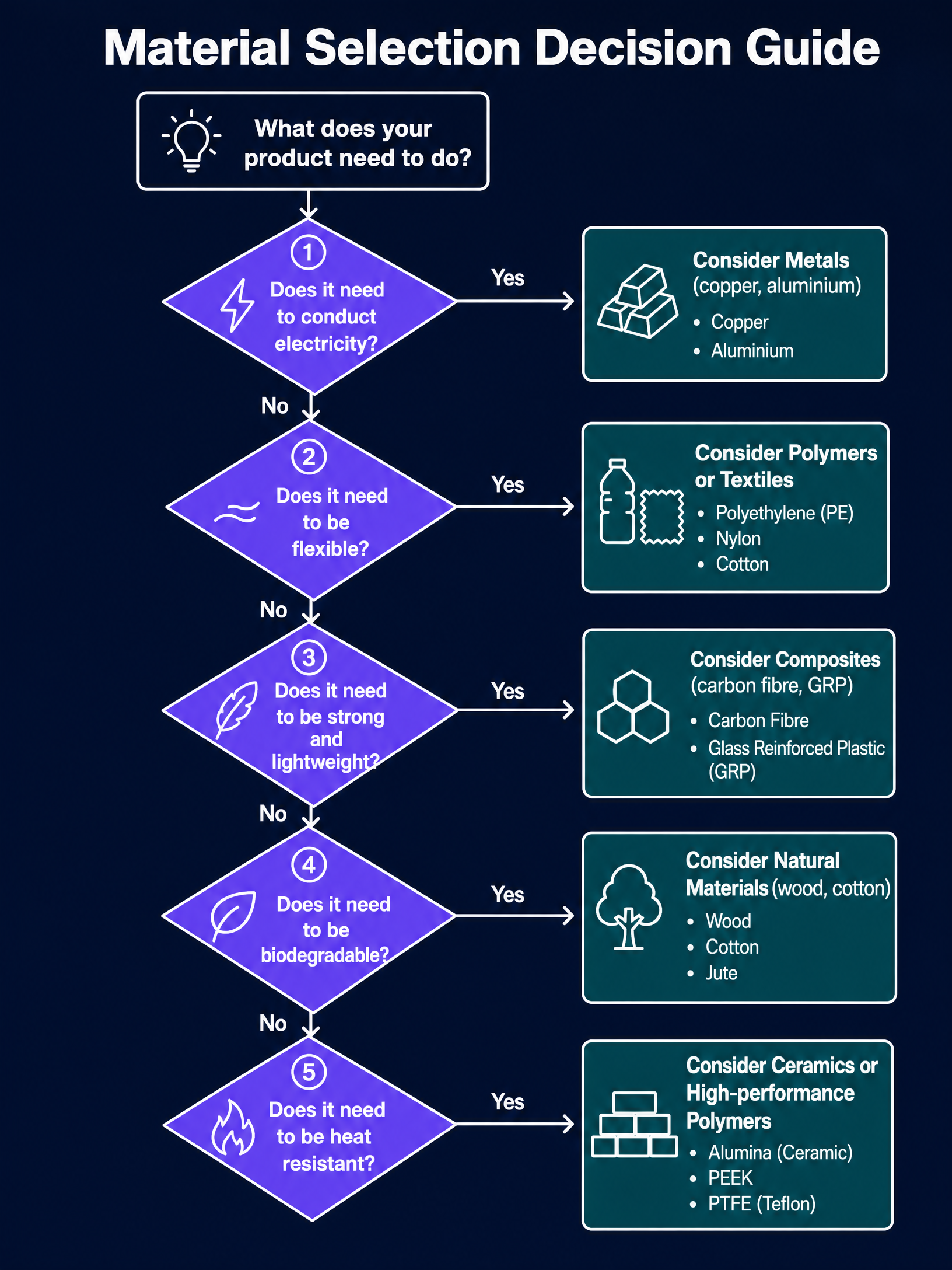
Material Selection Process
When designing a product, you must evaluate the functional requirements and match them to material properties.
Testing Materials
In the workshop, you can perform simple comparative tests to evaluate material properties:
- Hardness Test: Use a centre punch and a hammer with equal force on different materials and measure the size of the indentation.
- Tensile Strength Test: Clamp a sample securely and apply increasing weights until the material breaks or deforms.
- Conductivity Test: Use a multimeter to measure the electrical resistance across a set length of different material samples.
Portfolio/Coursework Guidance
Assessment Criteria
In your NEA, examiners award marks for how well you justify your material choices. You cannot simply state, "I used acrylic because it looks nice." You must say, "I selected acrylic for the casing because it is a thermoplastic with high impact resistance, excellent optical clarity, and it can be easily line-bent using a strip heater."
Building a Strong Portfolio
- Record Experimentation: Document your material testing. Show photographs of failed tests as well as successes to prove you understand material limitations.
- Justify with Terminology: Always use the correct technical vocabulary (the 'Magnificent Ten') when annotating your design developments.
- Consider Sustainability: Explicitly discuss the biodegradability, recyclability, and environmental impact of your chosen materials.
Exam Component
Written Exam Knowledge
In the written paper, you will face questions asking you to justify the use of specific materials for given products. You must link the theoretical property directly to the practical application.
Exam Strategy
Pay close attention to the command words:
- Identify: State the property (e.g., "Conductivity").
- Describe: Give an account of the property (e.g., "The ability to transfer heat or electricity").
- Explain: Provide a reasoned justification linking property to application (e.g., "Copper is used for wiring because its high electrical conductivity allows efficient energy transfer").
Visual Resources
2 diagrams and illustrations
Interactive Diagrams
1 interactive diagram to visualise key concepts
Conceptual Flow Outline
Logical process for material selection and justification.
Worked Examples
3 worked examples — open one to explore the question and available guidance.
Practice Questions
Test your understanding — click to reveal model answers
Identify two performance characteristics that make copper suitable for electrical wiring. (2 marks)
Hint: Think about what the wire needs to carry, and how the wire is shaped during manufacturing.
Explain why carbon fibre reinforced polymer (CFRP) is increasingly used instead of aluminium for manufacturing high-performance tennis rackets. (4 marks)
Hint: Compare the specific properties of a composite to a lightweight metal.
A student is designing a children's outdoor play slide. Evaluate the suitability of using a thermoplastic versus a hardwood for this product. (6 marks)
Hint: Consider weather resistance, safety (splinters), maintenance, and sustainability.