Pearson Edexcel · A-Level · Design and Technology
Part 4: Evaluating own design and prototype
This topic covers the essential performance characteristics of materials and the framework for evaluating your own designs. Mastering this allows you to make informed, justified material choices—a critical skill that examiners reward heavily in both your NEA coursework and written exams.
- 7 min read
- 3 worked examples
- 3 practice questions
- 6 key terms
Study Notes
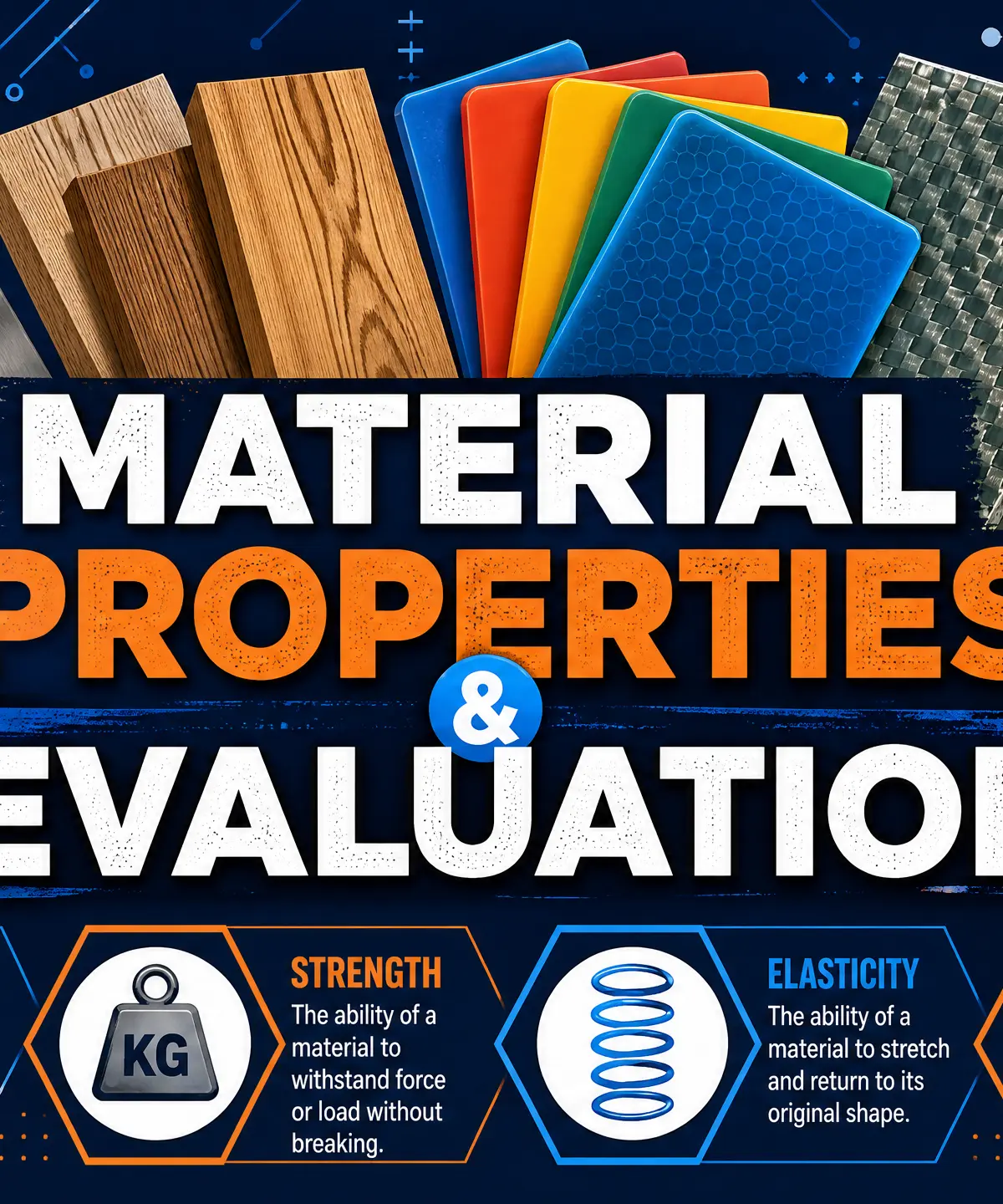
Overview
Understanding material properties is the foundation of Design and Technology. When examiners assess your coursework portfolio or your written exam answers, they are looking for your ability to discriminate between materials based on their performance characteristics. You must be able to justify why a specific material is suitable for a specific application, using correct scientific terminology. Furthermore, you must apply this knowledge to iteratively evaluate your own designs and prototypes against your initial success criteria.
Key Knowledge & Theory
Core Concepts
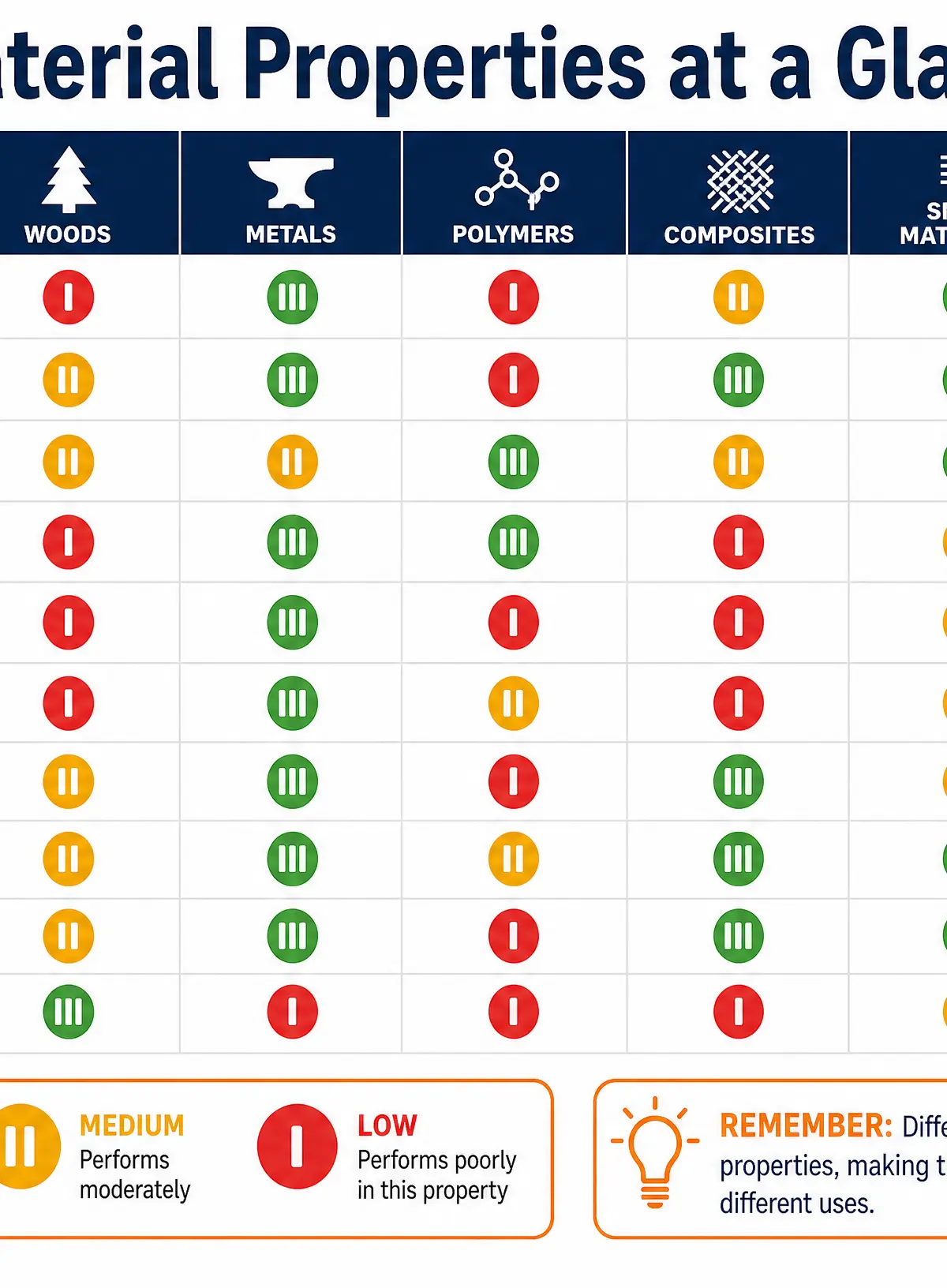
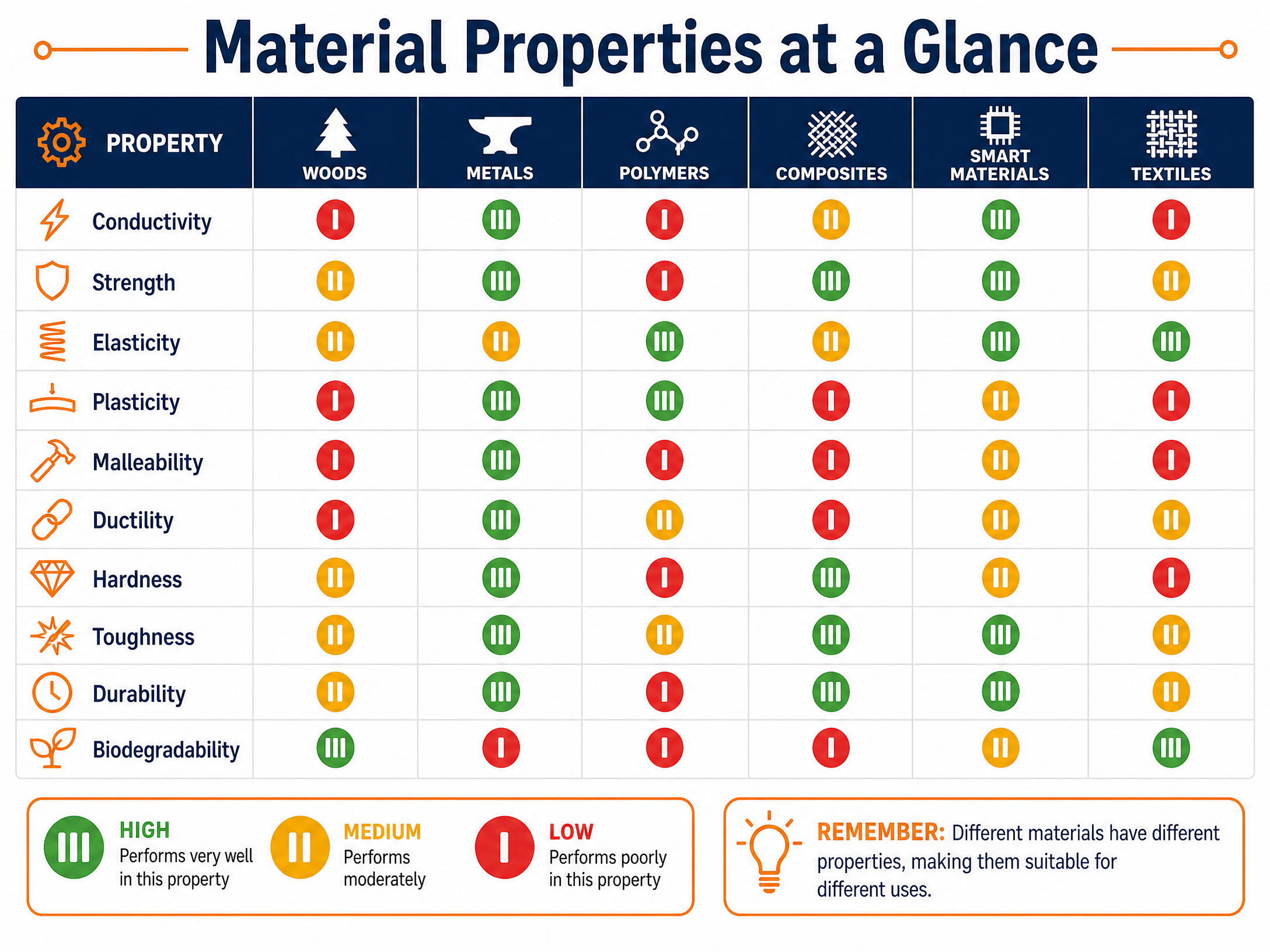
To make informed design decisions, you must understand how materials behave under different conditions. The specification requires you to know ten fundamental performance characteristics. These apply across all material categories: woods, metals, polymers, smart and modern materials, papers, boards, textiles, and composites.

1. ConductivityHow well a material allows heat (thermal conductivity) or electricity (electrical conductivity) to pass through it.
Application: Copper is used for electrical wiring due to its high electrical conductivity, while polymers are used for tool handles because they are thermal and electrical insulators.
2. StrengthThe ability of a material to withstand a force or load without breaking or permanently deforming. You must specify the type of strength:
- Tensile strength: Resistance to being pulled apart (e.g., ropes, cables).
- Compressive strength: Resistance to being squashed (e.g., bricks, concrete).
- Shear strength: Resistance to sliding forces or cutting.
3. ElasticityThe ability of a material to stretch or compress under force and return to its original shape when the force is removed.
Application: Elastane in sportswear; springs in mechanical devices.
4. PlasticityThe ability of a material to be permanently deformed and retain its new shape without breaking.
Application: Heating a thermoplastic like acrylic allows it to be bent into a new shape (line bending).
5. MalleabilityA specific type of plasticity: the ability of a material to be hammered, pressed, or rolled into thin sheets without cracking.
Application: Mild steel is malleable, allowing it to be pressed into car body panels.
6. DuctilityThe ability of a material to be drawn out (stretched) into a thin wire without breaking.
Application: Copper and aluminium are highly ductile.
7. HardnessThe resistance of a material to scratching, wear, or indentation.
Application: High carbon steel is used for cutting tools because its hardness prevents the edge from blunting quickly.
8. ToughnessThe ability of a material to absorb impact energy without fracturing. A tough material will deform rather than shatter.
Application: Mild steel is tough; glass is hard but brittle (not tough).
9. DurabilityThe ability of a material to withstand wear, pressure, corrosion, and degradation over time, maintaining its performance.
Application: Stainless steel has high durability in wet environments; untreated mild steel does not.
10. BiodegradabilityThe ability of a material to be broken down naturally by microorganisms into harmless substances.
Application: Biopol (PHA) is a biodegradable polymer used for disposable packaging to reduce landfill impact.
Technical Vocabulary
- Alloy: A mixture of two or more metals (or a metal and a non-metal) to improve specific properties.
- Composite: A material made from two or more constituent materials with significantly different physical or chemical properties.
- Smart Material: A material that changes its properties in response to an external stimulus (e.g., temperature, light, pressure).
- Iterative Design: A cyclical process of prototyping, testing, evaluating, and refining a product.
Practical Skills
Techniques & Processes: Testing Material Properties
In your coursework, you may need to conduct practical tests to justify your material choices.
- Tensile Testing: Clamp a standard sample of material and apply increasing weights until it breaks. Record the maximum load.
- Hardness Testing: Use a centre punch and a hammer with a consistent force to indent the material. Measure the size of the indentation (smaller indent = harder material).
- Toughness Testing: Secure the material in a vice and strike it with a pendulum or hammer. Observe whether it bends (tough) or snaps/shatters (brittle).
Materials & Equipment
When selecting materials for your prototype, consider not just the final properties, but how the material behaves during manufacture. For example, acrylic is excellent for laser cutting but brittle if drilled incorrectly. MDF is stable and easy to machine but generates hazardous dust, requiring appropriate PPE and extraction.
Portfolio/Coursework Guidance
Assessment Criteria for Evaluation
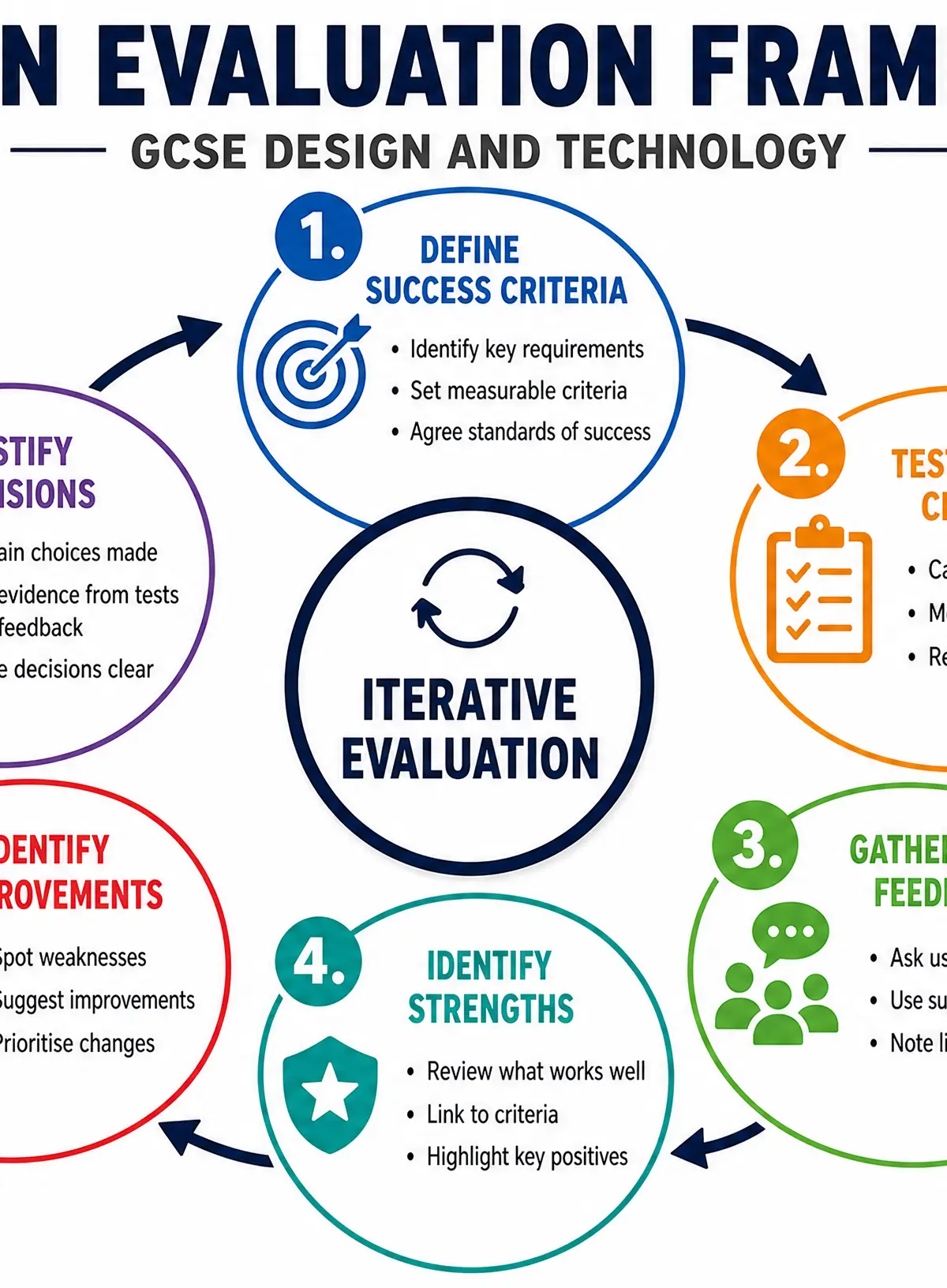
Examiners award the highest marks in the evaluation section to candidates who:
- Critically and objectively test their prototype against the original design specification.
- Gather and analyse meaningful feedback from their target user or client.
- Suggest realistic, justified modifications to improve the design.
- Explain how their material choices impacted the success of the final product.
Building a Strong Portfolio
To evidence your evaluation skills:
- Document the process: Do not wait until the end to evaluate. Show iterative evaluation throughout the making process. If a joint fails, photograph it, explain why (e.g., "the material lacked sufficient shear strength"), and document your solution.
- User Testing: Provide photographic evidence of your target user interacting with the prototype. Include direct quotes from their feedback.
- Justify everything: Never state an improvement without a "because..." clause linking back to material properties or manufacturing processes.
Exam Component
Written Exam Knowledge
In the written paper, you will frequently encounter questions presenting a product and asking you to justify the materials used. You must structure your answers logically: **Identify the property -> Define it -> Link it to the product's function.**You may also be asked to compare two materials for a specific application. In comparison questions, you must discuss both materials, highlighting the advantages of one and the relative disadvantages of the other in that specific context.
Visual Resources
2 diagrams and illustrations
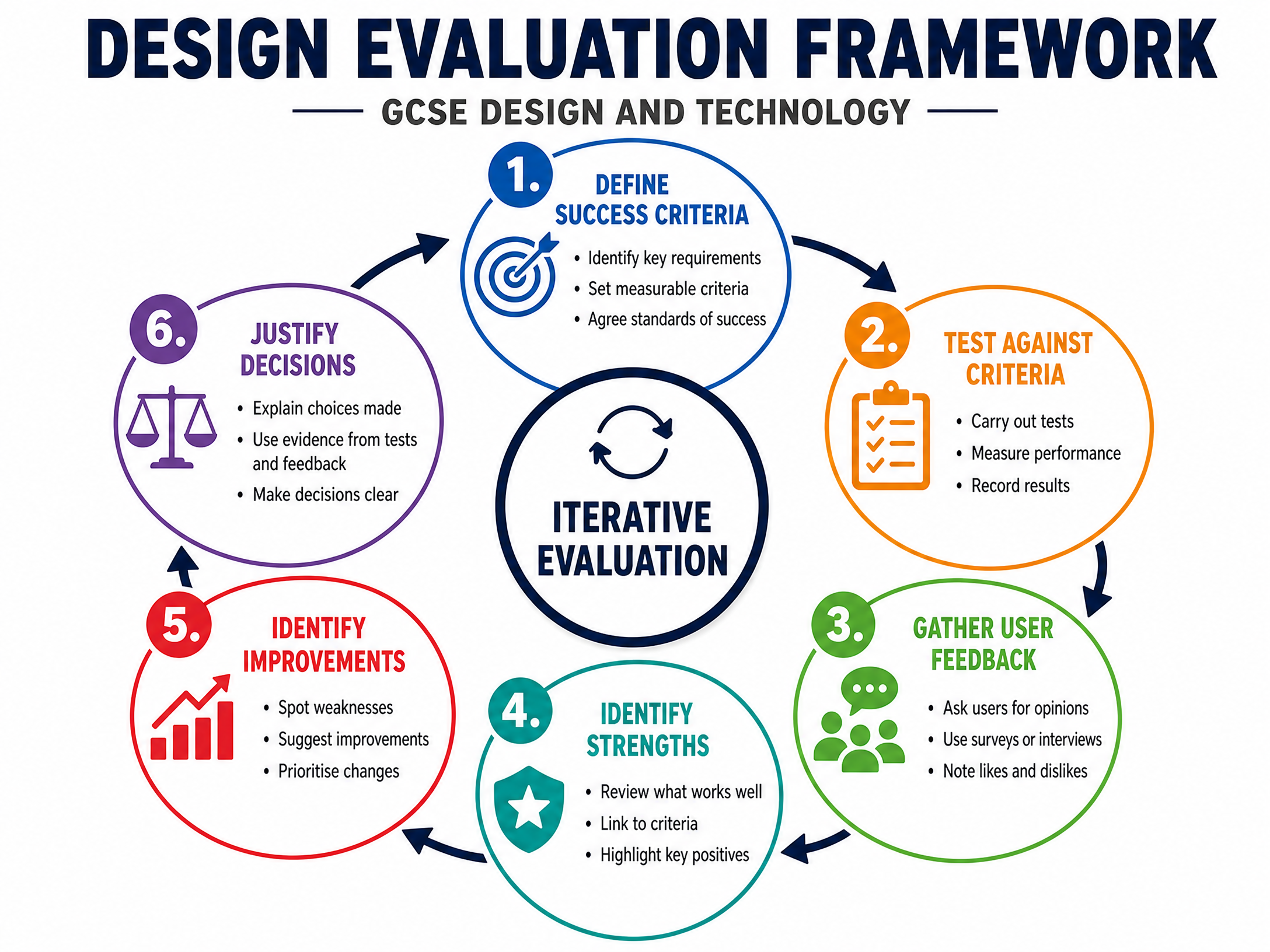
Interactive Diagrams
1 interactive diagram to visualise key concepts
Conceptual Flow Outline
The Iterative Evaluation Process
Worked Examples
3 worked examples — open one to explore the question and available guidance.
Practice Questions
Test your understanding — click to reveal model answers
Identify the property that allows copper to be drawn into thin wires for electrical cables. (1 mark)
Hint: Think about the difference between shaping into sheets and drawing into wires.
Explain two reasons why aluminium is a suitable material for a drinks can. (4 marks)
Hint: Think about manufacturing processes and the environment the can will be in.
A student has designed a wooden chopping board. Evaluate the suitability of using beech compared to pine for this product. (6 marks)
Hint: Compare the hardness, toughness, and grain structure of hardwoods vs softwoods in the context of a knife cutting on the surface.