Pearson Edexcel · A-Level · Design and Technology
Topic 11: Information handling, Modelling and forward planning
This topic covers how designers gather and use data, test ideas through modelling, and plan production efficiently. It is a critical foundation for both the written exam and your Non-Examined Assessment (NEA) coursework.
- 5 min read
- 3 worked examples
- 4 practice questions
- 6 key terms
Study Notes
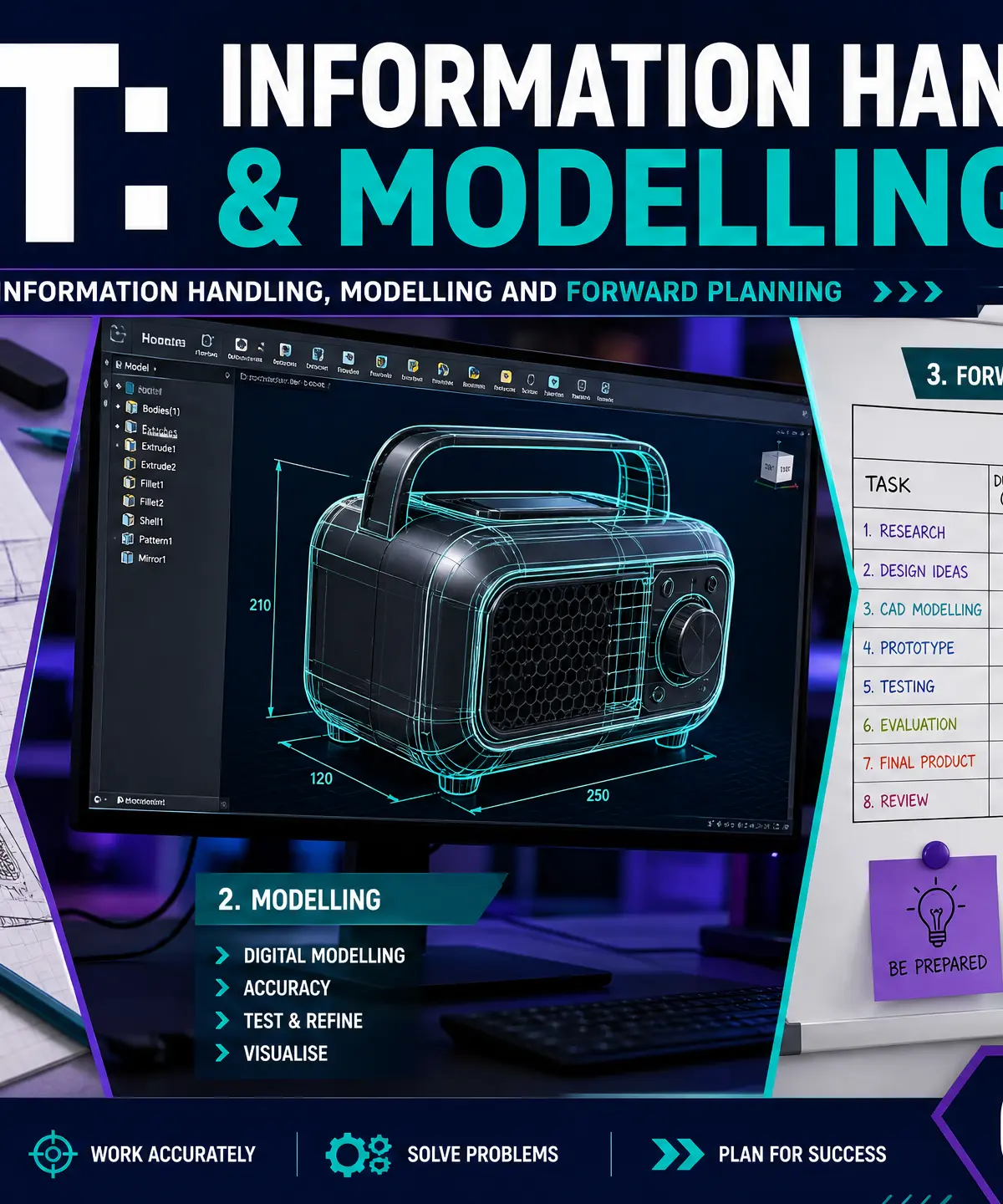
Overview
Topic 11: Information Handling, Modelling and Forward Planning is at the core of the iterative design process. Before a designer commits to manufacturing a final product, they must understand the problem, test potential solutions, and plan how the product will be made. This topic explores the tools and techniques used to make these critical decisions.
Key Knowledge & Theory
Information Handling
Information handling involves collecting, organising, and analysing data to inform design decisions. Designers rely on two main types of research:
Primary Research: Information gathered firsthand directly from the source. This includes surveys, questionnaires, interviews, and physical product testing. It is highly specific to the design problem but can be time-consuming to collect.
Secondary Research: Information that already exists and was collected by someone else. This includes reading books, browsing websites, studying British Standards, and reviewing existing product specifications. It is quick to gather but may not be perfectly tailored to your specific needs.
Data Presentation
Once data is collected, it must be organised:
- Spreadsheets: Used for numerical data, cost calculations, and creating charts.
- Databases: Used for storing and searching large volumes of information (e.g., material properties).
- Charts & Graphs: Visualise trends and comparisons (e.g., bar charts for survey results).
- Mood Boards: Organise qualitative data such as colour schemes, textures, and aesthetic inspiration.
Modelling
Modelling is the process of creating a representation of a design to test and communicate ideas. Crucially, modelling saves time and money by identifying flaws before expensive manufacturing begins.
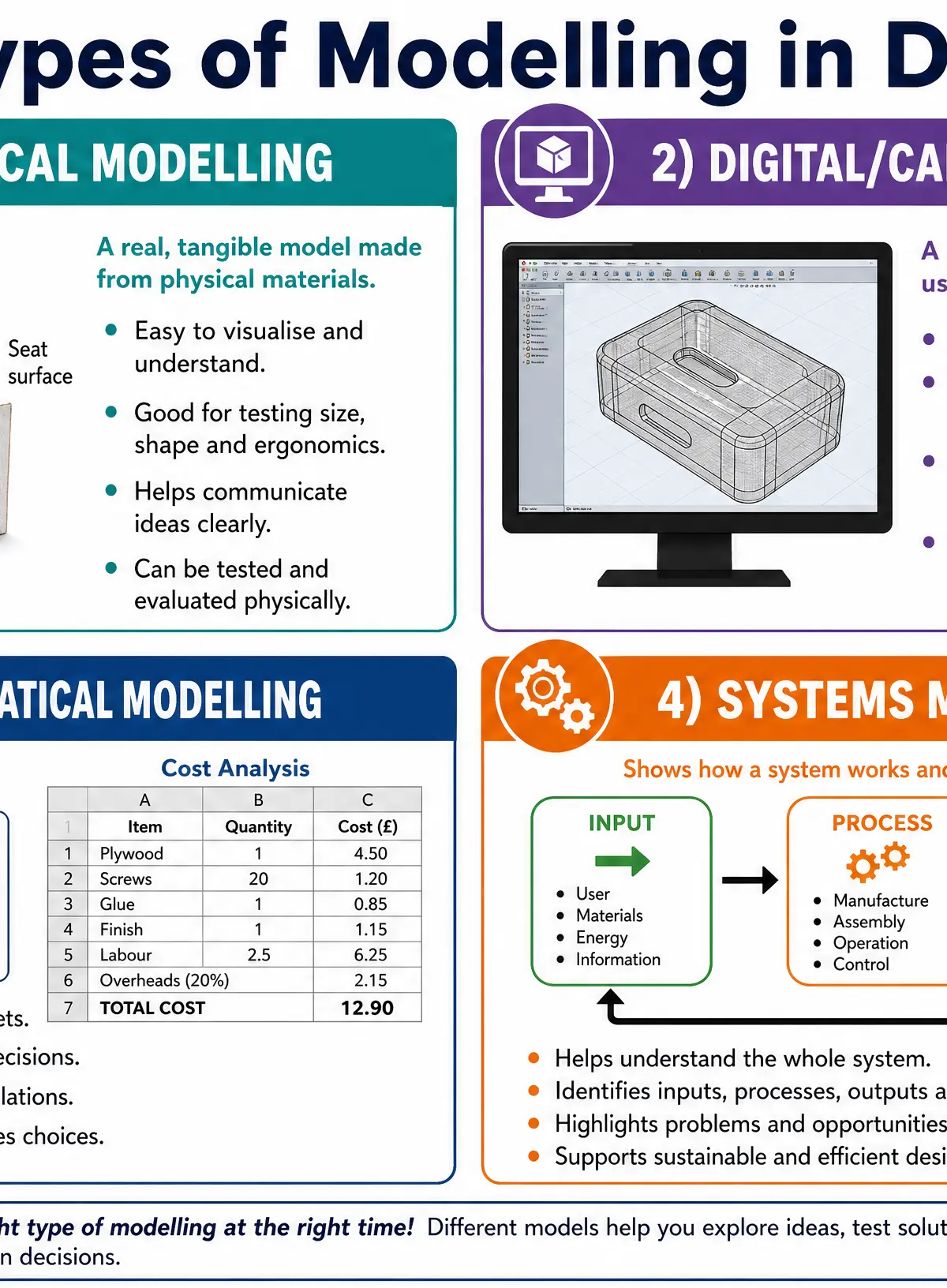
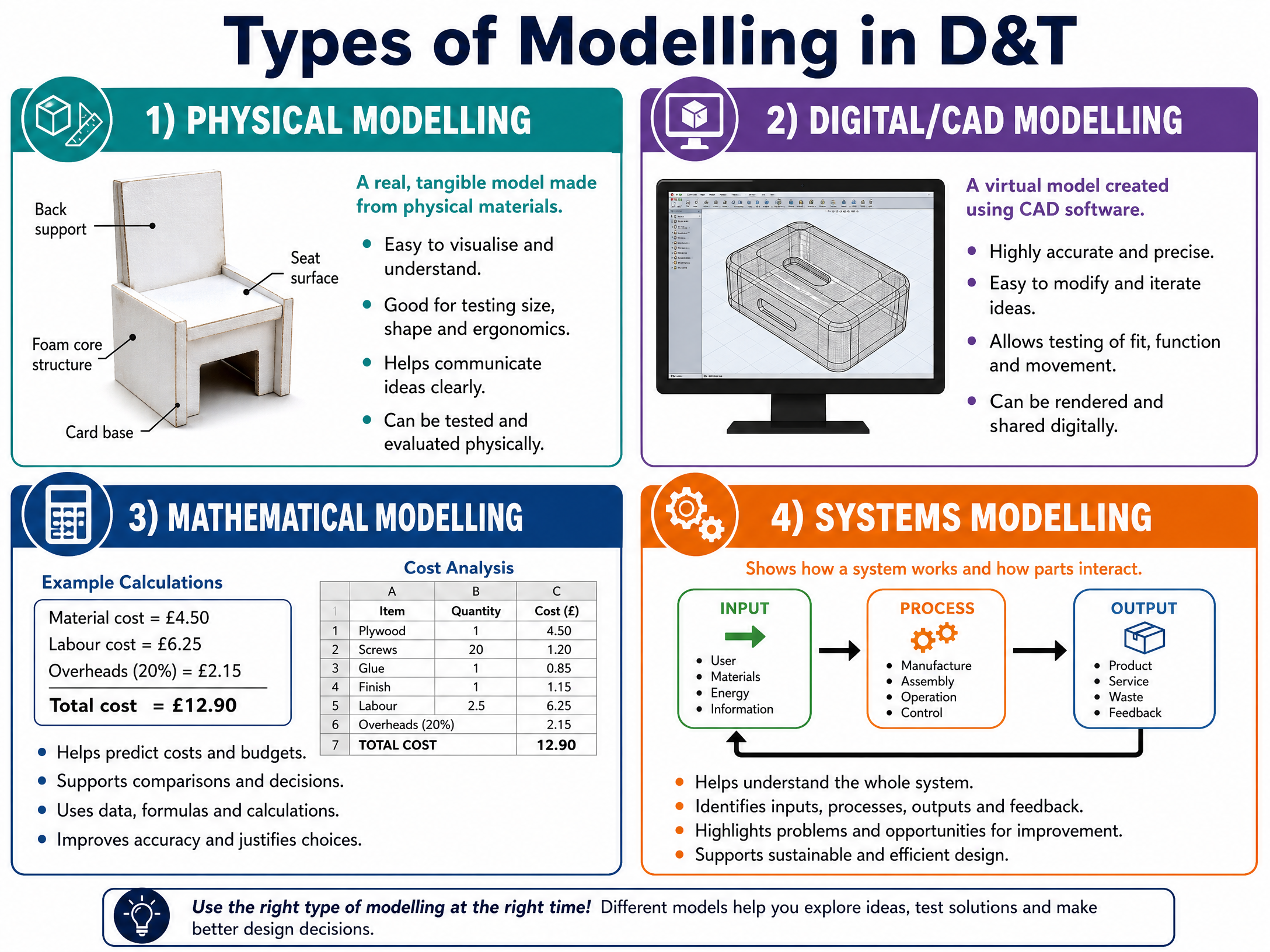
There are four main types of modelling:
- Physical Modelling: Creating tangible 3D models using materials like card, foam, balsa wood, or clay. Excellent for testing ergonomics and scale.
- Digital/CAD Modelling: Using Computer-Aided Design software (e.g., Fusion 360, SolidWorks) to create precise virtual models. Allows for stress testing, rapid modification, and realistic rendering.
- Mathematical Modelling: Using calculations to predict performance, such as working out structural loads or material costs.
- Systems Modelling: Using diagrams (like block diagrams) to represent how a system functions, showing inputs, processes, and outputs.
Forward Planning
Forward planning ensures that manufacturing is efficient, cost-effective, and completed on time.
- Gantt Charts: A visual timeline showing tasks plotted against time. They highlight concurrent tasks (tasks happening simultaneously) and sequential tasks (tasks that must happen in order).
- Flow Charts: Diagrams using standard symbols to map out a sequence of operations or decisions in a manufacturing process.
- Critical Path Analysis: Identifying the longest sequence of dependent tasks in a project to determine the minimum completion time.
- Production Schedules: Detailed timetables listing every task, required resources, and personnel responsible.
Quality Control vs Quality Assurance
- Quality Control (QC): Reactive checks during or after production to ensure products meet standards (e.g., measuring a part, visually inspecting a finish).
- Quality Assurance (QA): Proactive systems and procedures put in place to prevent defects from occurring in the first place (e.g., staff training, regular machine maintenance).
Practical Skills
Applying Research in the NEA
In your coursework, examiners expect to see a clear link between your research and your design ideas. If your primary research shows users prefer a lightweight product, your subsequent design sketches must reflect this. Do not conduct research just to tick a box; use it to justify your design decisions.
Effective Modelling Techniques
When physical modelling, start with low-fidelity materials (like corrugated cardboard) for quick massing models, then progress to higher-fidelity materials (like Styrofoam or 3D printing) for detailed ergonomic testing. Always photograph your models being tested by potential users.
Portfolio/Coursework Guidance
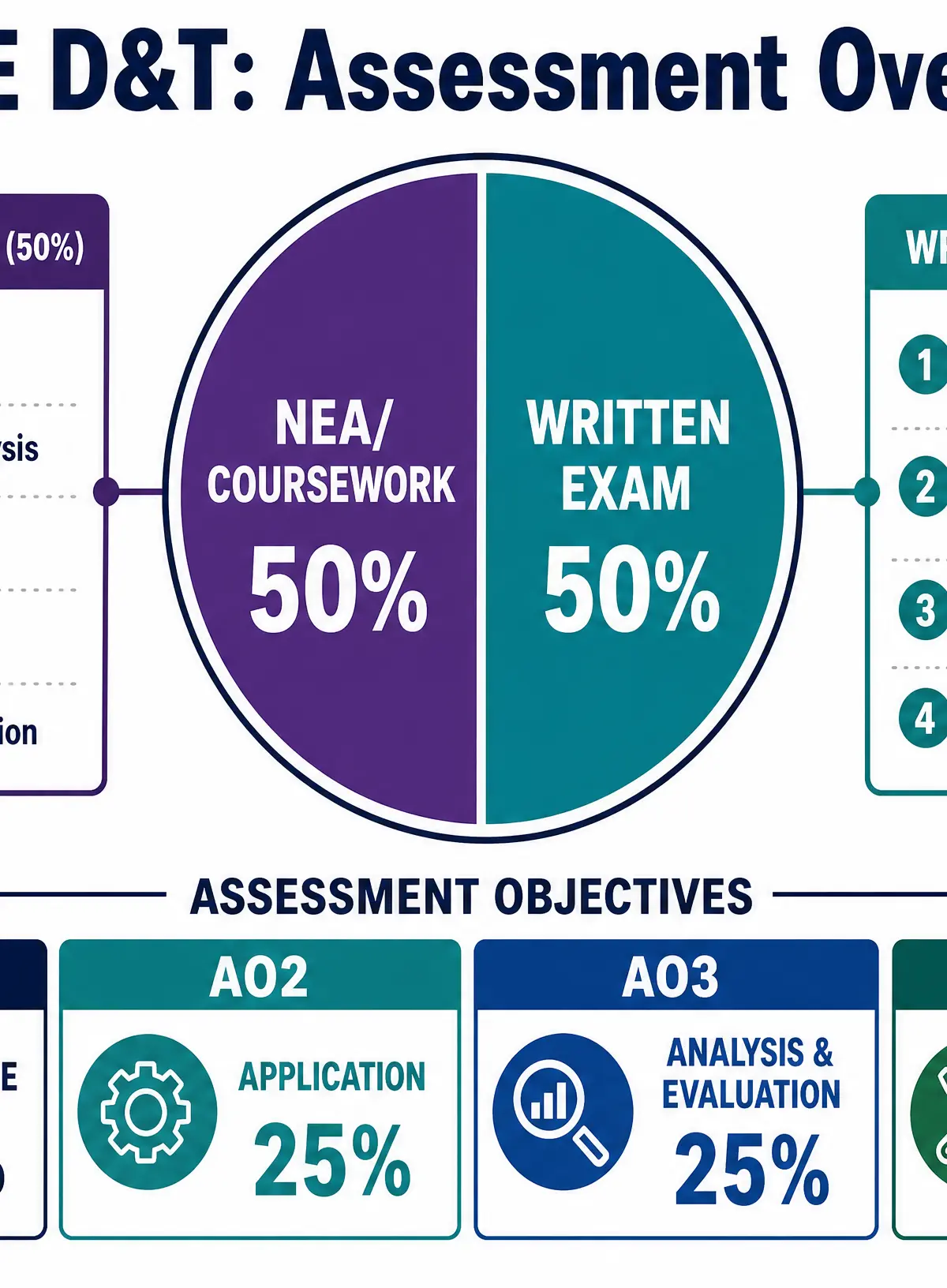
Evidencing Information Handling
Your portfolio must demonstrate a clear journey from research to final product. Annotate your research pages with conclusions: "From this survey, I have learned that... Therefore, my design will..."
Documenting Forward Planning
Include a detailed Gantt chart or production plan before you begin making your final prototype. As you manufacture, keep a diary or log. If you deviate from your plan, explain why — examiners reward candidates who can adapt and solve problems during the making process.
Exam Component
Written Exam Preparation
The written exam frequently tests your ability to evaluate different modelling methods. You must be able to confidently compare CAD with physical modelling, providing balanced arguments for both. You may also be asked to interpret data from a table or chart, or to explain the purpose of quality control checks in a given manufacturing scenario.
Listen to the Topic 11 Revision Podcast
For a comprehensive review of this topic, including exam tips and a quick-fire quiz, listen to the revision podcast below:
Visual Resources
3 diagrams and illustrations
Interactive Diagrams
1 interactive diagram to visualise key concepts
Conceptual Flow Outline
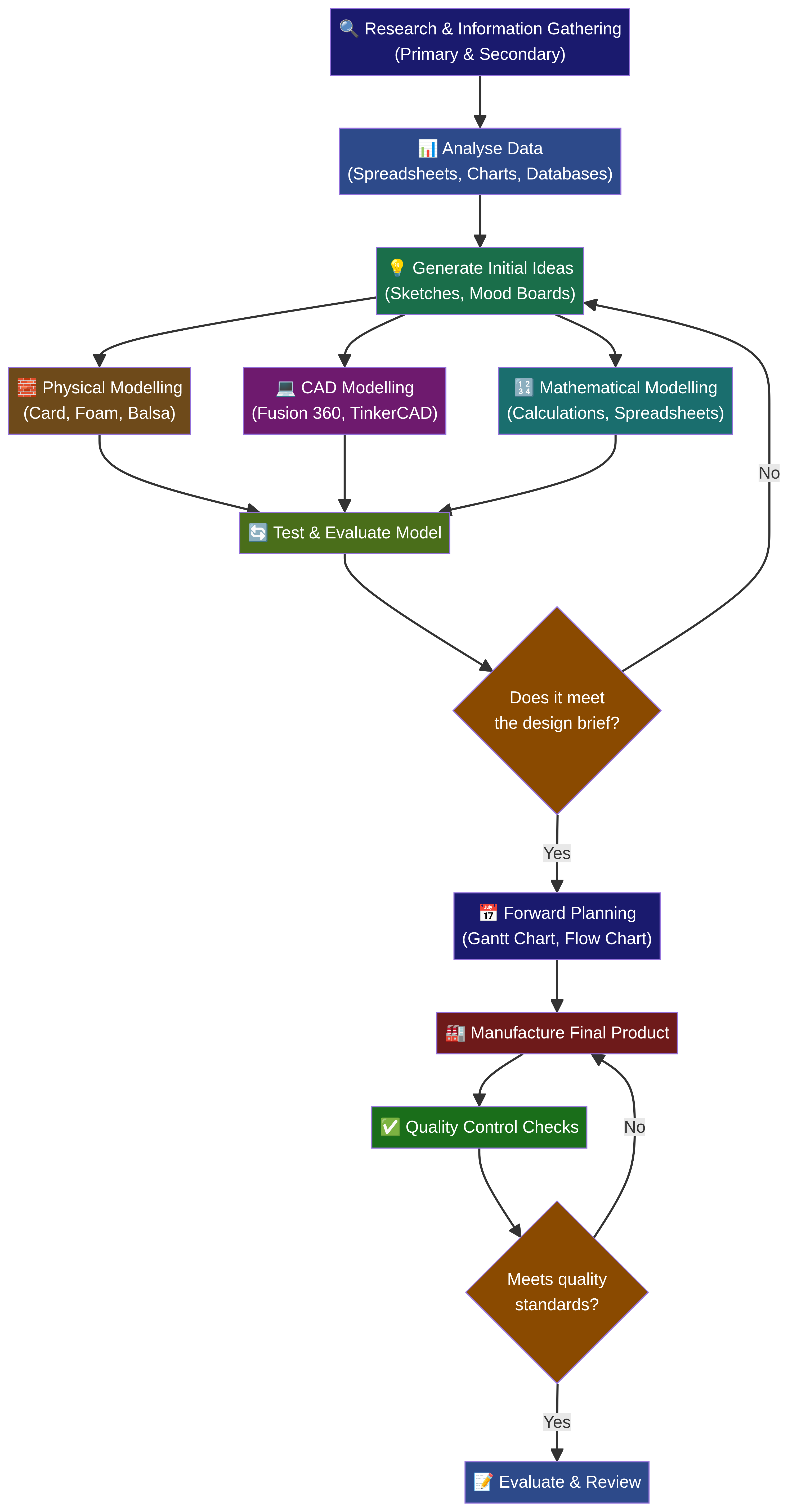
The Iterative Design and Planning Process
Worked Examples
3 worked examples — open one to explore the question and available guidance.
Practice Questions
Test your understanding — click to reveal model answers
Identify two methods of primary research a designer could use when designing a new backpack for students. [2 marks]
Hint: Think about information you collect yourself from the target market.
Explain two advantages of using a spreadsheet to handle data gathered from a consumer survey. [4 marks]
Hint: Think about what software can do automatically compared to working on paper.
A manufacturer is setting up a production line for a new desk lamp. Explain the difference between quality control and quality assurance in this context. [4 marks]
Hint: Remember the hook: QC catches, QA prevents.
Evaluate the use of physical modelling versus mathematical modelling when designing a new bridge. [6 marks]
Hint: Address both types of modelling. What does a physical model show that maths can't, and vice versa?