Pearson Edexcel · A-Level · Design and Technology
Topic 1: Materials
This comprehensive guide covers the essential performance characteristics of materials required for GCSE Design and Technology. It bridges the gap between scientific material properties and practical design choices, helping you select the right materials and justify those choices in your exam.
- 5 min read
- 3 worked examples
- 3 practice questions
- 6 key terms
Study Notes
Overview
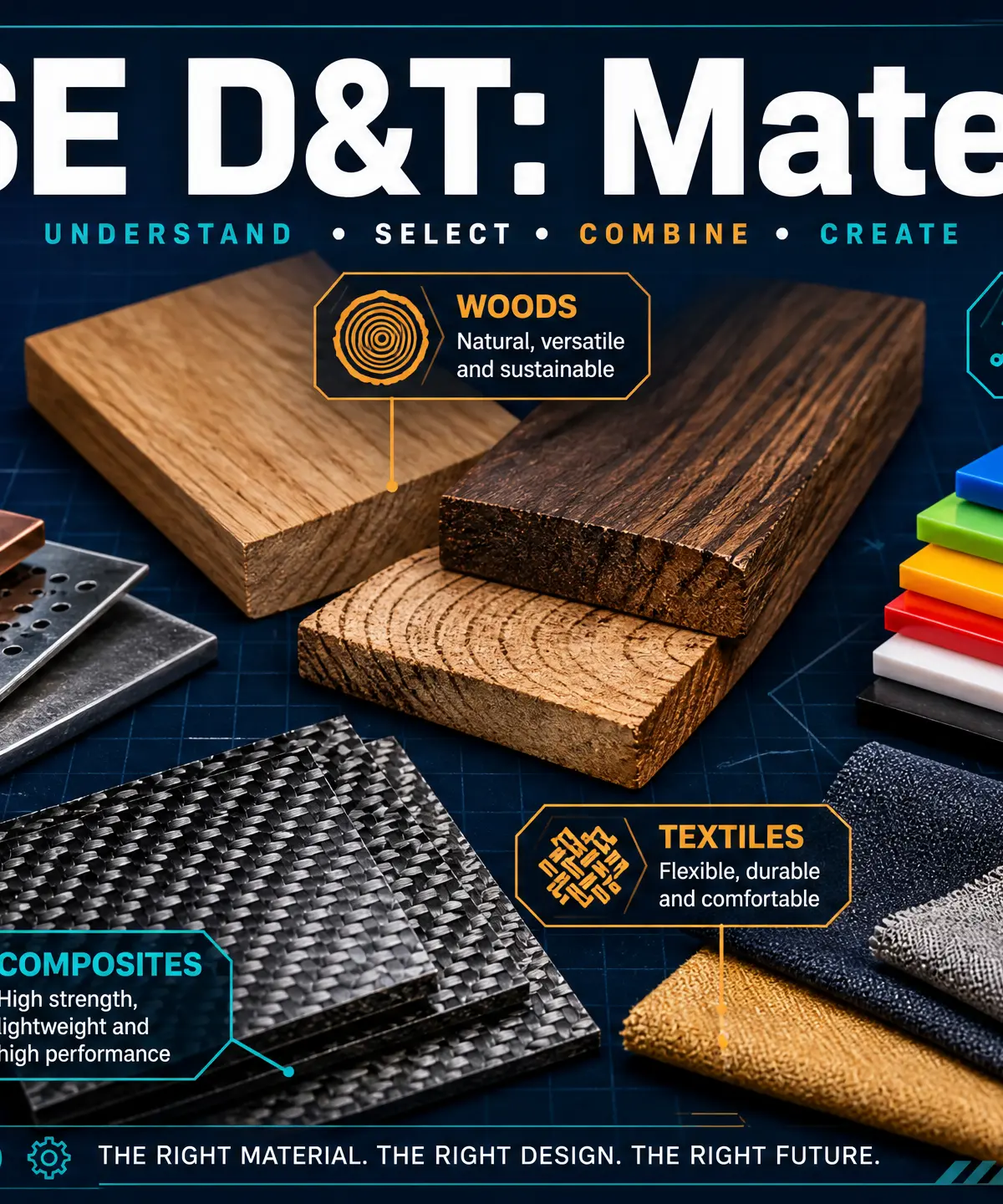
Welcome to Topic 1: Materials. In Design and Technology, understanding materials is the foundation of all good design. A brilliant concept will fail if manufactured from the wrong material. This topic requires you to understand the performance characteristics of woods, metals, polymers, smart and modern materials, papers, boards, textiles, and composites. You must be able to discriminate between these materials and justify your selection based on their specific properties.
Key Knowledge & Theory
Core Concepts: The 10 Material Properties
Before we look at specific materials, you must master the vocabulary used to describe them. Examiners look for precise use of these ten terms.
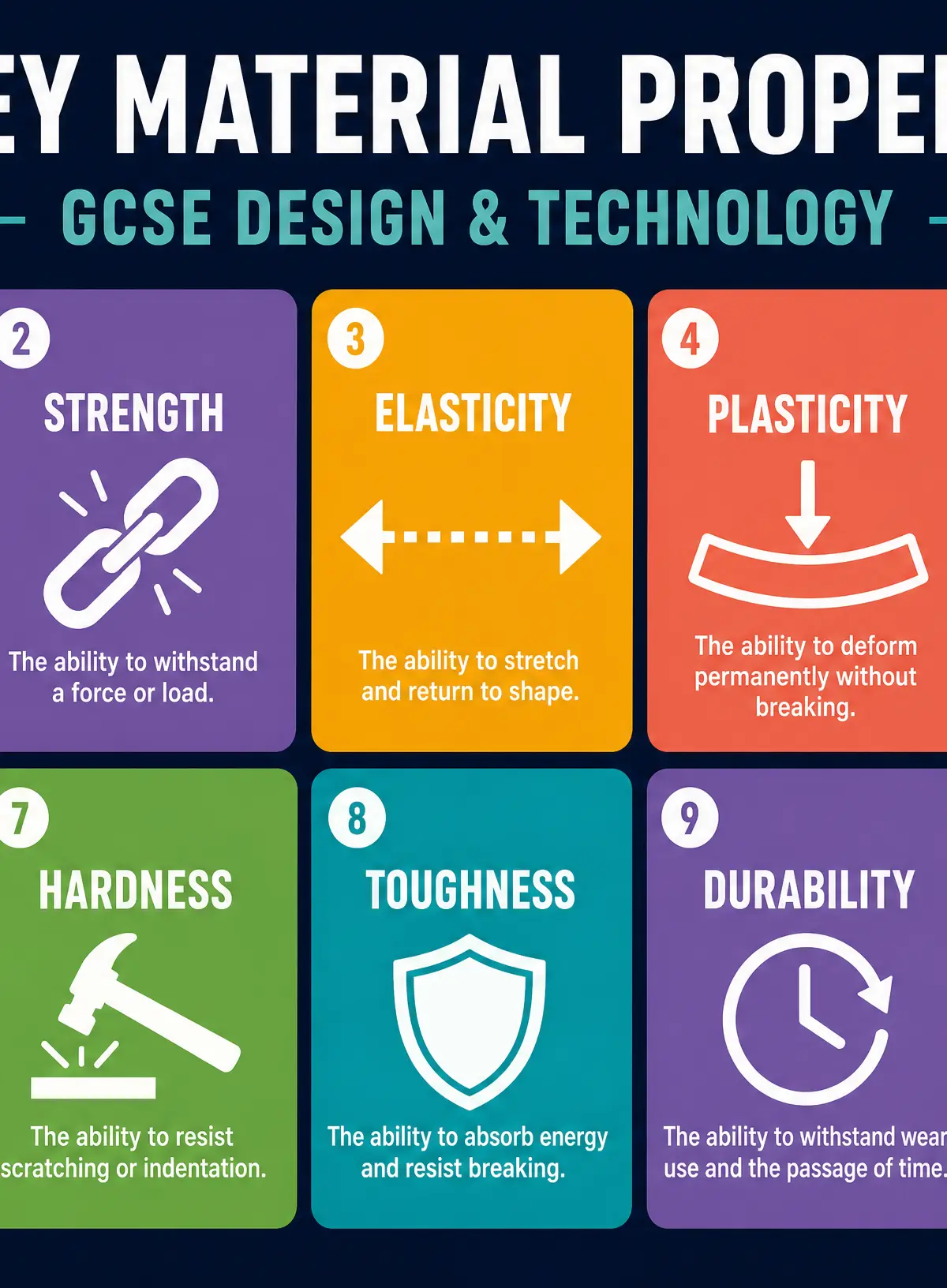
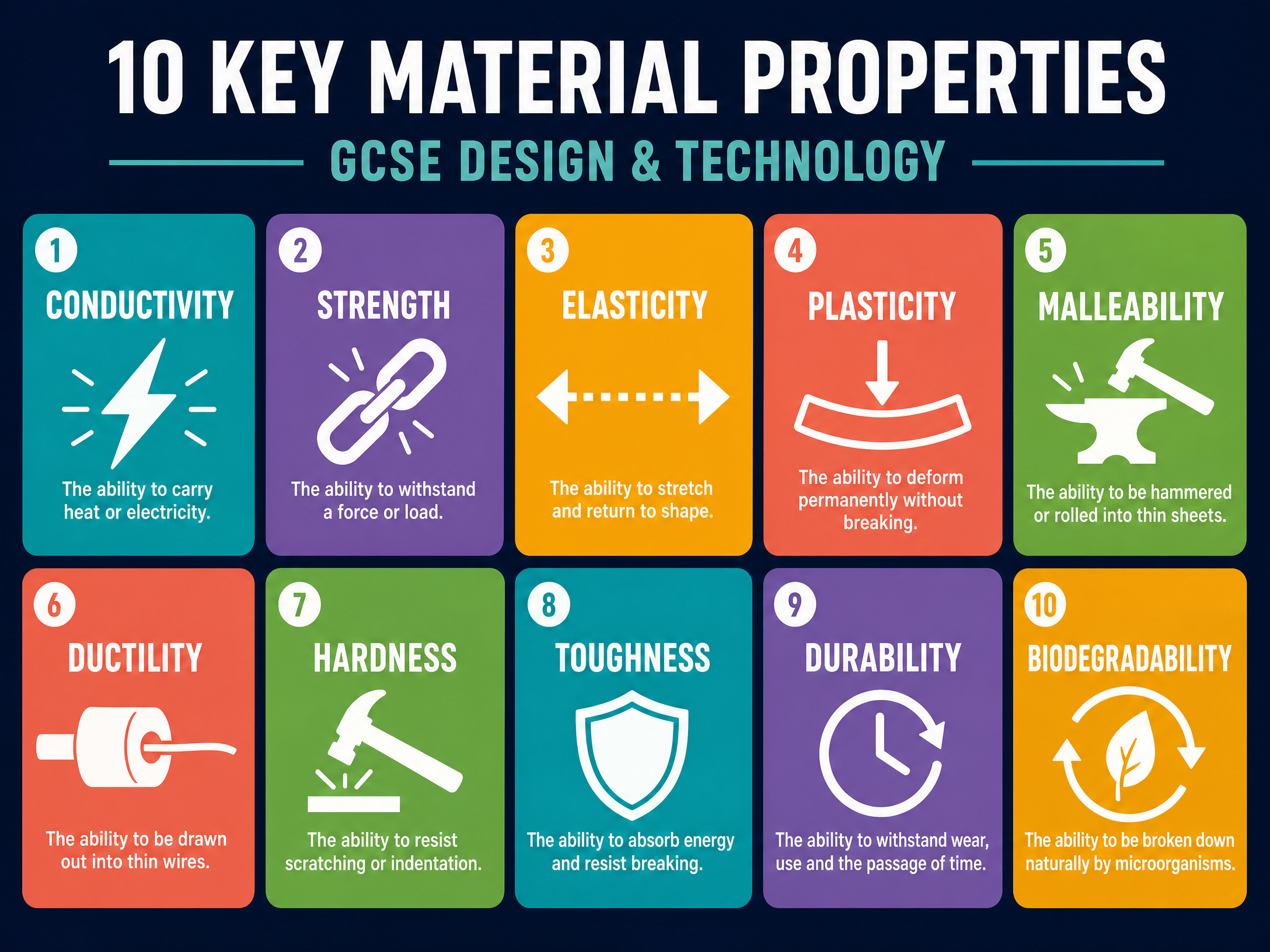
- Conductivity: The ability to carry heat or electricity. Metals are generally good conductors; polymers are insulators.
- Strength: The ability to withstand a force or load without breaking. This includes tensile (pulling), compressive (squashing), and shear forces.
- Elasticity: The ability to stretch and return to its original shape when the force is removed.
- Plasticity: The ability to deform permanently without breaking (the opposite of elasticity).
- Malleability: The ability to be hammered or rolled into thin sheets.
- Ductility: The ability to be drawn out into thin wires.
- Hardness: The ability to resist scratching, wear, or indentation.
- Toughness: The ability to absorb energy and resist breaking under impact.
- Durability: The ability to withstand wear, use, and environmental degradation over time.
- Biodegradability: The ability to be broken down naturally by microorganisms.
Material Categories
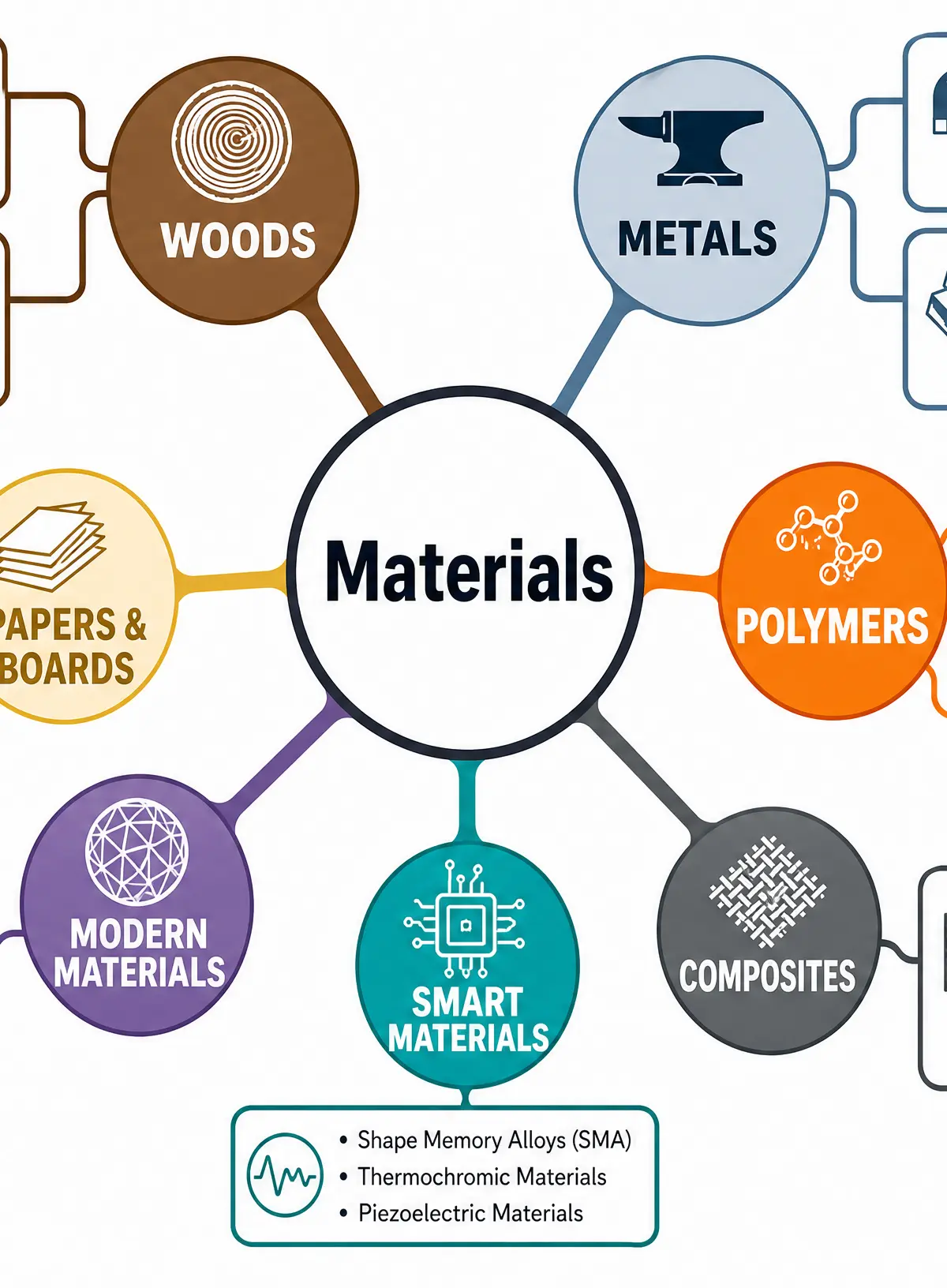
| Category | Sub-categories | Examples | Key Characteristics |
|---|---|---|---|
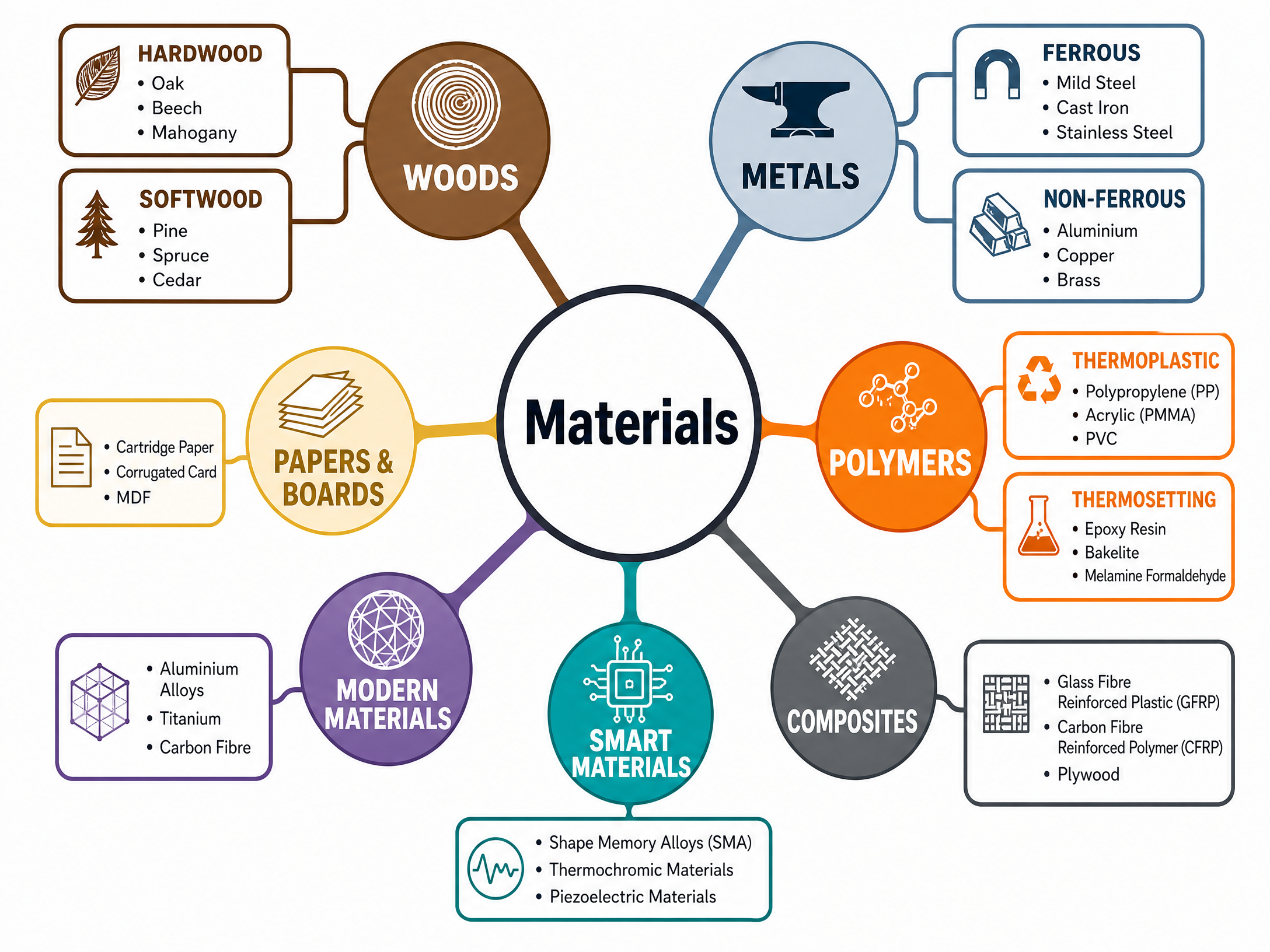
| Woods | Hardwood, Softwood, Manufactured Boards | Oak, Pine, MDF | Natural, versatile, renewable (if managed). Hardwoods are generally denser; softwoods grow faster. |
| Metals | Ferrous, Non-Ferrous, Alloys | Mild Steel, Aluminium, Brass | Strong, conductive, malleable. Ferrous metals contain iron and may rust. |
| Polymers | Thermoplastic, Thermosetting | Acrylic, Epoxy Resin | Lightweight, insulators. Thermoplastics can be reshaped; thermosets cannot. |
| Composites | N/A | GRP, CFRP, Plywood | Combines two or more materials to create superior properties (e.g., strong and lightweight). |
| Smart Materials | N/A | Shape Memory Alloys, Thermochromic pigments | React to changes in their environment (heat, light, pressure) in a reversible way. |
| Modern Materials | N/A | Graphene, Titanium alloys | Developed through new technologies for high performance. |
| Papers & Boards | N/A | Cartridge paper, Corrugated card | Used for packaging, modelling, and graphic communication. |
| Textiles | Natural, Synthetic, Blended | Cotton, Polyester, Polycotton | Woven, knitted or bonded. Flexible, durable, and can be tailored for specific uses. |
Technical Vocabulary
- Ferrous / Non-Ferrous: Metals containing iron vs. metals without iron.
- Thermoplastic / Thermosetting: Polymers that can be reheated and reshaped vs. those that undergo a permanent chemical change.
- Alloy: A mixture of two or more metals (or a metal and a non-metal) to improve properties.
Practical Skills
Techniques & Processes
When selecting materials for your NEA (Non-Exam Assessment), you must consider how they will be processed:
- Forming: Shaping materials using heat or pressure (e.g., vacuum forming polymers, forging metals).
- Wasting/Subtractive: Removing material to create a shape (e.g., sawing wood, milling metal).
- Addition/Fabrication: Joining materials together (e.g., welding metals, gluing woods).
Materials & Equipment
Always consider the tools available in your workshop. Selecting a high-carbon steel might be excellent for a product's durability, but if you only have hand tools, it will be incredibly difficult to work with compared to a softer material like aluminium or pine.
Portfolio/Coursework Guidance
Assessment Criteria
In your NEA portfolio, examiners look for explicit justification of material choices. You will lose marks if you simply state "I used acrylic because it looks nice." You must say, "I selected acrylic (a thermoplastic) because it is available in a range of opaque and translucent colours, and its plasticity when heated allowed me to use line bending to form the casing."
Building a Strong Portfolio
Document your material testing. Show photographic evidence of you testing the strength, flexibility, or finish of different materials before making your final selection. This demonstrates analytical thinking and practical application of theory.
Exam Component
Written Exam Knowledge
The written paper will present you with products and ask you to evaluate the materials used. You must link the scientific property to the specific user need or manufacturing requirement.
Podcast Revision
Listen to the audio guide below for a comprehensive review of material properties and exam technique.

Visual Resources
2 diagrams and illustrations
Interactive Diagrams
1 interactive diagram to visualise key concepts
Conceptual Flow Outline
The Material Selection Process for NEA
Worked Examples
3 worked examples — open one to explore the question and available guidance.
Practice Questions
Test your understanding — click to reveal model answers
State one ferrous metal and one non-ferrous metal.
Hint: Think about which metals contain iron and which do not.
Explain why copper is used for electrical wiring in houses.
Hint: Consider both electrical properties and physical manipulation.
A designer is choosing a material for a reusable coffee cup. Evaluate the use of stainless steel versus polypropylene for this product.
Hint: Discuss thermal properties, durability, environmental impact, and weight for both.