Pearson Edexcel · A-Level · Design and Technology
Topic 12: Further processes and techniques
This topic covers the essential performance characteristics of materials and how they dictate material selection in design and manufacturing. Understanding these properties allows designers to choose the right material for the right application, ensuring products are functional, safe, and sustainable.
- 9 min read
- 3 worked examples
- 3 practice questions
- 6 key terms
Study Notes
Overview
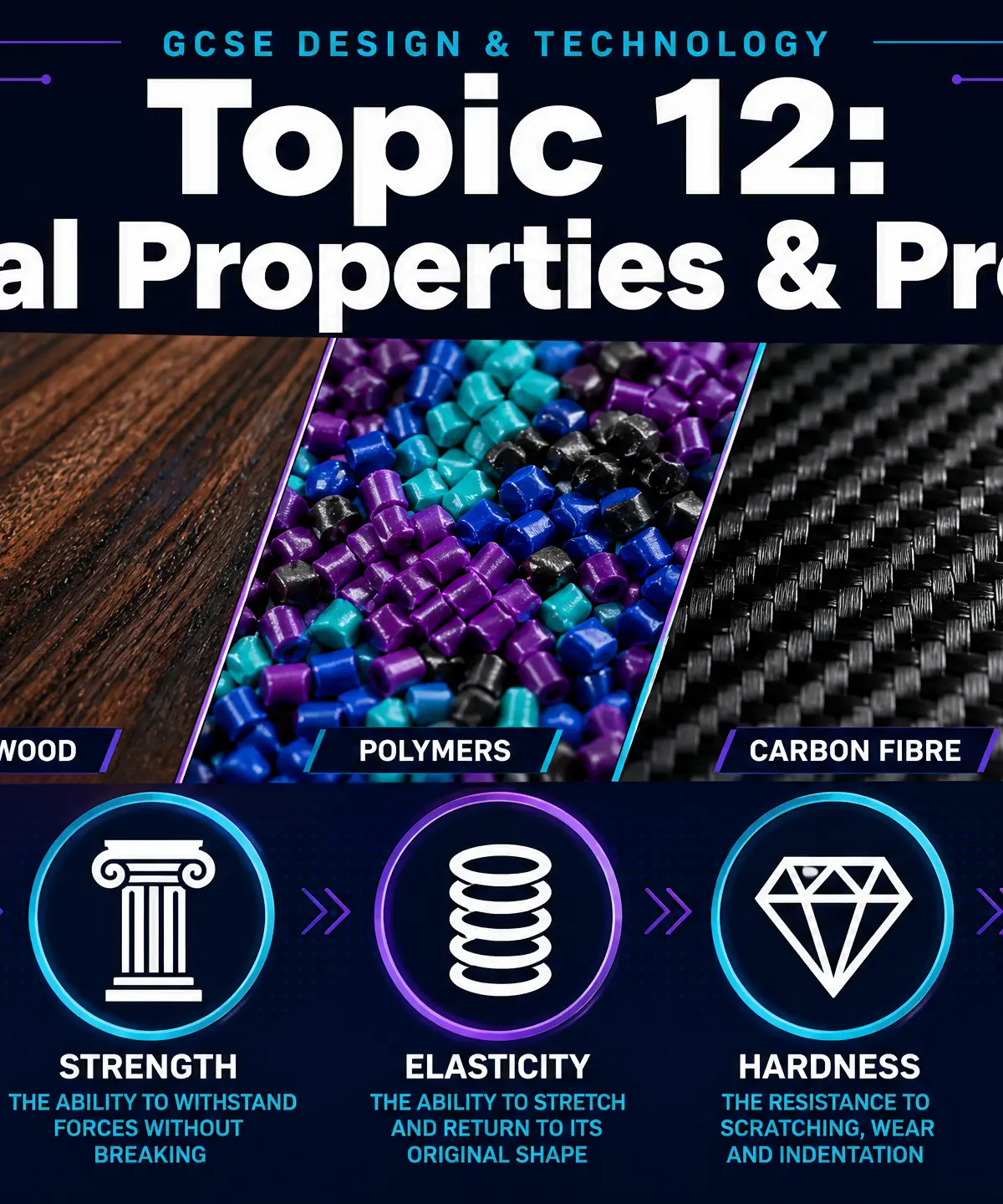
Welcome to Topic 12: Further Processes and Techniques. In Design and Technology, understanding materials is fundamental. You cannot design a successful product if you don't understand the materials you are working with. This topic explores the specific performance characteristics of woods, metals, polymers, smart materials, papers, boards, textiles, and composites. Examiners expect you to not only know what these properties are, but to be able to apply them to real-world design contexts and manufacturing processes.
Audio Guide
Listen to the comprehensive audio guide for this topic below:

Key Knowledge & Theory
Core Concepts: The Ten Performance Characteristics
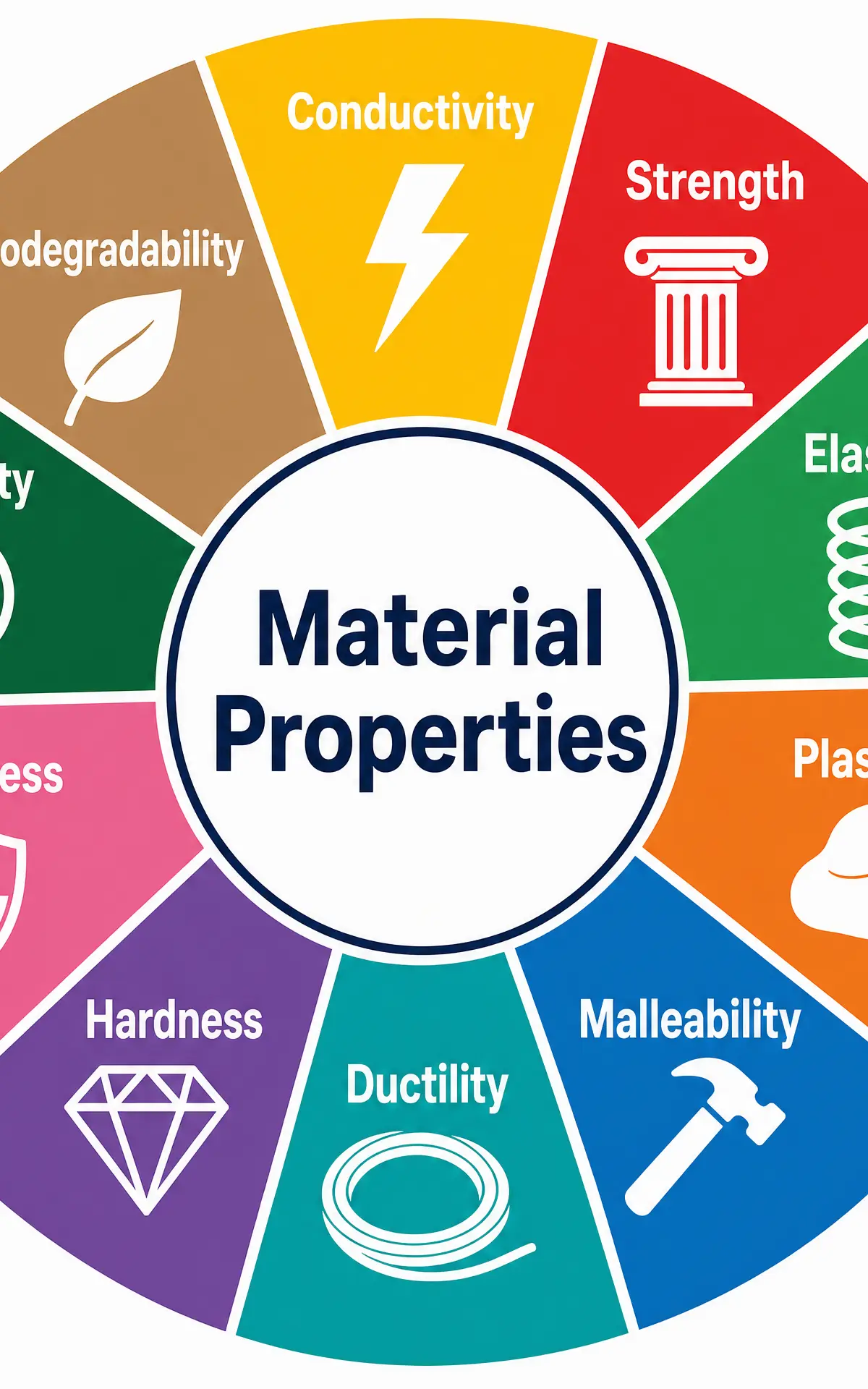
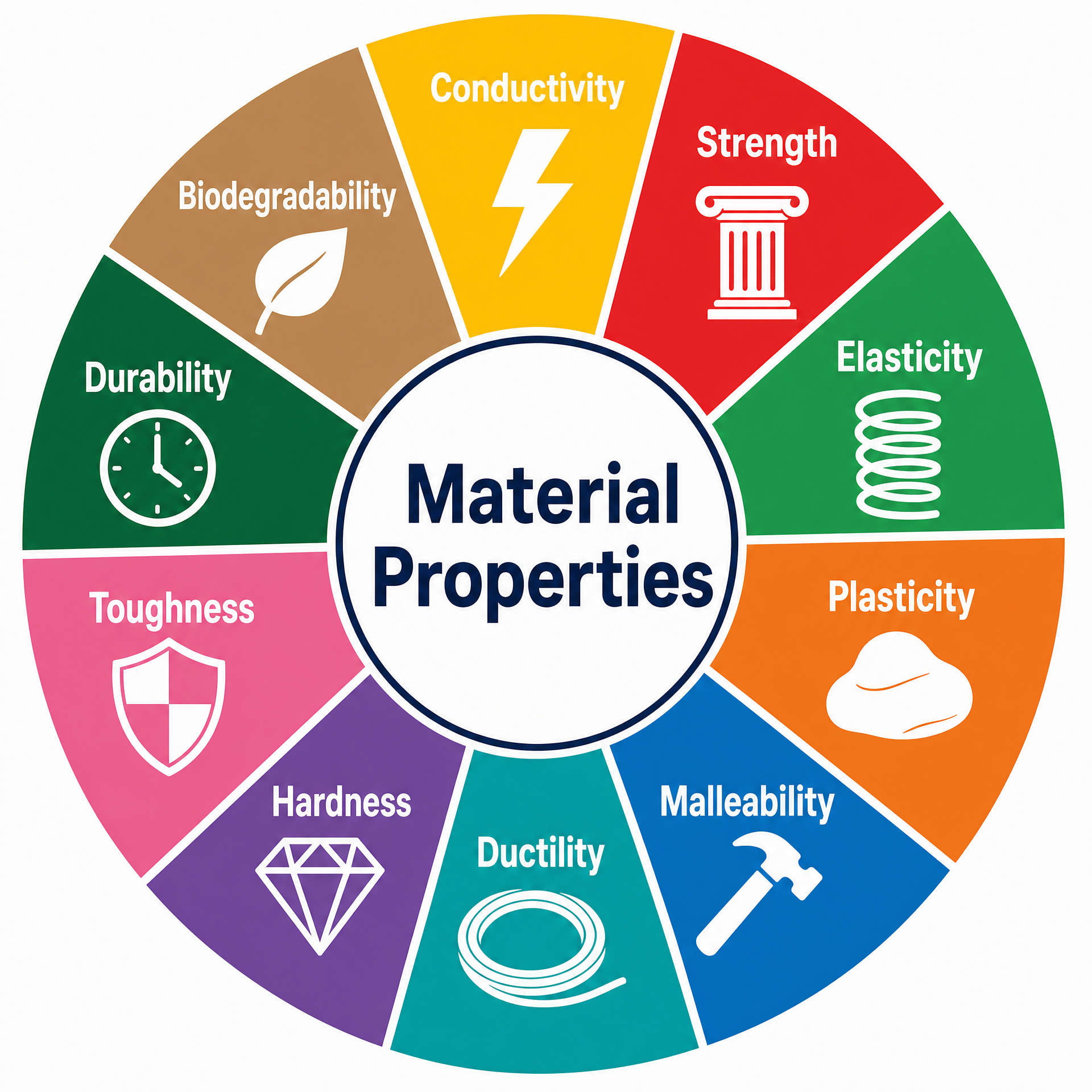
To succeed in this topic, you must master ten key material properties. Examiners frequently test your ability to define these and, more importantly, apply them to product examples.
- Conductivity: The ability of a material to allow heat or electricity to flow through it. Metals generally have high conductivity, making them suitable for electrical wiring (copper) or heat sinks (aluminium). Materials with low conductivity are called insulators (e.g., most polymers and woods).
- Strength: The ability of a material to withstand an applied force without breaking or permanently deforming. Strength is categorised by the type of force applied:
- Tensile strength: Resistance to being pulled apart (e.g., steel cables in a suspension bridge).
- Compressive strength: Resistance to being squashed or crushed (e.g., concrete pillars).
- Shear strength: Resistance to sliding forces that act in opposite directions.
- Elasticity: The ability of a material to deform under a force and return to its original shape once the force is removed. Elastomers like rubber have high elasticity, essential for shock absorbers and seals.
- Plasticity: The ability of a material to be permanently deformed without breaking. This is crucial for manufacturing processes like vacuum forming thermoplastics or pressing sheet metal.
- Malleability: A specific type of plasticity; the ability of a material to be hammered, pressed, or rolled into thin sheets without cracking. Aluminium and gold are highly malleable.
- Ductility: The ability of a material to be drawn or stretched into a wire without breaking. Copper is highly ductile, which, combined with its conductivity, makes it ideal for wiring.
- Hardness: The resistance of a material to scratching, wear, and indentation. High carbon steel is very hard, making it suitable for cutting tools like drill bits.
- Toughness: The ability of a material to absorb energy and resist fracture under sudden impact. A tough material will deform rather than shatter. Mild steel is tough; glass is hard but brittle (not tough).
- Durability: The ability of a material to withstand wear, pressure, weathering, and degradation over time. Stainless steel and oak are highly durable materials.
- Biodegradability: The ability of a material to be broken down naturally by microorganisms. Natural materials (wood, cotton) are biodegradable, whereas most synthetic polymers are not, presenting significant environmental challenges.
Material Categories and Examples
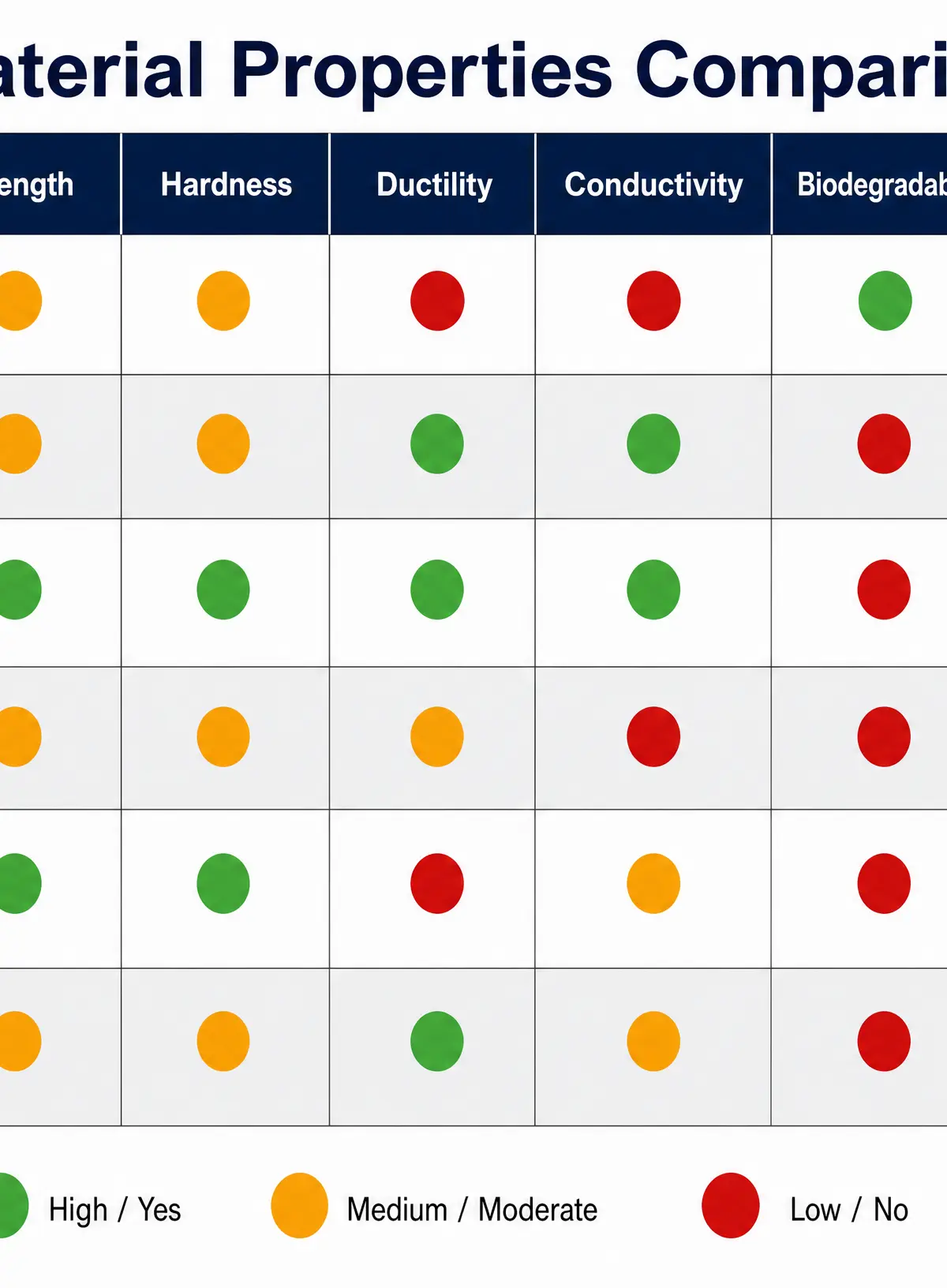
| Category | Sub-categories | Examples | Key Properties & Typical Uses |
|---|---|---|---|
| Woods | Hardwoods, Softwoods, Manufactured Boards | Oak (Hardwood), Pine (Softwood), MDF (Board) | Oak is hard and durable (furniture). Pine is softer and cheaper (construction). MDF is isotropic and stable (flat-pack furniture). |
| Metals | Ferrous (contains iron), Non-Ferrous, Alloys | Mild Steel (Ferrous), Aluminium (Non-Ferrous), Brass (Alloy) | Mild steel is tough and malleable (car bodies). Aluminium is lightweight and corrosion-resistant (aircraft). |
| Polymers | Thermoplastics, Thermosetting Plastics | Acrylic (Thermoplastic), Epoxy Resin (Thermosetting) | Thermoplastics can be reheated and reshaped (recyclable). Thermosetting plastics set permanently (heat resistant). |
| Smart Materials | - | Shape Memory Alloys (SMA), Thermochromic pigments | SMA returns to its original shape when heated (dental braces). Thermochromic changes colour with heat (thermometers). |
| Composites | - | Carbon Fibre Reinforced Polymer (CFRP), Glass Reinforced Plastic (GRP) | CFRP has an excellent strength-to-weight ratio (aerospace, sports equipment). |
Technical Vocabulary
- Isotropic: Having identical properties in all directions (e.g., MDF).
- Anisotropic: Having properties that differ according to the direction of measurement (e.g., natural wood is stronger along the grain than across it).
- Alloy: A mixture of two or more elements, where at least one is a metal, created to improve properties (e.g., adding carbon to iron to make steel).
- Work Hardening: The process of toughening a metal through plastic deformation (cold working).
- Annealing: Heating a metal and allowing it to cool slowly to relieve internal stresses and make it more workable (increasing malleability and ductility).
Practical Skills
Techniques & Processes
Understanding material properties is only half the battle; you must understand how these properties dictate manufacturing processes.
- Forming Processes: Rely on a material's plasticity or malleability.
- Vacuum Forming: Uses the plasticity of thermoplastics (like HIPS) when heated to stretch them over a mould.
- Press Forming: Uses the malleability of sheet metals (like aluminium or mild steel) to press them into 3D shapes (e.g., car body panels).
- Redistribution Processes: Rely on a material's ability to change state (melt).
- Injection Moulding: Melting thermoplastic granules and forcing them into a mould cavity under pressure. Requires materials that flow well when molten.
- Casting: Pouring molten metal (like aluminium or cast iron) into a mould.
- Wasting Processes: Removing material to create a shape. Requires materials with specific machining properties.
- Milling/Turning: Requires materials that can be cut cleanly without crumbling. The cutting tools themselves must have high hardness and toughness (e.g., High-Speed Steel or Tungsten Carbide).
Materials & Equipment Selection
When selecting materials for a practical project or answering a design question, you must justify your choice using specific performance characteristics.
- Why use ABS for a power tool casing? Because it has high impact toughness (resists dropping) and is an electrical insulator (safety).
- Why use Oak for a dining table? Because it is a hardwood with high durability, compressive strength, and an aesthetically pleasing grain.
Portfolio/Coursework Guidance
Assessment Criteria
In your Non-Examined Assessment (NEA) or coursework, examiners allocate significant marks for 'Making' and 'Technical Principles'. They are looking for:
- Justified Material Selection: You must explicitly state why you chose a material based on its working properties and the product's function.
- Appropriate Manufacturing Methods: Your chosen processes must align with the material's properties (e.g., don't propose vacuum forming a thermosetting plastic).
- Testing and Evaluation: Evidence of testing material properties (e.g., impact tests, finish adhesion) to inform your design development.
Building a Strong Portfolio
- Show your working: Include photographs of material testing. If you tested three different joints in wood, show the results and explain which was strongest and why.
- Use the vocabulary: In your annotations, don't just say "it's strong." Say "I selected mild steel because its high tensile strength is required for the structural frame."
- Consider sustainability: Always evaluate the biodegradability and recyclability of your chosen materials.
Exam Component
Written Exam Knowledge
The written paper will heavily test your ability to discriminate between materials. You will face:
- Multiple Choice/Short Answer: Identifying specific properties or categorising materials (e.g., "Which of the following is a thermosetting polymer?").
- Product Analysis: Given a product (e.g., a bicycle helmet), you must suggest a suitable material and justify it using specific performance characteristics.
- Process Justification: Explaining why a specific manufacturing process is suitable for a given material and product.
Exam Preparation Strategy
- Learn the definitions: Be precise. Do not confuse hardness with toughness.
- Create a material database: For every major material category, know two specific examples, their key properties, and a typical application.
- Practice 'Evaluate' questions: Practice writing balanced arguments discussing the pros and cons of using a specific material for a product, considering functional, aesthetic, and environmental factors.
Visual Resources
2 diagrams and illustrations
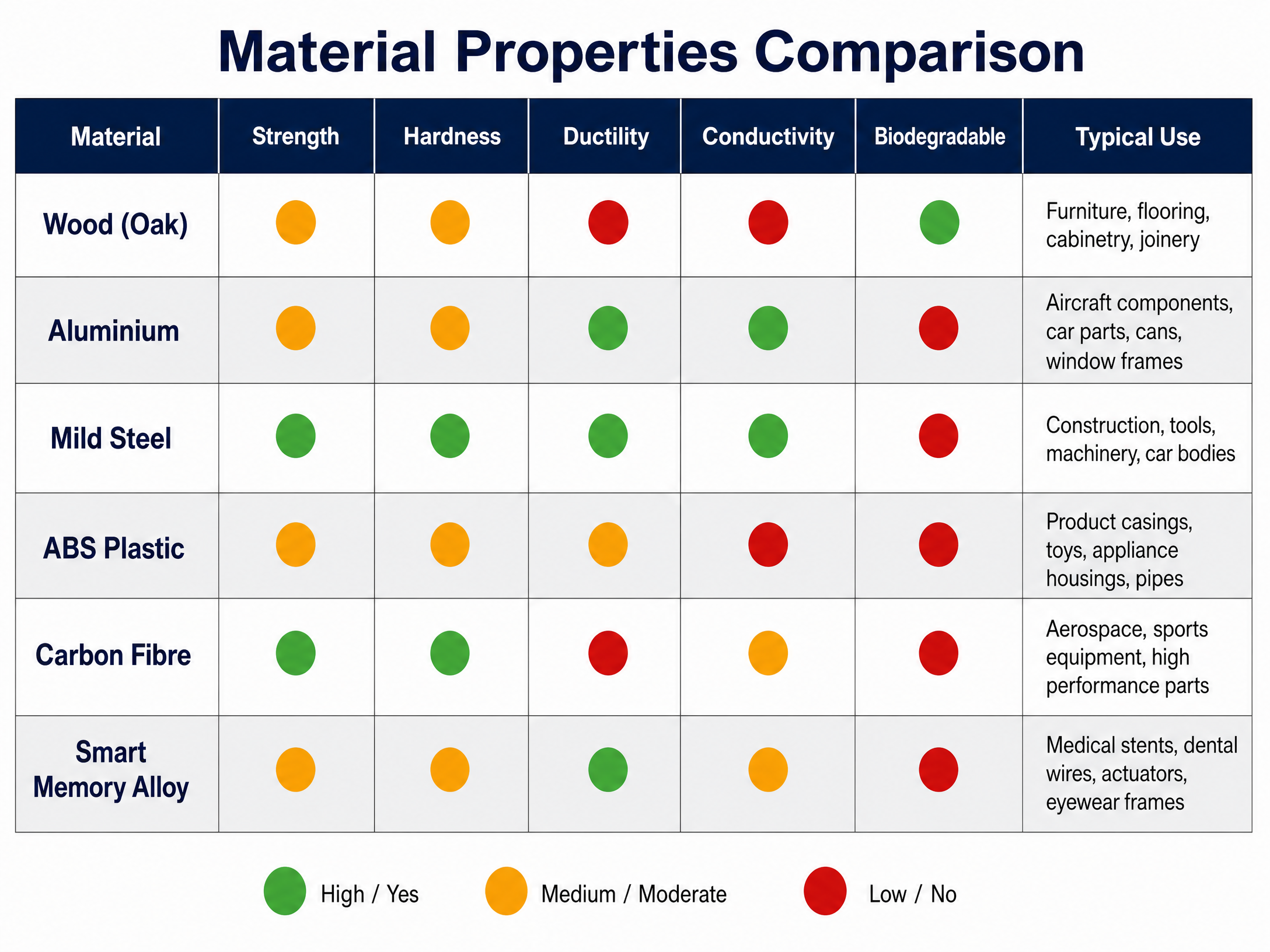
Interactive Diagrams
1 interactive diagram to visualise key concepts
Conceptual Flow Outline
The logical process for selecting materials in design coursework and exam answers.
Worked Examples
3 worked examples — open one to explore the question and available guidance.
Practice Questions
Test your understanding — click to reveal model answers
Identify one smart material and state its specific property. [2 marks]
Hint: Think of a material that reacts to temperature or light.
Explain two reasons why aluminium is a suitable material for manufacturing drinks cans. [4 marks]
Hint: Consider the manufacturing process to make the shape, and the environment the can will be in.
A manufacturer is deciding between mild steel and carbon fibre reinforced polymer (CFRP) for a bicycle frame. Evaluate the use of both materials for this application. [6 marks]
Hint: Compare strength-to-weight ratios, manufacturing complexity, cost, and durability.