Pearson Edexcel · A-Level · Design and Technology
Topic 3: Processes and techniques
This comprehensive topic guide covers the essential performance characteristics and categories of materials required for GCSE Design and Technology. Mastering these concepts will enable you to confidently discriminate between materials and justify their selection for specific products in both your coursework and the final exam.
- 7 min read
- 3 worked examples
- 3 practice questions
- 6 key terms
Study Notes
Overview
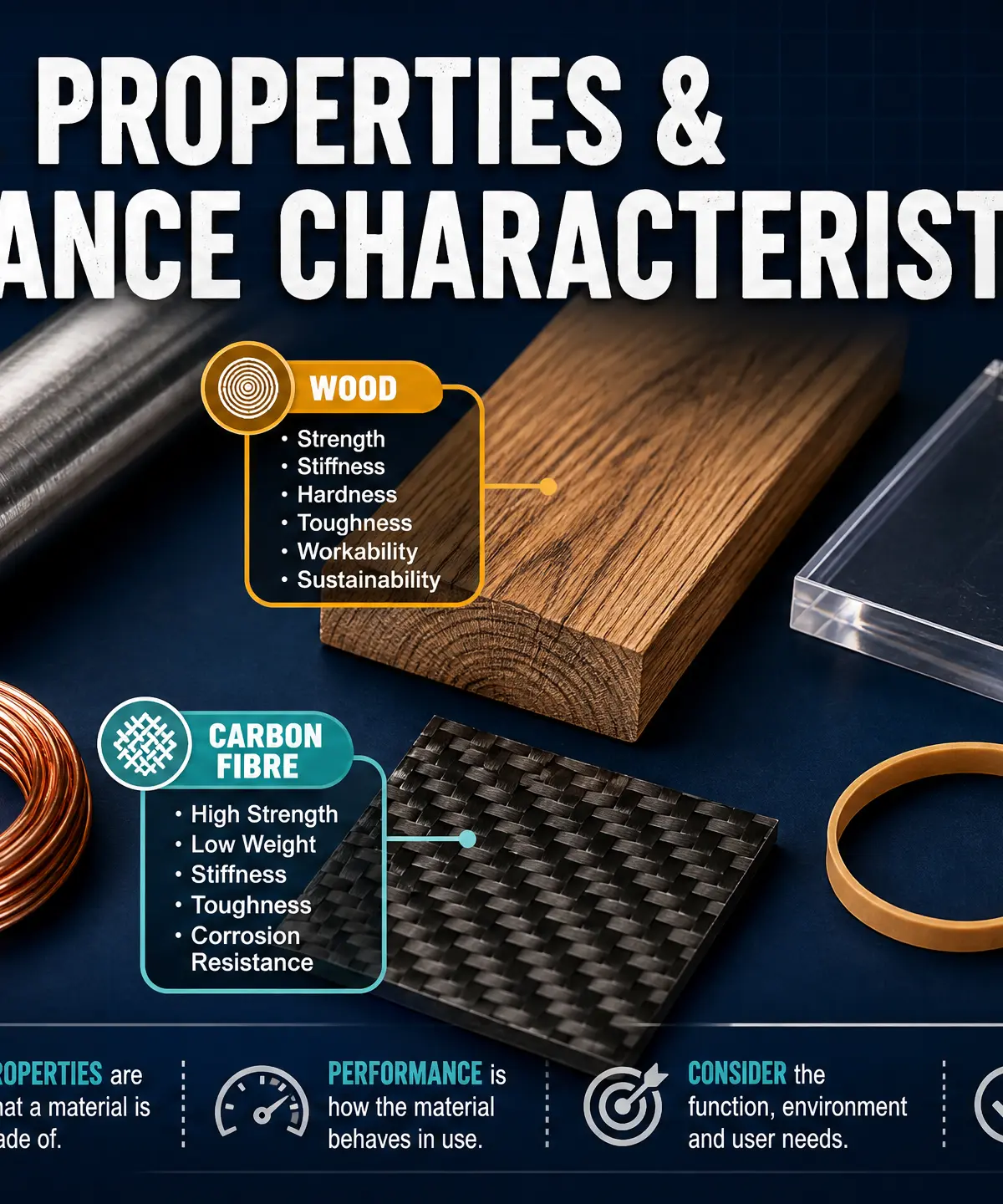
Welcome to Topic 3: Processes and Techniques, focusing specifically on Material Properties and Performance Characteristics. This is a foundational topic in GCSE Design and Technology. Examiners consistently test your ability to not only identify materials but to critically evaluate their performance characteristics in relation to specific products. Understanding why a material behaves the way it does is the key to accessing higher mark bands.
Key Knowledge & Theory
Core Concepts: Performance Characteristics
Performance characteristics describe how a material behaves under different conditions and forces. Examiners expect you to use precise technical vocabulary when discussing these.
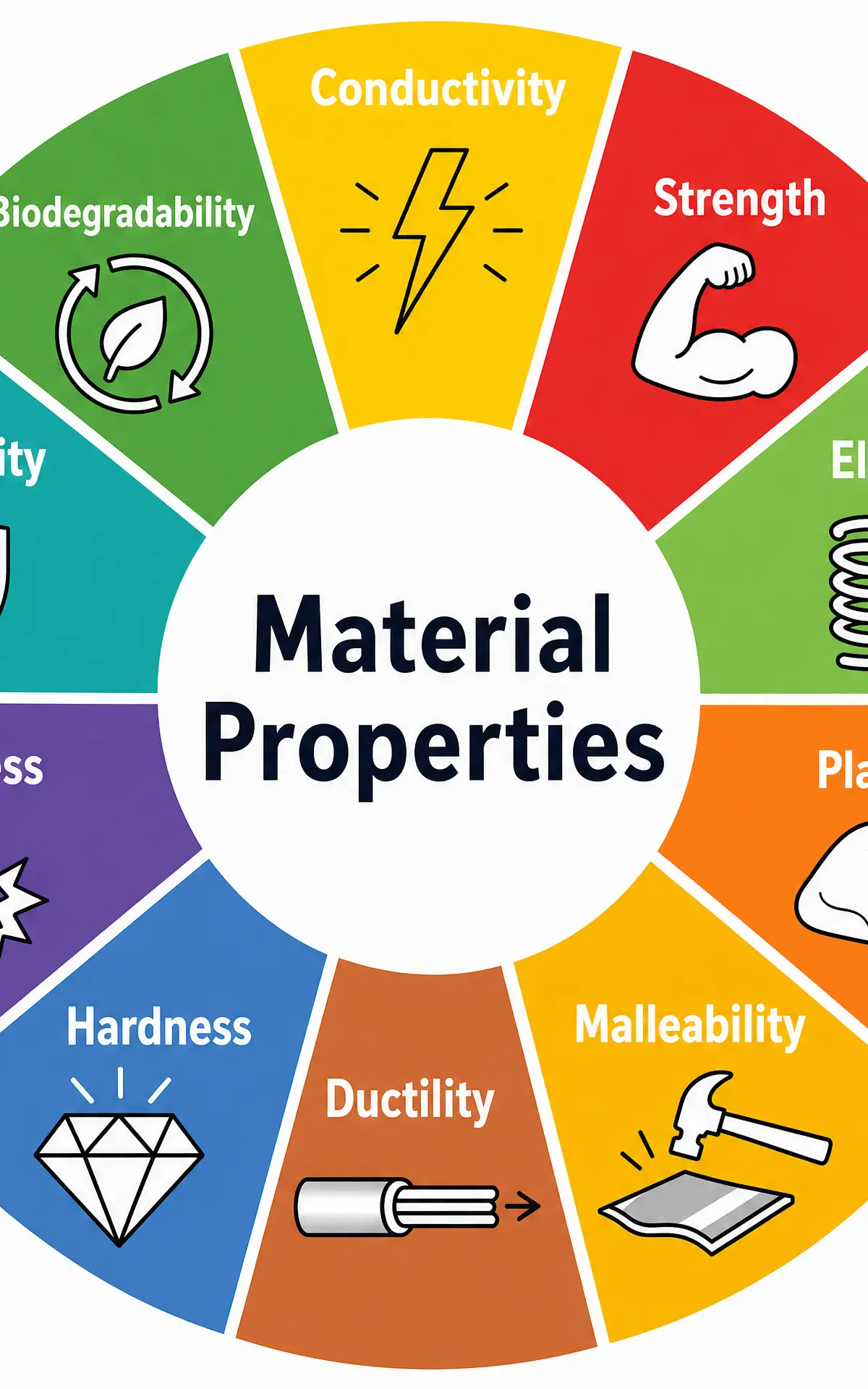
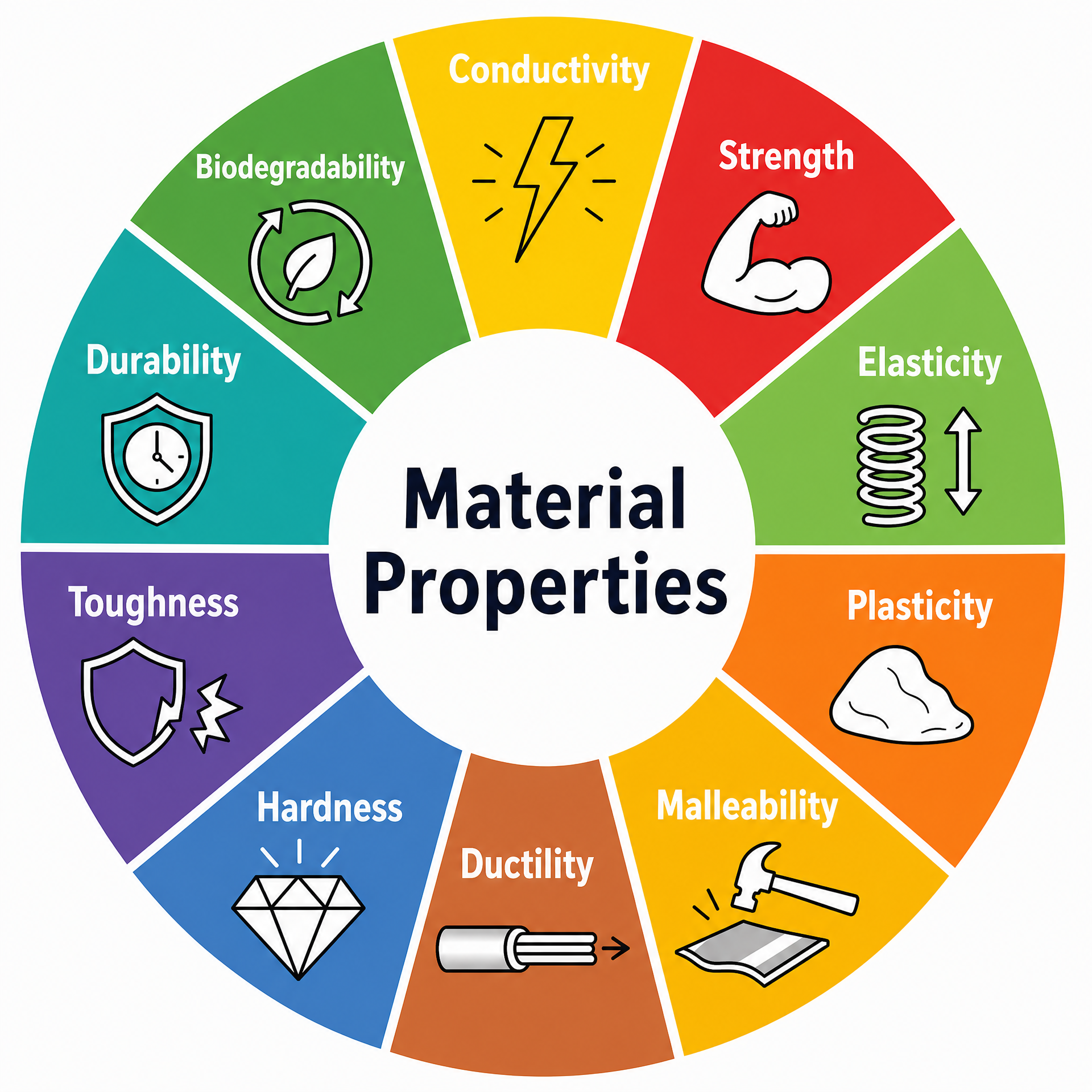
- Conductivity: The ability of a material to transfer heat or electricity. (e.g., Copper has high electrical conductivity; Polymers are poor conductors and act as insulators).
- Strength: The ability of a material to withstand an applied force without breaking or permanently deforming. This can be tensile (pulling), compressive (squashing), or shear (sliding).
- Elasticity: The ability of a material to return to its original shape after an applied force is removed (e.g., Rubber, Elastomers).
- Plasticity: The ability of a material to be permanently deformed and retain its new shape without breaking (e.g., Clay, heated metals).
- Malleability: The ability of a material to be permanently deformed in all directions without cracking, specifically allowing it to be hammered or rolled into thin sheets (e.g., Gold, Aluminium).
- Ductility: The ability of a material to be drawn or stretched out into a thin wire without breaking (e.g., Copper).
- Hardness: The ability of a material to resist scratching, wear, and indentation (e.g., High carbon steel, Diamond).
- Toughness: The ability of a material to absorb impact energy and resist fracturing. Tough materials deform rather than shatter (e.g., Mild steel, many polymers).
- Durability: The ability of a material to withstand wear, pressure, or damage over time, including resistance to weathering and corrosion (e.g., Stainless steel, Oak).
- Biodegradability: The ability of a material to be broken down naturally by microorganisms into harmless substances (e.g., Natural woods, Paper, Bioplastics).
Material Categories
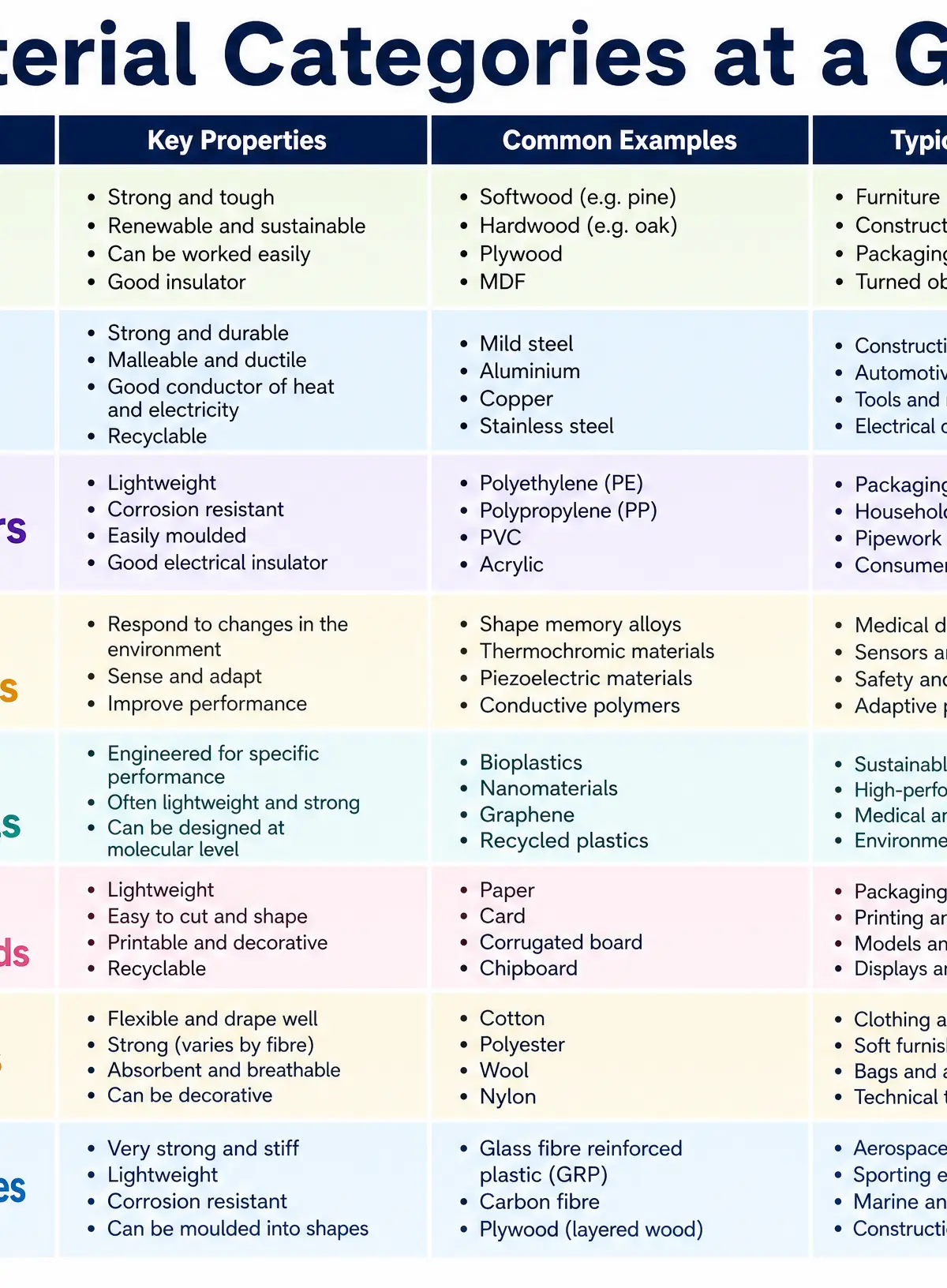
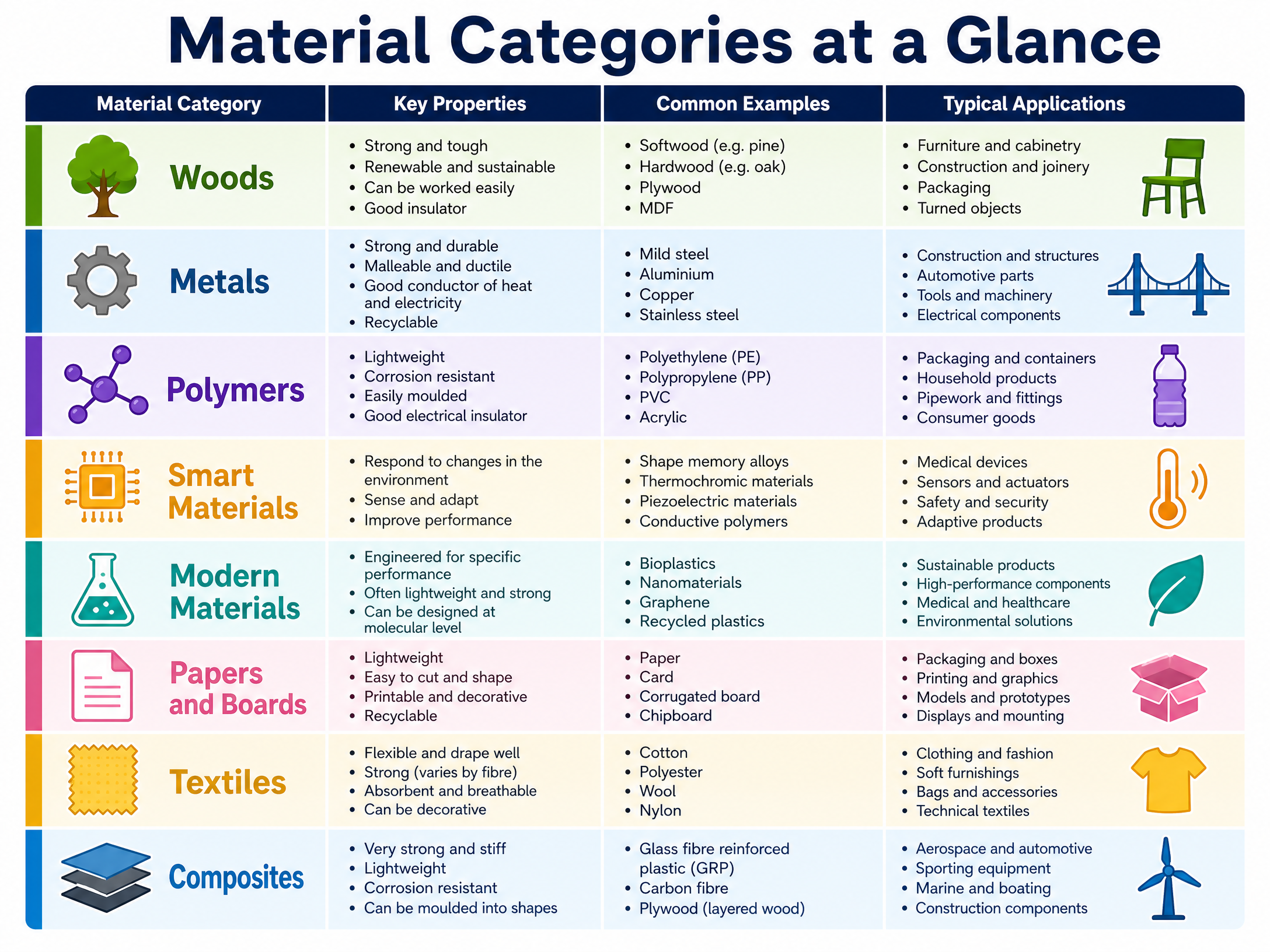
Candidates must be able to classify materials and understand the general properties of each category:
- Woods: Divided into hardwoods (e.g., Oak, durable and hard) and softwoods (e.g., Pine, fast-growing and workable). Manufactured boards (e.g., MDF) offer uniform properties.
- Metals: Divided into ferrous (containing iron, magnetic, prone to rust, e.g., Mild steel) and non-ferrous (no iron, highly corrosion-resistant, e.g., Aluminium, Copper). Alloys combine metals to improve properties (e.g., Brass, Stainless steel).
- Polymers: Divided into thermoplastics (can be reheated and reshaped, recyclable, e.g., Acrylic, PET) and thermosetting polymers (cannot be reheated, rigid cross-links, e.g., Epoxy resin, Melamine formaldehyde).
- Smart Materials: Materials whose physical properties change in response to an external stimulus (e.g., Shape Memory Alloys respond to heat, Thermochromic pigments change colour with temperature).
- Modern Materials: Materials developed through the invention of new or improved processes (e.g., Kevlar, Graphene, Polymorph).
- Papers and Boards: Characterised by weight (gsm) or thickness (microns). Used for packaging and modelling (e.g., Corrugated board, Cartridge paper).
- Textiles: Fibres spun into yarns and woven, knitted, or bonded into fabrics. Can be natural (Cotton, Wool) or synthetic (Polyester, Nylon).
- Composites: Produced by combining two or more different materials to create a new material with improved properties (e.g., Carbon Fibre Reinforced Polymer - CFRP, Glass Reinforced Plastic - GRP).
Podcast Revision Episode
Listen to this 13-minute revision podcast covering all the core concepts, common exam mistakes, and a quick-fire recall quiz.

Practical Skills
Material Selection in the Workshop
When undertaking practical tasks or your Non-Examined Assessment (NEA), you must demonstrate an understanding of material properties through your selection and working methods.
- Working with Hardness: If you select a hard material like high carbon steel, you must use appropriate tools (e.g., HSS drill bits, grinding wheels) because standard tools will blunt quickly.
- Working with Malleability: When forming sheet metal (like aluminium or copper), you rely on its malleability. However, working the metal causes 'work hardening', making it brittle. You must apply the process of annealing (heating and slowly cooling) to restore its malleability.
- Testing Properties: You can conduct simple workshop tests to compare materials. For example, a scratch test using different graded pencils or tools can compare relative hardness, while an impact test using a swinging pendulum (Izod test principle) can compare toughness.
Portfolio/Coursework Guidance
Evidencing Material Selection (NEA)
In your NEA portfolio, examiners award significant marks for the justification of material choices. A common pitfall is simply listing materials without explaining why they are suitable.
**Assessment Criteria Focus:**To achieve top marks in the 'Development of Design Proposals' section, you must:
- Identify specific materials (e.g., 'High Impact Polystyrene (HIPS)' rather than just 'Plastic').
- State the relevant performance characteristics.
- Link these characteristics directly to the product's function, user needs, and manufacturing processes.
Building a Strong Portfolio
- Material Testing Log: Include a page in your portfolio detailing physical tests you conducted on different materials (e.g., testing the flexibility of different polymers for a living hinge). Photograph the tests and write evaluative conclusions.
- Comparative Tables: Use tables to compare 2-3 possible materials for a specific component, scoring them against your specification criteria (e.g., Cost, Toughness, Aesthetics).
Exam Component
Written Exam Knowledge
The written paper will test your theoretical knowledge of materials through a mix of multiple-choice, short-answer, and extended-response questions.
- Contextual Application: Questions rarely ask for definitions in isolation. They will present a product (e.g., a child's toy, a bicycle frame, a kitchen utensil) and ask you to select a material and justify your choice based on its properties.
- Sustainability: Always consider the environmental impact. If evaluating a polymer, discuss its source (finite petrochemicals vs. renewable bioplastics) and its end-of-life (recyclability, biodegradability).
Exam Technique: The P-D-A Method
For questions asking you to justify a material choice, use the Property - Definition - Application (P-D-A) structure:
- Property: Name the specific characteristic.
- Definition: Briefly state what it means.
- Application: Explain how it makes the product function better or last longer.
Visual Resources
2 diagrams and illustrations
Interactive Diagrams
1 interactive diagram to visualise key concepts
Conceptual Flow Outline
Decision-making flowchart for material selection
Worked Examples
3 worked examples — open one to explore the question and available guidance.
Practice Questions
Test your understanding — click to reveal model answers
Identify the specific property that allows copper to be made into electrical wire.
Hint: Think about the shape the material needs to be formed into (a wire).
Explain two reasons why Acrylic (PMMA) is a suitable material for a car's rear brake light cover.
Hint: Consider the environment the car is in and what the light cover needs to do with the light bulb behind it.
A company is designing a new range of reusable coffee cups. Evaluate the use of Stainless Steel versus a Thermoplastic (such as Polypropylene) for the body of the cup.
Hint: Discuss the properties, manufacturing, aesthetics, and sustainability of both options before making a final conclusion.