Pearson Edexcel · A-Level · Design and Technology
Topic 4: Digital technologies
This topic covers the essential performance characteristics of materials across seven main categories. Understanding these properties is crucial for selecting the right material for a specific product and justifying that choice in your exam to earn maximum marks.
- 6 min read
- 3 worked examples
- 3 practice questions
- 6 key terms
Study Notes

Overview
Topic 4: Digital Technologies and Material Properties is a foundational element of your GCSE Design and Technology specification. Before you can design or manufacture any product, you must understand the materials available to you. Examiners expect you to be able to discriminate between materials based on their performance characteristics and apply this scientific knowledge to justify their suitability for specific applications.
Listen to the revision podcast for a complete overview of this topic:

Key Knowledge & Theory
Core Concepts: Material Categories
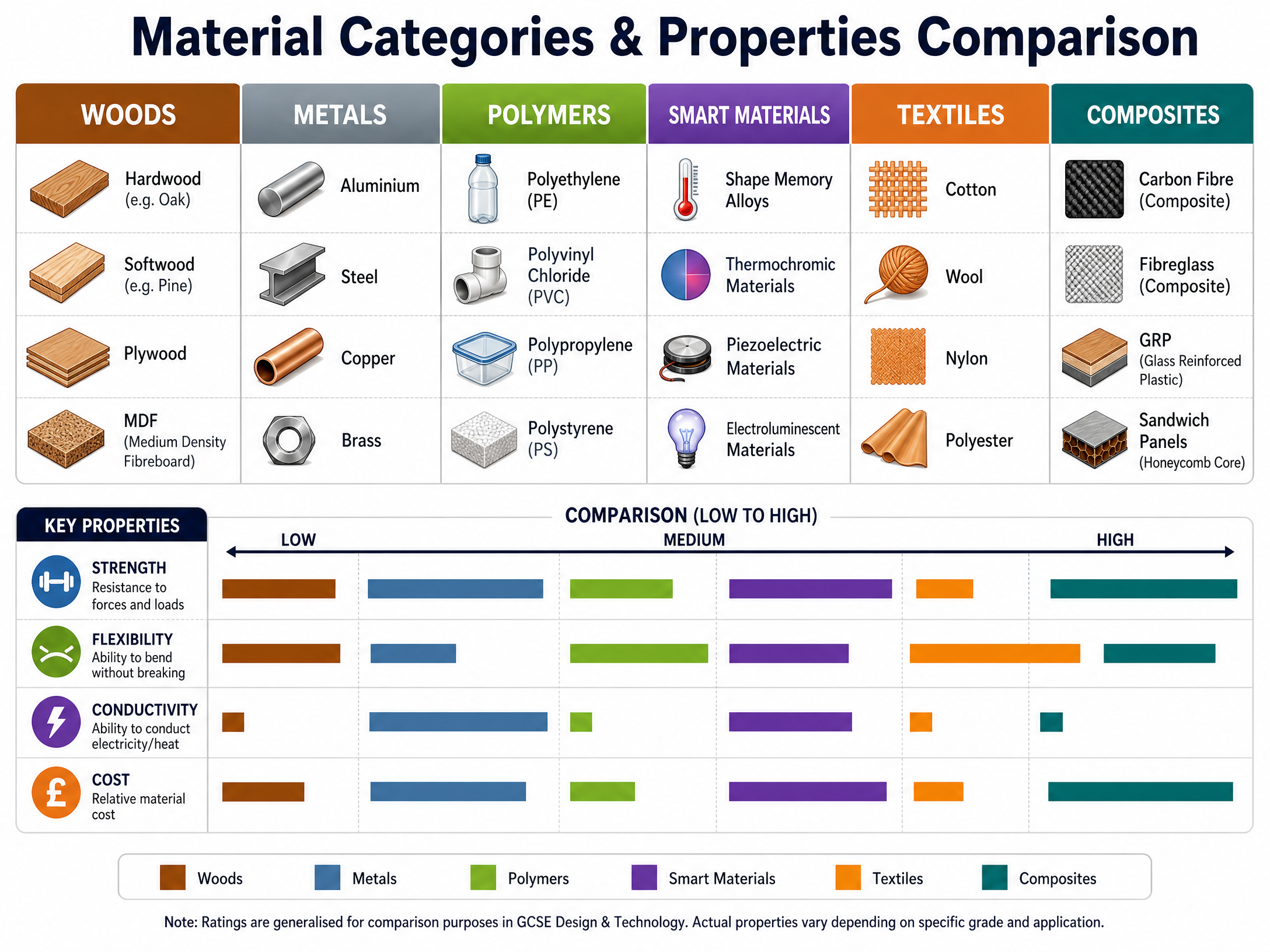
The specification requires you to understand the properties of seven main material categories:
- Woods: Including hardwoods (e.g., oak, mahogany) and softwoods (e.g., pine, cedar), plus manufactured boards (e.g., MDF, plywood).
- Metals: Including ferrous metals (containing iron, e.g., mild steel, high carbon steel) and non-ferrous metals (no iron, e.g., aluminium, copper, brass).
- Polymers: Including thermoforming polymers (can be reshaped when heated, e.g., acrylic, PVC) and thermosetting polymers (cannot be reshaped, e.g., epoxy resin, melamine formaldehyde).
- Smart and Modern Materials: Materials that react to changes in their environment or have been developed for specific applications.
- Papers and Boards: Ranging from tracing paper to corrugated cardboard.
- Textiles: Including natural fibres (cotton, wool) and synthetic fibres (polyester, nylon).
- Composites: Materials made by combining two or more different materials to create a new material with improved properties (e.g., carbon fibre, GRP).
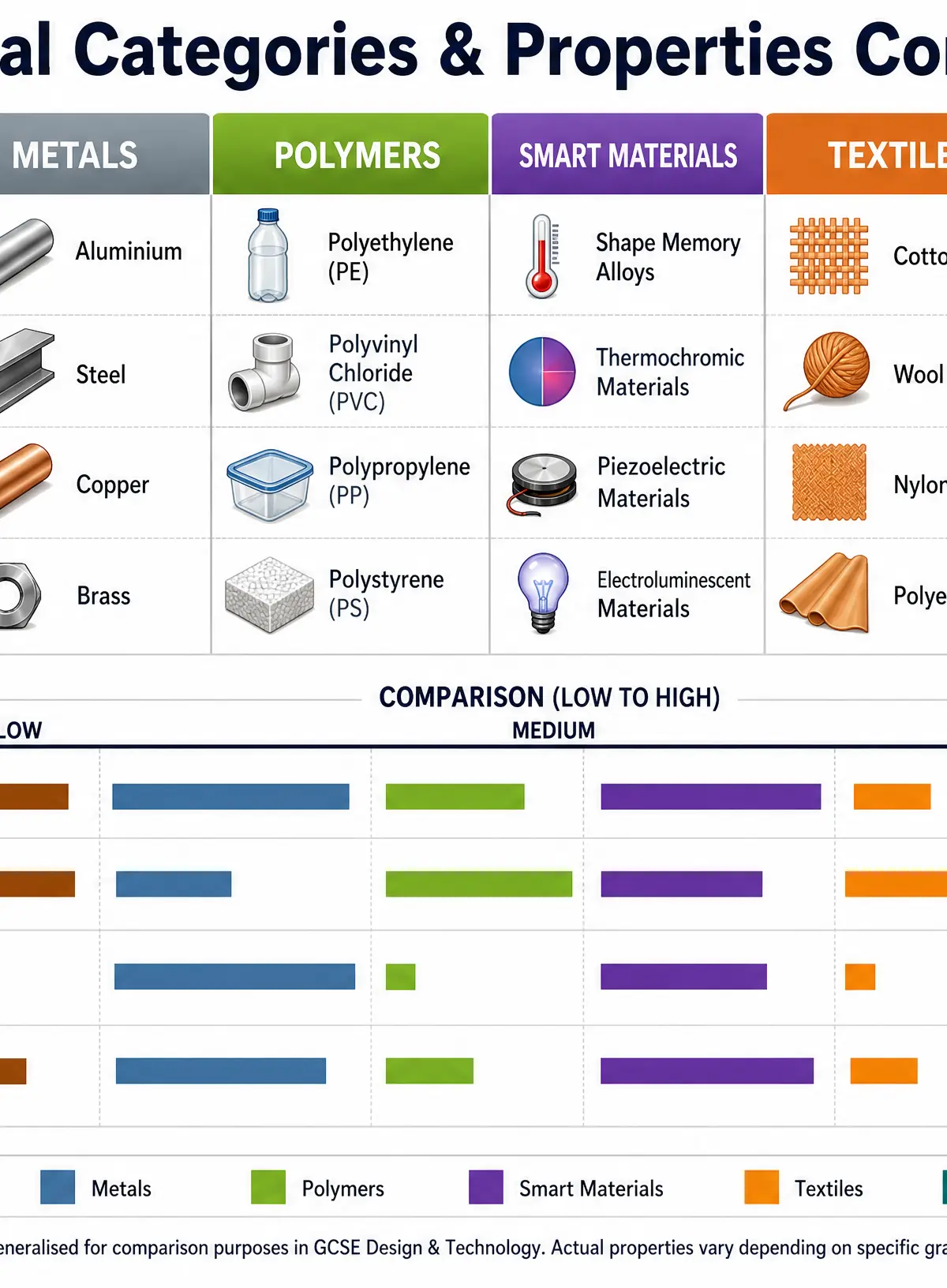
The 10 Key Performance Characteristics
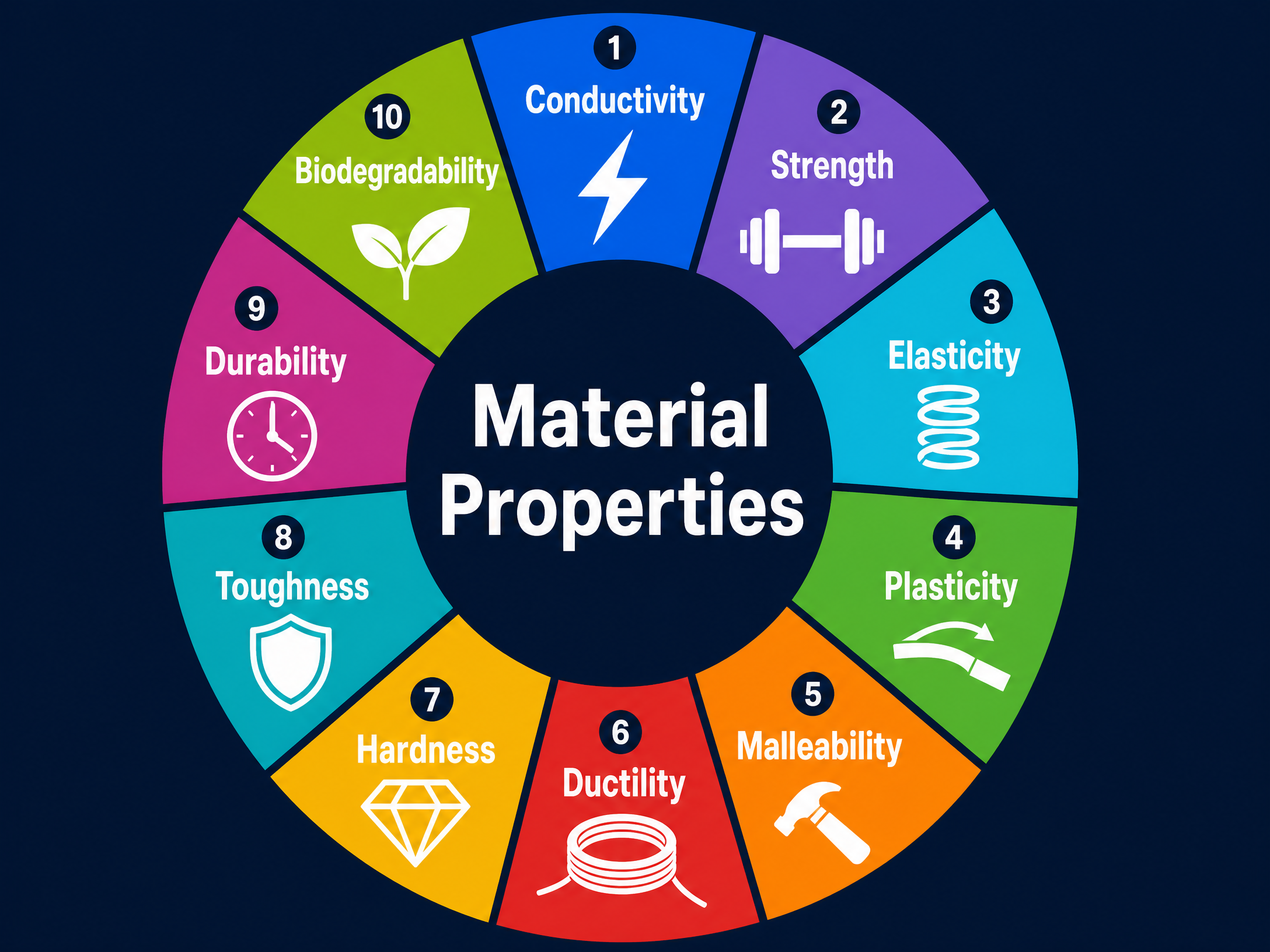
To justify material choices, you must use the correct technical vocabulary. These ten properties are the 'superpowers' you need to know:
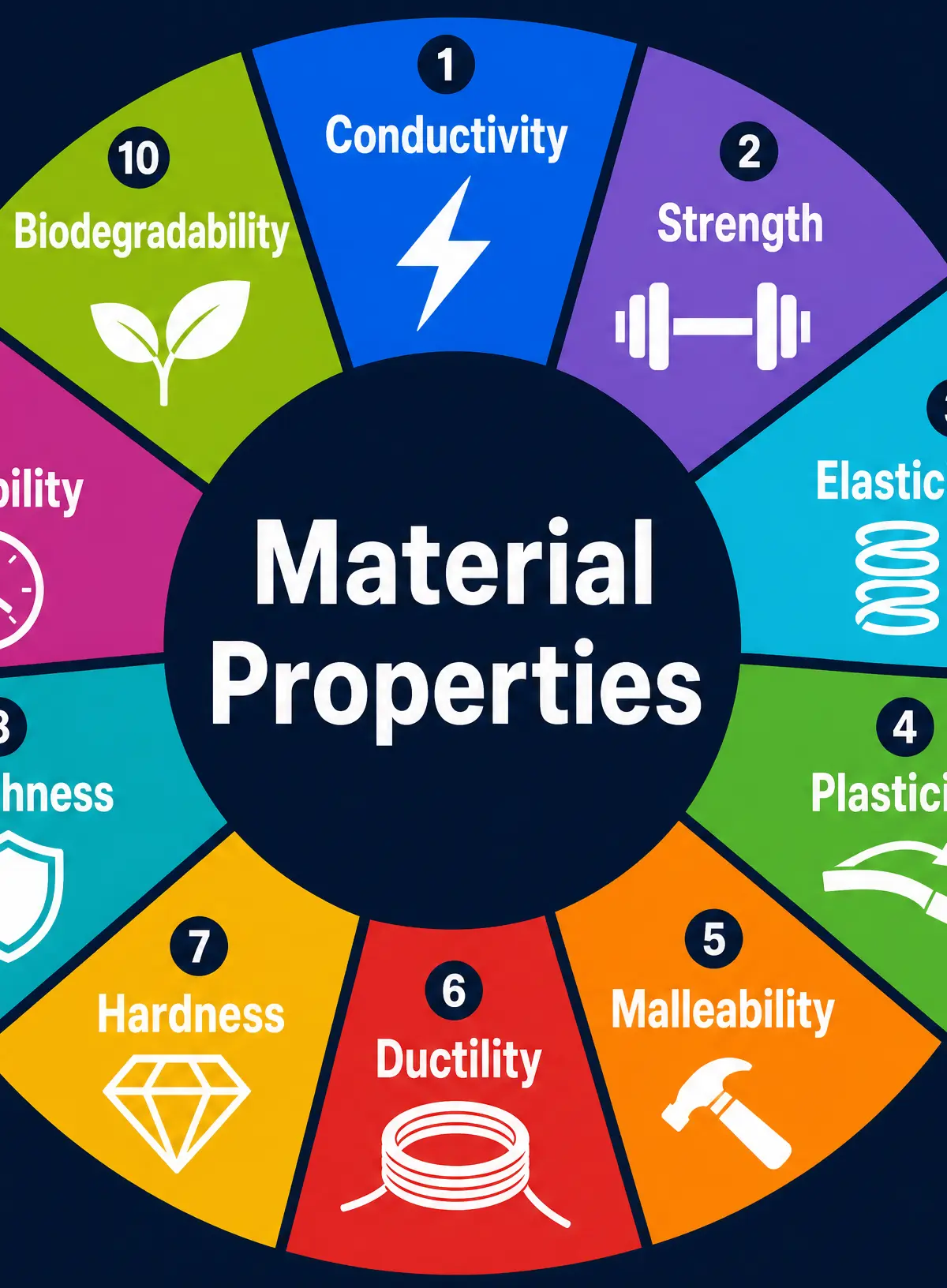
- Conductivity: The ability to conduct heat or electricity. Metals like copper are excellent electrical conductors. Polymers are generally poor conductors (insulators).
- Strength: The ability to withstand forces without breaking.
- Tensile strength: Resists pulling forces (e.g., steel cables).
- Compressive strength: Resists squashing forces (e.g., concrete).
- Elasticity: The ability to return to the original shape after a force is removed (e.g., a rubber band). The key concept is recovery.
- Plasticity: The ability to be permanently deformed without breaking. Essential for manufacturing processes like bending and pressing.
- Malleability: The ability to be hammered or pressed into shape without cracking (e.g., gold leaf, aluminium foil).
- Ductility: The ability to be drawn out into a wire without breaking (e.g., copper wiring).
- Hardness: Resistance to being scratched, indented, or worn away. Crucial for cutting tools and surfaces subject to wear.
- Toughness: The ability to absorb impact energy without fracturing. A car bumper must be tough to absorb a crash without shattering.
- Durability: The ability to withstand wear, weathering, and deterioration over time (e.g., resisting corrosion or rot).
- Biodegradability: The ability to be broken down naturally by microorganisms. A critical property when evaluating the environmental impact and sustainability of a product.
Technical Vocabulary
- Ferrous / Non-Ferrous: Metals containing iron (magnetic, prone to rust) vs metals without iron.
- Thermoforming / Thermosetting: Polymers that can be reheated and reshaped vs those that set permanently.
- Alloy: A mixture of two or more metals (or a metal and a non-metal) to improve properties (e.g., brass = copper + zinc).
- Sustainable: Meeting present needs without compromising the ability of future generations to meet their needs.
Practical Skills
Techniques & Processes
When applying this theory to your practical coursework (NEA), you must select materials based on these properties:
- Analysing the Brief: Identify the forces and conditions the product will face (e.g., will it be dropped? will it be outside?).
- Material Selection: Match the required properties to specific materials (e.g., needs to be tough and weather-resistant \rightarrow ABS polymer or treated hardwood).
- Justification: Document your choices in your portfolio using the 10 performance characteristics.
Materials & Equipment
Understanding properties ensures safe and effective manufacturing:
- You cannot vacuum form a thermosetting polymer.
- You need a tool harder than the material you are cutting (e.g., high-speed steel drill bits for mild steel).
Portfolio/Coursework Guidance
Assessment Criteria
Examiners award high marks in the 'Design and Make' criteria when candidates:
- Explicitly state why a material was chosen using correct terminology (e.g., "I selected aluminium for the casing because it has a high strength-to-weight ratio and excellent corrosion resistance, making it durable for outdoor use.")
- Show evidence of testing material properties (e.g., testing different woods for flexibility before making a curved component).
Building a Strong Portfolio
Create a 'Material Specification' table for your final design. List every component, the specific material chosen, and the 2-3 key properties that justify that choice. Never just write 'wood' or 'plastic' — always name the specific material (e.g., 'Beech', 'High Impact Polystyrene (HIPS)').
Exam Component
Written Exam Knowledge
The written paper will test your ability to recall properties, discriminate between materials, and justify selections for given products. You may be given a product (e.g., a children's toy) and asked to evaluate the suitability of two different materials.
Practical Exam Preparation
For questions requiring extended responses, structure your answer logically:
- State the required properties for the product.
- Evaluate Material A against those properties.
- Evaluate Material B against those properties.
- Conclude which is better and why.
Visual Resources
2 diagrams and illustrations
Interactive Diagrams
1 interactive diagram to visualise key concepts
Conceptual Flow Outline
The Material Selection Process
Worked Examples
3 worked examples — open one to explore the question and available guidance.
Practice Questions
Test your understanding — click to reveal model answers
State the meaning of the term 'ductility'. (1 mark)
Hint: Think about how copper is used in electronics.
Explain two reasons why aluminium is a suitable material for a drinks can. (4 marks)
Hint: Consider manufacturing processes and what happens to the can after use.
A company is designing a new outdoor children's climbing frame. Evaluate the use of mild steel versus a thermosetting polymer for the main structure. (6 marks)
Hint: Consider strength, toughness, weathering, and safety.