Pearson Edexcel · A-Level · Design and Technology
Topic 5: Factors influencing the development of products
This topic covers the fundamental performance characteristics of materials — from conductivity to toughness. Understanding these properties is essential for making informed design decisions and explaining why specific materials are suitable for particular products in the exam.
- 6 min read
- 3 worked examples
- 4 practice questions
- 6 key terms
Study Notes
Overview
In GCSE Design and Technology, Topic 5 explores the performance characteristics of materials. Whether you are working with woods, metals, polymers, smart materials, papers, boards, textiles, or composites, you must be able to discriminate between them based on their physical and working properties. This knowledge is not just theoretical; it forms the foundation of all practical design work and is heavily tested in the written exam.
Key Knowledge & Theory
Core Concepts
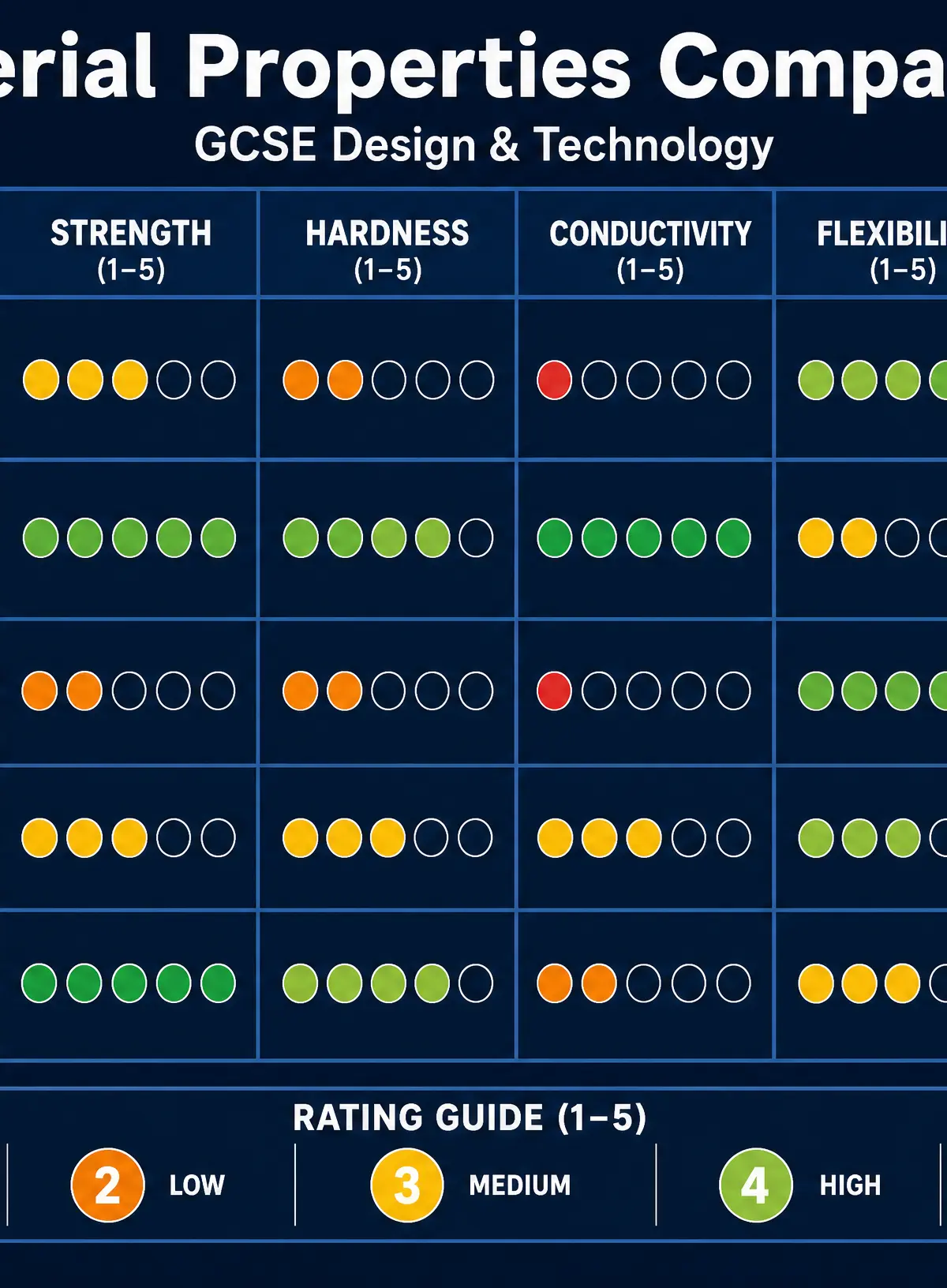
To succeed in this topic, you need a precise understanding of ten core material properties. Examiners look for specific definitions and the ability to apply these to real-world products.
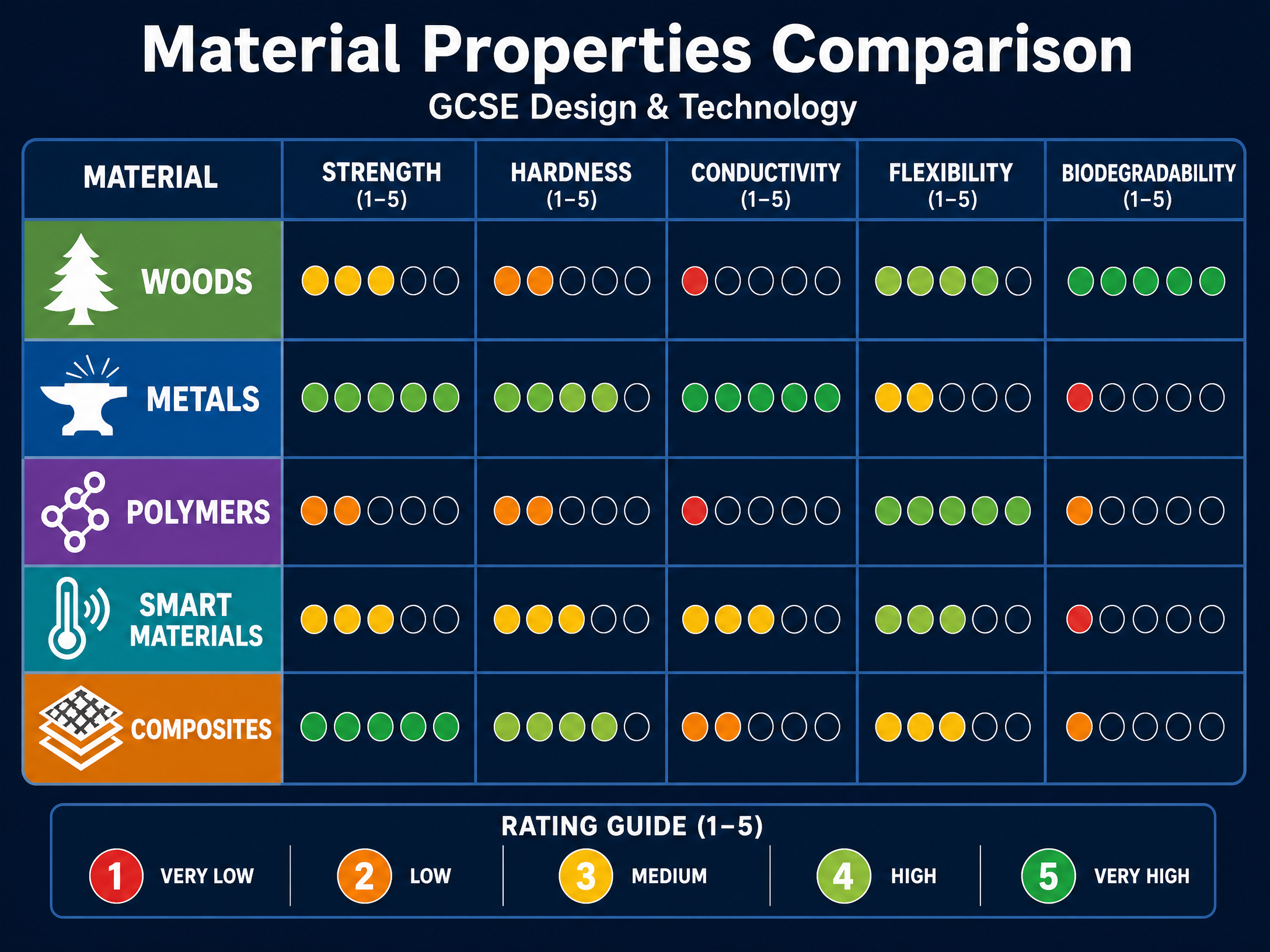
1. ConductivityThis is the ability of a material to allow heat (thermal conductivity) or electricity (electrical conductivity) to pass through it. Metals like copper and aluminium are excellent conductors, making them ideal for wiring and cookware. Woods and most polymers are poor conductors (insulators), making them suitable for handles and protective casings.
2. StrengthStrength is the ability to withstand forces without breaking. In D&T, you must specify the type of strength:
- Tensile strength: Resisting pulling forces (e.g., steel cables in a bridge).
- Compressive strength: Resisting squashing forces (e.g., concrete pillars).
- Shear strength: Resisting sliding forces acting in opposite directions (e.g., scissors cutting paper).
3. ElasticityElasticity is the ability of a material to stretch or deform under force and return to its original shape when the force is removed. Elastomers like rubber are highly elastic, making them useful for shock absorbers and seals.
4. PlasticityPlasticity is the ability of a material to permanently deform without breaking when a force is applied. It does not return to its original shape. This property is crucial for forming and moulding processes, such as pressing steel into car body panels.
5. MalleabilityMalleability is a specific type of plasticity. It is the ability of a material to be deformed under compression, typically by hammering or rolling into thin sheets, without cracking. Gold and aluminium are highly malleable.
6. DuctilityDuctility is the ability of a material to be drawn out under tension into long wires without breaking. Copper is highly ductile, which, combined with its conductivity, makes it the standard for electrical wiring.
7. HardnessHardness is the ability of a material to resist scratching, indentation, or wear. High-carbon steel is extremely hard, making it ideal for cutting tools like drill bits and saw blades.
8. ToughnessToughness is the ability of a material to absorb impact force and resist fracturing. A tough material will deform rather than shatter. Mild steel is tough, whereas glass is hard but brittle (not tough).
9. DurabilityDurability is the ability of a material to withstand wear, decay, weathering, and corrosive environments over time. Stainless steel and teak wood are highly durable materials often used outdoors.
10. BiodegradabilityBiodegradability is the ability of a material to be broken down naturally by microorganisms. Natural materials like wood, paper, and cotton are biodegradable, whereas most synthetic polymers are not, posing significant environmental challenges.
Practical Skills
Material Selection
In your coursework (NEA), you will need to justify your material choices. You cannot simply say "I chose pine because it looks nice." You must evaluate its performance characteristics against the product's requirements.
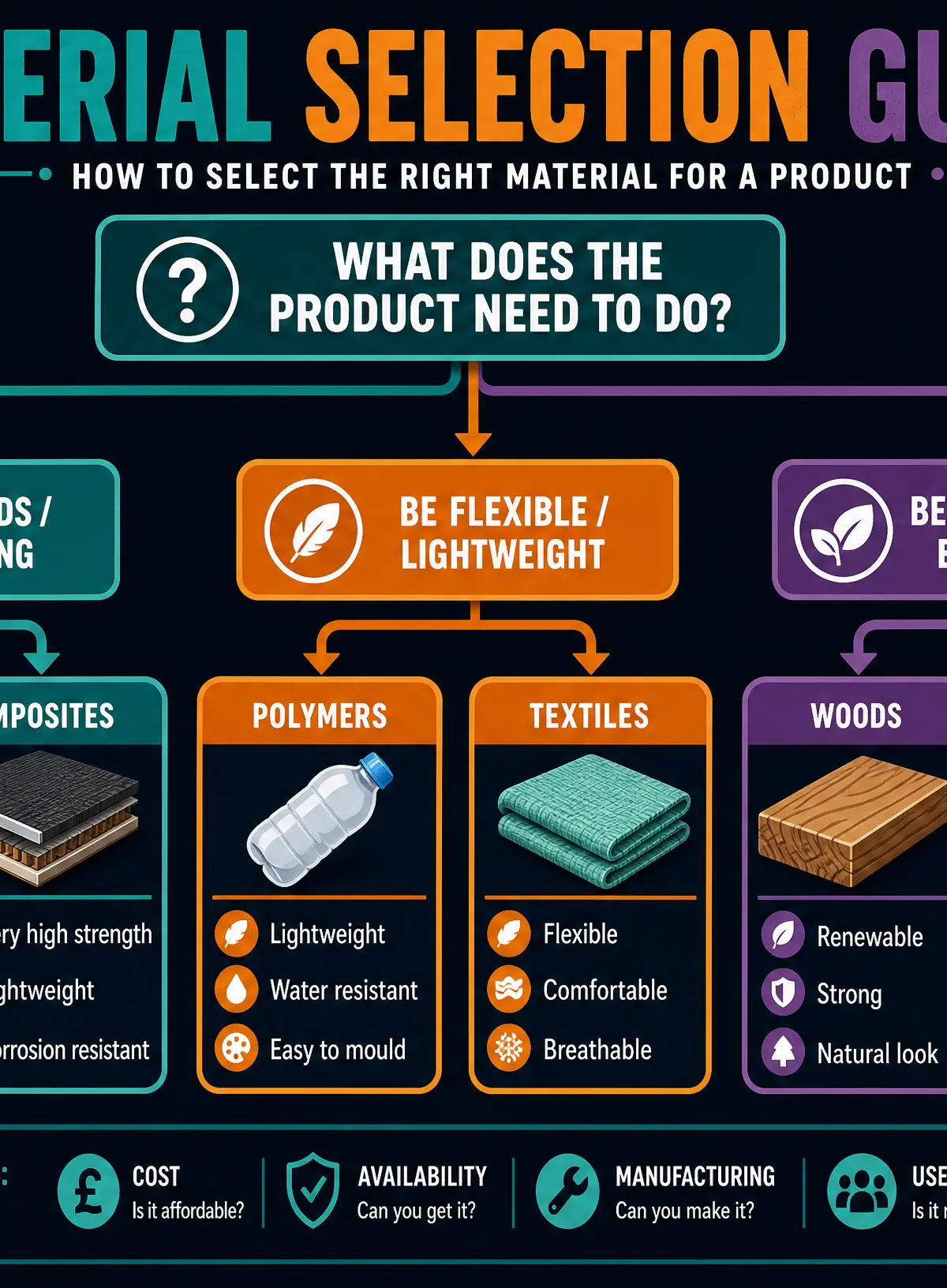
When selecting a material, consider:
- Function: What forces will the product experience? (Requires strength, toughness, hardness).
- Environment: Where will it be used? (Requires durability, corrosion resistance).
- Manufacturing: How will it be shaped? (Requires malleability, plasticity, ductility).
- Sustainability: What happens at the end of its life? (Requires biodegradability, recyclability).
Testing Materials
You may need to conduct simple workshop tests to compare materials:
- Tensile Testing: Clamping a material and adding weights until it breaks.
- Hardness Testing: Using a centre punch and a hammer with equal force on different materials and measuring the size of the indent.
- Toughness Testing: Clamping a material in a vice and striking it with a hammer to see if it bends or snaps.
Portfolio/Coursework Guidance
Assessment Criteria
In your Non-Exam Assessment (NEA), marks are awarded for technical knowledge and understanding. Examiners expect to see detailed annotation on your design pages explaining exactly why a material has been chosen using the correct terminology from this topic.
Building a Strong Portfolio
- Include a Material Testing Page: Document the physical tests you carried out on different materials (e.g., testing different woods for hardness before choosing one for a chopping board).
- Use Specialist Vocabulary: Do not write "it is strong." Write "it has high compressive strength to support the weight of the user."
- Evaluate Alternatives: Show that you considered multiple materials and used their properties to discriminate between them. Explain why you rejected the alternatives.
Exam Component
Written Exam Knowledge
Topic 5 is heavily tested in Section A (Core technical principles) and Section B (Specialist technical principles) of the written paper. You will face a mix of multiple-choice questions, short-answer definition questions, and extended response questions requiring you to justify material choices for specific products.
Listen to our revision podcast to consolidate your understanding of these core concepts:
Exam Strategy
- Read the Context: Exam questions always provide a context (e.g., a child's toy, outdoor furniture). Highlight the key requirements of that context before answering.
- Don't Mix Up Properties: The most common lost marks are from confusing Hardness vs. Toughness, and Malleability vs. Ductility. Ensure you know the exact definitions.
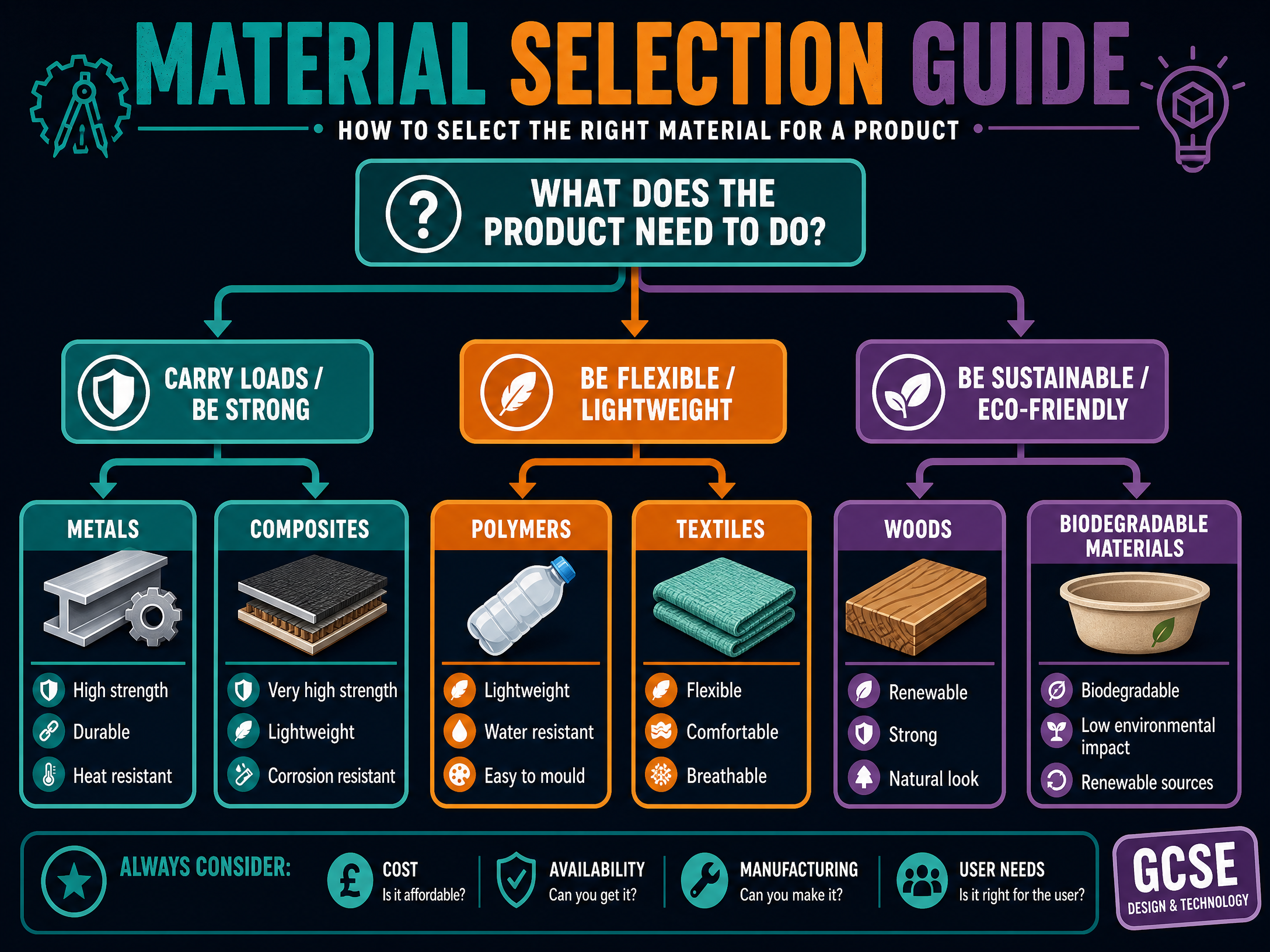
Interactive Diagrams
1 interactive diagram to visualise key concepts
Conceptual Flow Outline
Mapping forces to required material properties
Worked Examples
3 worked examples — open one to explore the question and available guidance.
Practice Questions
Test your understanding — click to reveal model answers
Identify the property that allows copper to be drawn into thin wires for electrical cables. (1 mark)
Hint: Think of the 'duck in a tube' memory hook.
Explain why High Impact Polystyrene (HIPS) is a suitable material for a children's toy. (3 marks)
Hint: Use the PEA structure: Point (property), Evidence (definition), Application (link to a child's toy).
A manufacturer is deciding between Oak and Pine for a high-quality outdoor dining table. Evaluate the suitability of both materials and justify a final choice. (6 marks)
Hint: Compare their durability, hardness, and aesthetic qualities. Make a clear final decision.
Describe the property of elasticity and give an example of a product where it is essential. (2 marks)
Hint: What must the material do after it has been stretched?