Pearson Edexcel · A-Level · Design and Technology
Topic 8: Features of manufacturing industries
This topic covers the essential performance characteristics of materials — from woods and metals to smart materials and composites. Understanding these properties is crucial for making justified material choices in your design coursework and securing high marks in the written exam.
- 6 min read
- 3 worked examples
- 3 practice questions
- 6 key terms
Study Notes
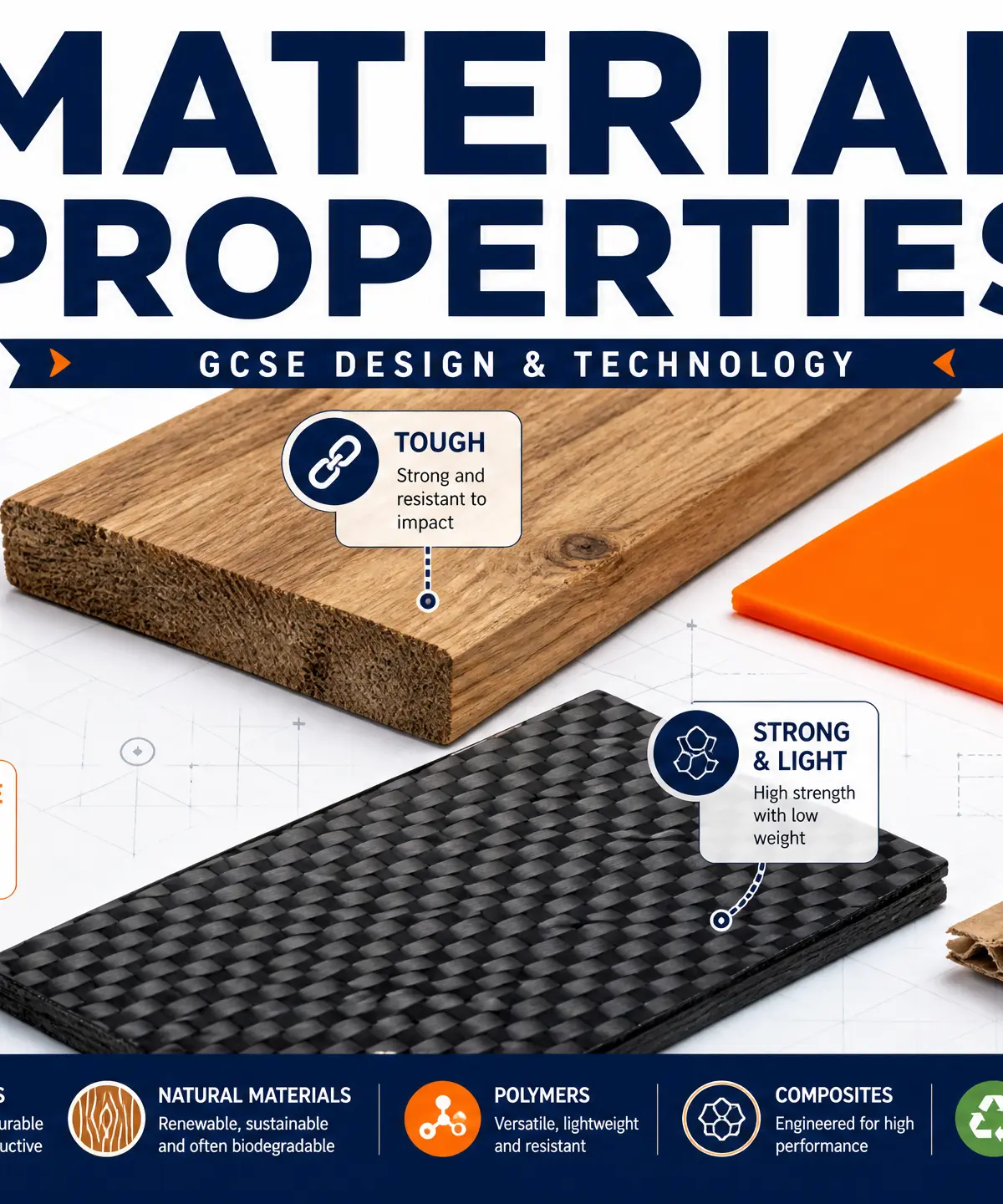
Overview
Welcome to Topic 8: Features of manufacturing industries, with a specific focus on material properties. In Design and Technology, selecting the right material is the foundation of any successful product. Examiners do not just want to know what material you have chosen; they want to know why, based on its specific performance characteristics. This guide will equip you with the technical vocabulary and theoretical knowledge to analyse, compare, and select materials like a professional designer.
Listen to the companion podcast for this topic below:

Key Knowledge & Theory
Core Concepts: The Ten Key Properties
To succeed in this topic, you must be able to define and apply these ten core material properties:
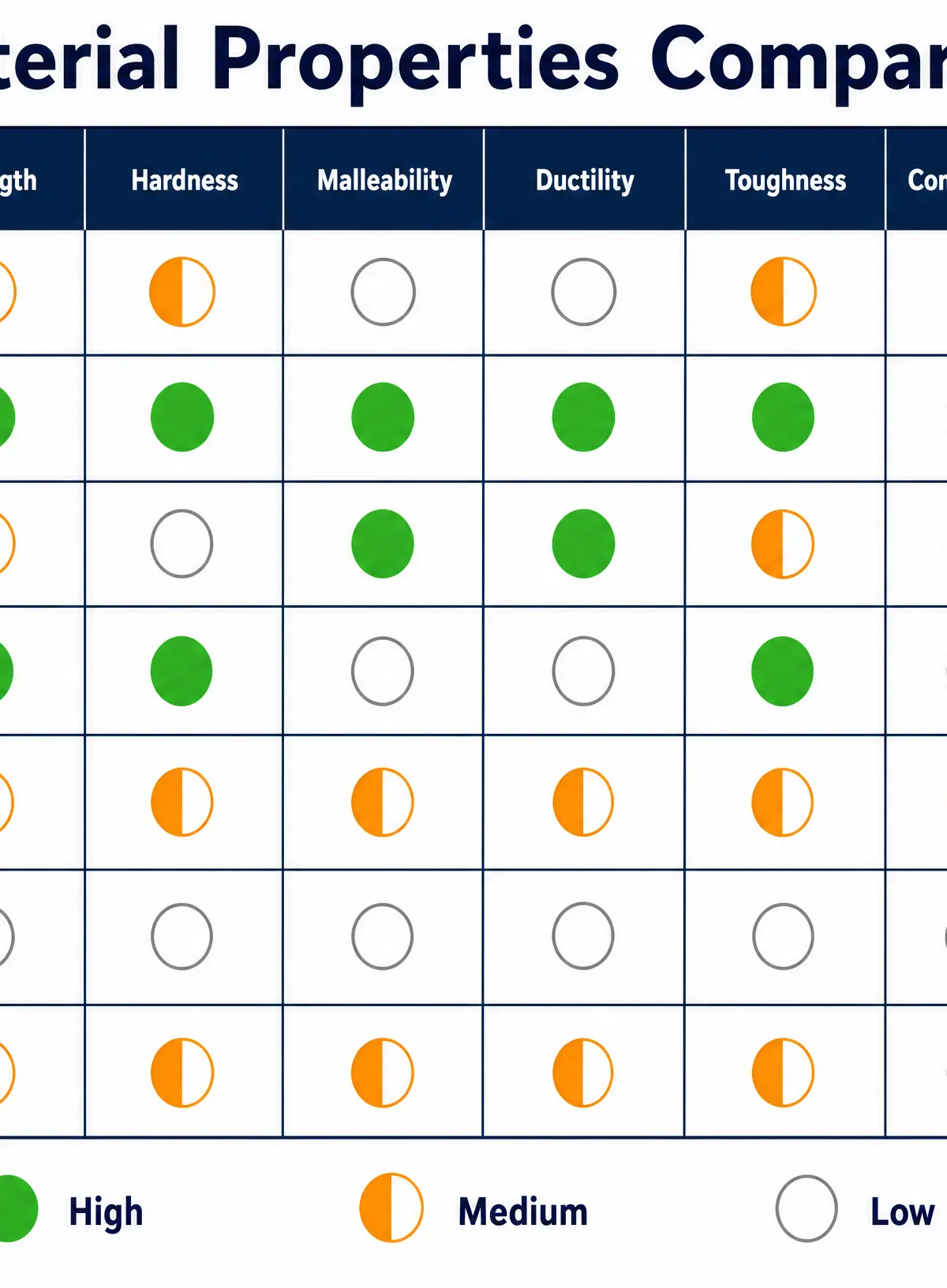
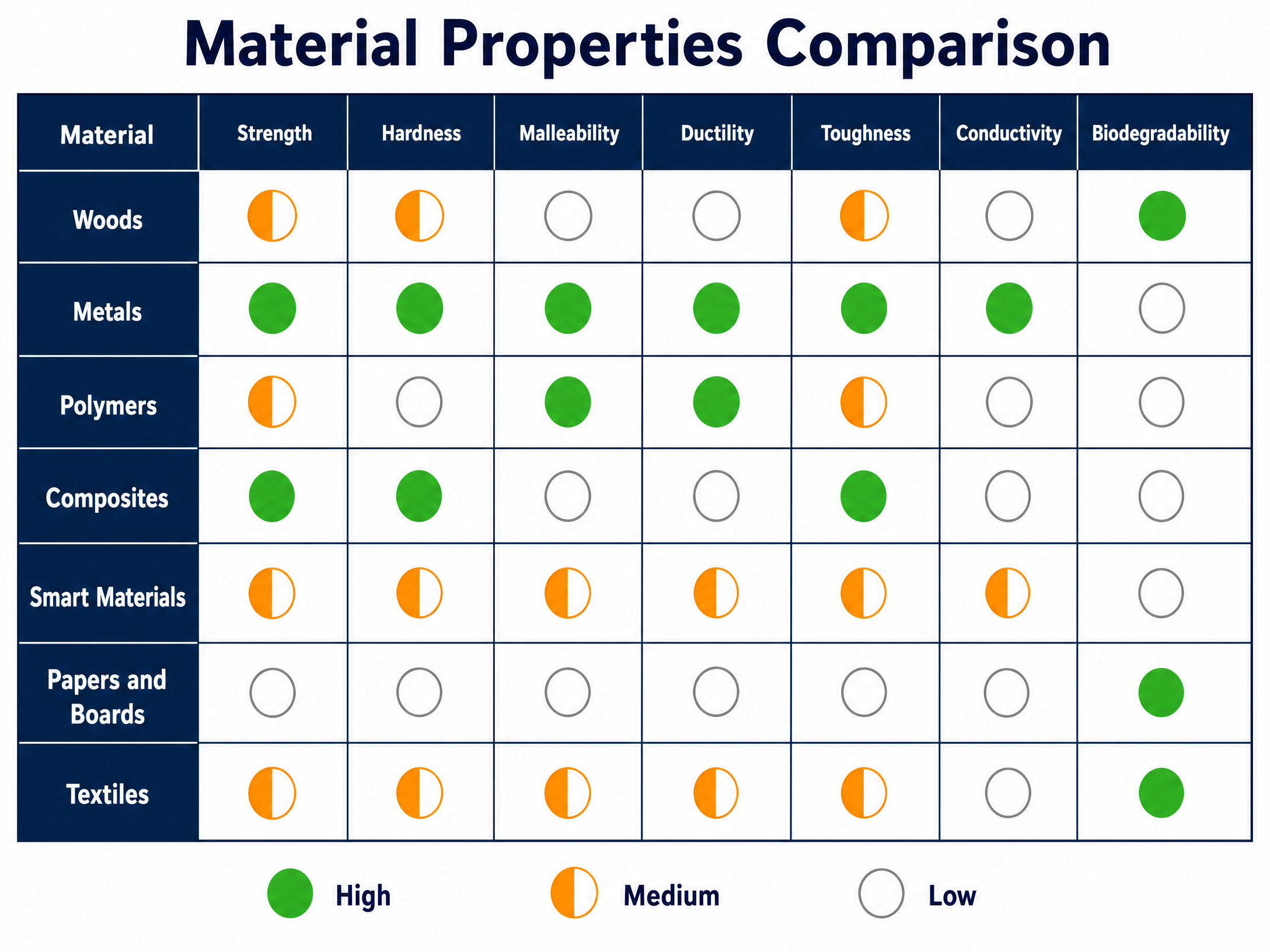
- Conductivity: The ability to allow heat or electricity to pass through. Metals are excellent conductors; most polymers are insulators.
- Strength: The ability to withstand an applied force without breaking. You must specify the type: tensile (pulling), compressive (squashing), or shear (sliding).
- Elasticity: The ability to return to the original shape after a deforming force is removed (e.g., natural rubber).
- Plasticity: The ability to permanently deform without breaking when a force is applied (e.g., shaping sheet metal).
- Malleability: The ability to be hammered or pressed into shape without cracking (e.g., aluminium for cans).
- Ductility: The ability to be drawn out into a thin wire without breaking (e.g., copper for electrical wiring).
- Hardness: The ability to resist scratching, wear, and indentation (e.g., high-carbon steel for cutting tools).
- Toughness: The ability to absorb impact energy without fracturing. A tough material will dent rather than shatter (e.g., mild steel for car panels).
- Durability: The ability to withstand wear, pressure, and environmental damage over time (e.g., stainless steel).
- Biodegradability: The ability to be broken down naturally by microorganisms (e.g., wood and paper).
Material Categories
| Category | Key Properties | Common Examples | Typical Applications |
|---|---|---|---|
| Woods | Moderate strength, biodegradable, good aesthetics | Oak (hardwood), Pine (softwood) | Furniture, interior products, construction |
| Metals | High strength, hardness, conductivity, malleable | Steel (ferrous), Aluminium (non-ferrous) | Structural components, casings, wiring |
| Polymers | Lightweight, insulators, water-resistant, plastic | Acrylic (thermoforming), Epoxy resin (thermosetting) | Casings, packaging, waterproof components |
| Composites | Engineered for specific high-performance needs | Carbon Fibre Reinforced Polymer (CFRP) | Sports equipment, aerospace components |
| Smart Materials | React to environmental changes (heat, light, stress) | Shape Memory Alloys, Thermochromic pigments | Temperature indicators, self-repairing structures |
| Papers & Boards | Lightweight, biodegradable, easily printed/folded | Corrugated cardboard, cartridge paper | Packaging, modelling, graphic products |
| Textiles | Flexible, breathable, varying strength | Cotton (natural), Polyester (synthetic) | Clothing, upholstery, structural reinforcement |
Practical Skills
Techniques & Processes: Material Selection
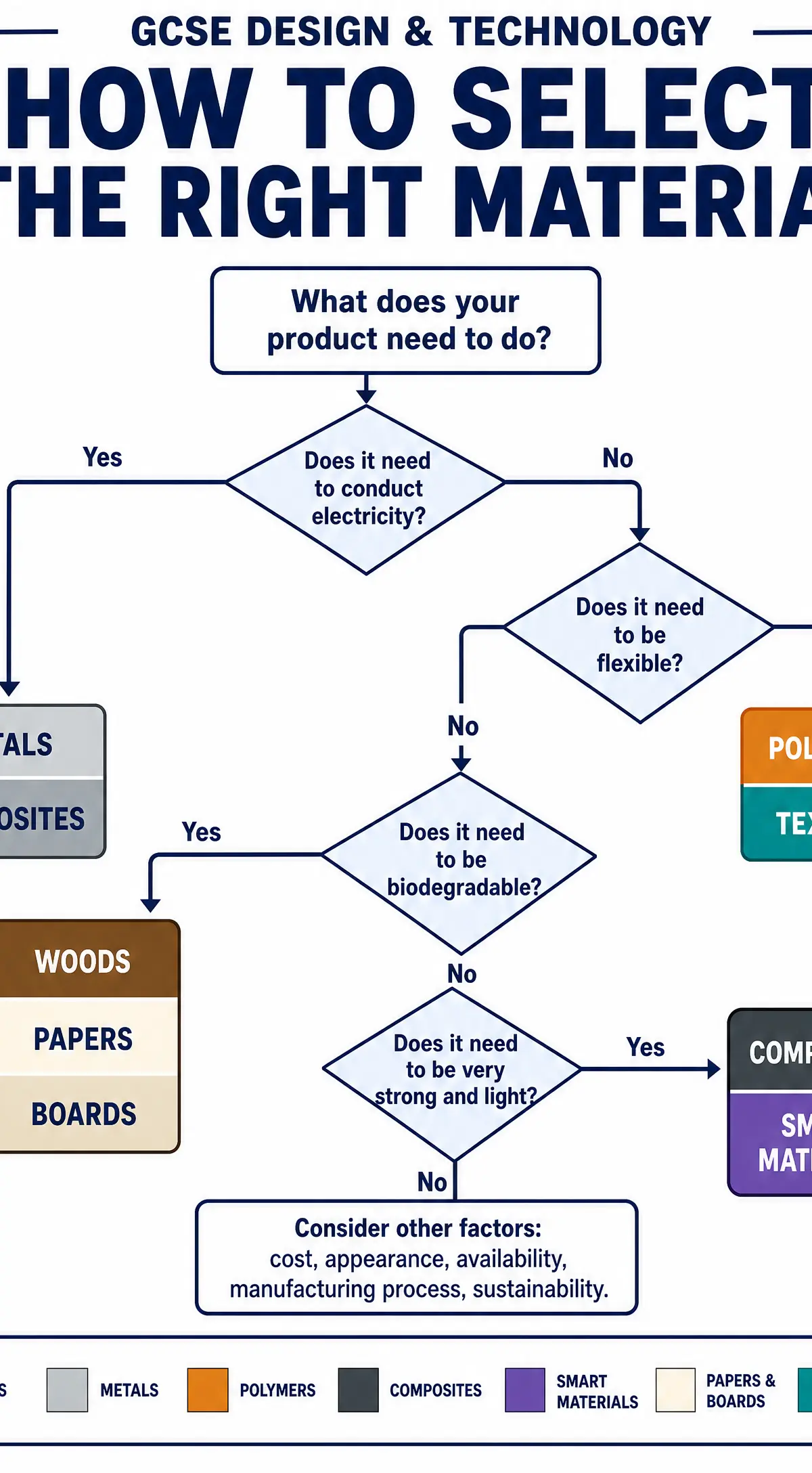
Selecting the correct material requires a systematic approach. You must evaluate the product's function against the available materials.
- Analyse the Brief: What must the product do? What environment will it be used in? Who is the user?
- Identify Required Properties: Does it need to be tough to survive drops? Does it need to be lightweight for portability? Does it need to be an electrical insulator for safety?
- Evaluate Options: Compare materials that offer these properties. Consider secondary factors like cost, availability, and ease of manufacture.
- Justify the Choice: Make your final selection and explain why it is the best option using specific technical terms.
Materials & Equipment: Safe Use
When working with different materials in the workshop, understanding their properties is crucial for safety:
- Hard materials (like high-carbon steel) require specialized cutting tools and eye protection due to the risk of shattering.
- Polymers can release toxic fumes if overheated during forming; always use extraction.
- Woods produce fine dust when sanded; always use dust extraction and masks.
Portfolio/Coursework Guidance
Assessment Criteria
In your Non-Exam Assessment (NEA) portfolio, examiners award marks for material selection under the 'Development of Design Proposals' and 'Realising Design Ideas' sections. They look for:
- Thorough research into suitable materials.
- Testing and modelling to prove material suitability.
- Justification of final material choices using the technical vocabulary listed above.
- Consideration of sustainability (e.g., choosing biodegradable or recyclable options).
Building a Strong Portfolio
Do not just state "I will use acrylic because it looks nice." Instead, write: "I have selected acrylic for the casing because it is a thermoforming polymer with excellent plasticity when heated, allowing it to be vacuum-formed into complex shapes. It is also an electrical insulator, which ensures user safety."
Exam Component
Written Exam Knowledge
The written paper will heavily test your knowledge of material properties. Expect questions that ask you to:
- Name a suitable material for a specific product.
- Explain why a material is suitable (linking property to function).
- Compare two materials for a given application.
- Evaluate the environmental impact of material choices.
Exam Preparation
Memorise the precise definitions of the ten key properties. Examiners frequently set trap questions testing the difference between toughness and hardness, or malleability and ductility. Use the retrieval cues and practice questions in this guide to test your recall.
Visual Resources
2 diagrams and illustrations
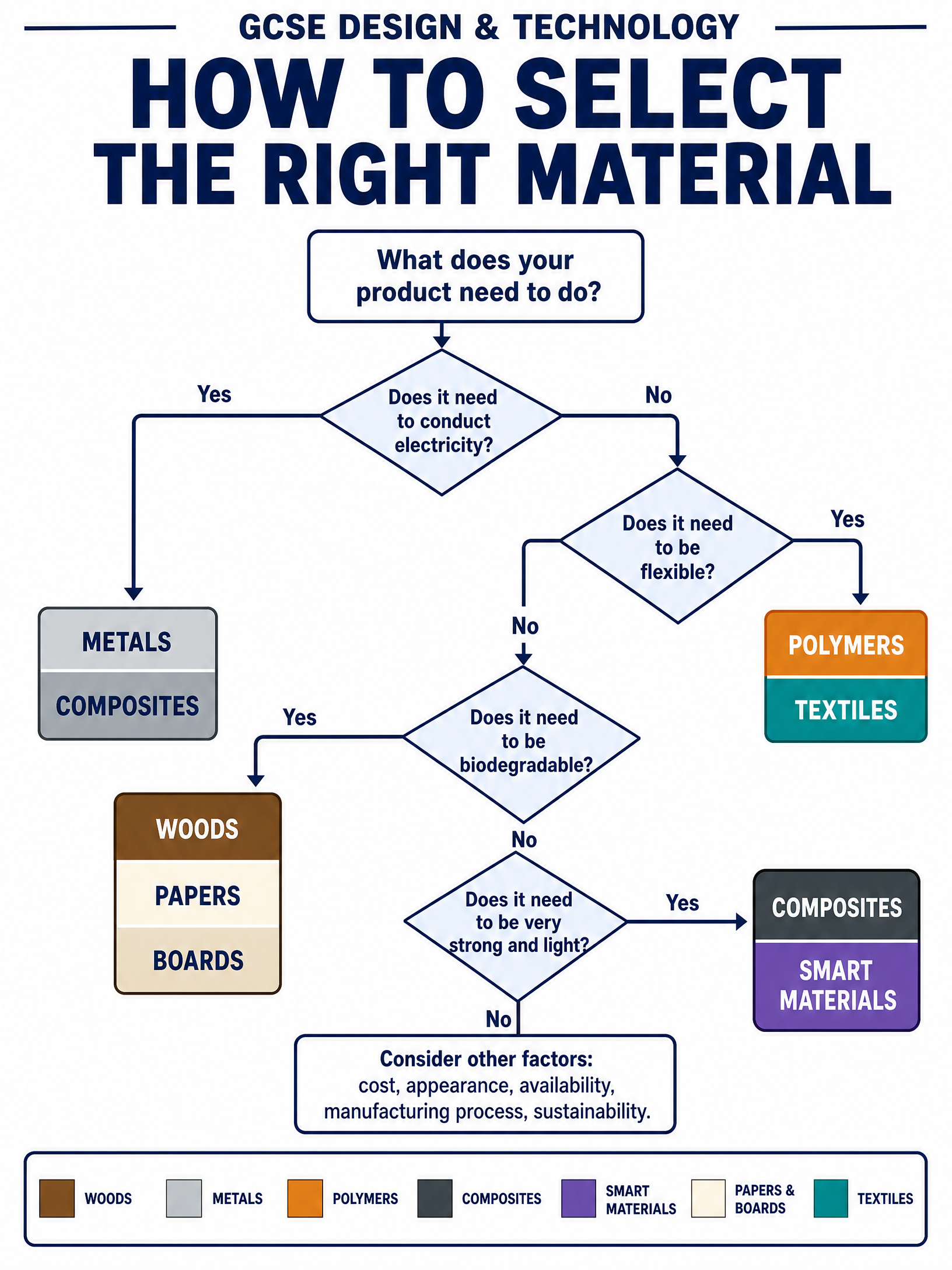
Interactive Diagrams
1 interactive diagram to visualise key concepts
Conceptual Flow Outline
A logical decision tree for material selection in the exam.
Worked Examples
3 worked examples — open one to explore the question and available guidance.
Practice Questions
Test your understanding — click to reveal model answers
Identify one material property that is essential for the blade of a wood chisel. (1 mark)
Hint: Think about what happens when the blade cuts into the wood. What must the blade resist?
Explain two reasons why pine is often chosen for manufacturing flat-pack indoor furniture. (4 marks)
Hint: Think about the cost, weight, and ease of working with pine compared to hardwoods or metals.
A company is designing a reusable coffee cup. Evaluate the use of stainless steel versus a thermoplastic (like polypropylene) for this product. (6 marks)
Hint: Compare the materials across several factors: durability, thermal conductivity, weight, and environmental impact.