Pearson Edexcel · A-Level · Design and Technology
Topic 9: Designing for maintenance and the cleaner environment
This topic covers the essential principles of sustainable design, focusing on material performance characteristics and the environmental impact of product lifecycles. It is crucial for both the written exam theory and demonstrating responsible material selection in your coursework portfolio.
- 6 min read
- 3 worked examples
- 4 practice questions
- 6 key terms
Study Notes
Overview
Topic 9: Designing for maintenance and the cleaner environment is one of the most critical areas in modern Design and Technology. As a designer, every decision you make—from the materials you select to the manufacturing processes you specify—has an environmental consequence. This topic equips you with the theoretical knowledge to discriminate between materials based on their performance characteristics and the practical understanding to design products that minimise environmental impact through their entire lifecycle.
Key Knowledge & Theory
Core Concepts: Material Performance Characteristics
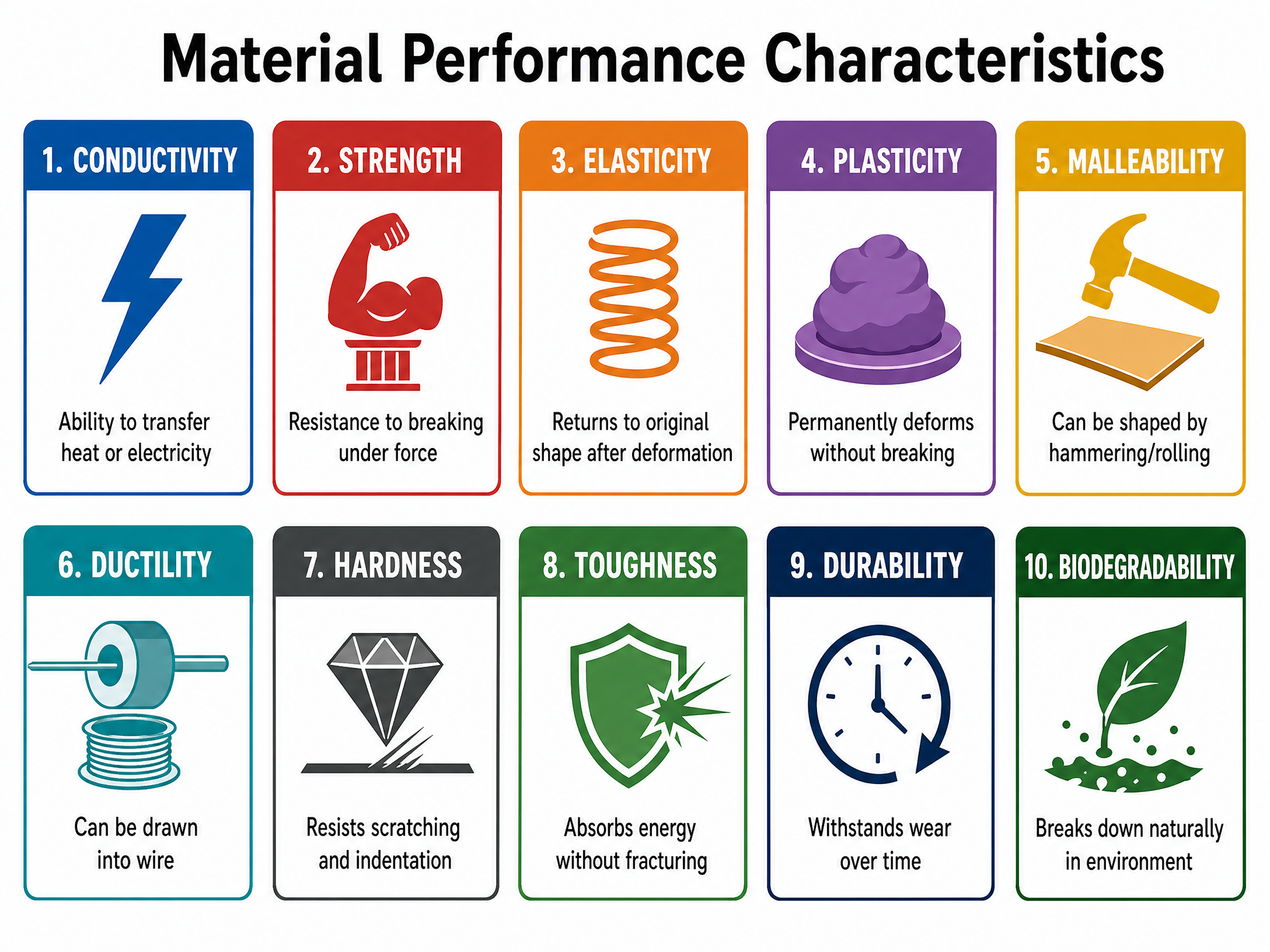
To design effectively, you must understand how materials behave under different conditions. Examiners expect you to apply these ten characteristics to specific product scenarios:
- Conductivity: The ability to transfer heat or electricity. Metals (e.g., copper) are excellent conductors; polymers are insulators.
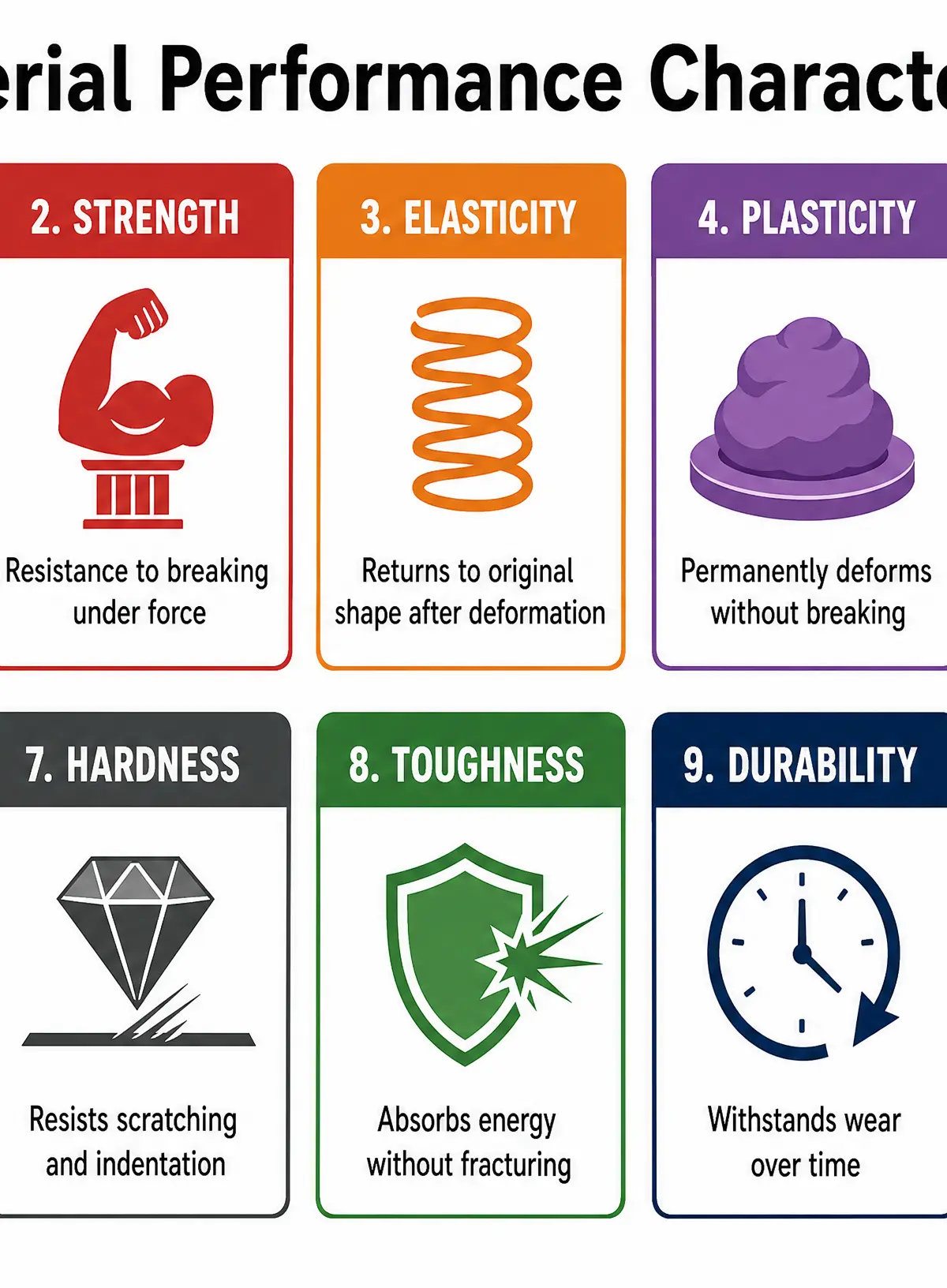
- Strength: Resistance to breaking under an applied force. Key types include tensile (pulling), compressive (squashing), and shear (cutting).
- Elasticity: The ability to return to the original shape after a deforming force is removed (e.g., a rubber band).
- Plasticity: The ability to permanently deform without breaking when a force is applied (e.g., shaping clay or heated metal).
- Malleability: The ability to be permanently deformed in all directions without cracking, such as being hammered or rolled into sheets (e.g., aluminium foil).
- Ductility: The ability to be drawn or stretched into a wire without breaking (e.g., copper wire).
- Hardness: Resistance to scratching, cutting, and indentation. Crucial for tool blades and work surfaces.
- Toughness: The ability to absorb impact energy and resist fracturing. Safety helmets require high toughness.
- Durability: The ability to withstand wear, pressure, and damage over time, contributing to a longer product lifespan.
- Biodegradability: The ability of a material to be broken down naturally by microorganisms in the environment.
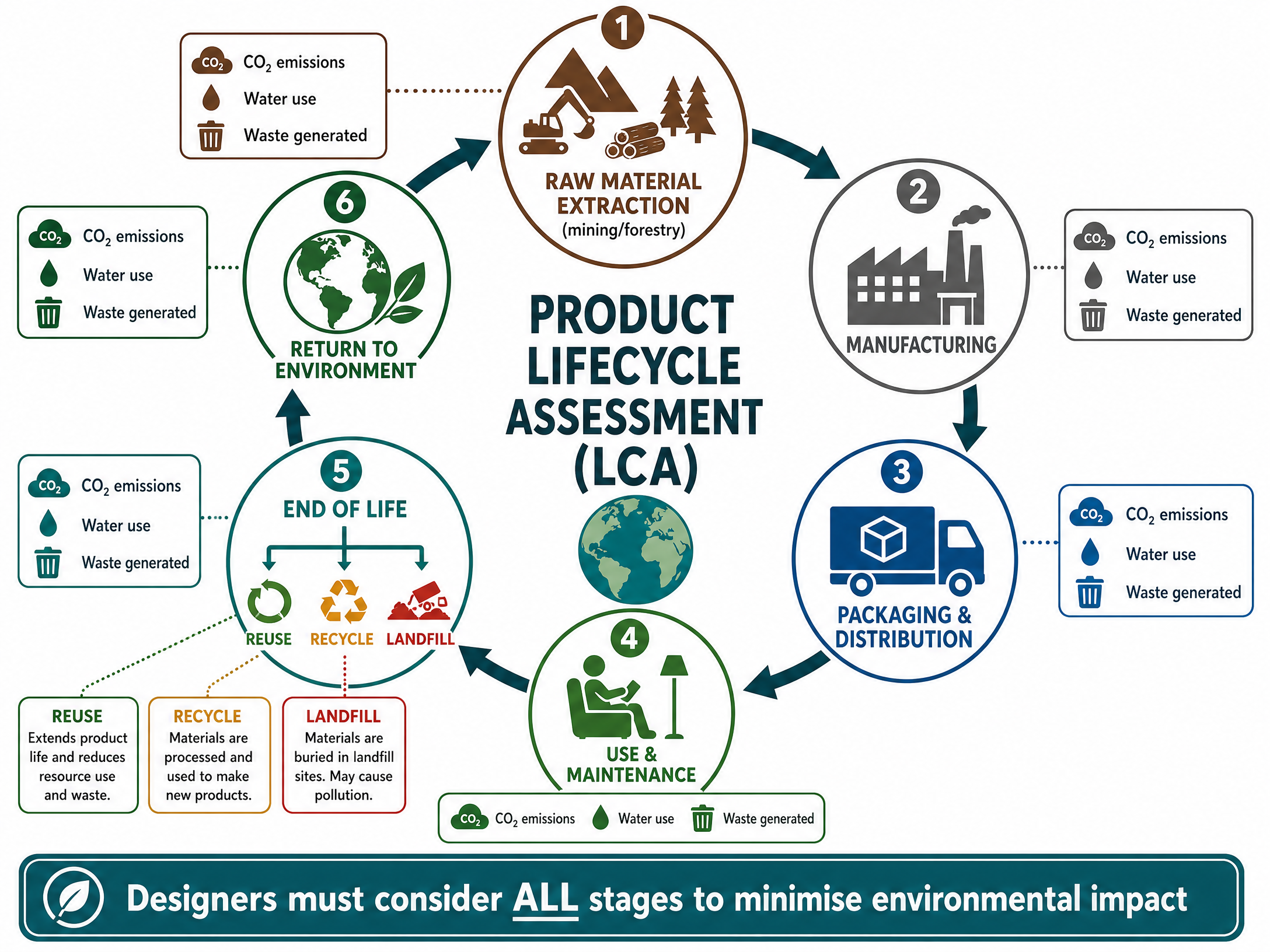
The Product Lifecycle Assessment (LCA)
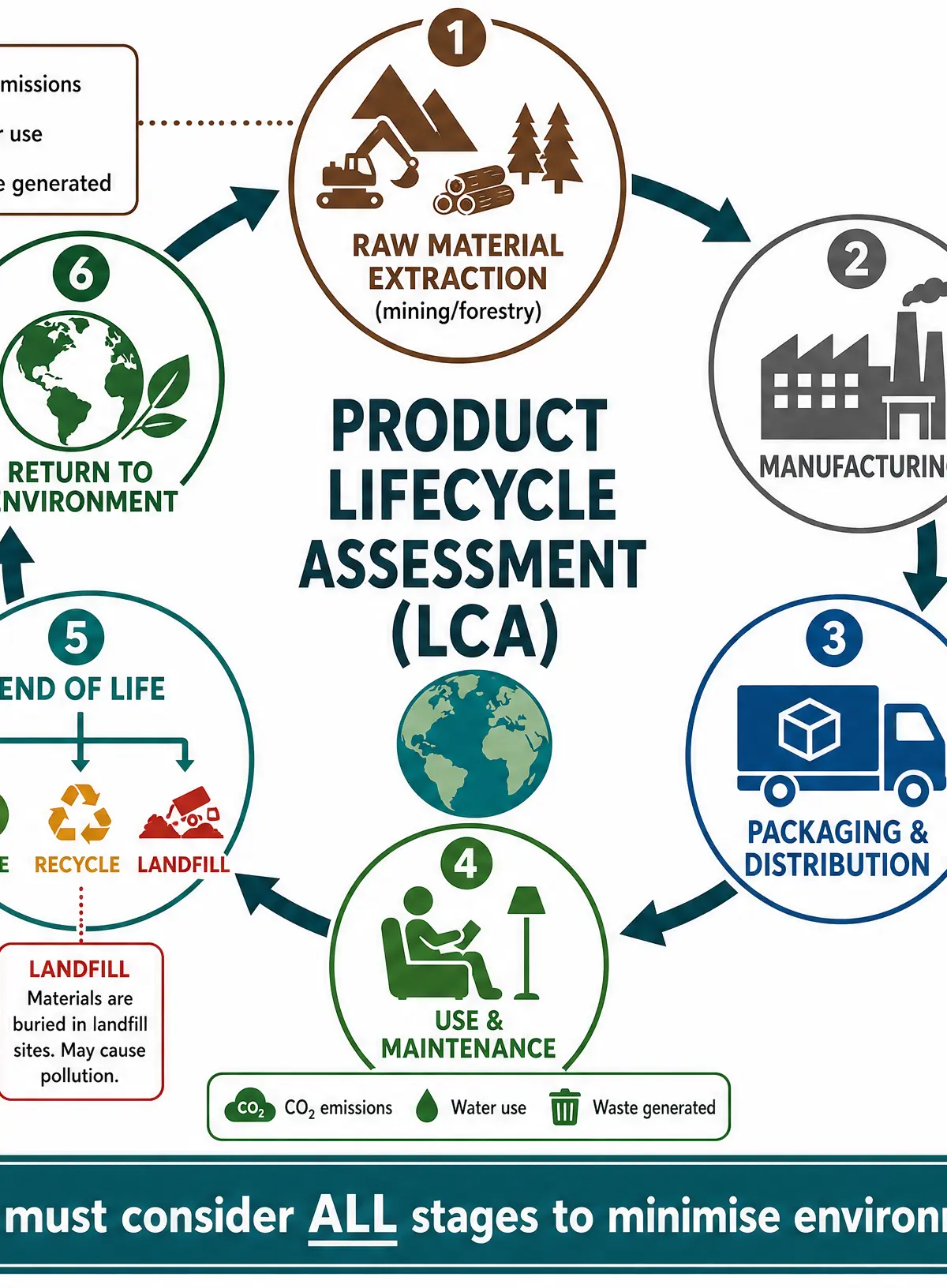
The LCA is a systematic method for evaluating the environmental impact of a product across six key stages:
- Raw Material Extraction: Mining ores, drilling for oil, or felling trees.
- Manufacturing: Processing materials and assembling the product (often highly energy-intensive).
- Packaging and Distribution: Transporting the product to the consumer, including the materials used to protect it.
- Use and Maintenance: Energy or consumables required while the product is functioning.
- End of Life: What happens when the product is no longer needed (reuse, recycle, or landfill).
- Return to the Environment: The final breakdown of materials.
Technical Vocabulary
- Sustainability: Meeting the needs of the present without compromising the ability of future generations to meet their own needs.
- Planned Obsolescence: Designing a product with an artificially limited useful life.
- Carbon Footprint: The total greenhouse gas emissions caused by an individual, event, organization, service, or product.
- FSC (Forest Stewardship Council): Certification indicating wood is sourced from responsibly managed forests.
Practical Skills
Designing for Maintenance
Designing a product that can be maintained and repaired extends its useful life, directly reducing its environmental impact. Key techniques include:
- Standardised Components: Using standard screws and fixings rather than permanent adhesives, allowing parts to be easily replaced.
- Modularity: Designing products in self-contained modules (e.g., a battery pack or screen assembly) that can be swapped out without discarding the whole product.
- Accessibility: Ensuring that components most likely to wear out (like belts or brake pads) are easily accessible with standard tools.
- Material Selection: Choosing durable, easy-to-clean materials that resist degradation.
Material Categories & Environmental Profiles
When selecting materials for your coursework, consider their environmental profile:
- Woods: Renewable if sustainably sourced (FSC). Biodegradable.
- Metals: High extraction energy, but highly recyclable. Recycling aluminium saves 95% of the energy compared to raw extraction.
- Polymers: Derived from finite fossil fuels. Most are non-biodegradable and persist in landfill, though many thermoplastics can be recycled.
- Papers & Boards: Highly recyclable and biodegradable.
- Composites: Combine materials for enhanced properties (e.g., GRP, CFRP), but are notoriously difficult to recycle at end-of-life because the constituent materials cannot be easily separated.
Portfolio/Coursework Guidance
Assessment Criteria
Examiners award marks in your NEA (Non-Exam Assessment) portfolio for demonstrating environmental awareness:
- Investigation: Analysing the environmental impact of existing products.
- Design Ideas: Explicitly considering the 6 Rs (Rethink, Refuse, Reduce, Reuse, Recycle, Repair) in your concepts.
- Development: Justifying material choices based on performance characteristics AND sustainability.
- Evaluation: Assessing your final prototype's potential lifecycle impact.
Building a Strong Portfolio
Do not just state "I chose wood because it is sustainable." You must provide a nuanced justification: "I selected FSC-certified beech for the casing because its high durability will extend the product's lifespan, and unlike polymer alternatives, it is biodegradable at end-of-life. I used standard mechanical fixings rather than PVA glue to ensure the internal electronic components can be accessed for repair."
Exam Component
Written Exam Knowledge
The theory paper will test your ability to discriminate between materials. You will frequently be presented with a product scenario (e.g., a child's outdoor play slide) and asked to evaluate the suitability of different materials based on their properties.
Audio Revision
Listen to the podcast below for a comprehensive review of this topic, including a quick-fire recall quiz.

Visual Resources
2 diagrams and illustrations
Interactive Diagrams
1 interactive diagram to visualise key concepts
Conceptual Flow Outline
Integrating sustainability into the iterative design process
Worked Examples
3 worked examples — open one to explore the question and available guidance.
Practice Questions
Test your understanding — click to reveal model answers
Identify two stages of a Product Lifecycle Assessment (LCA).
Hint: Think about the very beginning and the very end of a product's life.
Explain how the property of plasticity is utilised in the manufacturing of a clay ceramic mug.
Hint: What does plasticity allow you to do to the clay before it is fired?
A company currently glues the polymer casing of its remote controls together. Propose a design modification to improve the product's maintainability and explain the environmental benefit of this change.
Hint: If it's glued, you have to break it to fix it. What could you use instead?
Evaluate the use of composite materials, such as Carbon Fibre Reinforced Polymer (CFRP), in the manufacture of high-performance racing bicycles, with reference to performance characteristics and end-of-life environmental impact.
Hint: Consider why CFRP is great for racing, but terrible for the environment when the bike breaks.