Pearson Edexcel · GCSE · Design and Technology
All design and technological practice takes place within contexts which inform outcomes
This topic covers how the intended environment and user shape every design decision. You will learn how to select and justify materials, components, and manufacturing processes based on their performance characteristics to solve specific problems within given contexts.
- 6 min read
- 3 worked examples
- 4 practice questions
- 6 key terms
Study Notes
Overview
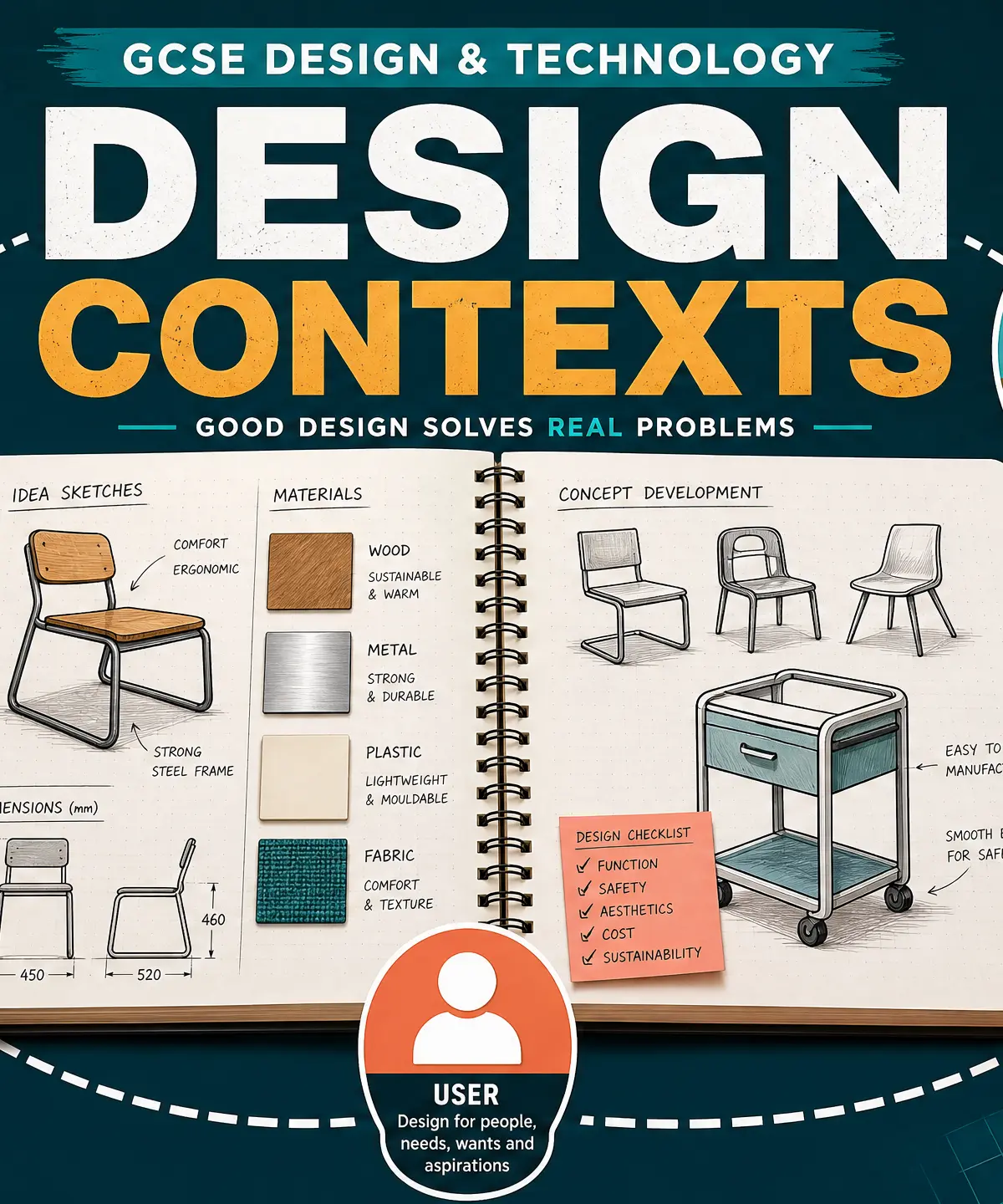
All design and technological practice takes place within specific contexts that inform outcomes. This means that a product is never designed in isolation; its final form, material, and manufacturing method are entirely dependent on who will use it, where it will be used, and what it needs to achieve. Examiners will test your ability to link your knowledge of materials and processes directly to these real-world scenarios.
Listen to the topic podcast below for a complete walkthrough of how to pick up marks in this section:

Key Knowledge & Theory
Core Concepts
To succeed in this topic, candidates must demonstrate a deep understanding of how contexts drive design decisions. The primary contexts you must be familiar with include:
- Domestic Contexts: Products designed for use in the home. Priorities often include aesthetics, safety, ease of cleaning, and ergonomics.
- Industrial/Commercial Contexts: Products designed for workplaces or factories. Priorities shift towards durability, efficiency, standardization, and cost-effectiveness at scale.
- Medical Contexts: Products designed for healthcare settings. Strict hygiene, non-toxicity, and reliability are paramount.
- Environmental Contexts: Designing with sustainability in mind, focusing on recyclable materials, low carbon footprints, and circular economy principles.
Material Performance Characteristics
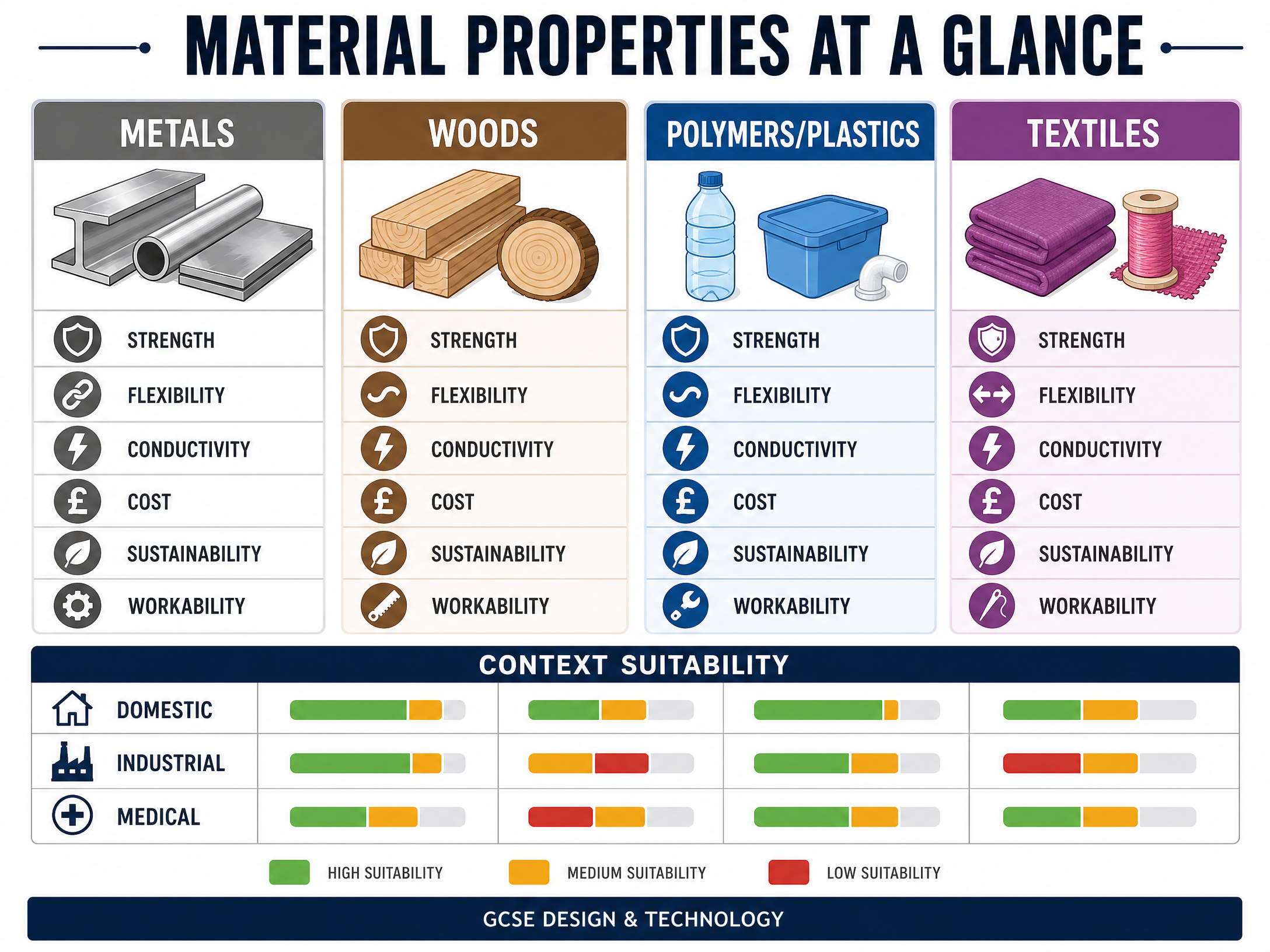
You must be able to justify material choices based on their performance characteristics. Examiners reward candidates who use specific terminology rather than vague descriptions.
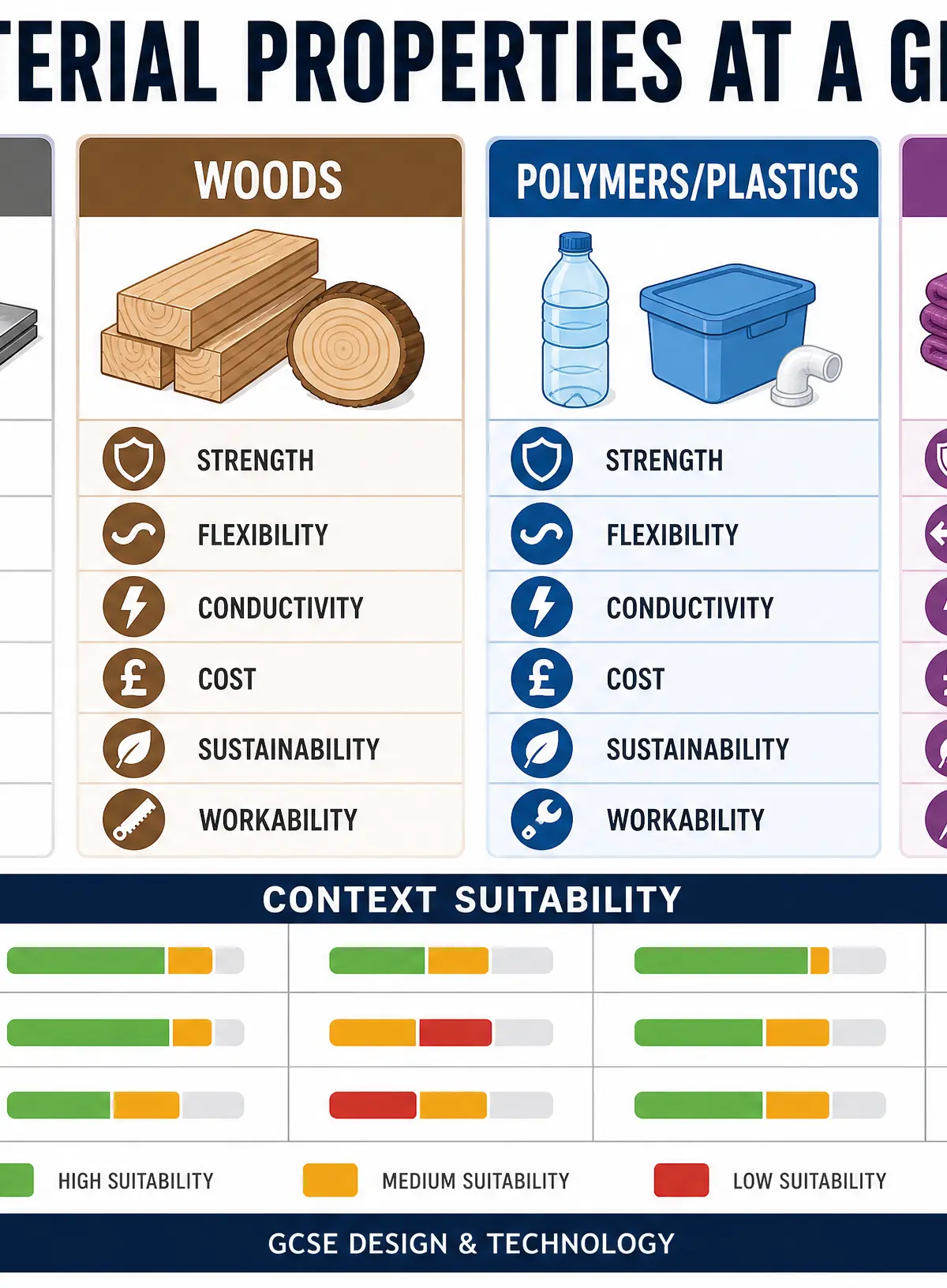
| Material Family | Key Properties | Typical Contextual Application | Limitations |
|---|---|---|---|
| Metals (e.g., Steel, Aluminium) | High tensile strength, good conductivity, malleability. | Industrial structures, medical equipment (aluminium). | Prone to corrosion (if untreated), heavy, conductive (safety risk in some contexts). |
| Woods (e.g., Oak, Pine, MDF) | Natural aesthetic, good strength-to-weight ratio, renewable. | Domestic furniture, architectural structures. | Absorbs moisture, can warp or rot, anisotropic (strength varies with grain). |
| Polymers (e.g., ABS, Epoxy Resin) | Excellent insulators, lightweight, easily moulded, chemical resistance. | Consumer electronics, waterproof casings, mass-produced items. | Poor sustainability (fossil-fuel derived), lower heat resistance than metals. |
| Textiles (e.g., Cotton, Nylon) | Flexibility, breathability, high tensile strength (synthetics). | Clothing, upholstery, medical dressings. | Flammable (without treatment), can degrade under UV light. |
Technical Vocabulary
Candidates MUST use these terms accurately in their exam responses and coursework annotation:
- Tensile Strength: The resistance of a material to breaking under tension.
- Malleability: The ability of a material to be deformed under compression (e.g., hammered or rolled into sheets).
- Thermoplastic: A polymer that becomes pliable or mouldable above a specific temperature and solidifies upon cooling.
- Thermosetting Polymer: A polymer that irreversibly becomes rigid when heated or cured.
- Ergonomics: The application of psychological and physiological principles to the engineering and design of products, processes, and systems.
- Contextual Constraints: The limitations placed on a design by its intended environment or user.
Practical Skills
Techniques & Processes
Understanding how things are made is just as important as knowing what they are made of. You must be able to select the correct manufacturing process for the context.
- Injection Moulding: Ideal for high-volume production of complex polymer shapes (e.g., casing for a medical device). High initial tooling cost, but very low cost per unit thereafter.
- Laser Cutting: Excellent for precision 2D profiles in acrylic, MDF, or thin metals. Used frequently in iterative prototyping and small-batch production.
- Casting: Used for metals where complex, solid 3D forms are required (e.g., an industrial engine block).
- 3D Printing (Additive Manufacturing): Perfect for rapid prototyping and bespoke, one-off medical implants where customization to the individual patient is required.
Materials & Equipment
When working practically, you must demonstrate safe and appropriate use of tools. For example, using a pillar drill requires securing the workpiece with a machine vice to prevent it spinning, whereas using a scroll saw requires keeping fingers clear of the blade path while maintaining downward pressure on the material.
Portfolio/Coursework Guidance
Assessment Criteria
In your Non-Examined Assessment (NEA), examiners are looking for a clear 'golden thread' that links your initial contextual challenge to your final prototype. Marks are awarded for:
- Investigating: Analyzing the context and identifying the needs of the primary user.
- Designing: Generating iterative ideas that explicitly solve the problems identified in the context.
- Making: Selecting appropriate materials and processes that suit the intended environment.
- Evaluating: Testing the final prototype in its intended context against the original specification.
Building a Strong Portfolio
To secure high marks, your portfolio must show evidence of decision-making. Do not just present a final design. Show your journey. If you tested a joint and it failed, document it. Explain why it failed in relation to the context (e.g., "The PVA glue joint failed under a 5kg load, making it unsuitable for the heavy-duty industrial context I am designing for. I will iterate by testing a mechanical fixing instead.").
Exam Component
Written Exam Knowledge
The written paper will heavily test your ability to apply theory to unfamiliar contexts. You will frequently encounter questions that present a product (e.g., a child's highchair) and ask you to justify the materials and manufacturing processes used.
Practical Exam Preparation
For questions requiring sketching or design generation, always annotate your drawings with contextual justification. Use arrows to point to specific features and explain why they are there. "Rounded corners for safety in a domestic environment" earns marks; "Rounded corners" does not.
Visual Resources
2 diagrams and illustrations
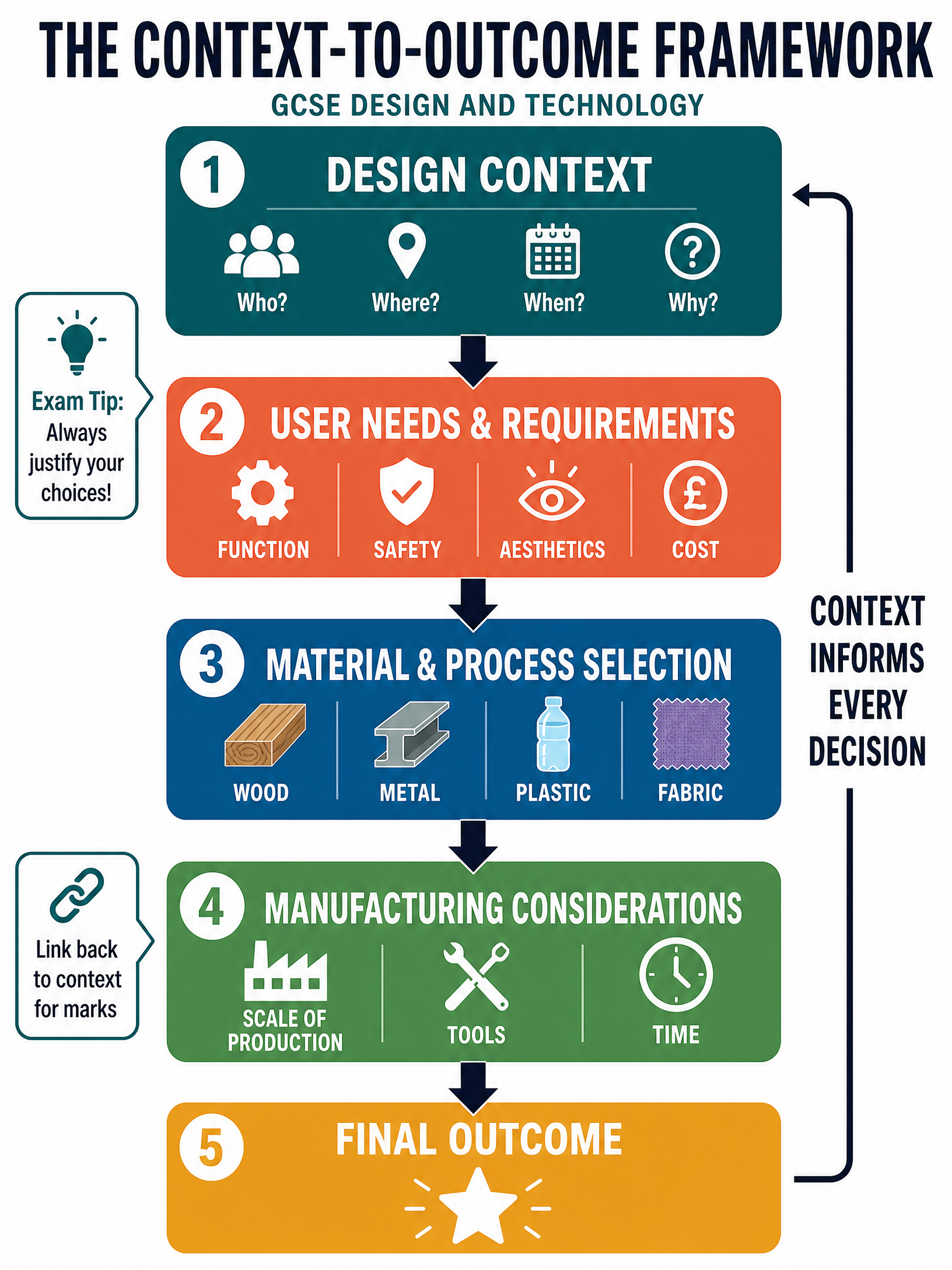
Interactive Diagrams
1 interactive diagram to visualise key concepts
Conceptual Flow Outline
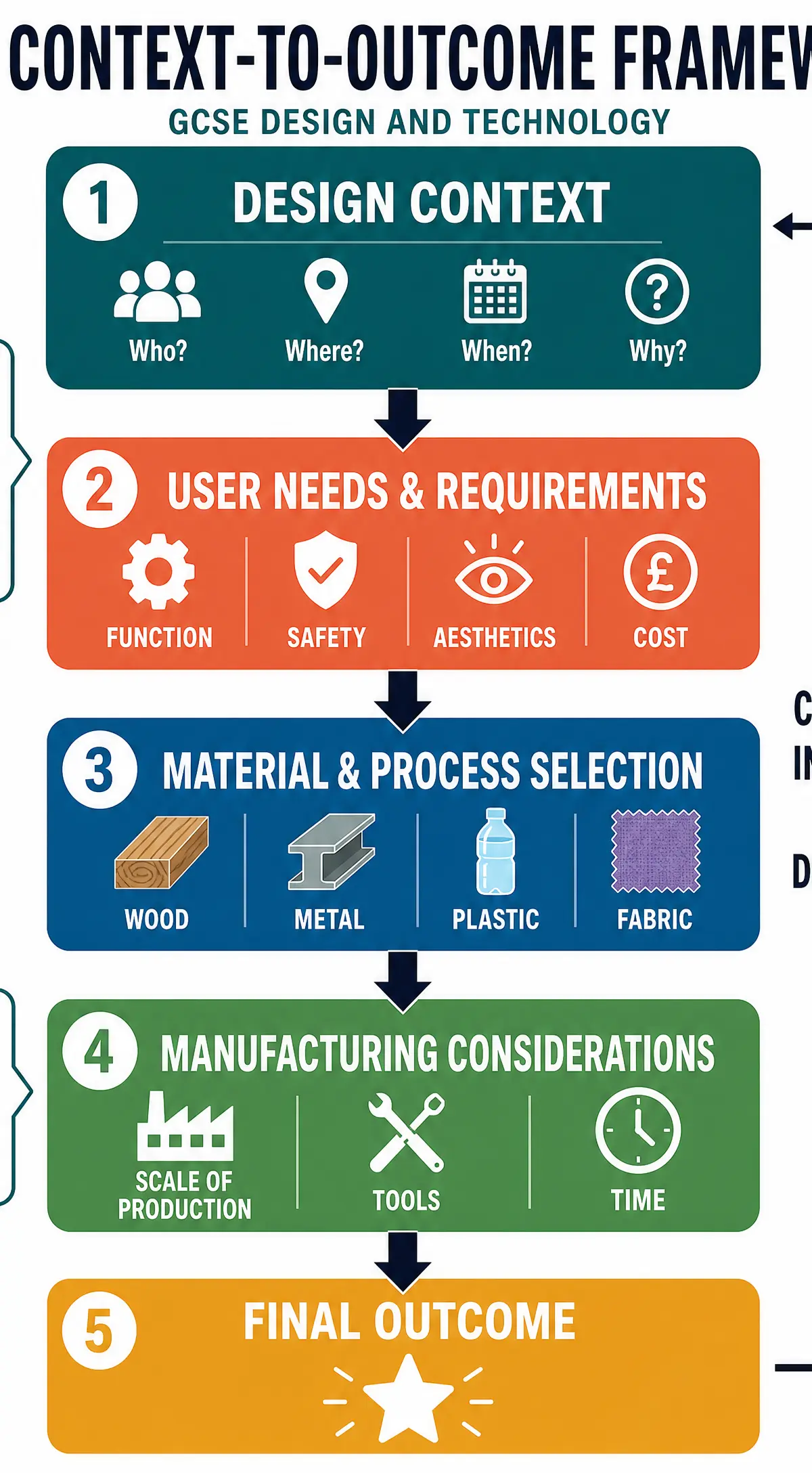
The Contextual Design Decision Pathway
Worked Examples
3 worked examples — open one to explore the question and available guidance.
Practice Questions
Test your understanding — click to reveal model answers
Identify two performance characteristics of mild steel.
Hint: Think about its strength and how it reacts to being bent or hammered.
A company is designing a new range of outdoor playground equipment. Explain why they might choose to use high-density polyethylene (HDPE) rather than pine.
Hint: Compare how both materials react to the outdoor environment (weather) and the users (children).
Discuss the impact of the environmental context on the design and manufacture of modern consumer electronics, such as smartphones.
Hint: Think about the whole lifecycle: materials used, energy consumption, repairability, and end-of-life disposal.
Evaluate the use of 3D printing (additive manufacturing) for producing a batch of 50 bespoke medical splints.
Hint: Consider the advantages of customization in a medical context versus the speed and cost of the process.