Pearson Edexcel · GCSE · Design and Technology
Developments in modern and smart materials, composite materials and technical textiles
This topic explores the cutting edge of materials science, covering modern, smart, and composite materials alongside technical textiles. Understanding these materials and their specific applications is crucial for answering extended theory questions and making informed material choices in your NEA portfolio.
- 8 min read
- 3 worked examples
- 3 practice questions
- 6 key terms
Study Notes
Overview
Welcome to one of the most dynamic and rapidly evolving areas of Design and Technology: Developments in modern and smart materials, composite materials, and technical textiles (Topic 1.4). As designers, the materials we choose dictate the success, sustainability, and functionality of our products. In this topic, you will move beyond traditional woods, metals, and polymers to explore materials engineered at the atomic level, materials that respond to their environment, and fabrics designed to save lives.
Listen to the companion revision podcast for an in-depth audio guide:

Key Knowledge & Theory
Core Concepts
To succeed in your exam, you must clearly distinguish between four distinct categories:
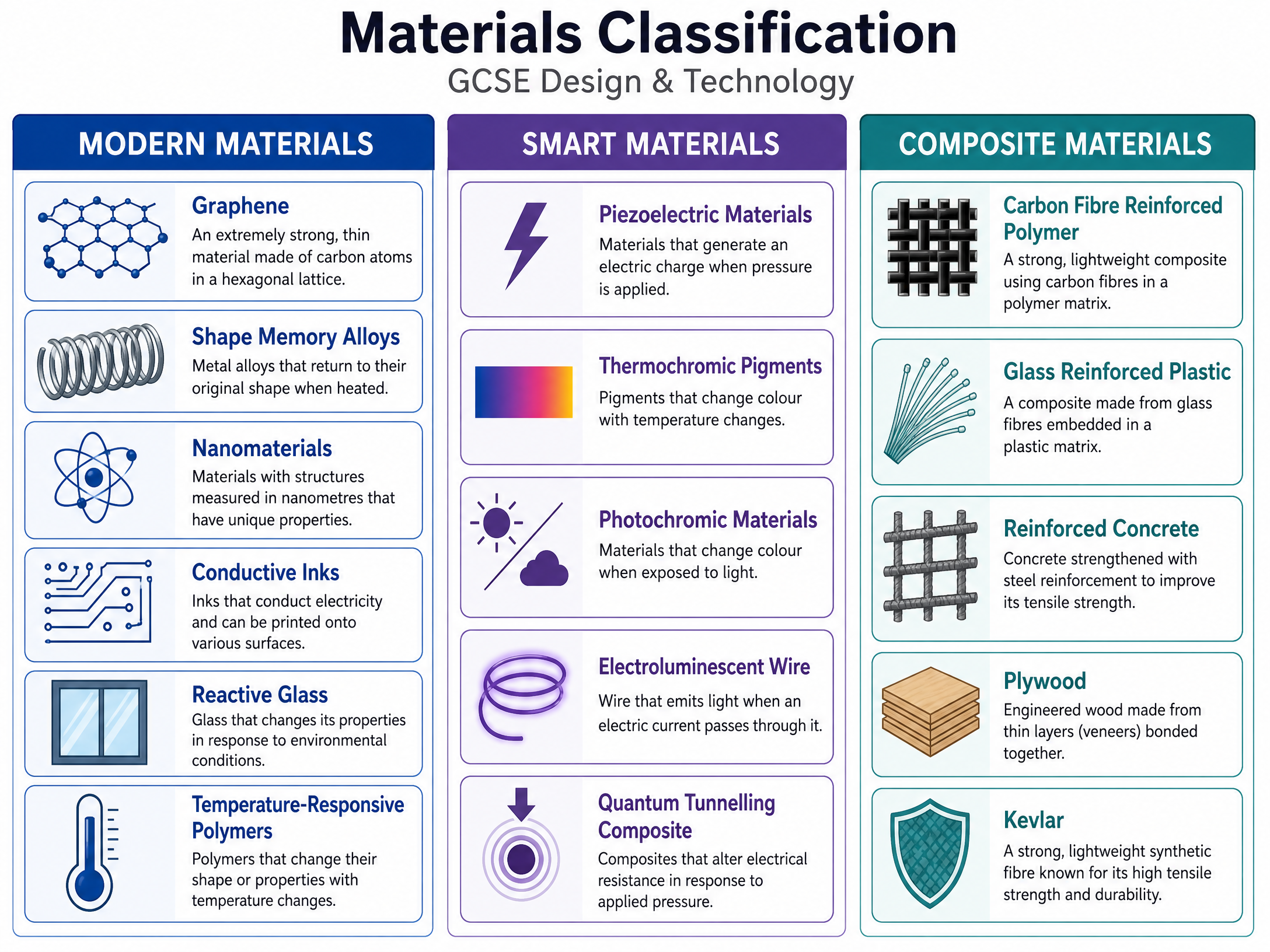
- Modern Materials: Materials developed relatively recently through new manufacturing processes or scientific discoveries. They do not react to their environment, but possess exceptional properties compared to traditional materials.
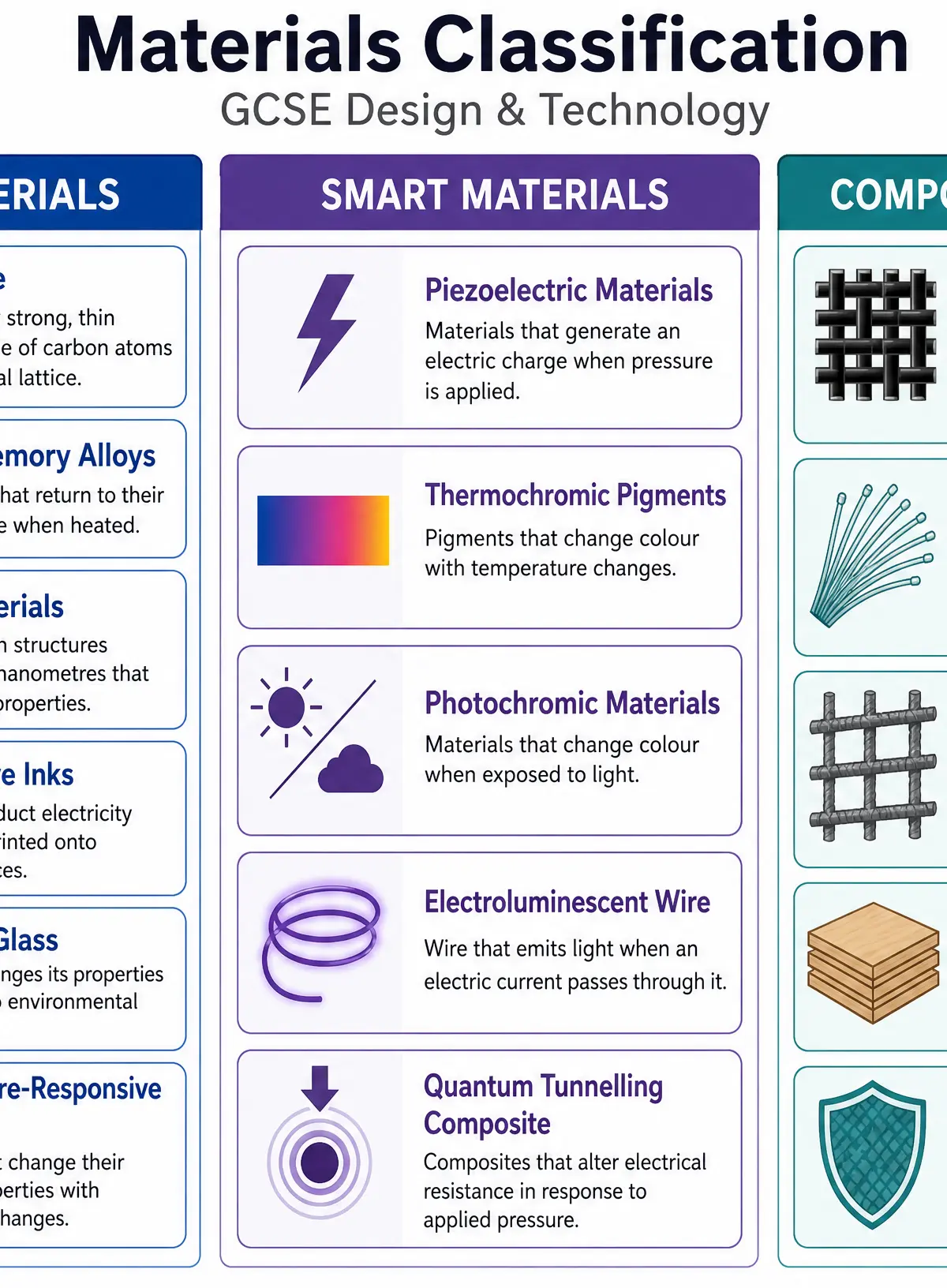
- Smart Materials: Materials that physically alter their properties in response to a change in their environment (a stimulus), such as temperature, light, pressure, or electricity.
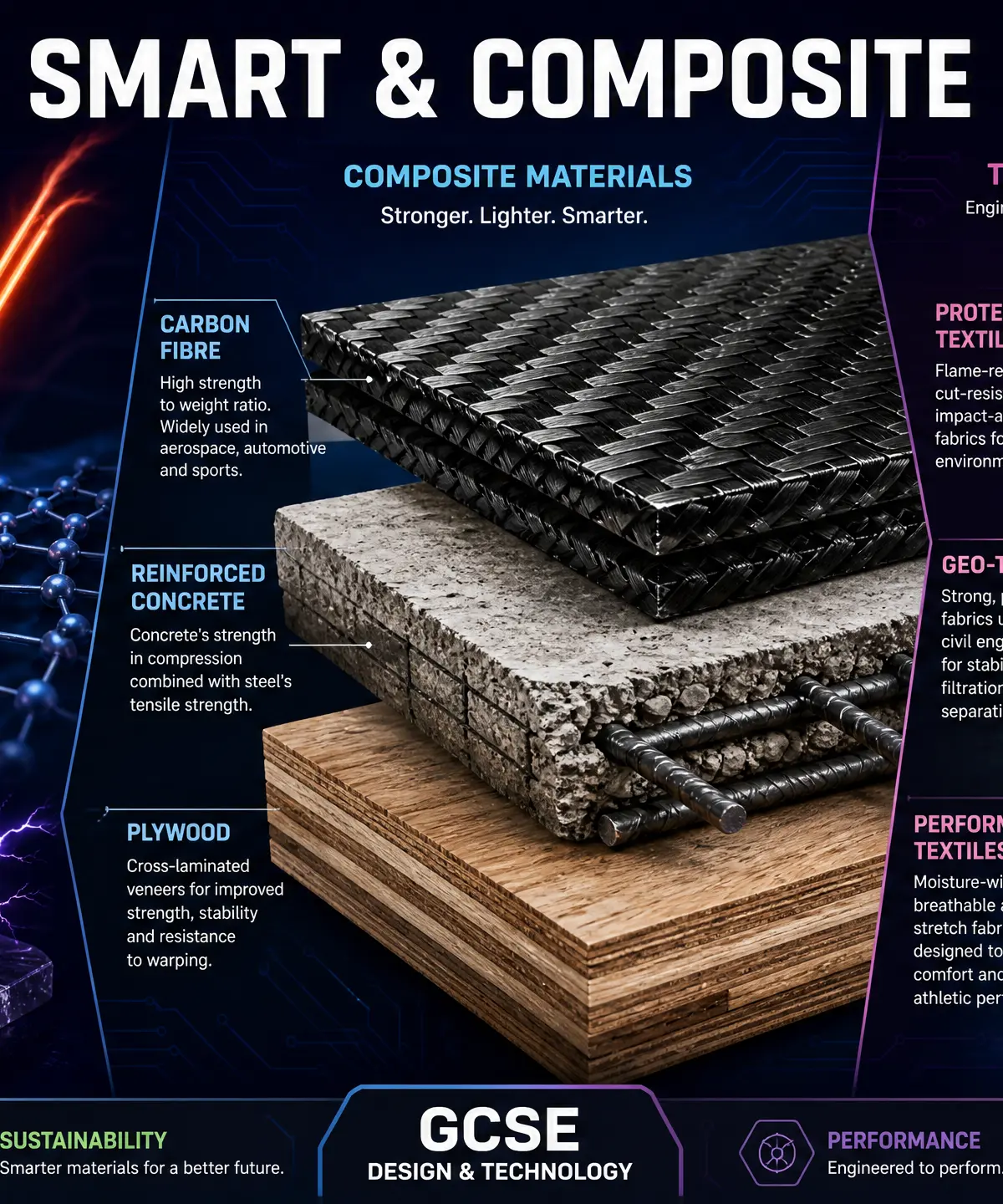
- Composite Materials: Materials made by combining two or more constituent materials with significantly different physical or chemical properties to produce a new material with superior characteristics.
- Technical Textiles: Engineered fabrics designed specifically for their functional performance and technical properties rather than their aesthetic appearance.
Modern Materials in Focus
| Material | Key Property | Common Applications |
|---|---|---|
| Graphene | A single layer of carbon atoms; exceptionally strong, lightweight, and highly conductive. | High-performance sports equipment, flexible electronics, medical devices. |
| Nanomaterials | Engineered at the nanoscale (1-100nm); exhibit unique physical and chemical properties. | Carbon nanotubes for structural reinforcement; silver nanoparticles for antimicrobial dressings. |
| Conductive Inks | Inks containing conductive particles (like silver or carbon) that allow electricity to flow. | Printed circuit boards (PCBs), RFID tags, smart packaging. |
| Reactive Glass | Changes from transparent to opaque when an electrical voltage is applied. | Privacy windows in offices, aircraft cabin windows. |
Smart Materials in Focus
| Material | Stimulus | Response & Application |
|---|---|---|
| Shape Memory Alloys (SMA) | Heat / Temperature | Returns to a pre-set shape when heated. Used in medical stents, dental braces, and fire alarm triggers. |
| Piezoelectric Materials | Mechanical Pressure | Generates an electrical charge when compressed (used in touchscreens, energy-harvesting floors). Conversely, deforms when an electrical charge is applied (used in ultrasound transducers). |
| Thermochromic Pigments | Heat / Temperature | Changes colour at specific temperatures. Used in baby bath thermometers, novelty mugs, and food packaging indicators. |
| Photochromic Materials | UV Light | Changes colour or darkens when exposed to ultraviolet light. Used in transition spectacle lenses and security markers. |
| Quantum Tunnelling Composite (QTC) | Mechanical Pressure | Changes from an electrical insulator to a conductor when compressed. Used in flexible wearable electronics and pressure sensors. |
Composite Materials in Focus
Composites typically consist of a reinforcement (which provides strength) embedded within a matrix (which binds the reinforcement together and transfers the load).
| Composite | Components | Properties & Applications |
|---|---|---|
| Carbon Fibre Reinforced Polymer (CFRP) | Carbon fibres (reinforcement) + Polymer resin (matrix) | Exceptional strength-to-weight ratio, stiff, expensive. Used in F1 car chassis, aerospace, high-end bicycles. |
| Glass Reinforced Plastic (GRP / Fibreglass) | Glass fibres (reinforcement) + Polyester resin (matrix) | Lightweight, easily moulded, corrosion-resistant. Used in boat hulls, theme park rides, car body panels. |
| Reinforced Concrete | Steel rebar (tensile strength) + Concrete (compressive strength) | High compressive and tensile strength, durable. Used in large-scale construction, bridges, high-rise buildings. |
| Plywood | Wood veneers + Adhesive resin | Cross-laminated layers provide uniform strength and resist warping. Used in furniture, construction, flooring. |
Technical Textiles in Focus
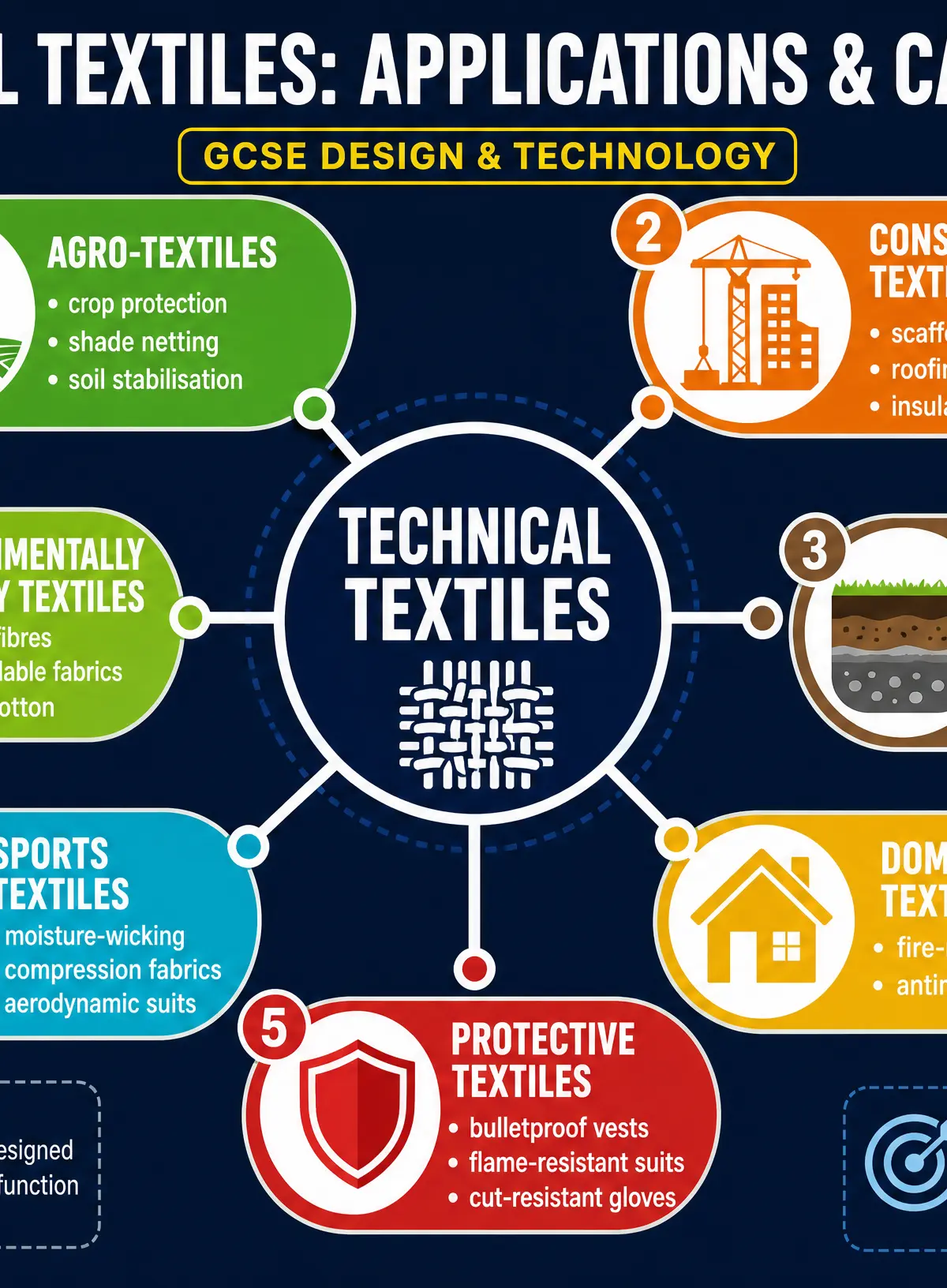
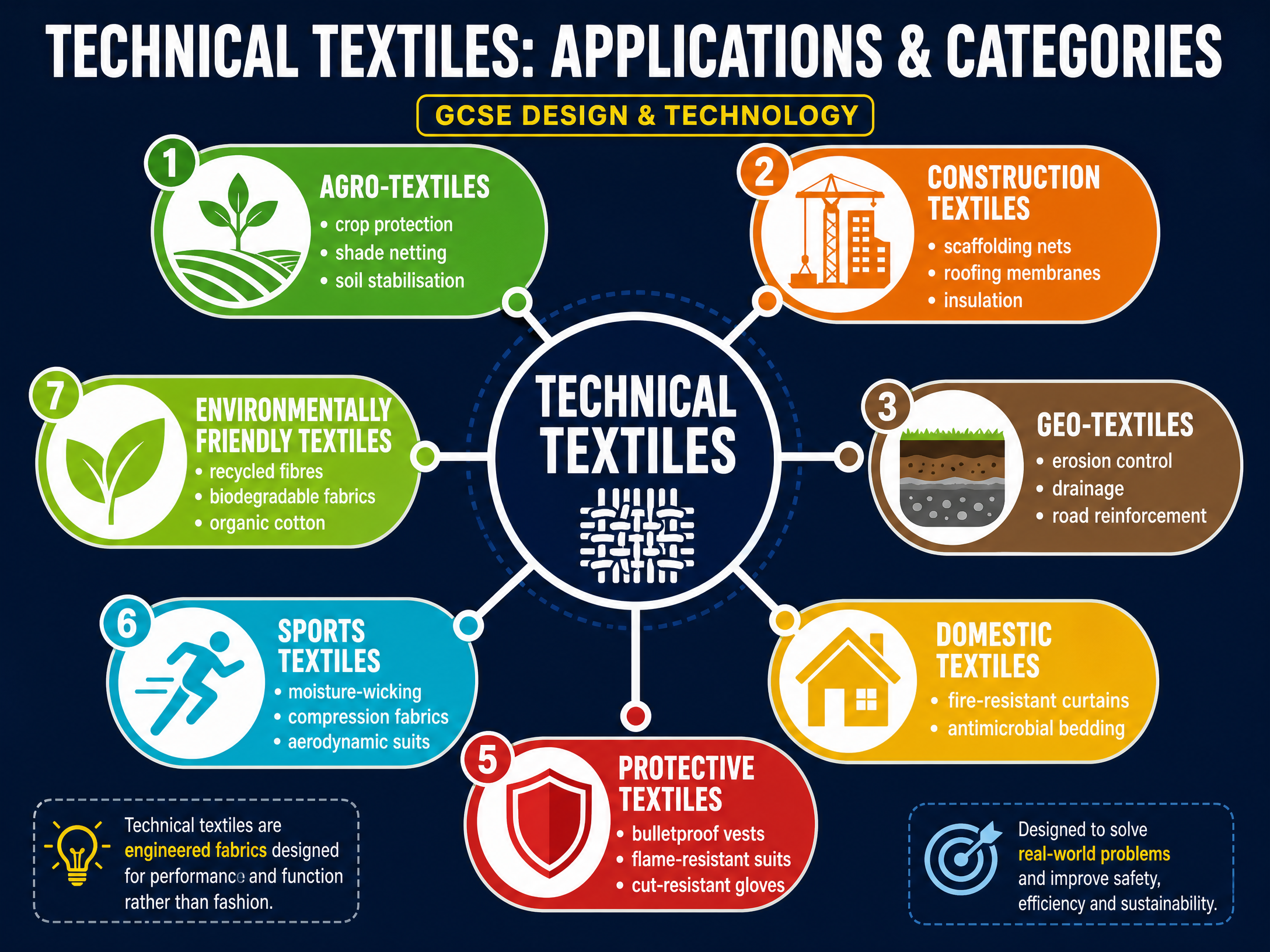
Technical textiles are categorised by their end-use:
- Agro-textiles: Used in agriculture (e.g., shade nets, crop protection, weed suppression).
- Construction textiles: Used in building (e.g., scaffolding nets, breathable roofing membranes).
- Geo-textiles: Used in civil engineering for groundworks (e.g., soil stabilisation, drainage, erosion control).
- Domestic textiles: Used in the home for function (e.g., fire-resistant upholstery, antimicrobial dishcloths).
- Environmentally friendly textiles: Focus on sustainability (e.g., organically grown cotton, recycled PET fabrics, biodegradable fibres).
- Protective textiles: Used for safety (e.g., Kevlar bulletproof vests, Nomex flame-resistant suits).
- Sports textiles: Used to enhance athletic performance (e.g., moisture-wicking fabrics, aerodynamic compression suits).
Practical Skills
Applying Theory to your NEA (Non-Exam Assessment)
Examiners actively look for candidates who demonstrate an understanding of modern and smart materials in their design portfolios. You do not necessarily have to manufacture with CFRP or Graphene, but you should evidence your understanding of them during the design and development phases.
- Design Specification: When writing your specification, justify material choices by comparing traditional materials against modern alternatives. (e.g., "While mild steel is cheaper, using a Shape Memory Alloy for the hinge mechanism would allow for automatic deployment upon heating.")
- Modelling: If your final product would ideally use a composite like GRP, you can model this process in the workshop using papier-mâché or layering techniques to demonstrate your understanding of the matrix-and-reinforcement concept.
- Evaluation: In your final evaluation, discuss how commercial manufacturing of your product would utilise advanced materials to improve performance, reduce weight, or enhance user interaction.
Exam Component
Written Exam Knowledge
In the written paper, this topic is heavily assessed across all Assessment Objectives (AOs):
- AO1 (Knowledge): Identifying specific materials from descriptions or images.
- AO2 (Application): Selecting the most appropriate smart or composite material for a given product context (e.g., a medical device or a sports car).
- AO3 (Analysis/Evaluation): Comparing a modern material with a traditional material, weighing up the advantages (performance, weight) against the disadvantages (cost, difficulty of recycling).
Exam Strategy
When asked to justify a material choice, always use the PEE structure:
- Point: Name the specific material (e.g., Thermochromic pigment).
- Evidence: State its key property (e.g., It changes colour in response to temperature changes).
- Explain: Link this directly to the product context (e.g., This is ideal for a baby feeding spoon as it provides an immediate visual warning to the parent if the food is dangerously hot, preventing burns).
Visual Resources
2 diagrams and illustrations
Interactive Diagrams
1 interactive diagram to visualise key concepts
Conceptual Flow Outline
Material Selection Decision Process
Worked Examples
3 worked examples — open one to explore the question and available guidance.
Practice Questions
Test your understanding — click to reveal model answers
Identify one smart material and state its specific stimulus. [2 marks]
Hint: Think of a material that changes based on heat or light.
Explain how the structure of Plywood makes it a composite material and improves its physical properties compared to natural timber. [4 marks]
Hint: Mention the layers, the grain direction, and the adhesive.
A designer is creating a jacket for extreme winter sports. Evaluate the use of modern and smart materials in the design of the jacket. [6 marks]
Hint: Discuss specific materials (e.g., phase change materials, QTC, or technical textiles) and weigh their benefits against costs.