Pearson Edexcel · GCSE · Design and Technology
Component 2: Non-examined assessment (NEA) - Evaluate
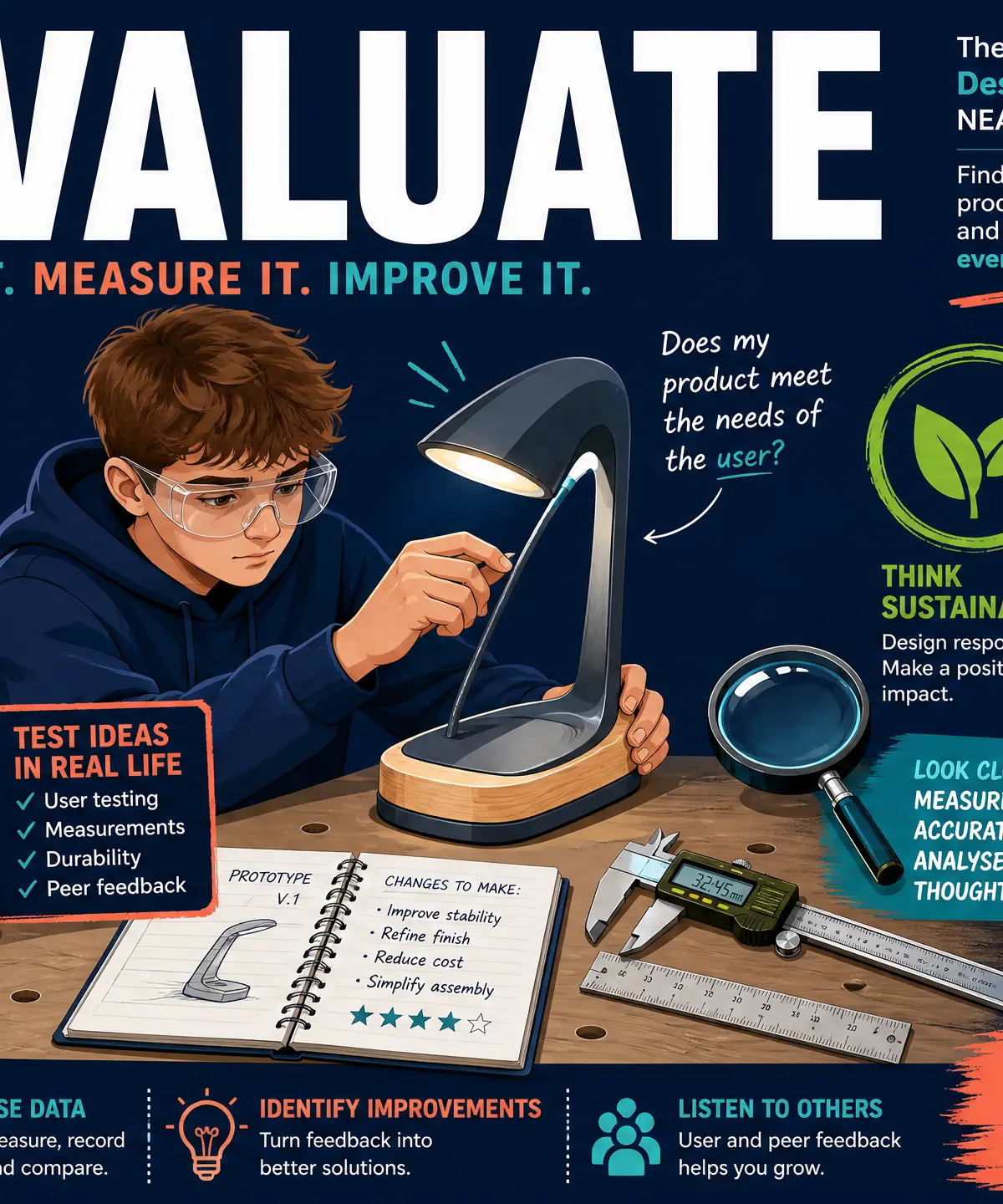
The Evaluate stage is the critical final component of your Design and Technology NEA, where you prove your prototype's success. It requires rigorous testing against your initial specification and a detailed Life Cycle Assessment (LCA) to demonstrate your understanding of sustainable design.
- 6 min read
- 3 worked examples
- 4 practice questions
- 6 key terms
Study Notes
Overview
The 'Evaluate' stage of the Component 2 Non-examined assessment (NEA) is where you draw conclusions about the success of your design journey. It is not enough to simply state that your product works; you must prove it through objective testing and analysis. Examiners award marks for candidates who can critically assess their prototype against the original product specification and evaluate its broader environmental impact through a Life Cycle Assessment (LCA).

Key Knowledge & Theory
Core Concepts
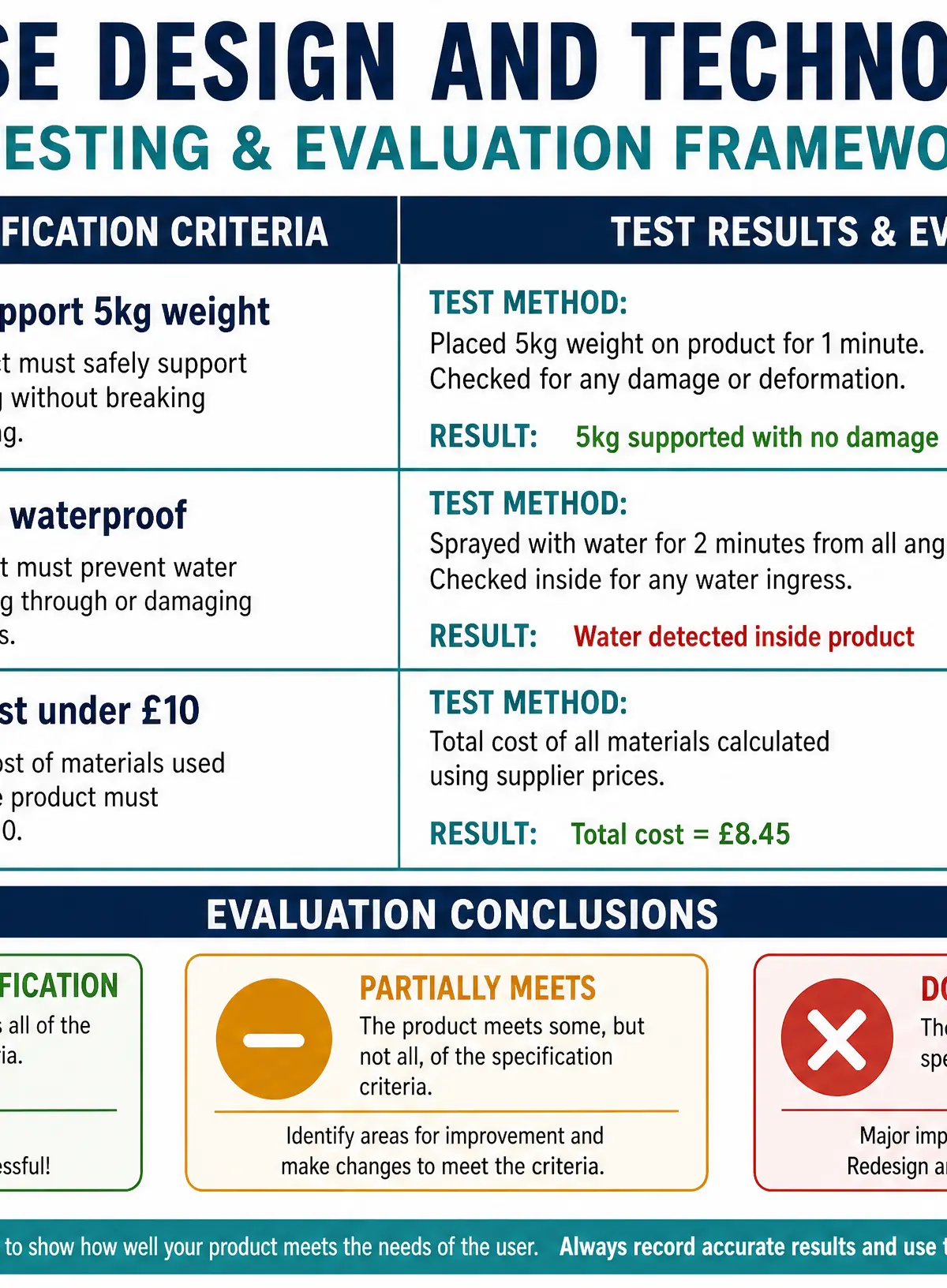
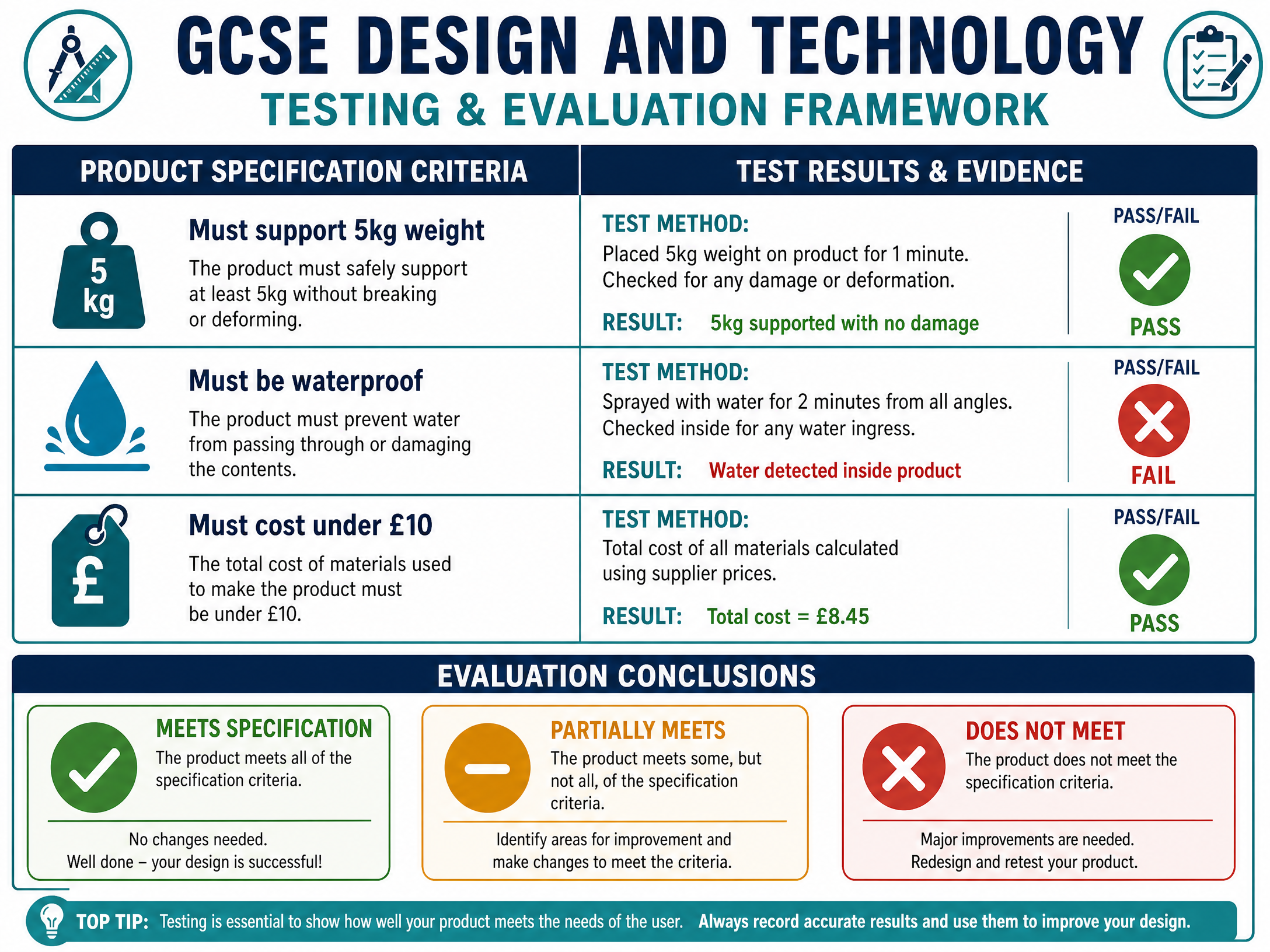
1. Testing Under Realistic ConditionsTesting must replicate the actual environment and use-case the product was designed for. Theoretical or 'imagined' testing earns very few marks. If a product is designed to hold 5kg, it must be physically tested with a 5kg weight. If it is meant to be waterproof, it must be exposed to water.
2. Specification-Driven EvaluationEvery test conducted and every conclusion drawn must explicitly link back to a criterion established in your initial product specification. The specification is the benchmark for success; evaluation is the process of measuring against that benchmark.
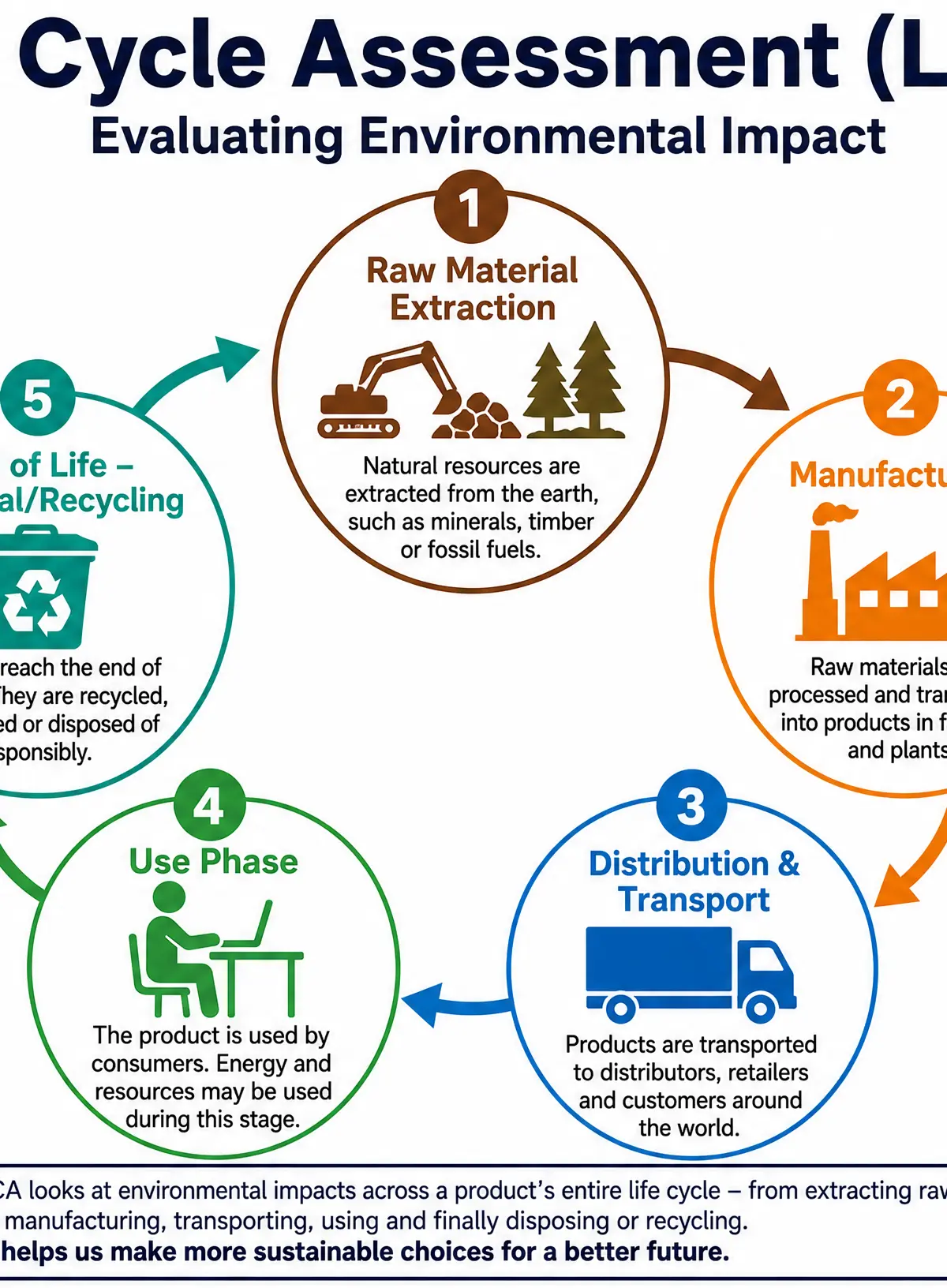
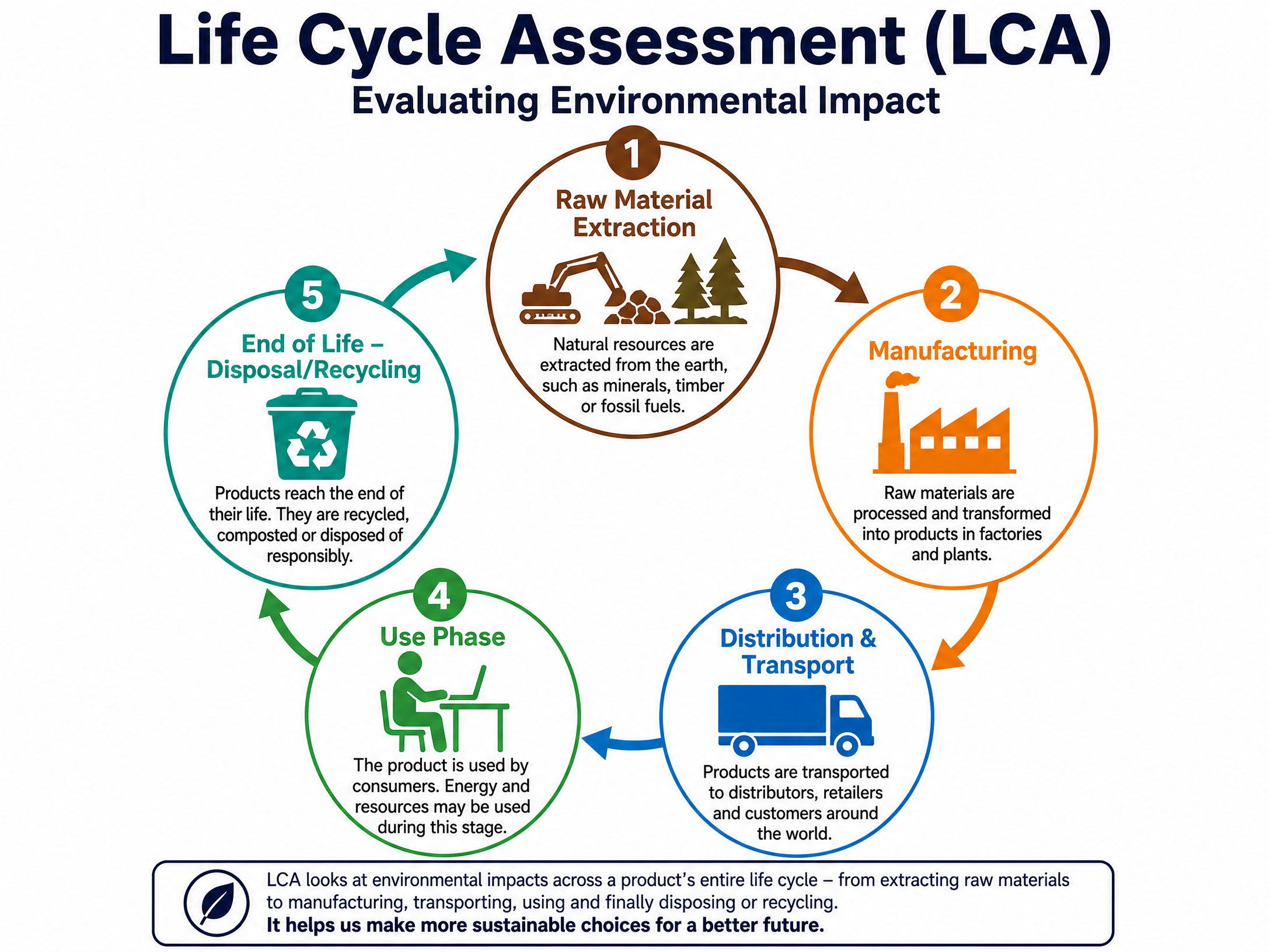
**3. Life Cycle Assessment (LCA)**An LCA is a systematic analysis of the environmental impact of a product throughout its entire lifespan. For the NEA, your LCA must be highly specific to the actual materials, components, and manufacturing processes you used in your final prototype, rather than a generic discussion of materials.
The Five Stages of an LCA
| Stage | Description | Key Considerations for NEA |
|---|---|---|
| Raw Material Extraction | Obtaining the base materials from the earth. | Are your materials renewable (e.g., FSC timber) or non-renewable (e.g., petroleum-based plastics)? |
| Manufacturing | Processing raw materials into the final product. | What processes did you use? Were they energy-intensive? Did they produce significant waste? |
| Distribution & Transport | Moving the product to the end user. | Consider the weight and volume of your product. How would it be packaged and shipped? |
| Use Phase | The product's active life with the consumer. | Does it require power to operate? Does it need maintenance? How durable is it? |
| End of Life | Disposal, recycling, or reuse when no longer needed. | Can your product be easily disassembled? Are the materials recyclable or biodegradable? |
Technical Vocabulary
- Fitness for Purpose: How well the product performs its intended function for the target user.
- Iterative Testing: Repeated cycles of testing, analysing, and refining during the development process.
- Anthropometric Data: Measurements of the human body used to ensure ergonomic fit.
- Sustainable Design: Designing products to minimize negative environmental impacts.
- Quantitative Data: Measurable, numerical data (e.g., weight supported, time taken to assemble).
- Qualitative Data: Descriptive, subjective data (e.g., user opinions on aesthetics or comfort).
Practical Skills
Techniques & Processes: Conducting Effective Tests
- Define the Test: Select a specific criterion from your specification (e.g., "Must be stable on a 15-degree incline").
- Set Up the Environment: Create a realistic testing scenario. Use a protractor to set a board at exactly 15 degrees.
- Execute and Document: Perform the test. Crucially, take clear photographs or video showing the test in progress. Photographic evidence is highly rewarded by examiners.
- Record Data: Note the exact results (e.g., "Product remained stable up to 18 degrees before tipping").
- Analyse and Conclude: State whether the criterion was met, partially met, or failed, and explain why based on the data.
Portfolio/Coursework Guidance
Assessment Criteria
Examiners are looking for:
- Thoroughness: Have you tested against all specification points, or just the easy ones?
- Objectivity: Are you honest about the flaws in your prototype? Overly positive evaluations that ignore obvious faults will lose marks.
- Evidence: Is your evaluation supported by photographic evidence, user feedback, and measurable data?
- Specificity in LCA: Does your LCA specifically address the exact materials (e.g., "3mm extruded acrylic") and processes (e.g., "laser cutting") used in your prototype?
Building a Strong Evaluation Section
Structure your portfolio logically. Use a table format for your testing to clearly show: Specification Point → Test Method → Photographic Evidence → Result → Conclusion. Follow this with a detailed, prose-based Life Cycle Assessment structured under the five LCA headings. Conclude with a summary of proposed modifications for future iterations.
Exam Component
Written Exam Knowledge
While this guide focuses on the NEA, the principles of Evaluation and LCA frequently appear in the written exam. You may be asked to evaluate a given commercial product against a brief, or to conduct a comparative LCA between two products made of different materials (e.g., a disposable plastic cup vs. a reusable bamboo cup).
Practical Application in Exams
When answering evaluation questions in the written paper, always structure your response by looking at both strengths and weaknesses before drawing a final, justified conclusion.
Visual Resources
2 diagrams and illustrations
Interactive Diagrams
1 interactive diagram to visualise key concepts
Conceptual Flow Outline
The NEA Evaluation Workflow
Worked Examples
3 worked examples — open one to explore the question and available guidance.
Practice Questions
Test your understanding — click to reveal model answers
State two ways you could gather qualitative data to evaluate the aesthetics of your prototype. (2 marks)
Hint: Think about how you find out what people think or feel about how something looks, rather than measuring it.
Explain why it is important to include photographic evidence when evaluating your prototype. (3 marks)
Hint: Consider what photographic evidence proves to the examiner about your testing process.
A student has designed a wooden coffee table. Evaluate the environmental impact of the 'Manufacturing' and 'Distribution' stages of its life cycle. (6 marks)
Hint: Break your answer down into the two specific stages requested. Think about energy use, waste, and transport logistics.
Your prototype failed a critical weight-bearing test. Explain how you should address this in your evaluation to maximize your marks. (4 marks)
Hint: Examiners don't penalize prototypes that fail; they penalize students who hide the failure or don't learn from it.