Pearson Edexcel · GCSE · Design and Technology
How energy is generated and stored in order to choose and use appropriate sources to make products and power systems
This topic explores how energy is generated and stored, a fundamental concept in modern product design. You'll learn to evaluate renewable and non-renewable sources, and justify the most appropriate power systems for specific design contexts.
- 6 min read
- 3 worked examples
- 3 practice questions
- 6 key terms
Study Notes
Overview
In GCSE Design and Technology, understanding energy is critical. Whether you are designing a solar-powered garden light, a battery-operated wearable device, or a mains-powered kitchen appliance, the energy source dictates the product's function, environmental impact, and user experience. This topic covers the generation and storage of energy, focusing on the sources of energy, methods of powering systems, and the factors involved in selecting appropriate energy sources for products and systems.
Key Knowledge & Theory
Core Concepts: Energy Generation
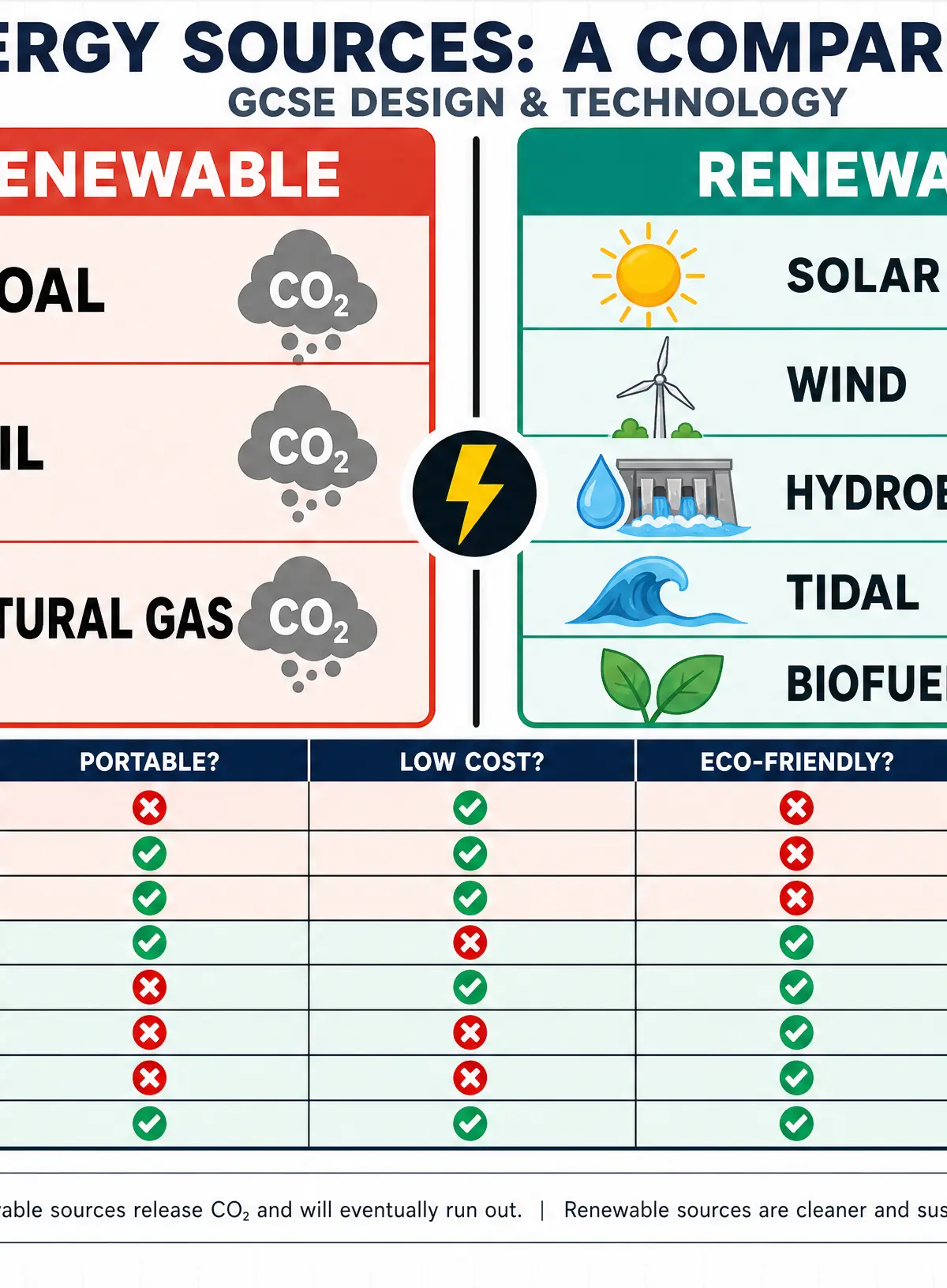
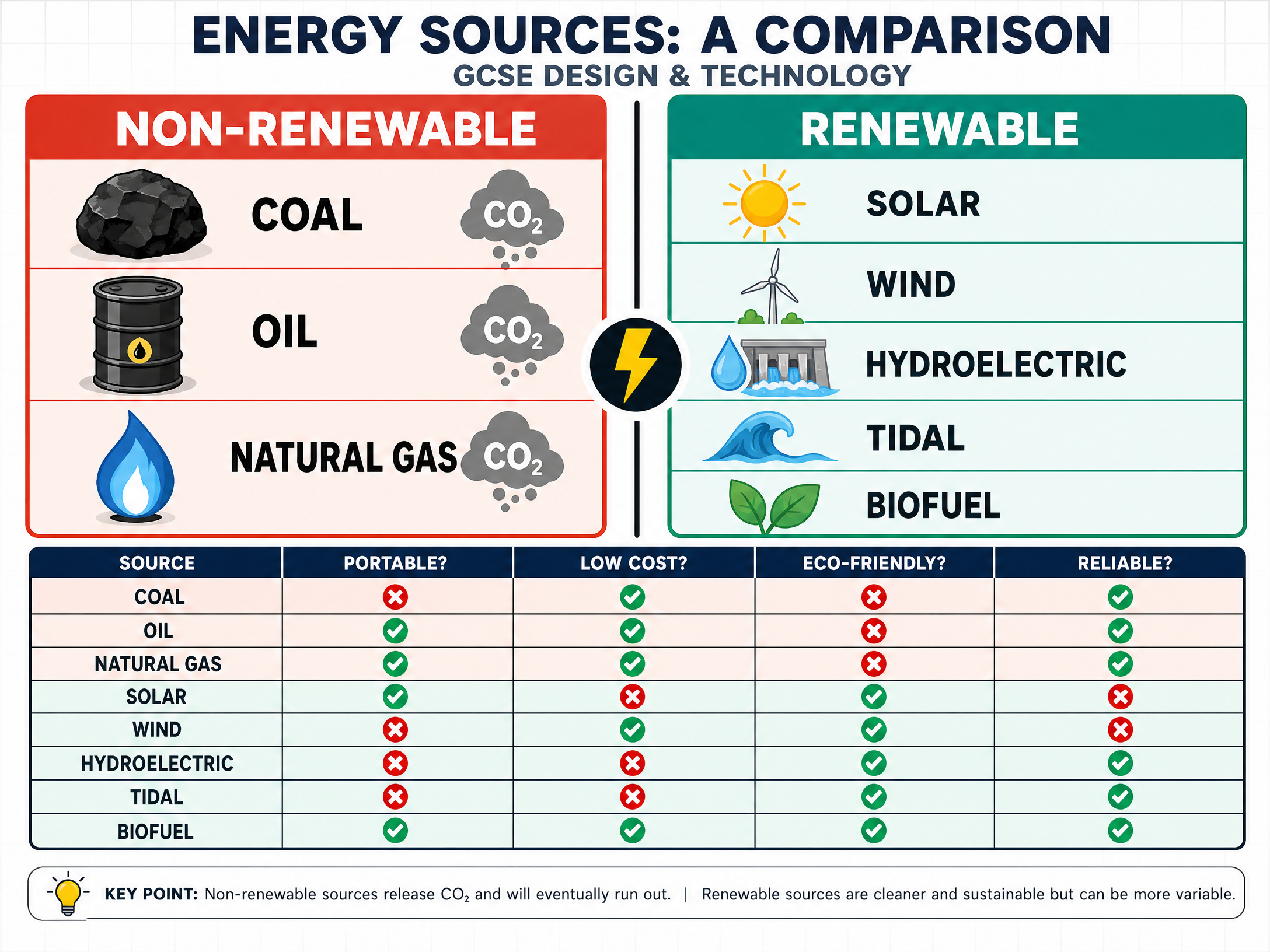
Energy sources are broadly categorised into two types: non-renewable and renewable.
Non-Renewable Energy SourcesThese are finite resources that will eventually run out. They primarily consist of fossil fuels formed over millions of years.
- Coal, Oil, and Natural Gas: These release significant energy when burned but also emit carbon dioxide (CO_2), a greenhouse gas contributing to climate change. In design, products rarely run directly on fossil fuels, but the electricity they draw from the national grid is often generated this way.
Renewable Energy SourcesThese are naturally replenished and will not run out. They are increasingly favoured in sustainable design.
- Solar: Uses photovoltaic (PV) cells to convert sunlight into electricity. Ideal for outdoor products or low-power electronics.
- Wind: Uses turbines to convert kinetic energy into electricity. Often used for large-scale generation or remote, off-grid installations.
- Hydroelectric: Uses the movement of water through a dam to spin turbines. Highly reliable but geographically limited.
- Tidal: Harnesses the predictable rise and fall of ocean tides. Very reliable but requires expensive coastal infrastructure.
- Biofuels: Includes biodiesel and biomass (organic matter). Considered renewable as plants absorb CO_2 while growing, partially offsetting emissions when burned.
Core Concepts: Energy Storage and Power Systems
Generating energy is only half the design challenge; storing and delivering it effectively is equally important.
- Batteries and Cells: A cell is a single electrochemical unit; a battery is two or more cells connected together. Primary cells are non-rechargeable (e.g., alkaline AA batteries), while secondary cells are rechargeable (e.g., lithium-ion). They provide essential portability.
- Solar Cells: These generate power but must often be paired with rechargeable batteries to ensure the product functions when there is no sunlight (e.g., solar garden lights charging during the day to illuminate at night).
- Mains Electricity: Provides high, consistent power output via the national grid (230V in the UK). It is highly reliable but restricts portability to the length of the power cable.
Technical Vocabulary
- Photovoltaic (PV) Cell: A device that converts light energy directly into electrical energy.
- Primary Cell: A non-rechargeable battery cell.
- Secondary Cell: A rechargeable battery cell.
- Carbon Footprint: The total amount of greenhouse gases generated by our actions, including the manufacture and powering of a product.
- Sustainable: Capable of being maintained at a steady level without exhausting natural resources or causing severe ecological damage.
Practical Skills & Application
Selecting the Right Energy Source
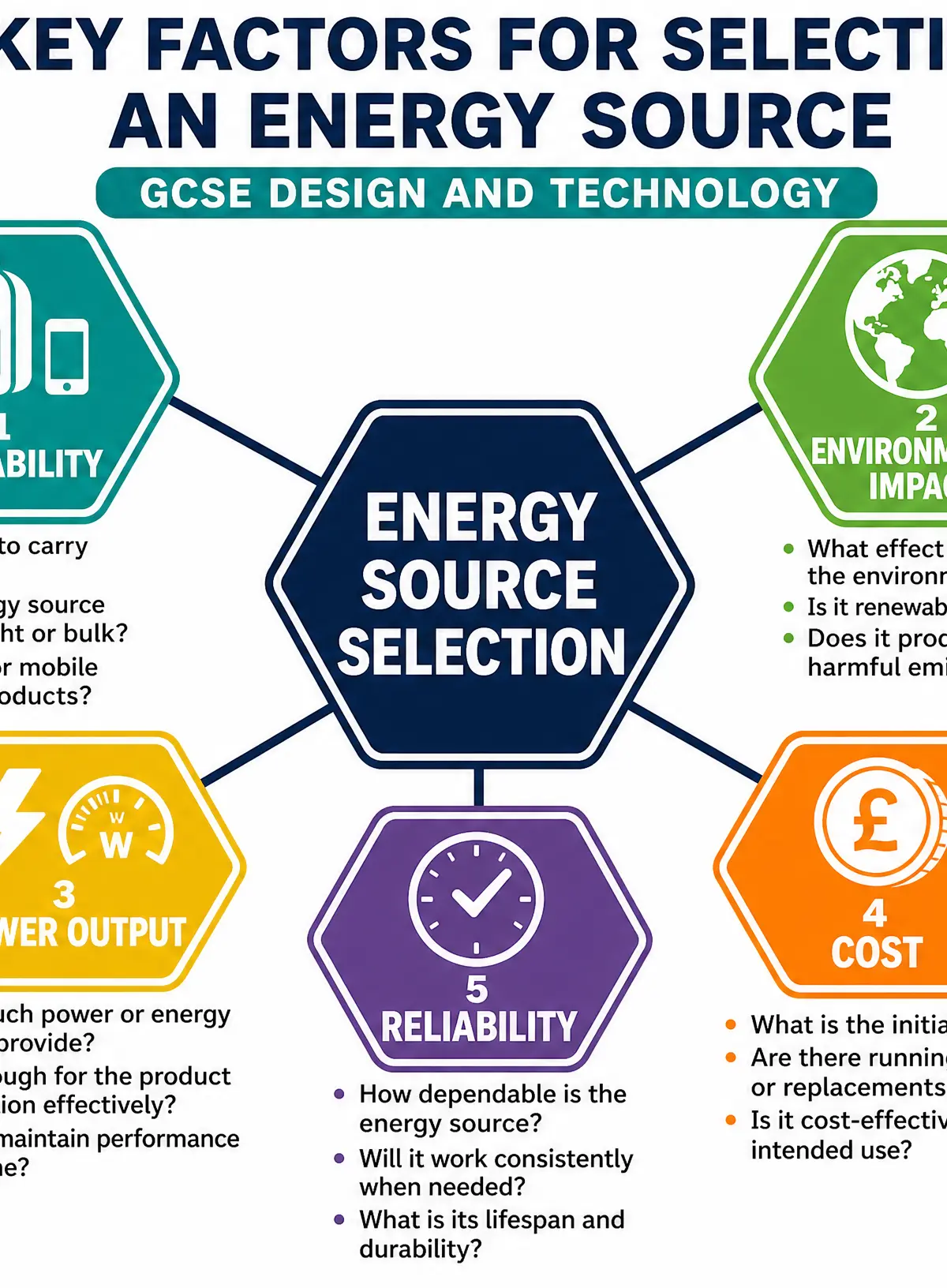
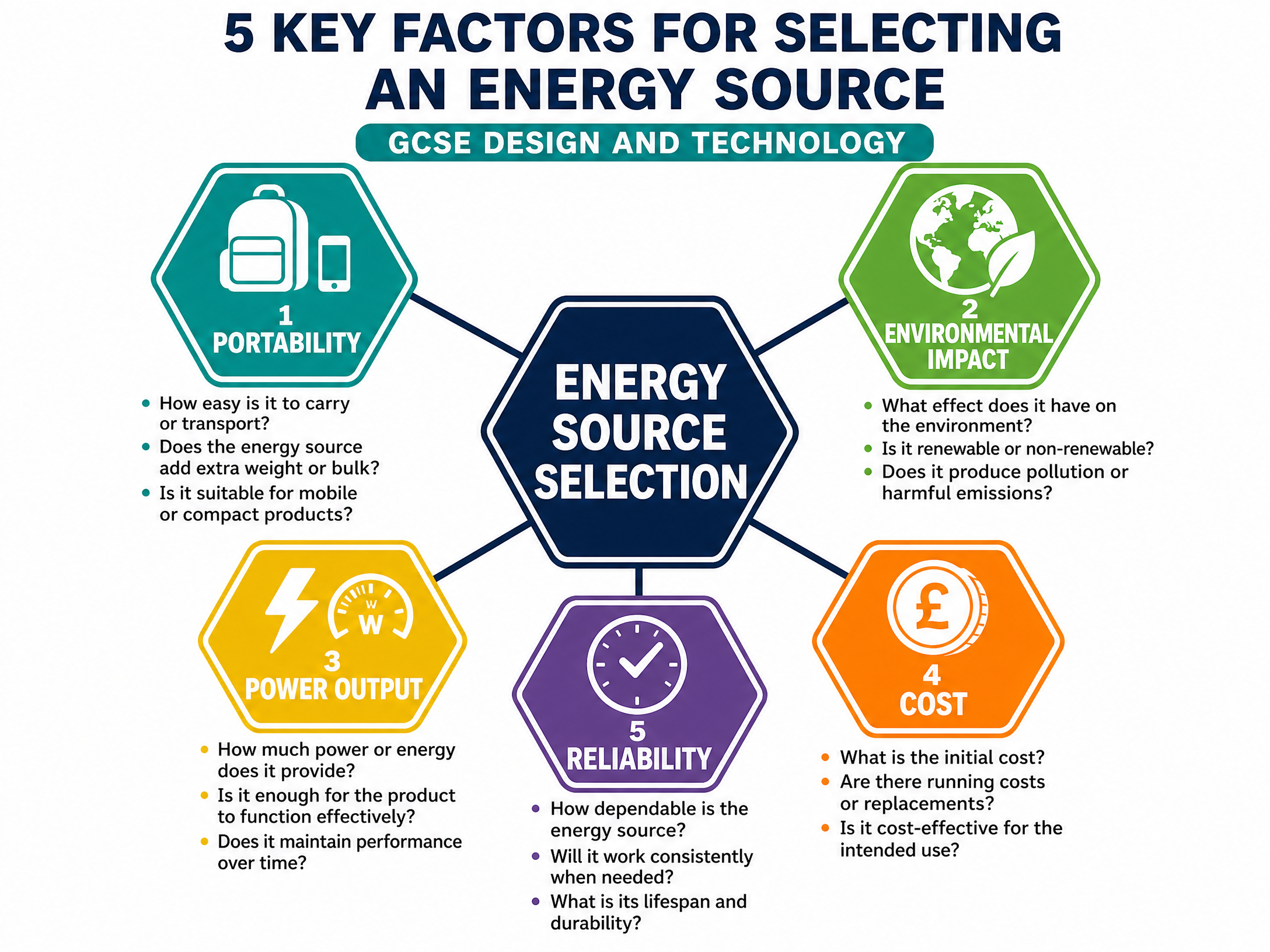
When designing a product, you must justify your choice of energy source. Examiners look for candidates who evaluate multiple factors rather than just stating a preference. Use the acronym PEPCR:
- Portability: Does the product need to move? (e.g., mobile phones require secondary cells; kettles require mains).
- Environmental Impact: Does the energy source contribute to global warming or toxic waste? (e.g., solar is cleaner than disposable primary cells).
- Power Output: How much energy does the product consume? (e.g., power tools need high output from mains or large lithium-ion batteries).
- Cost: What is the initial setup cost versus the ongoing running cost? (e.g., solar panels are expensive to buy but free to run).
- Reliability: Will the power be available when needed? (e.g., mains is reliable; solar depends on the weather).
Audio Revision
Listen to this 10-minute podcast covering the core concepts, exam tips, and a quick-fire quiz.

Exam Component
Written Exam Knowledge
In the written paper, you will be tested on your ability to recall facts (AO1), apply this knowledge to specific design contexts (AO2), and analyse/evaluate design decisions (AO3). You may be asked to compare two different power sources for a specific product, requiring a balanced argument that concludes with a justified recommendation.
Portfolio/Coursework Guidance (NEA)
In your Non-Exam Assessment (NEA), you must demonstrate how you considered energy when designing your prototype.
- Specification: Clearly state the power requirements of your product.
- Development: Show evidence of testing different power sources (e.g., calculating battery life or testing solar cell output).
- Evaluation: Assess the environmental impact of your chosen power source and suggest sustainable alternatives for commercial manufacture.
Visual Resources
2 diagrams and illustrations
Interactive Diagrams
1 interactive diagram to visualise key concepts
Conceptual Flow Outline
System diagram of a solar-powered garden light
Worked Examples
3 worked examples — open one to explore the question and available guidance.
Practice Questions
Test your understanding — click to reveal model answers
Identify two renewable energy sources. (2 marks)
Hint: Think of energy sources that rely on the weather or natural elements.
Explain why a manufacturer of a mobile phone would choose a secondary cell over a primary cell. (3 marks)
Hint: Consider how a mobile phone is used daily and the cost/convenience to the user.
Evaluate the environmental impact of using fossil fuels compared to wind power for generating electricity. (6 marks)
Hint: Discuss emissions, resource depletion, and the visual/local impacts of turbines.