Pearson Edexcel · GCSE · Design and Technology
Investigate and analyse the work of past and present professionals and companies in order to inform design
This topic explores how studying the work of past and present professional designers and companies can directly inspire and inform your own design decisions. By systematically analysing existing products against specific criteria, you learn to justify your choices and elevate the quality of your coursework.
- 6 min read
- 3 worked examples
- 4 practice questions
- 6 key terms
Study Notes
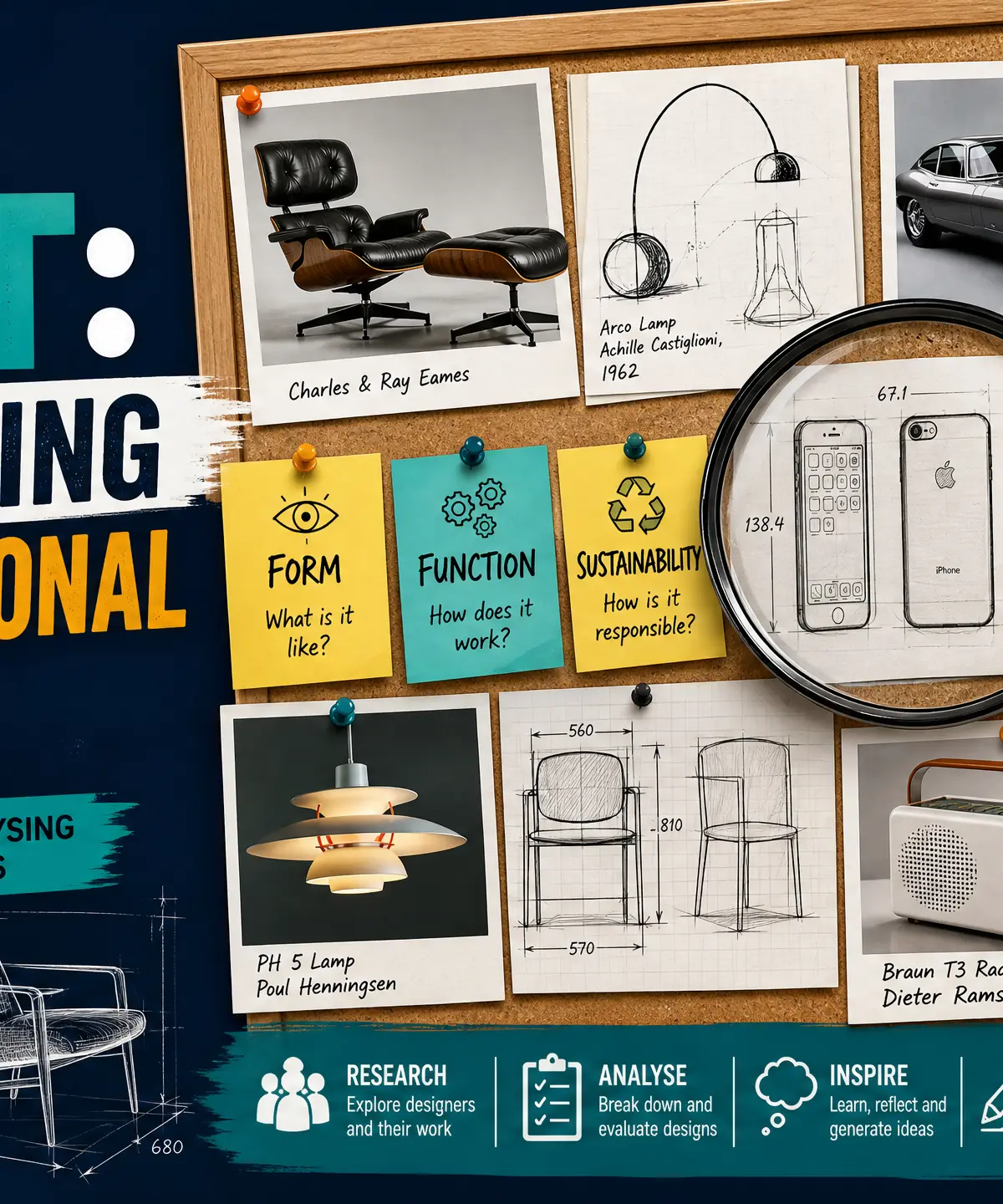
Overview
Investigating and analysing the work of professional designers is a cornerstone of GCSE Design and Technology. It is not merely an academic exercise; it is a practical tool used to generate ideas, solve problems, and justify the decisions you make in your own design projects. By studying how experts have tackled similar challenges, you can avoid common pitfalls and incorporate proven principles into your work.
Listen to the companion podcast for an in-depth discussion on how to approach this topic:

Key Knowledge & Theory
Core Concepts: The 10 Analysis Criteria
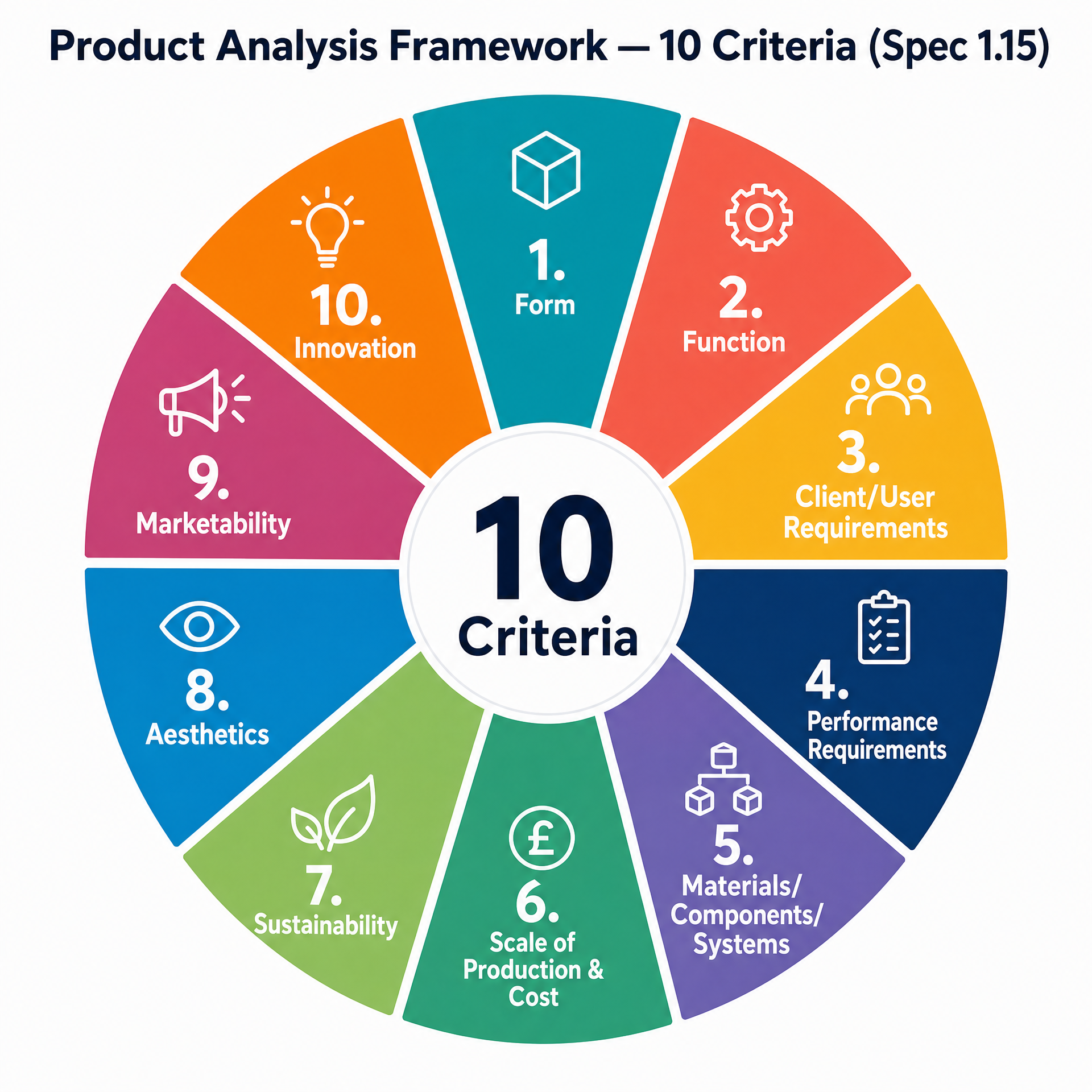
When investigating any product or designer, you must move beyond simple description. The specification demands systematic analysis using ten specific criteria. These criteria form the framework for all your research.
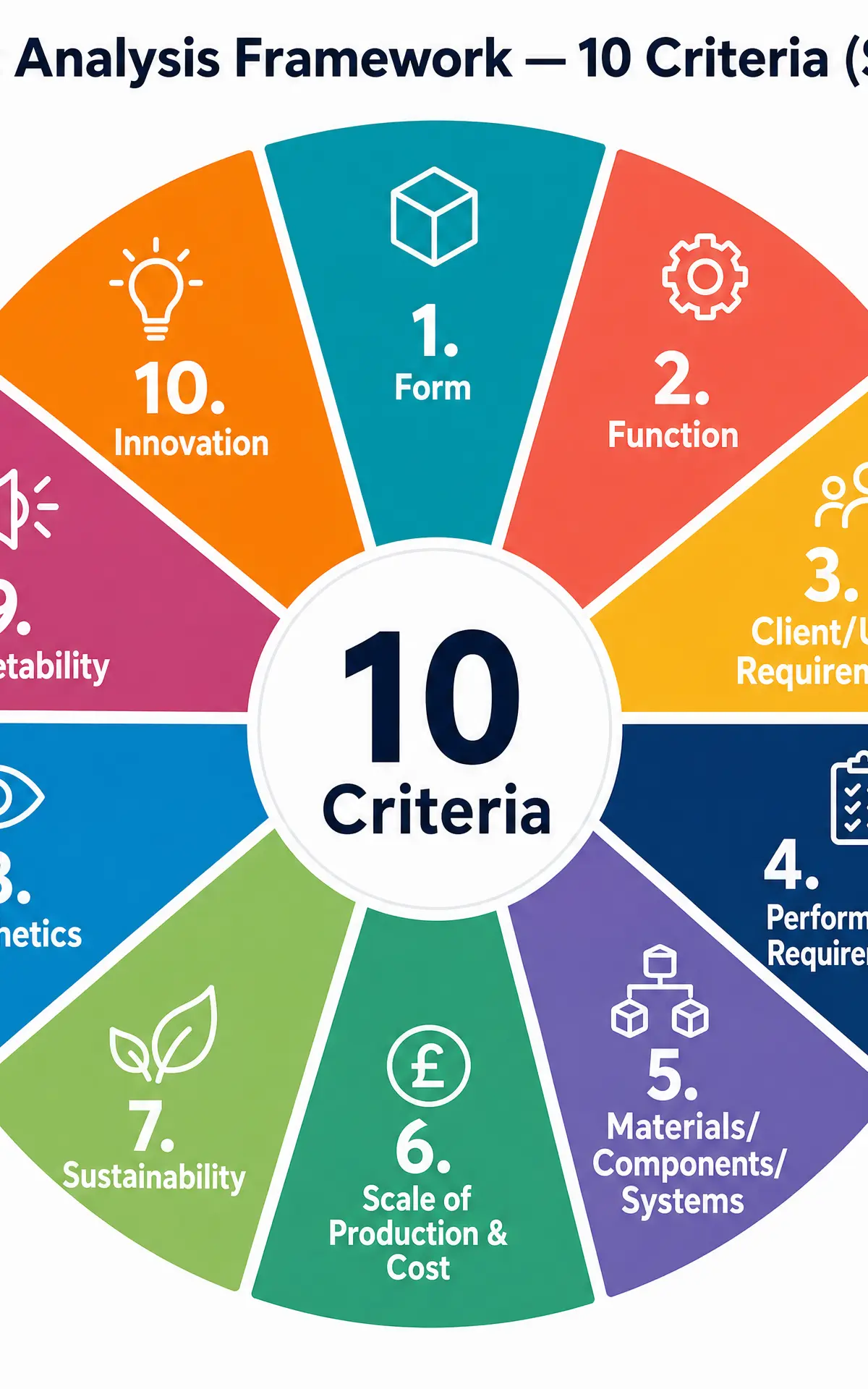
- Form: The physical shape, structure, and visual appearance of the product.
- Function: What the product is designed to do and how it operates.
- Client/User Requirements: How well the product meets the specific needs, preferences, and limitations of its intended audience.
- Performance Requirements: The technical demands placed on the product, such as strength, durability, and reliability under specific conditions.
- Materials/Components/Systems: The physical substances and internal mechanisms used, and why they were chosen over alternatives.
- Scale of Production and Cost: Whether the product is designed for one-off, batch, or mass production, and how this impacts its retail price and manufacturing methods.
- Sustainability: The environmental impact of the product throughout its lifecycle, including material sourcing, energy use, and end-of-life disposal.
- Aesthetics: The sensory appeal of the product, including colour, texture, proportion, and style.
- Marketability: The commercial viability of the product and how it is positioned to appeal to consumers.
- Innovation: The novel, original, or inventive aspects of the design that differentiate it from existing solutions.
Key Practitioners and Companies
| Name/Company | Period/Style | Key Works | Relevance |
|---|---|---|---|
| Dieter Rams (Braun) | Mid-20th Century / Functionalism | SK4 Record Player, T3 Pocket Radio | Championed 'less is more'. His 10 principles of good design are highly applicable to student projects. |
| Charles & Ray Eames | Mid-20th Century / Modernism | Eames Lounge Chair, DSW Chair | Pioneered the use of new materials like moulded plywood and fibreglass to combine ergonomics with mass production. |
| Jonathan Ive (Apple) | Late 20th - Early 21st Century / Minimalism | iMac, iPod, iPhone | Demonstrates the seamless integration of hardware, software, and aesthetics. Perfect for analysing user interface and form. |
| Dyson | Late 20th Century - Present / Engineering-led | DC01 Vacuum, Airblade | A prime example of innovation and performance-driven design, showing how engineering problems can dictate form. |
| IKEA | Mid-20th Century - Present / Democratic Design | Billy Bookcase, flat-pack furniture | Essential for studying scale of production, cost reduction, and the logistics of global distribution. |
Technical Vocabulary
- Ergonomics: The study of how people interact with products, ensuring comfort and efficiency.
- Anthropometrics: The use of human body measurements to inform design dimensions.
- Iterative Design: A cyclical process of prototyping, testing, analysing, and refining a product.
- Form Follows Function: The principle that the shape of a building or object should be primarily based upon its intended function or purpose.
- Planned Obsolescence: Designing a product with an artificially limited useful life.
Practical Skills
Techniques & Processes: The Research Workflow
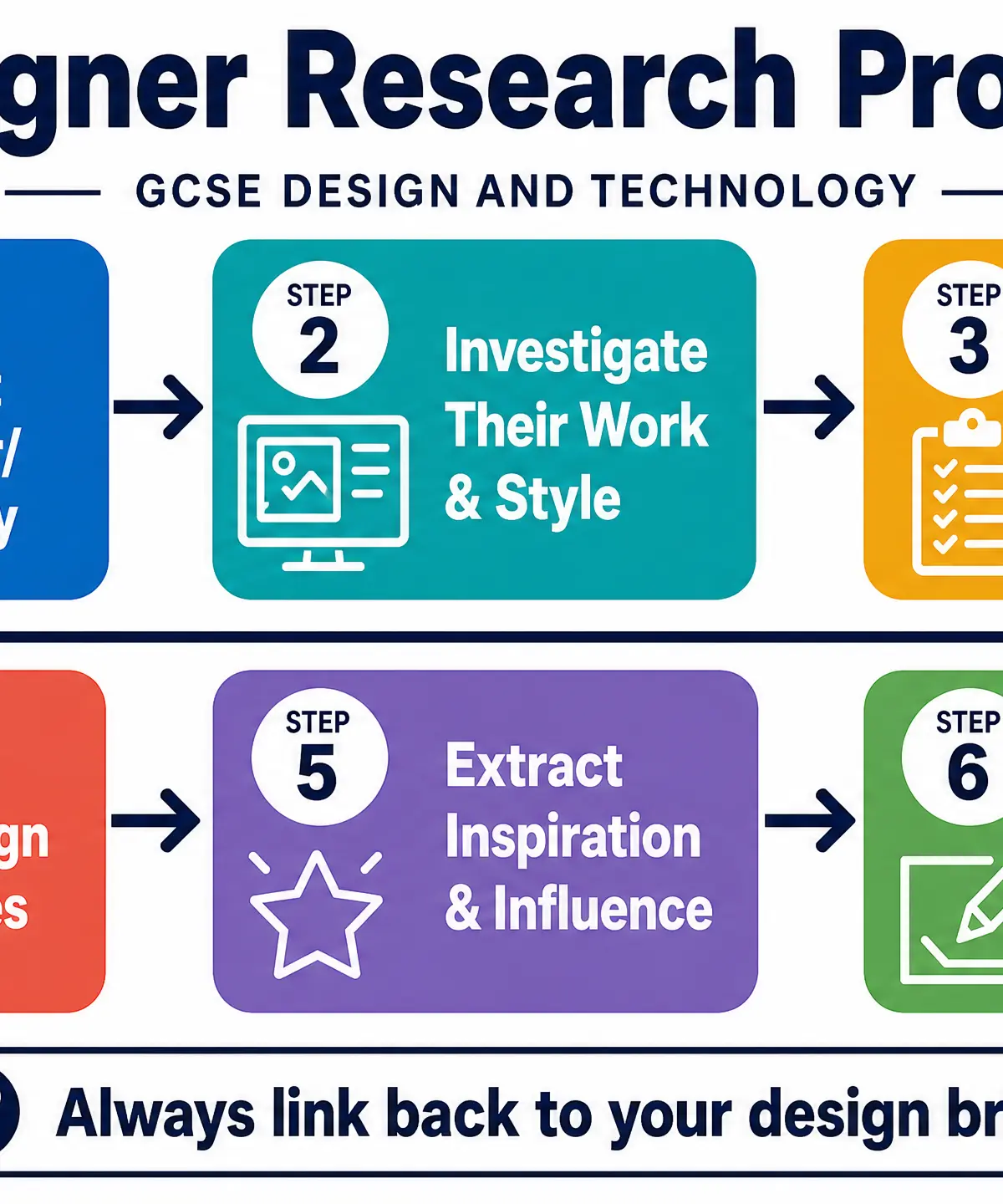
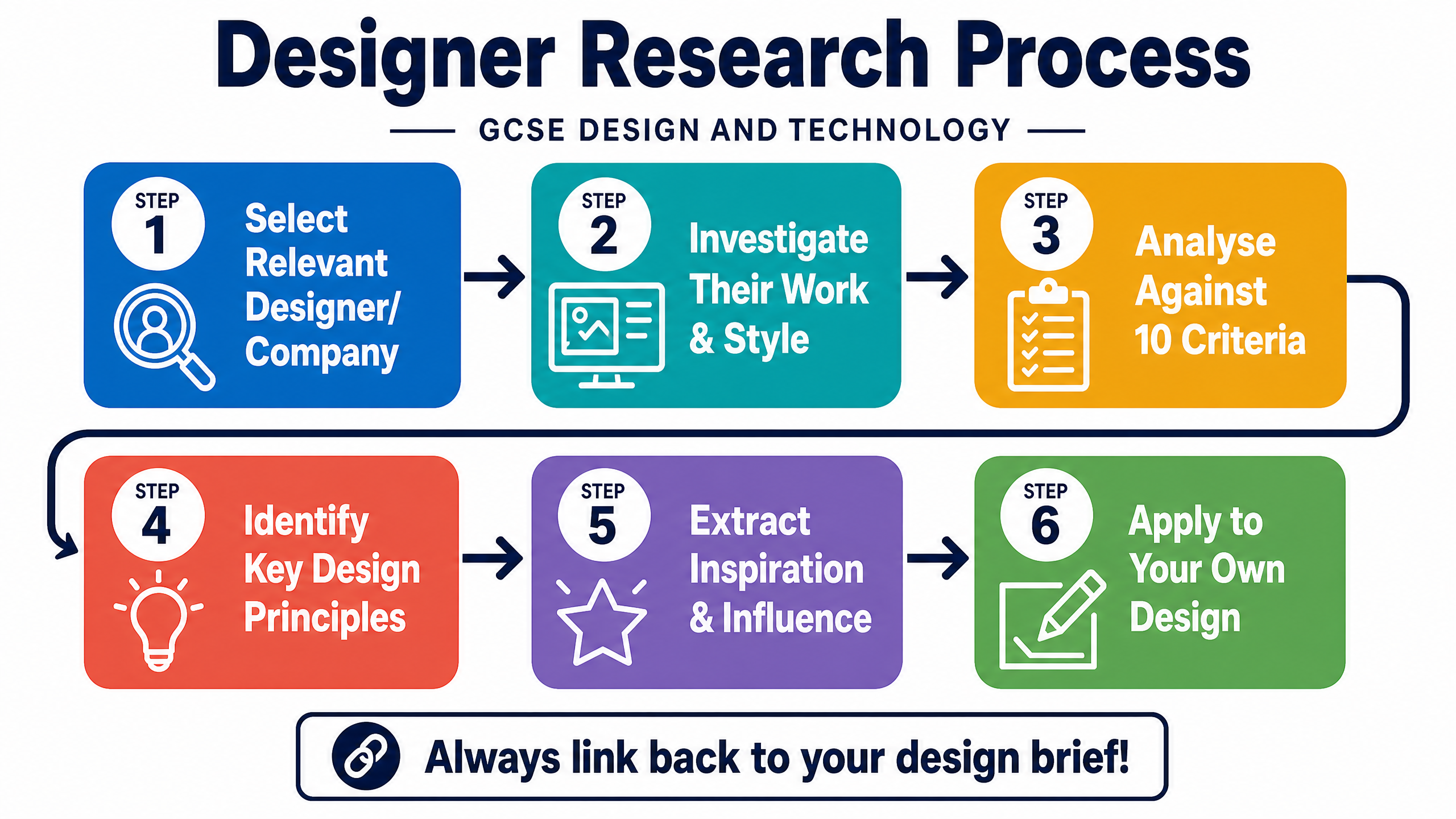
To effectively use professional work in your portfolio, follow a structured process:
- Select Relevant Examples: Do not choose designers at random. If you are designing a lighting product, study lighting designers like Poul Henningsen, not fashion designers.
- Deconstruct Using Criteria: Apply the 10 criteria systematically. Create a table or spider diagram to break down the product's features.
- Identify Transferable Principles: What specific design rules or techniques make the product successful? (e.g., 'The use of contrasting materials highlights the interactive components').
- Apply to Your Design: Explicitly state how this research changes your approach. (e.g., 'Inspired by Rams, I will colour-code the user touchpoints on my prototype').
Portfolio/Coursework Guidance
Assessment Criteria
Examiners are looking for a clear 'golden thread' connecting your research to your final outcome. Marks are awarded for:
- Depth of Analysis: Moving beyond stating what a product is made of, to explaining why that material was chosen.
- Relevance: Selecting designers whose work directly relates to your specific design context.
- Application: Using the insights gained to generate new ideas or refine existing ones.
Building a Strong Portfolio
Do not just paste pictures of famous products into your folder. Instead:
- Annotate heavily: Use arrows pointing to specific features of a professional's work, explaining its function or aesthetic value.
- Draw conclusions: End every research page with a 'Conclusion for my design' box.
- Show the influence: When you sketch your initial ideas, explicitly reference the designers who inspired them (e.g., 'Curved form inspired by Eames').
Exam Component
Written Exam Knowledge
In the written paper, you may be asked to analyse a product shown in an image, or compare two different products. You must be able to recall the 10 criteria and apply them under exam conditions. You may also be asked to discuss the impact of a specific designer on modern product development.
Exam Technique
Always look at the command word. 'Describe' requires factual recall, but 'Analyse' requires you to break the product down and explain the reasoning behind its features. 'Evaluate' requires a judgement on its success.
Visual Resources
2 diagrams and illustrations
Interactive Diagrams
1 interactive diagram to visualise key concepts
Conceptual Flow Outline
Integrating Professional Research into the Iterative Design Process
Worked Examples
3 worked examples — open one to explore the question and available guidance.
Practice Questions
Test your understanding — click to reveal model answers
Identify two of the ten criteria used for product analysis. (2 marks)
Hint: Think about what a product looks like and what it does.
Explain how the 'Scale of Production' can influence the materials chosen for a product. (3 marks)
Hint: Consider the difference between making one bespoke chair versus making ten thousand identical chairs.
Compare the design approaches of Dieter Rams and Jonathan Ive. (4 marks)
Hint: Focus on their shared philosophy regarding simplicity, but consider the different eras and technologies they worked with.
Analyse the sustainability of flat-pack furniture compared to pre-assembled solid wood furniture. (6 marks)
Hint: Consider the entire lifecycle: material sourcing, manufacturing, transportation, and end-of-life.