Pearson Edexcel · GCSE · Design and Technology
Investigate environmental, social and economic challenges when identifying opportunities and constraints that influence designing and making
This topic explores how designers must balance environmental protection, social equity, and economic viability. It covers essential frameworks like Life Cycle Analysis and the Six Rs, ensuring you understand the real-world constraints and opportunities that shape modern product design.
- 6 min read
- 3 worked examples
- 3 practice questions
- 6 key terms
Study Notes
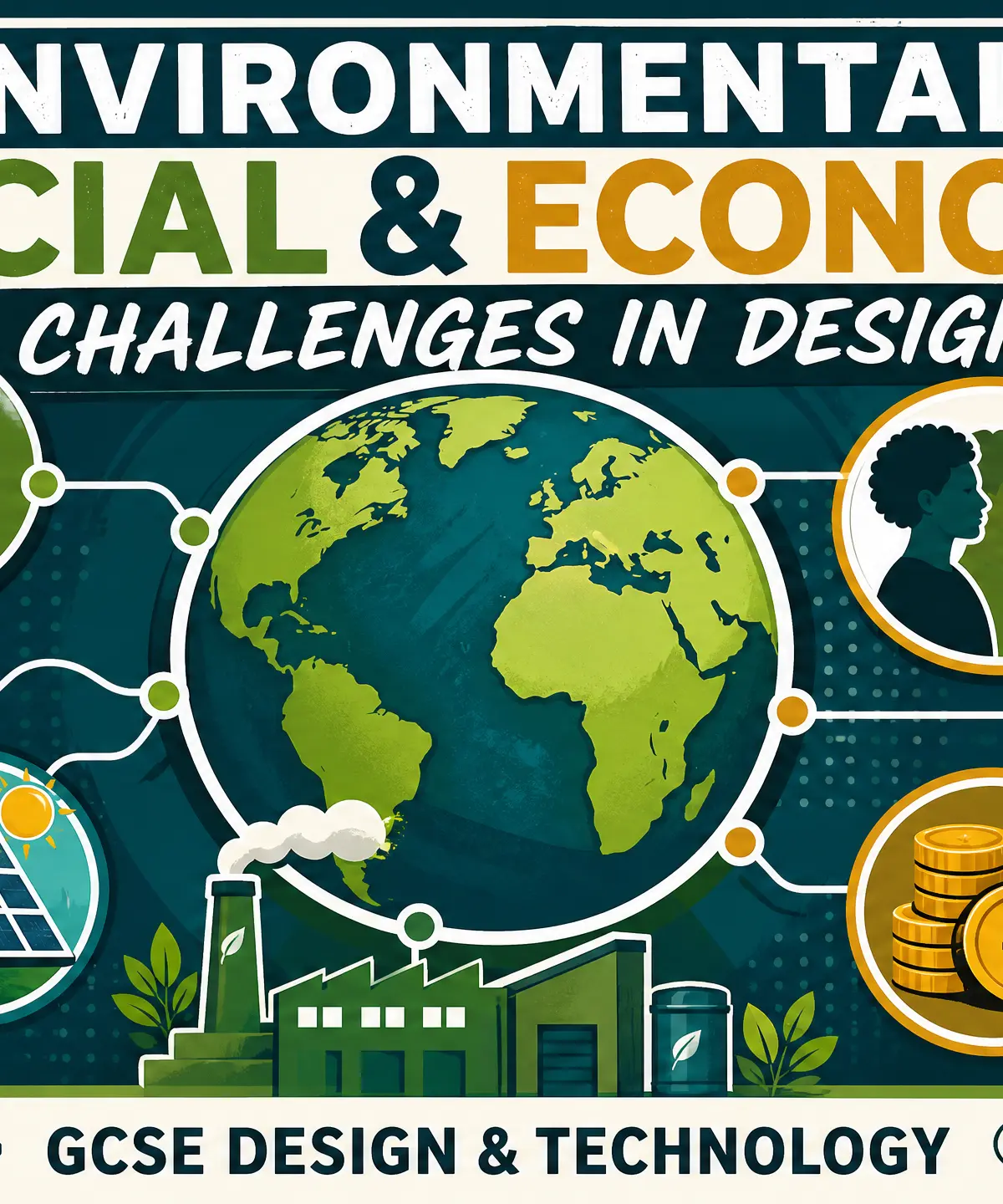
Overview
Welcome to one of the most relevant and real-world topics in the GCSE Design and Technology specification. Designers do not create products in a vacuum; every design decision has consequences for people, the planet, and profit. This topic explores the environmental, social, and economic challenges that influence the designing and making process. Examiners want to see that you can identify these factors, understand the tensions between them, and evaluate how a responsible designer balances these competing demands.
The Three Pillars of Sustainable Design
Modern design is driven by the 'triple bottom line' — a framework that evaluates performance based on social, environmental, and economic impact. A successful product must be economically viable to manufacture, socially inclusive and ethical, and environmentally sustainable.
Key Knowledge & Theory
1. Environmental Challenges
The environmental dimension focuses on minimising the negative impact a product has on the natural world. This begins with the extraction of raw materials and continues through to the product's end of life.
Life Cycle Analysis (LCA)
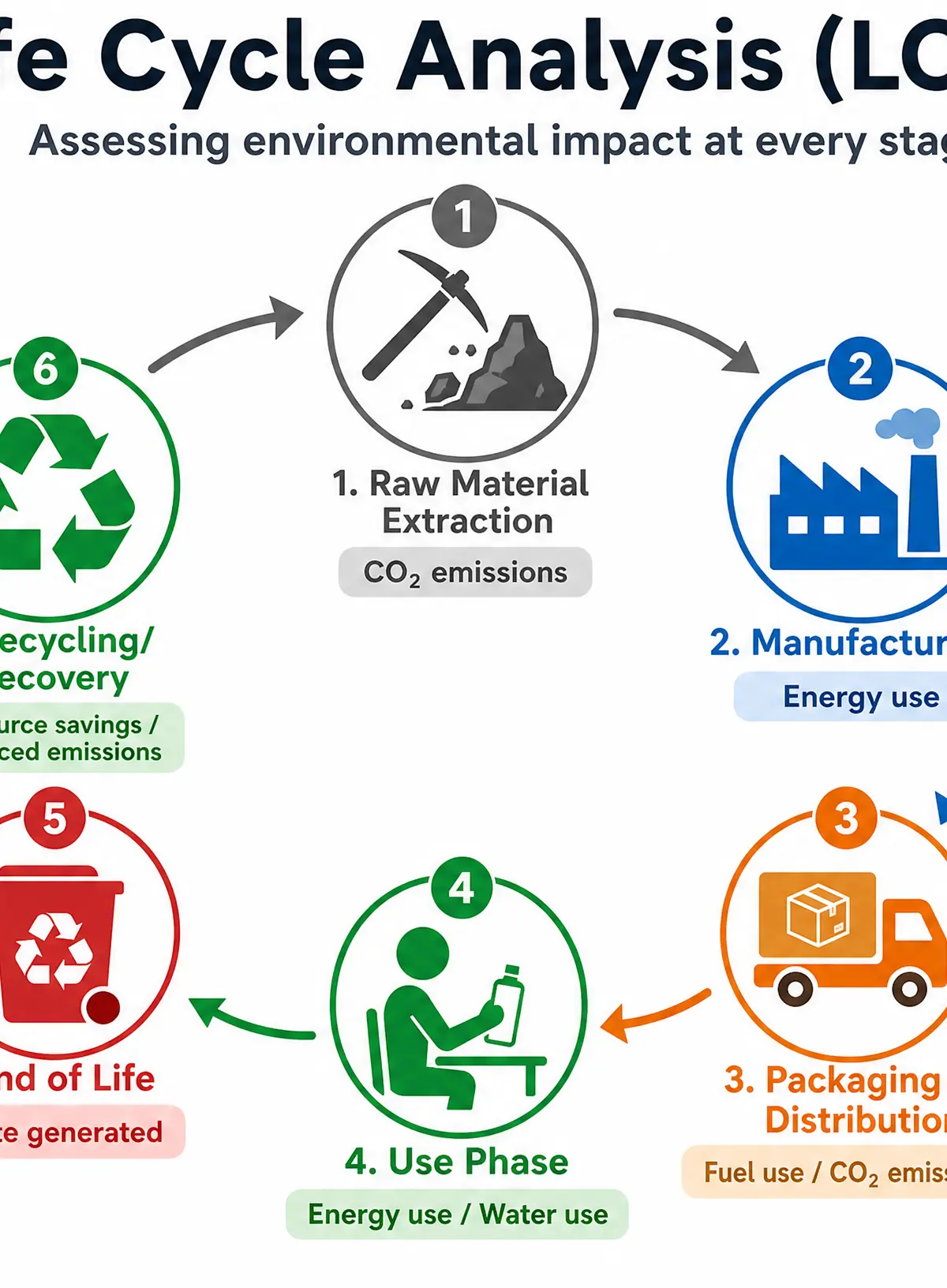
Life Cycle Analysis is a systematic method for assessing the total environmental impact of a product across its entire lifespan. If an exam question asks you to evaluate environmental impact, LCA is your required framework. The key stages are:
- Raw Material Extraction: The environmental cost of mining, farming, or logging (e.g., habitat destruction, CO2 emissions from heavy machinery).
- Manufacturing: The energy and resources consumed to process materials and assemble the product.
- Packaging & Distribution: The materials used to protect the product and the carbon footprint of transporting it globally.
- Use Phase: The energy, water, or consumables required while the product is functioning (e.g., electricity for a washing machine).
- End of Life: What happens when the product is discarded (e.g., landfill space, toxic leakage).
- Recycling/Recovery: The potential to reclaim materials for future use.
Green Design & The Six Rs
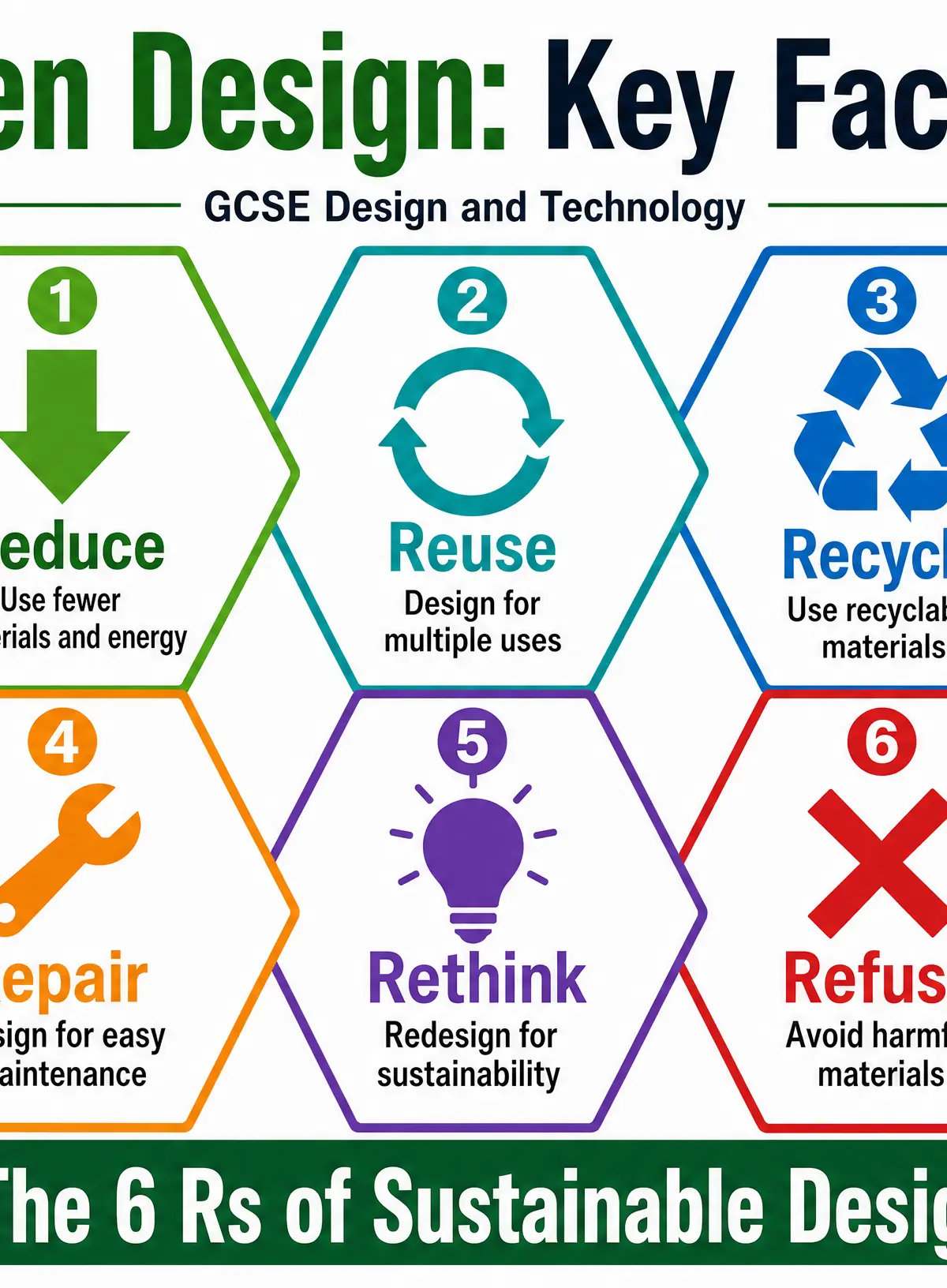
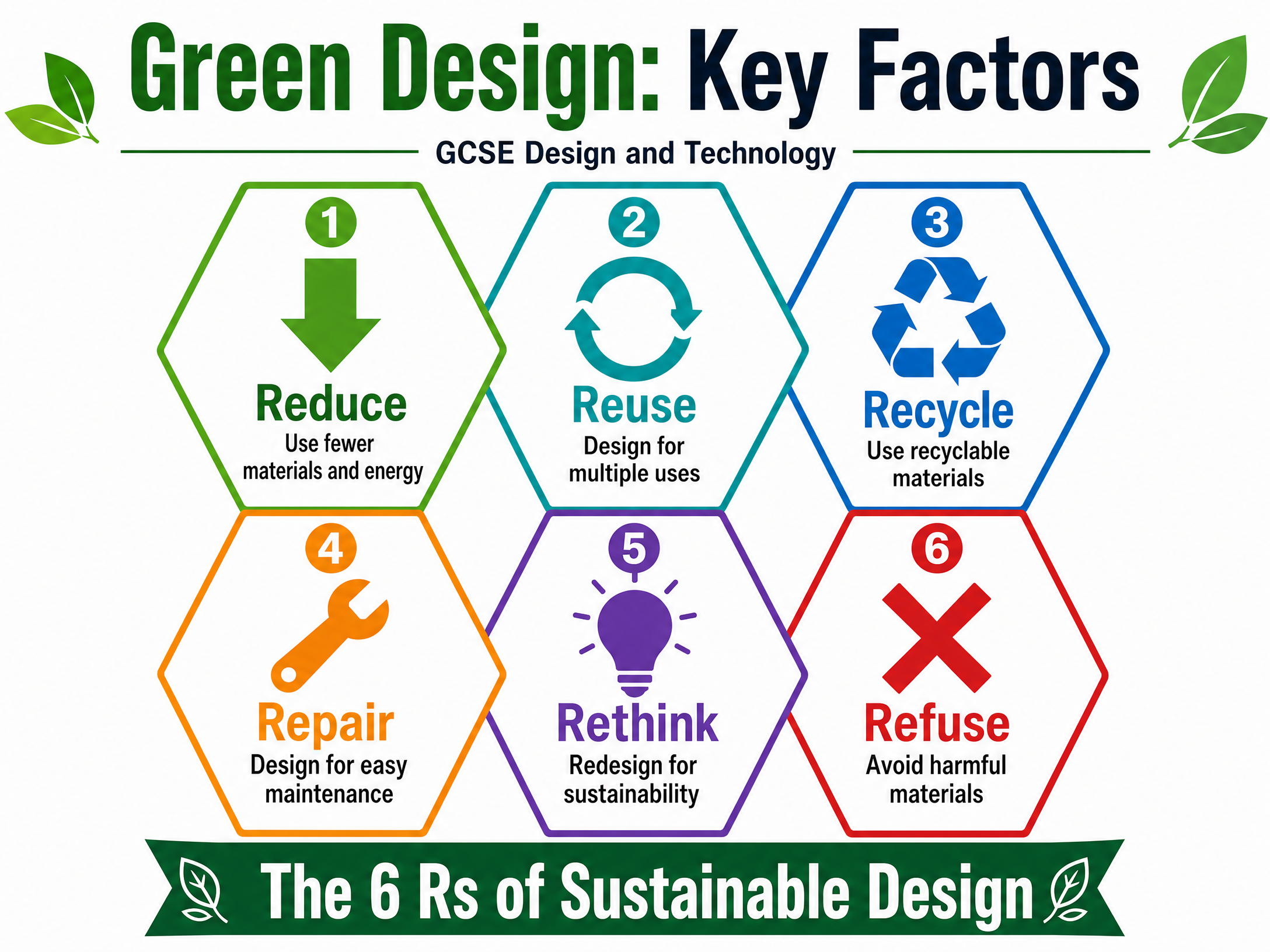
Green Design is the practice of creating products with minimal environmental impact. The core framework is the Six Rs:
- Reduce: Using fewer materials and less energy during production.
- Reuse: Designing products so they can be used multiple times or repurposed.
- Recycle: Selecting materials that can be processed and turned into new products.
- Repair: Designing for easy maintenance to extend the product's lifespan.
- Rethink: Fundamentally reconsidering the design to make it more sustainable.
- Refuse: Choosing not to use harmful, non-sustainable, or unnecessary materials.
2. Social Challenges
The social dimension concerns the impact of design on people and communities. A responsible designer must consider inclusivity, cultural sensitivity, and ethical supply chains.
- Inclusive Design & Human Capability: Products must be accessible to as many people as possible. Designers must consider varying physical abilities, dexterity, eyesight, and cognitive function. A design that only works for a young, able-bodied user is fundamentally flawed.
- Cultural Sensitivity: Designers must respect different social and ethnic groups. Colours, symbols, and forms carry different meanings across cultures.
- Fair Trade: This certification ensures that producers in developing countries receive fair prices, workers are paid fair wages, and safe working conditions are maintained. Specifying Fairtrade materials is a key social responsibility.
3. Economic Challenges
The economic dimension focuses on the financial realities of designing and making products.
- Material Costs: The choice of material directly affects the final price. Sustainable or recycled materials may sometimes cost more than virgin alternatives, creating a tension between environmental and economic goals.
- Manufacturing Capability: The scale of production dictates the cost per unit. Mass production utilises economies of scale to lower costs, while batch or one-off production is more expensive. A designer must understand what is possible within the constraints of the available machinery.
- Whole-Life Cost: This considers not just the purchase price, but the cost of running, maintaining, and disposing of the product over its lifetime.
Practical Skills & Portfolio Guidance
Applying Theory to Coursework (NEA)
In your Non-Exam Assessment (NEA), examiners will look for explicit evidence that you have considered these challenges during your design process.
- Specification Writing: Your design specification MUST include criteria related to sustainability, inclusivity, and cost.
- Material Selection: When justifying your material choices, you must discuss their environmental impact (e.g., "I selected FSC-certified pine because...") and cost implications.
- Design Development: Show evidence of 'Rethinking' your design to reduce material usage or simplify manufacturing.
- Evaluation: In your final evaluation, assess your product using the LCA framework. Be honest about its environmental shortcomings and suggest improvements.
Audio Revision
Listen to the podcast episode below for an in-depth discussion of these concepts, including examiner tips and a quick-fire recall quiz.

Exam Component
Tackling the Written Paper
Questions on this topic often require extended writing (6-8 marks). Examiners are looking for balanced arguments that acknowledge the tension between competing factors.
- Command Words: Pay close attention. 'Identify' requires a brief point. 'Explain' requires a justification (use 'because'). 'Evaluate' requires a balanced discussion of strengths and weaknesses leading to a conclusion.
- The 'Tension' Approach: Use phrases like: "There is a tension between using recycled polymers and keeping production costs low, because recycled plastics can be more expensive to source and process than virgin materials."
- Context is King: Always apply your knowledge to the specific product or scenario given in the question. Do not write generic essays about saving the planet.
Visual Resources
2 diagrams and illustrations
Interactive Diagrams
1 interactive diagram to visualise key concepts
Conceptual Flow Outline
Balancing competing challenges in the design process
Worked Examples
3 worked examples — open one to explore the question and available guidance.
Practice Questions
Test your understanding — click to reveal model answers
Identify two of the 'Six Rs' of sustainable design. (2 marks)
Hint: Think about the phrase 'Really Responsible Recyclers...'
Explain how designing a smartphone to be easily repaired can reduce its environmental impact. (3 marks)
Hint: Link the act of repairing to the manufacturing and disposal stages of the LCA.
A company is designing a new range of flat-pack furniture. Evaluate the environmental and economic implications of manufacturing the furniture in the UK versus manufacturing it overseas and shipping it to the UK. (8 marks)
Hint: Structure your answer to cover both environmental AND economic points for BOTH locations. Conclude with a justified judgement.