Pearson Edexcel · GCSE · Design and Technology
Metals: Alternative processes that can be used to manufacture ferrous and non-ferrous metal products to different scales of production
This topic covers the essential manufacturing processes for ferrous and non-ferrous metals, alongside the different scales of production. Understanding these concepts is critical for justifying design decisions in your coursework and securing high marks in the written exam.
- 6 min read
- 3 worked examples
- 4 practice questions
- 6 key terms
Study Notes
Overview
Topic 2.6 focuses on the alternative processes that can be used to manufacture ferrous and non-ferrous metal products to different scales of production. In Design and Technology, understanding how a product is made is just as important as the design itself. Examiners expect you to be able to select, describe, and justify appropriate manufacturing processes based on the material properties, the required shape, and the intended scale of production.
Listen to the Topic Podcast

Key Knowledge & Theory
Core Manufacturing Processes
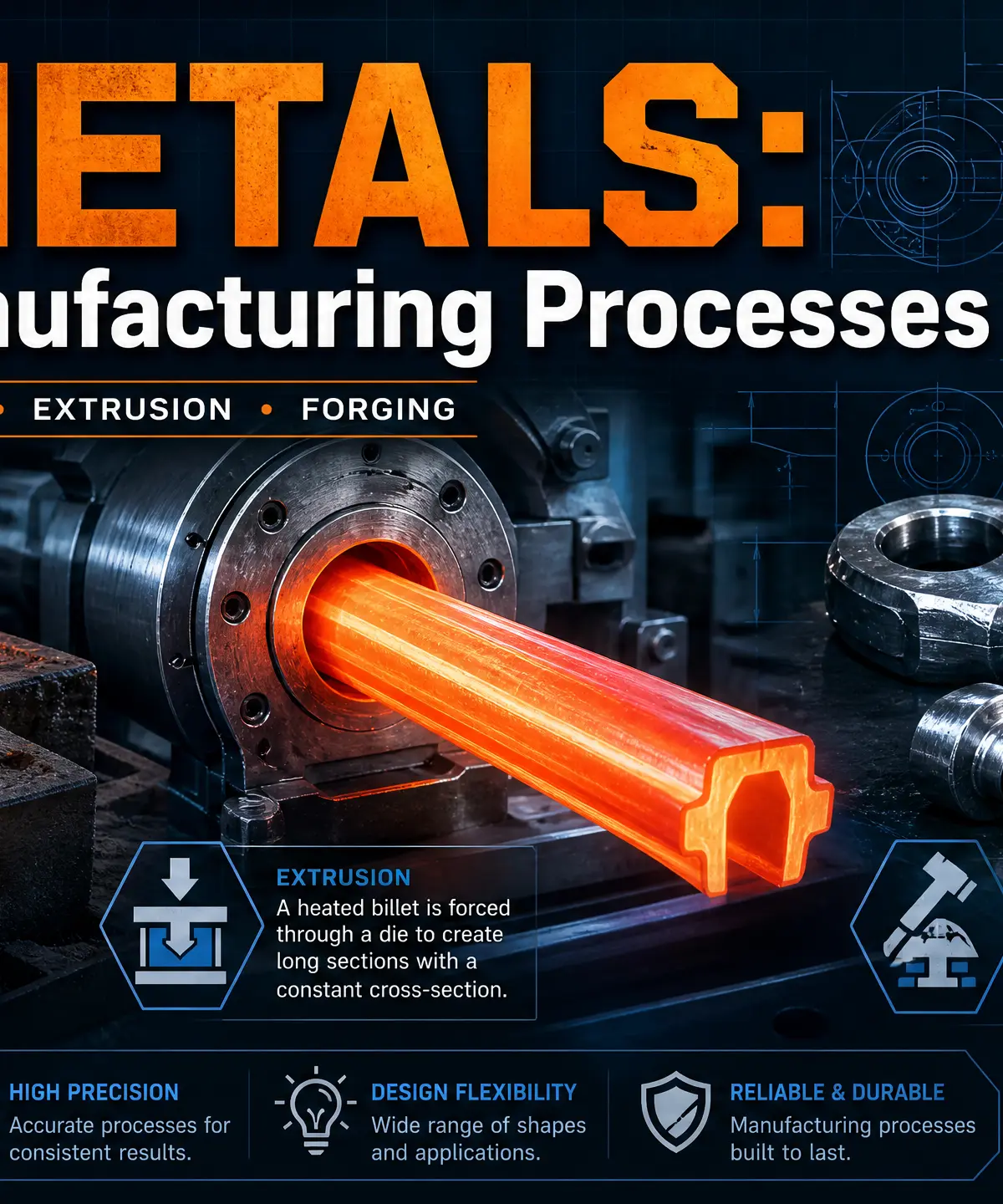
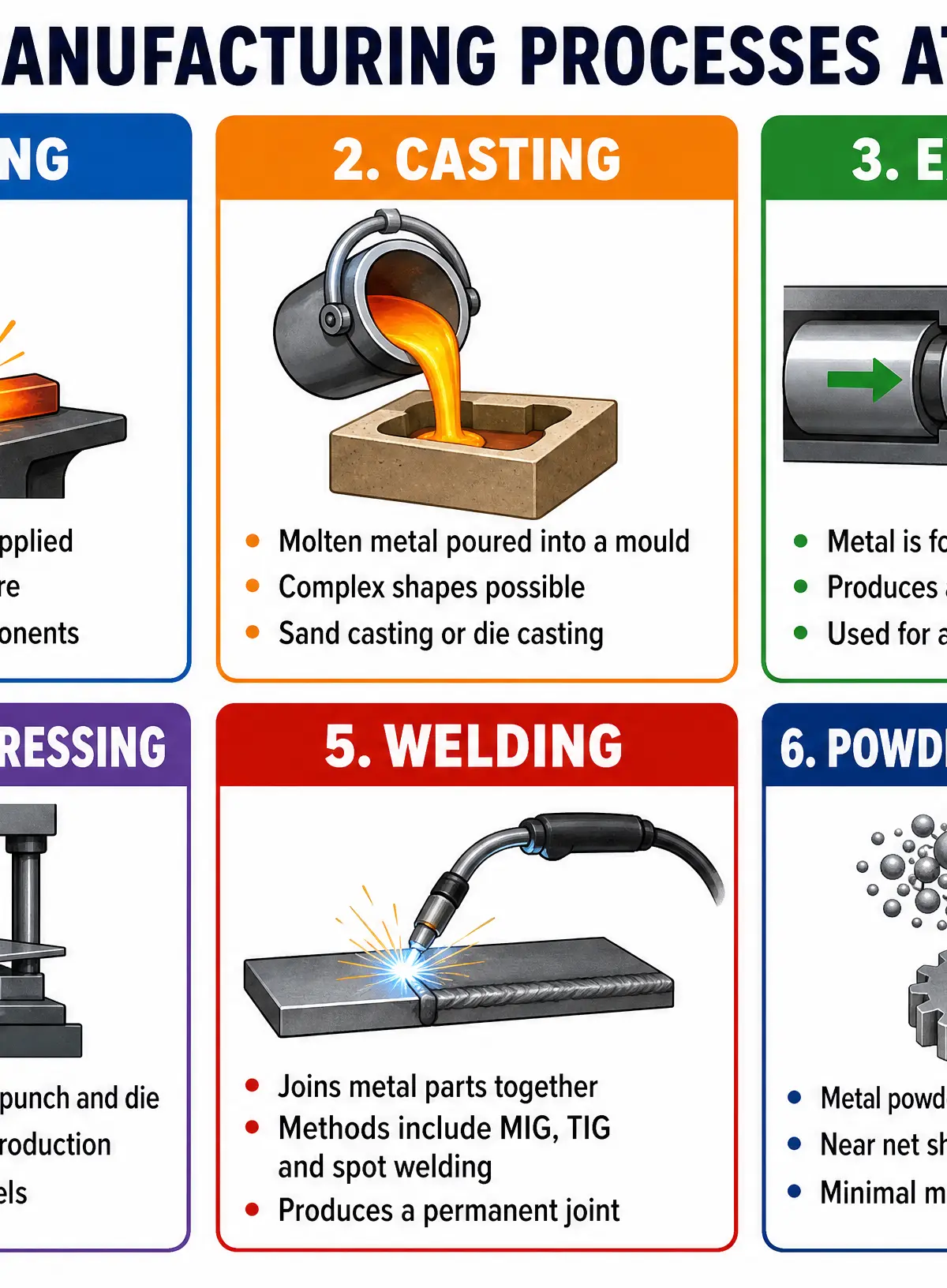
You must be able to discriminate between these seven key processes and justify their selection:
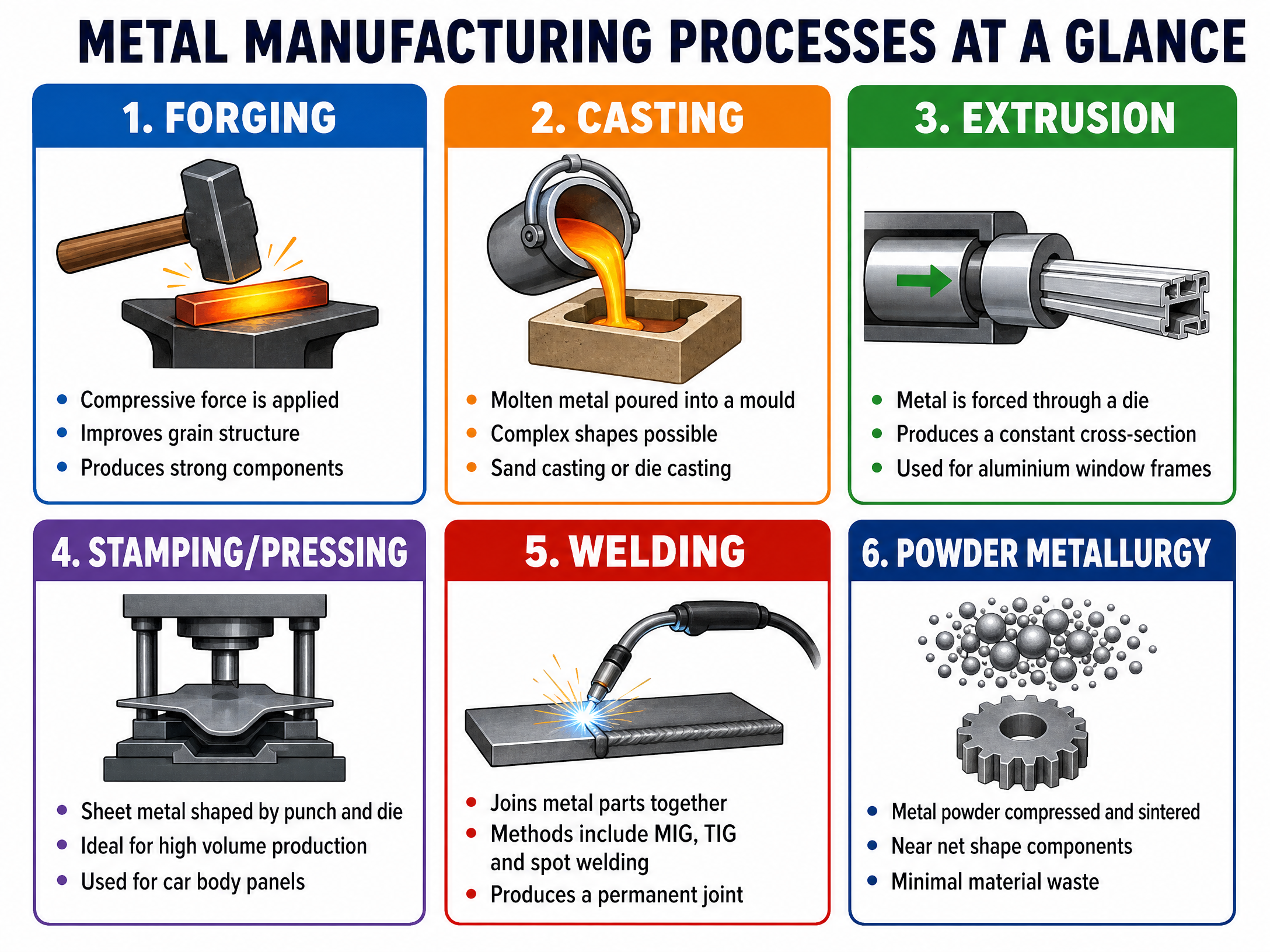
- Forging: Shaping metal using compressive force (hammering or pressing) while it is hot and plastic. Crucially, forging improves the grain structure of the metal, making the component significantly stronger. It is used for items that must withstand high stress, such as spanners or car crankshafts.
- Casting: Pouring molten metal into a mould cavity where it solidifies.
- Sand casting uses a temporary sand mould (ideal for one-off or batch production).
- Die casting uses a permanent metal mould (ideal for mass production of complex shapes, like engine blocks, providing excellent surface finish).
- Extrusion: Forcing a heated billet of metal through a shaped die to create a continuous length with a constant cross-section. It is commonly used with aluminium for window frames and curtain tracks.
- Stamping / Pressing: Using a punch and die in a press machine to cut or shape sheet metal. It is highly repeatable and used extensively in mass production, such as for car body panels.
- Welding: A permanent joining process that fuses metal parts using heat. Types include MIG (Metal Inert Gas) for steel, TIG (Tungsten Inert Gas) for precision work on aluminium/stainless steel, and spot welding for sheet metals.
- Powder Metallurgy: Compacting metal powder in a mould under high pressure, then heating it (sintering) to fuse the particles without fully melting them. This creates near-net-shape components with minimal waste, ideal for small gears and bearings.
- Hardening: A heat treatment process where steel is heated to a critical temperature and rapidly cooled (quenched) to increase hardness and wear resistance. It is often followed by tempering to reduce brittleness.
Scales of Production
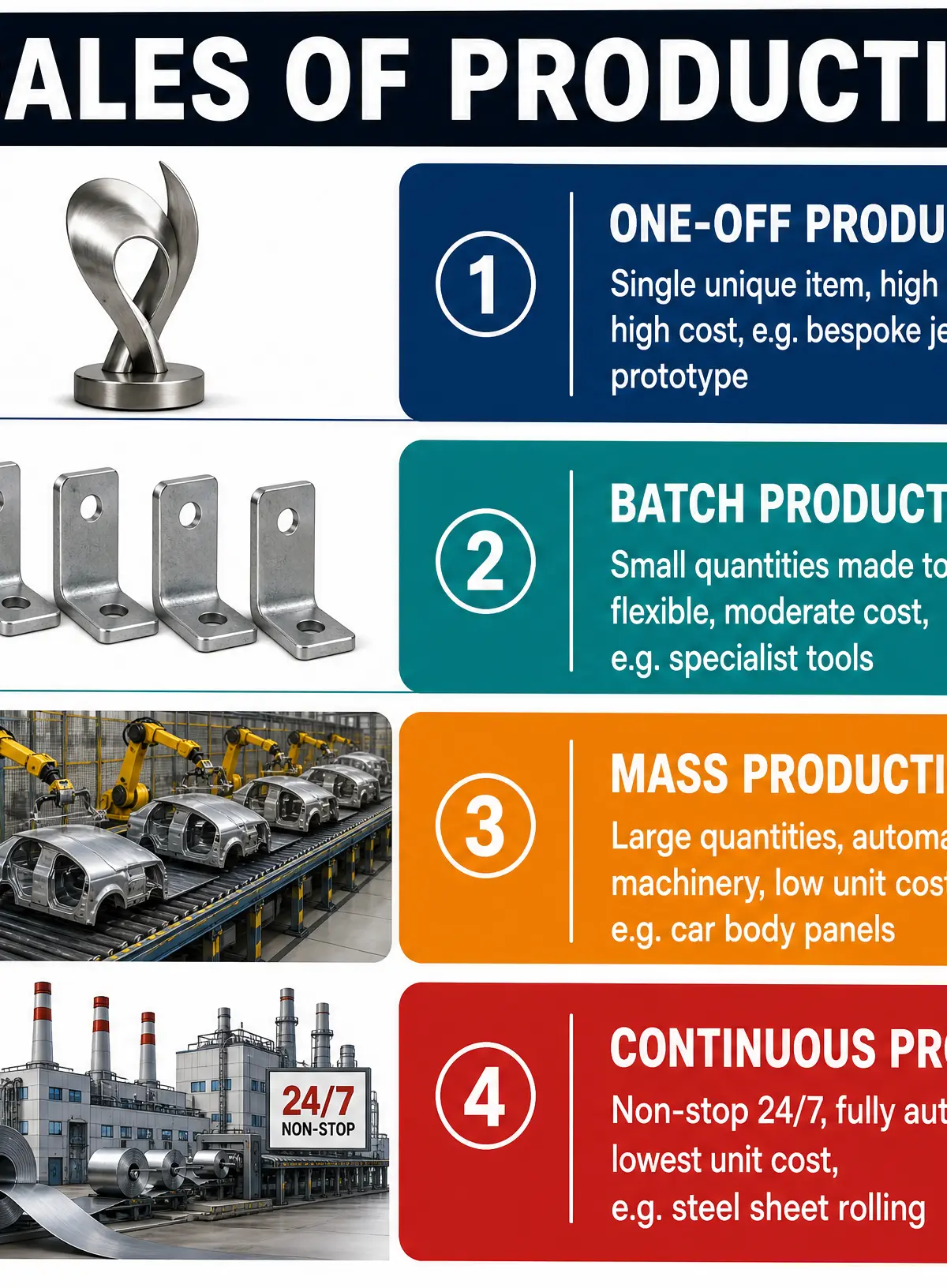
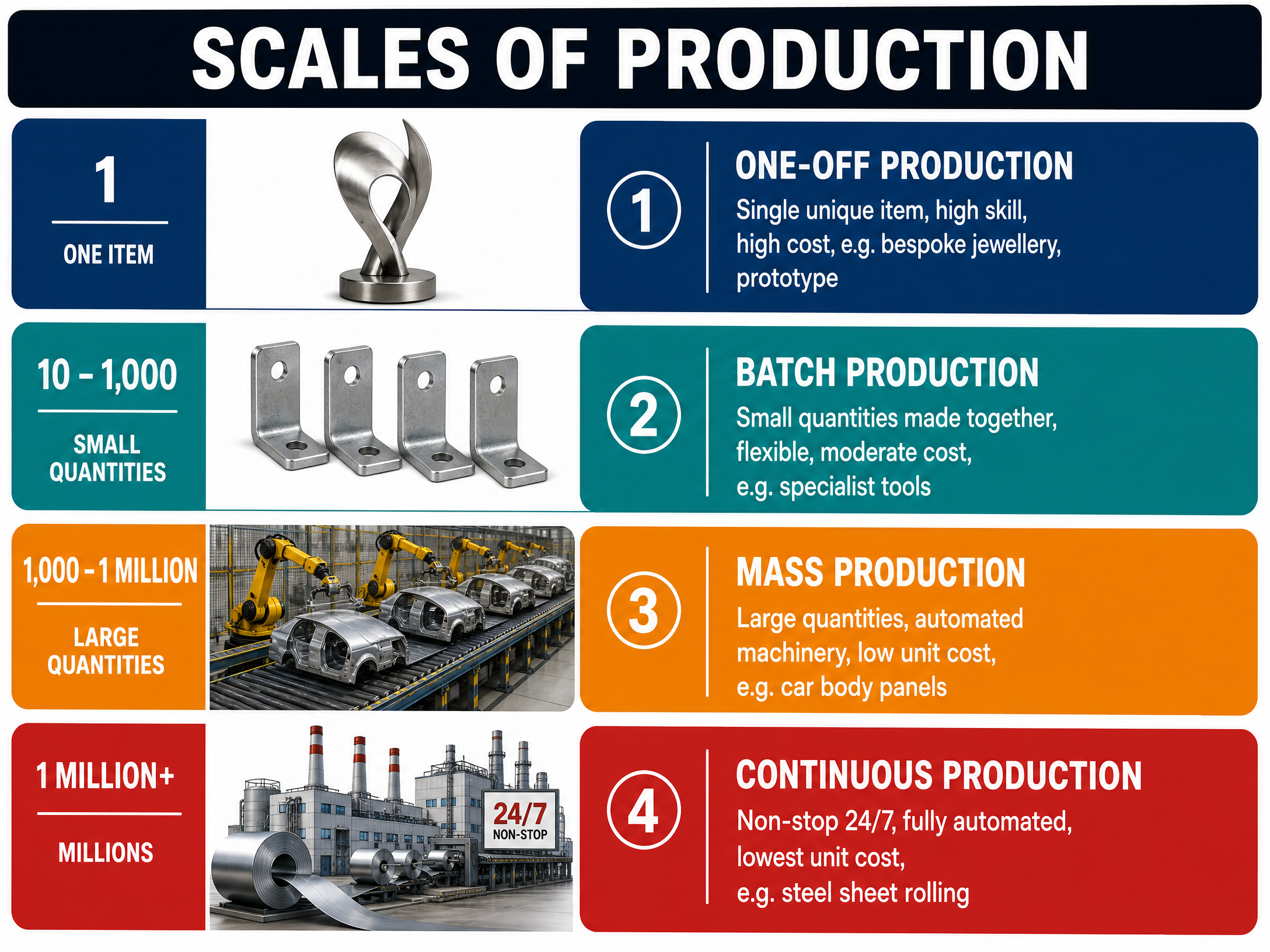
Examiners frequently ask you to link a manufacturing process to a specific scale of production:
- One-off Production: A single, unique item. High skill, high cost, slow process (e.g., bespoke jewellery, prototypes).
- Batch Production: A set quantity of identical items made together before the tooling is changed for a different product. Flexible and moderate cost (e.g., specialist tools, custom brackets).
- Mass Production: Large quantities made continuously using automated machinery. Low unit cost but high initial setup cost (e.g., car body panels, standard screws).
- Continuous Production: Non-stop 24/7 manufacturing, fully automated. Lowest unit cost, used for products with constant demand where stopping the process is too expensive (e.g., steel sheet rolling).
Technical Vocabulary
To access the highest mark bands, you MUST use correct terminology:
- Billet: A solid block or cylinder of metal used as the starting material for extrusion or forging.
- Die: A specialised tool used in manufacturing industries to cut or shape material mostly using a press.
- Sintering: The process of compacting and forming a solid mass of material by heat or pressure without melting it to the point of liquefaction.
- Tolerance: The acceptable margin of error in a manufactured dimension.
- Grain Structure: The arrangement of crystals within a metal, which determines its mechanical properties.
Practical Skills & Coursework Guidance
Techniques for Quantity Production
When designing for batch or mass production in your NEA (Non-Exam Assessment), you must demonstrate how you will ensure consistency and quality control. Examiners award marks for evidencing these techniques:
- Jigs: Devices that hold the workpiece and guide the cutting tool (e.g., a drilling jig ensures holes are in the exact same place on every part).
- Fixtures: Devices that securely hold the workpiece in position during machining.
- Templates: Patterns used to mark out identical shapes onto raw material quickly and accurately.
- CAM (Computer Aided Manufacture): Using software to control machine tools (like CNC routers or laser cutters) to ensure high precision and repeatability.
Building a Strong Portfolio
In your portfolio, do not just say "I will make this from steel." You must say: "I will manufacture this bracket using batch production. I will use a template to mark out the mild steel sheet to minimise waste, and a bending jig to ensure all brackets are folded to exactly 90 degrees within a tolerance of +/- 1mm."
Exam Component
Written Exam Preparation
In the written paper, questions on this topic typically assess AO1 (Knowledge) and AO2 (Application). You will often be given a product (e.g., an aluminium window frame) and asked to name the most suitable manufacturing process (Extrusion) and explain why it is suitable (it creates a constant cross-section continuously, which is ideal for long lengths, and aluminium is highly malleable).
Always remember to link the material, the process, and the scale of production together in your extended answers.
Visual Resources
2 diagrams and illustrations
Interactive Diagrams
1 interactive diagram to visualise key concepts
Conceptual Flow Outline
Decision matrix for selecting metal manufacturing processes based on scale and shape.
Worked Examples
3 worked examples — open one to explore the question and available guidance.
Practice Questions
Test your understanding — click to reveal model answers
Identify the most suitable scale of production for manufacturing a bespoke titanium hip replacement joint.
Hint: Think about the word 'bespoke' and how many of these exact joints would be needed.
Describe the process of extrusion.
Hint: Think of the toothpaste analogy. What state must the metal be in, what is it pushed through, and what is the result?
Explain two reasons why powder metallurgy is used to manufacture small, complex gears.
Hint: Consider material waste and the specific properties that can be engineered into the gear.
Evaluate the use of sand casting versus die casting for manufacturing a new design of aluminium alloy wheels for a sports car.
Hint: Compare the tooling costs, surface finish, and production volumes of both methods.