Pearson Edexcel · GCSE · Design and Technology
Metals: Design contexts
This topic covers the fundamental properties, manufacturing processes, and design applications of ferrous and non-ferrous metals. Mastering this area is essential for both answering theory questions and making justified material choices in your Non-Exam Assessment (NEA).
- 7 min read
- 3 worked examples
- 4 practice questions
- 6 key terms
Study Notes
Overview
Metals are among the most important materials in Design and Technology. From the structural beams holding up bridges to the delicate titanium implants used in surgery, metals shape our modern world. In this topic, you will learn to distinguish between different categories of metals, understand their physical and working properties, and evaluate their suitability for specific design contexts. Examiners expect you to apply this knowledge practically—justifying why a specific metal, stock form, or finish is the best choice for a given product.
Key Knowledge & Theory
Core Concepts
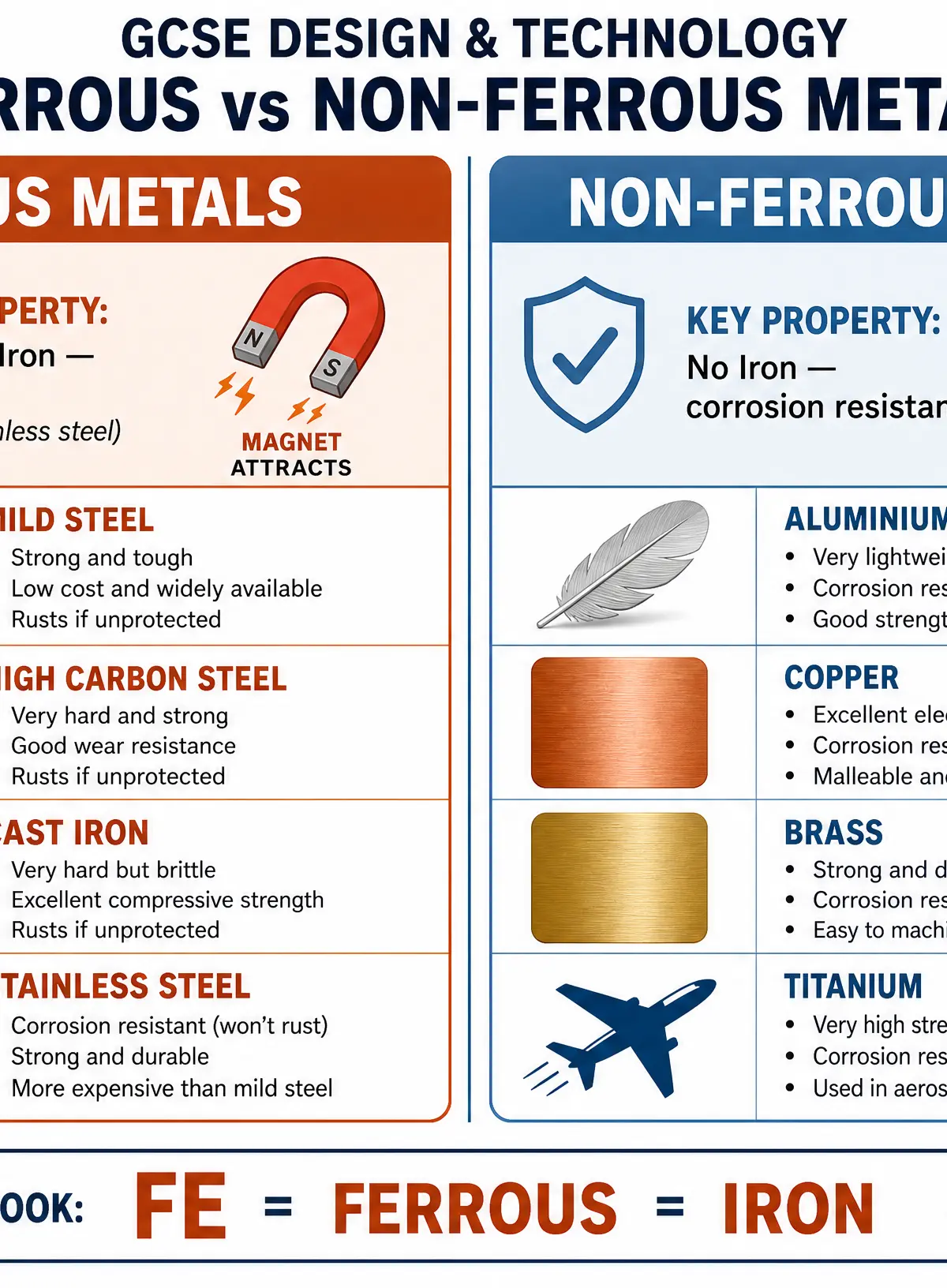
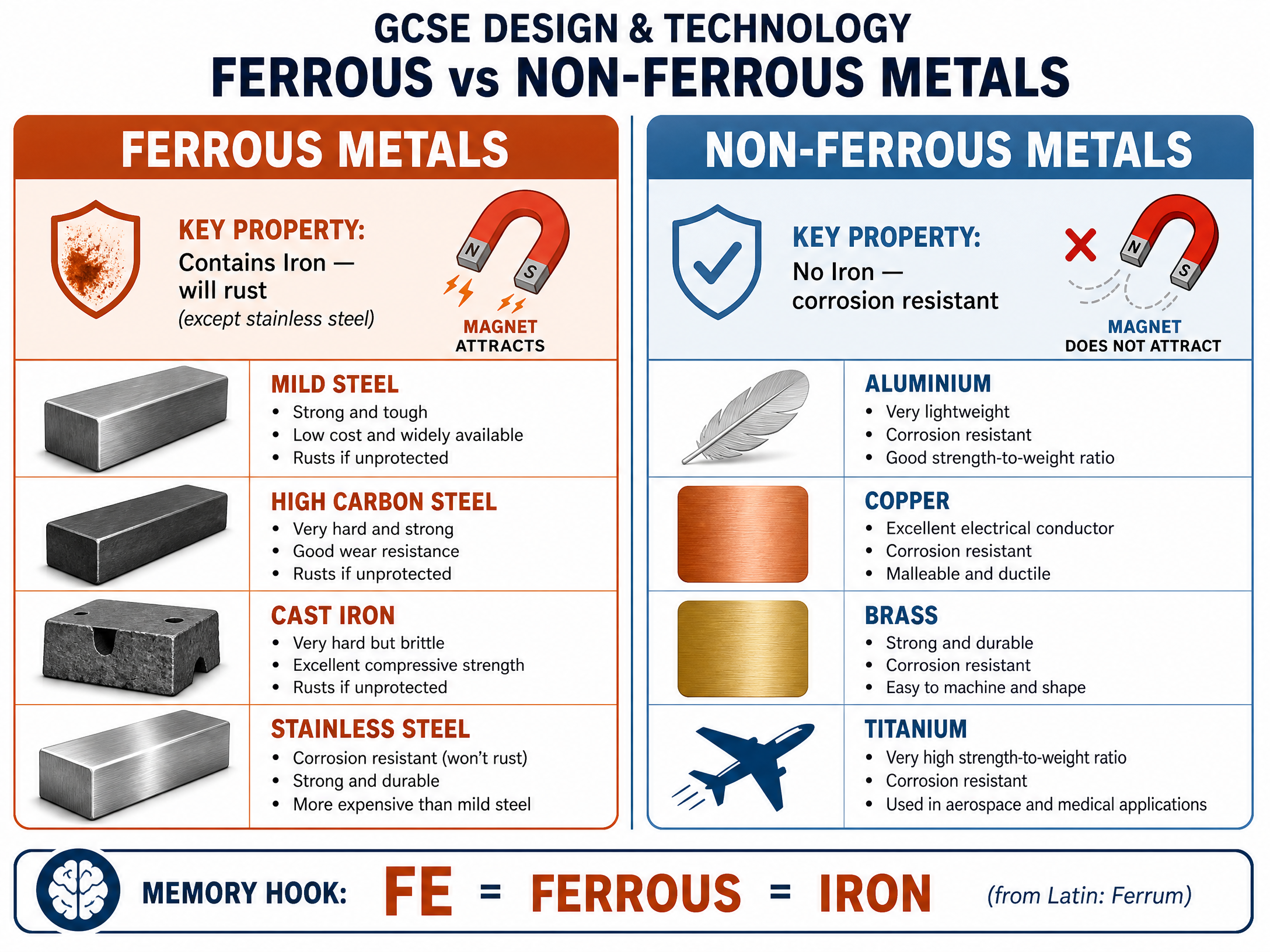
Ferrous vs Non-Ferrous MetalsThe most fundamental distinction in metallurgy is whether a metal contains iron.
- Ferrous Metals contain iron. They are generally magnetic and will rust (oxidise) if left unprotected. The major exception is stainless steel, which contains chromium to prevent rusting.
- Non-Ferrous Metals do not contain iron. They are generally not magnetic and have excellent natural resistance to corrosion.
AlloysAn alloy is a mixture of two or more elements, where at least one is a metal. Alloying is done to improve the properties of the base metal—for example, making it stronger, harder, or more resistant to corrosion. Brass (copper + zinc) and Stainless Steel (iron + carbon + chromium) are common examples.
Key Metals to Know
| Metal | Type | Key Properties | Common Uses | Why they matter in exams |
|---|---|---|---|---|
| Mild Steel | Ferrous Alloy | Strong, tough, ductile, low cost. Rusts easily. | Car bodies, structural beams, nuts and bolts. | The default choice for general engineering when cost is a factor. |
| High Carbon Steel | Ferrous Alloy | Very hard, wear-resistant, but brittle. | Cutting tools, drill bits, springs. | Demonstrates understanding of how carbon content affects hardness vs toughness. |
| Stainless Steel | Ferrous Alloy | High corrosion resistance, tough, hard to machine, expensive. | Cutlery, medical instruments, kitchen sinks. | The exception to the "ferrous metals rust" rule. |
| Aluminium | Non-Ferrous | Lightweight (high strength-to-weight ratio), excellent corrosion resistance, good conductor. | Aircraft, bicycle frames, drinks cans. | Crucial for contexts where weight reduction is the primary goal. |
| Copper | Non-Ferrous | Outstanding electrical/thermal conductor, highly ductile, malleable. | Electrical wiring, plumbing pipes. | The go-to metal for electrical conductivity. |
| Brass | Non-Ferrous Alloy | Stronger than copper, corrosion resistant, attractive golden finish, easy to machine. | Musical instruments, decorative fittings, valves. | Shows understanding of how alloying improves machinability. |
| Titanium | Non-Ferrous | Exceptional strength-to-weight ratio, biocompatible, highly corrosion resistant, very expensive. | Aerospace, medical implants, high-end sports gear. | Used in high-value contexts where performance outweighs cost. |
Technical Vocabulary
- Tensile Strength: The ability to resist stretching or pulling forces.
- Compressive Strength: The ability to resist squashing forces.
- Hardness: The ability to resist scratching, wear, or indentation.
- Toughness: The ability to absorb impact force without fracturing.
- Malleability: The ability to be deformed under compression (hammered or rolled) without cracking.
- Ductility: The ability to be drawn out under tension (into a wire) without breaking.
- Work Hardening: The process where a metal becomes harder and more brittle as it is repeatedly deformed (cold worked).
Practical Skills
Manufacturing Processes
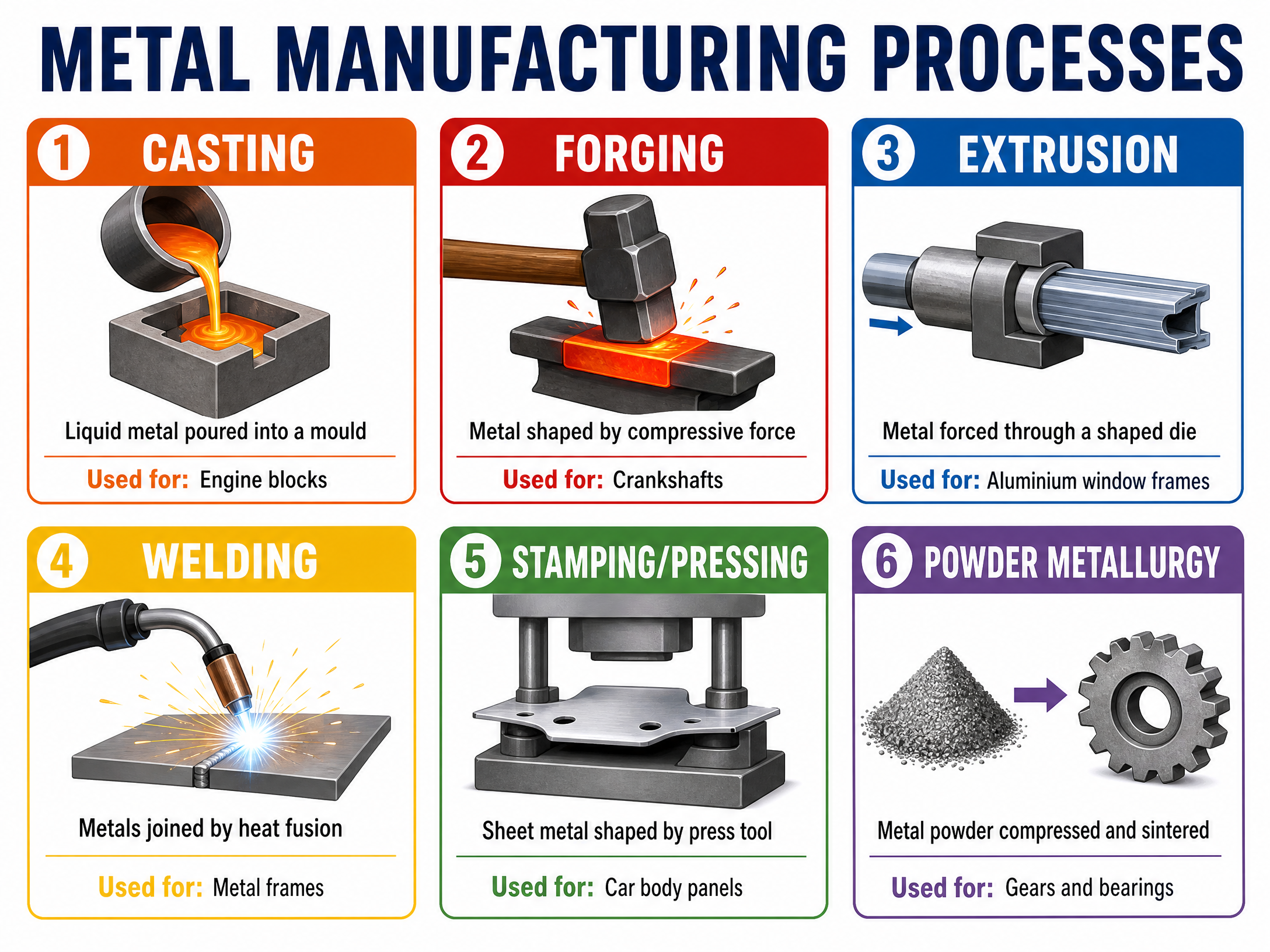
Examiners expect you to select appropriate manufacturing processes based on the scale of production and the desired shape.
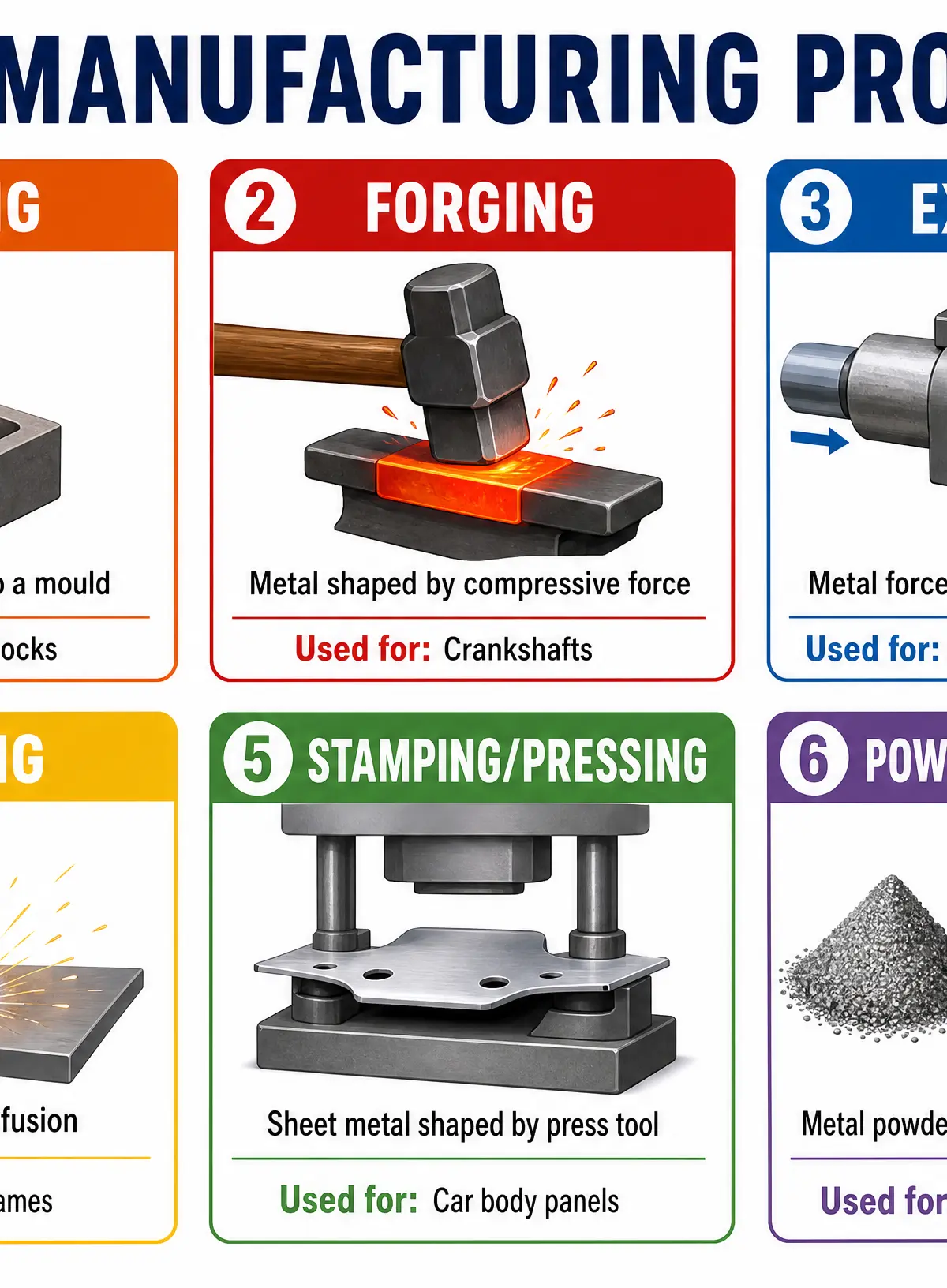
- Casting: Pouring molten metal into a mould. Sand casting is for one-off or batch production of complex shapes (e.g., engine blocks). Die casting uses reusable steel moulds for mass production of smaller items.
- Forging: Shaping hot metal using compressive force (hammering or pressing). This refines the grain structure, making the component exceptionally strong (e.g., spanners, crankshafts).
- Extrusion: Forcing heated metal through a shaped die to create long continuous profiles with a constant cross-section (e.g., aluminium window frames).
- Stamping/Pressing: Using a heavy press tool to cut or form sheet metal. Highly efficient for mass production (e.g., car body panels).
Surface Treatments & Finishes
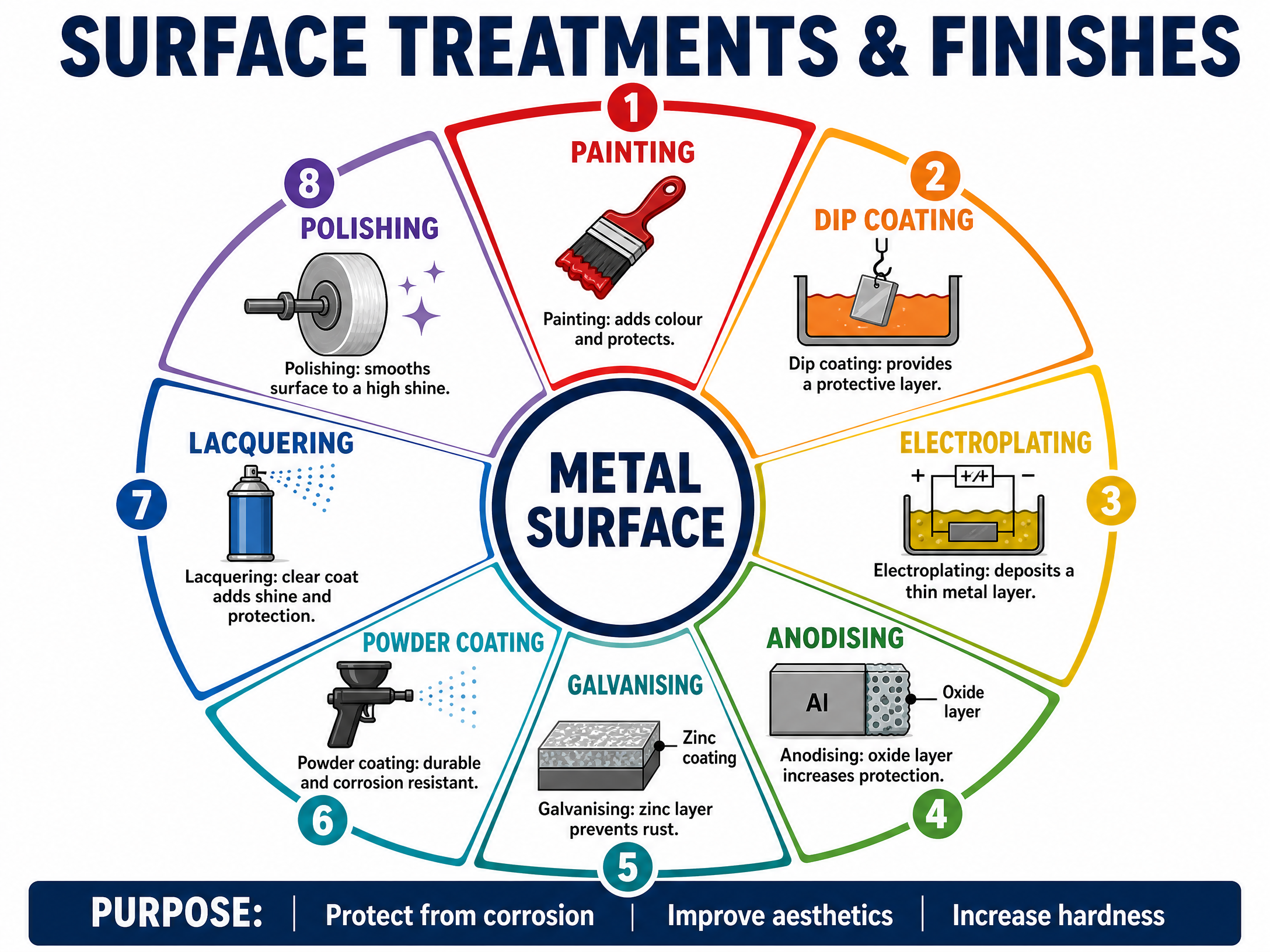
Metals are finished for two main reasons: protection (from corrosion or wear) and aesthetics (colour and shine).
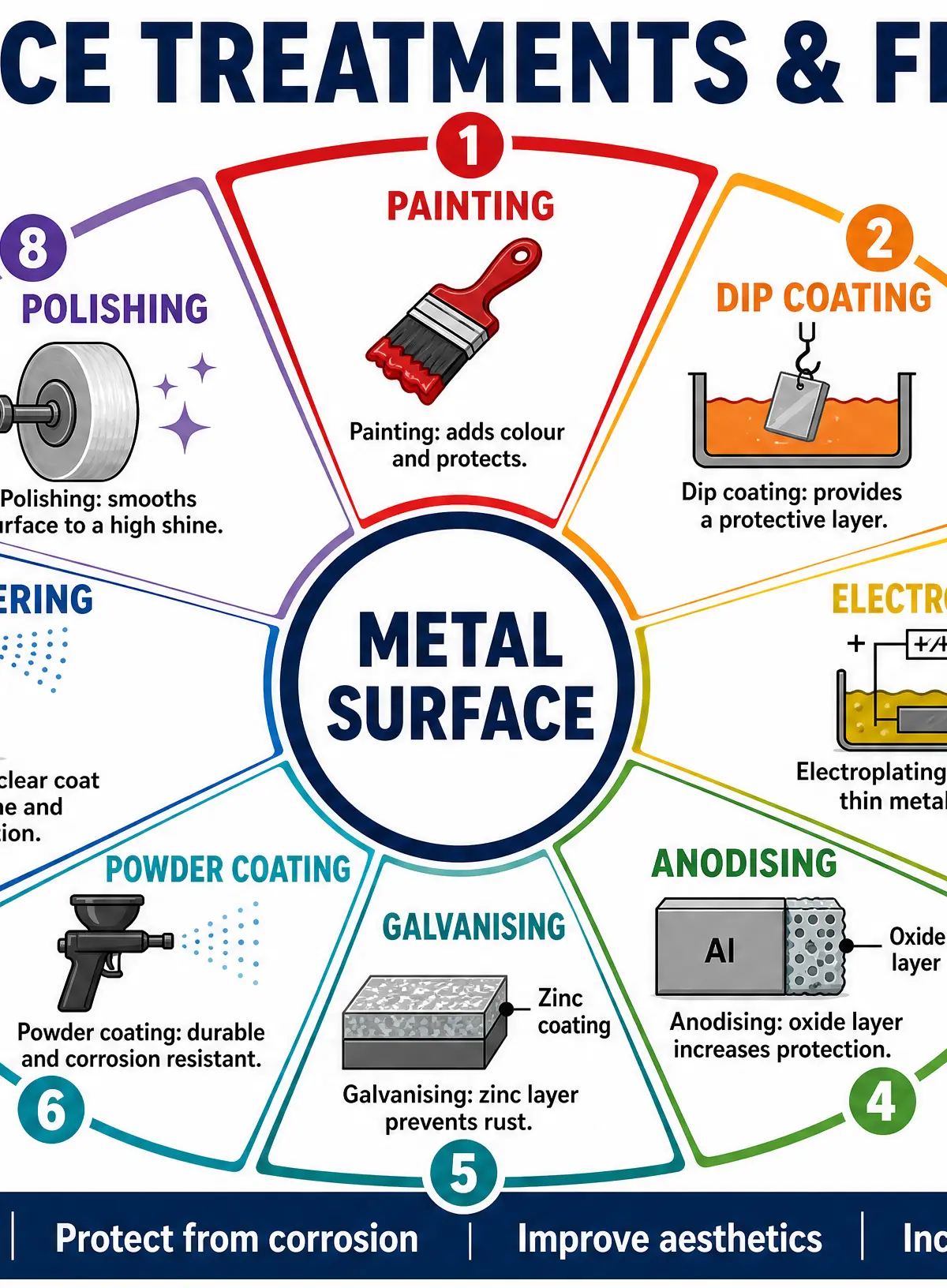
- Galvanising: Coating steel with a layer of zinc. The zinc acts as a sacrificial anode, corroding before the steel does. Used for outdoor structural steel and fencing.
- Anodising: An electrochemical process that thickens the natural oxide layer on aluminium, improving protection and allowing the metal to be dyed vibrant colours.
- Powder Coating: Spraying electrostatically charged powder onto metal, which is then baked in an oven. Produces a tough, even, durable finish without drips.
- Electroplating: Using electricity to coat a cheaper base metal with a thin layer of a more expensive metal (e.g., chrome plating on steel for car bumpers).
Portfolio/Coursework Guidance
Assessment Criteria
In your NEA (Non-Exam Assessment), examiners are looking for justified decision making. When you select a metal for your prototype, you cannot simply say "I used aluminium because it is good." You must link the material's specific properties to your product's functional requirements and user needs.
Building a Strong Portfolio
- Material Testing: Include photographic evidence of you testing different metals (e.g., bending, filing, finishing) to prove why you selected your final material.
- Ecological Footprint: Document the sustainability of your choice. Did you choose aluminium because it is highly recyclable? Did you minimize waste by selecting an appropriate stock form?
- Process Justification: If you brazed a joint rather than using a mechanical fixing, explain why (e.g., "Brazing provided a permanent, aesthetically clean joint with sufficient tensile strength for the load.").
Exam Component
Written Exam Knowledge
The written paper will test your ability to apply knowledge to unseen contexts. You will frequently be presented with an image of a product and asked to suggest a suitable material, manufacturing process, and finish, justifying your choices.
Listen to the Audio Guide
Review the core concepts, common exam mistakes, and a quick-fire recall quiz in this 10-minute revision podcast.

Visual Resources
3 diagrams and illustrations
Interactive Diagrams
1 interactive diagram to visualise key concepts
Conceptual Flow Outline
Decision pathway for selecting a casting process based on production scale.
Worked Examples
3 worked examples — open one to explore the question and available guidance.
Practice Questions
Test your understanding — click to reveal model answers
State one ferrous metal and one non-ferrous metal. (2 marks)
Hint: Think about the FE = Iron rule.
A bicycle manufacturer is choosing a material for a high-performance racing frame. Evaluate the use of Titanium compared to Aluminium for this product. (6 marks)
Hint: Consider strength-to-weight ratio, corrosion resistance, and cost.
Explain two reasons why mild steel is often galvanised before being used for outdoor gates. (4 marks)
Hint: What is mild steel's main weakness? How does galvanising fix it?
Name a suitable manufacturing process for producing 100,000 identical aluminium drinks cans, and justify your choice. (3 marks)
Hint: Think about the stock form (sheet metal) and the scale of production.