Pearson Edexcel · GCSE · Design and Technology
Metals: Stock forms, types and sizes in order to calculate and determine the quantity of ferrous and non-ferrous metals required
This topic covers the essential knowledge of ferrous and non-ferrous metals, focusing on standard stock forms and dimensions. Mastering this allows you to accurately calculate material quantities for manufacturing, reducing waste and ensuring cost-effective design decisions.
- 6 min read
- 3 worked examples
- 4 practice questions
- 6 key terms
Study Notes

Overview
When designing and manufacturing products in Design and Technology, metals are rarely supplied as custom shapes. Instead, they are produced in standard, commercially available shapes known as stock forms. Understanding these forms, alongside the key differences between ferrous and non-ferrous metals, is critical. This knowledge allows designers to calculate the exact quantity of material required for a project, minimizing waste and ensuring the design is economically viable.
Listen to the companion podcast for an in-depth review of this topic:

Key Knowledge & Theory
Core Concepts
Ferrous vs. Non-Ferrous Metals
Before selecting a stock form, candidates must correctly identify the appropriate metal category based on its properties.
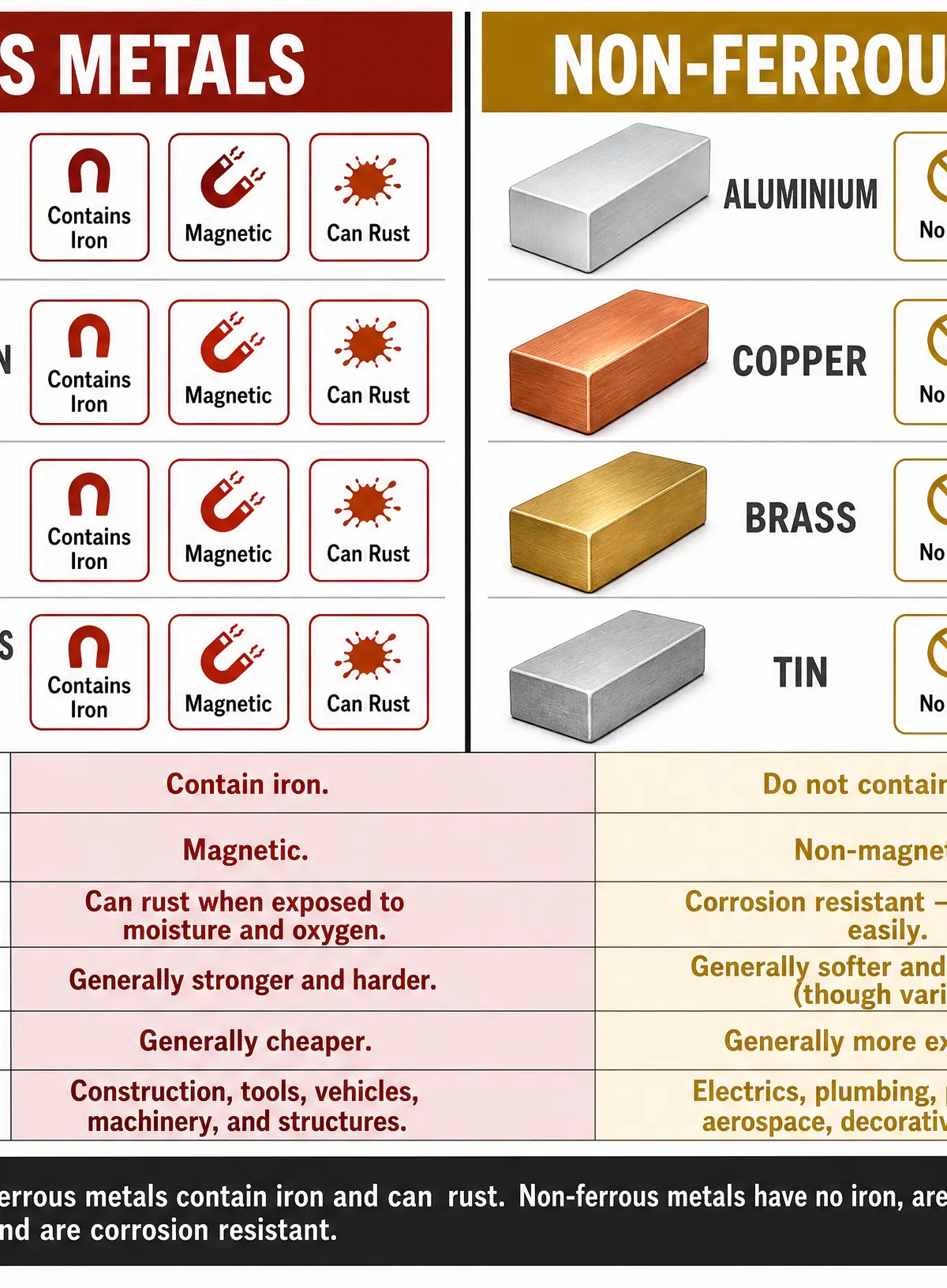
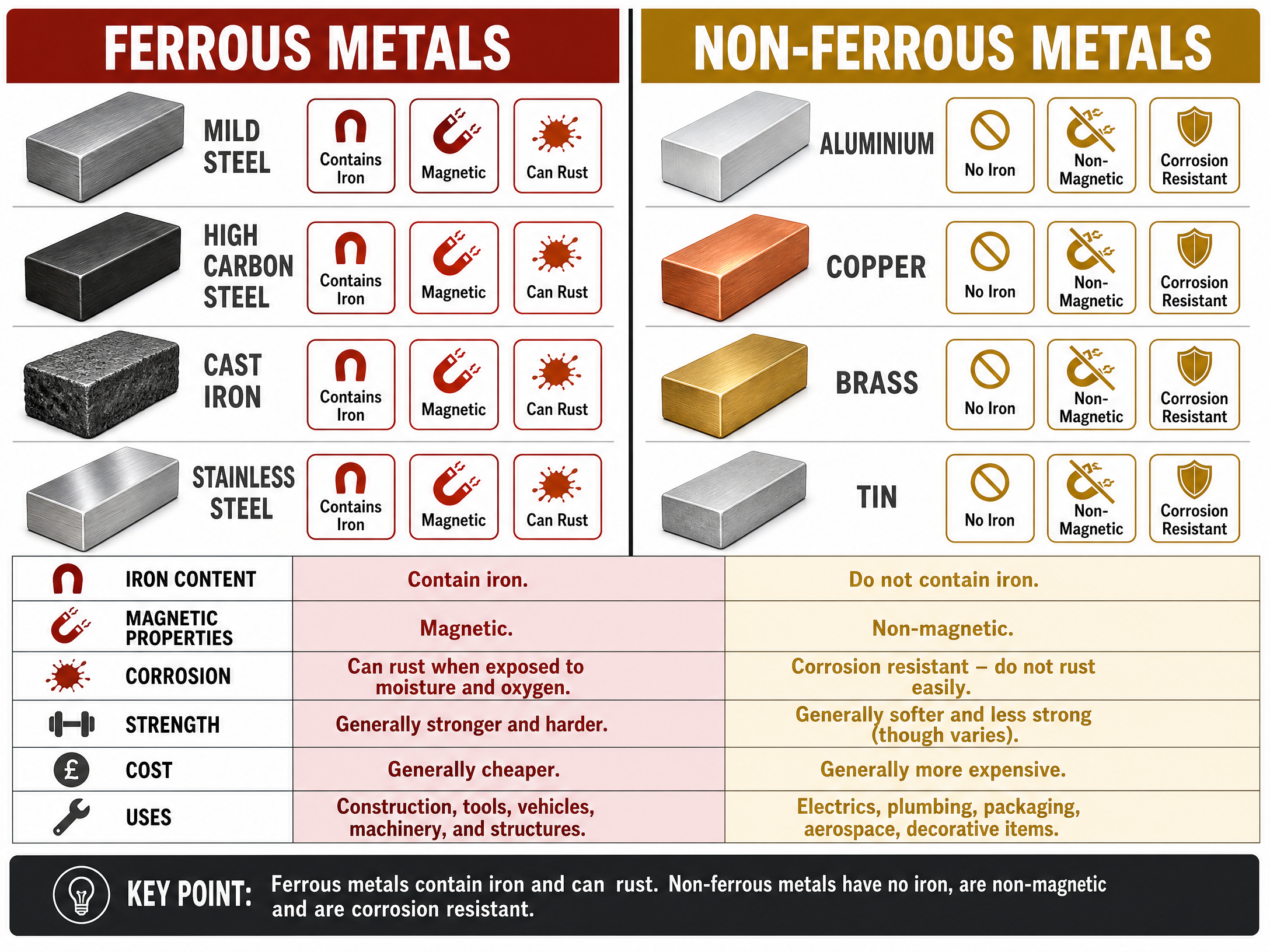
- Ferrous Metals: Contain iron (ferrite). They are generally magnetic, prone to corrosion (rusting) when exposed to moisture and oxygen, and are known for their strength and hardness. Examples include mild steel, high carbon steel, cast iron, and stainless steel (which is an alloy designed to resist rust).
- Non-Ferrous Metals: Do not contain iron. They are non-magnetic and highly resistant to corrosion. They often have specific properties like high electrical conductivity or low weight. Examples include aluminium, copper, brass (an alloy of copper and zinc), and tin.
Standard Stock Forms
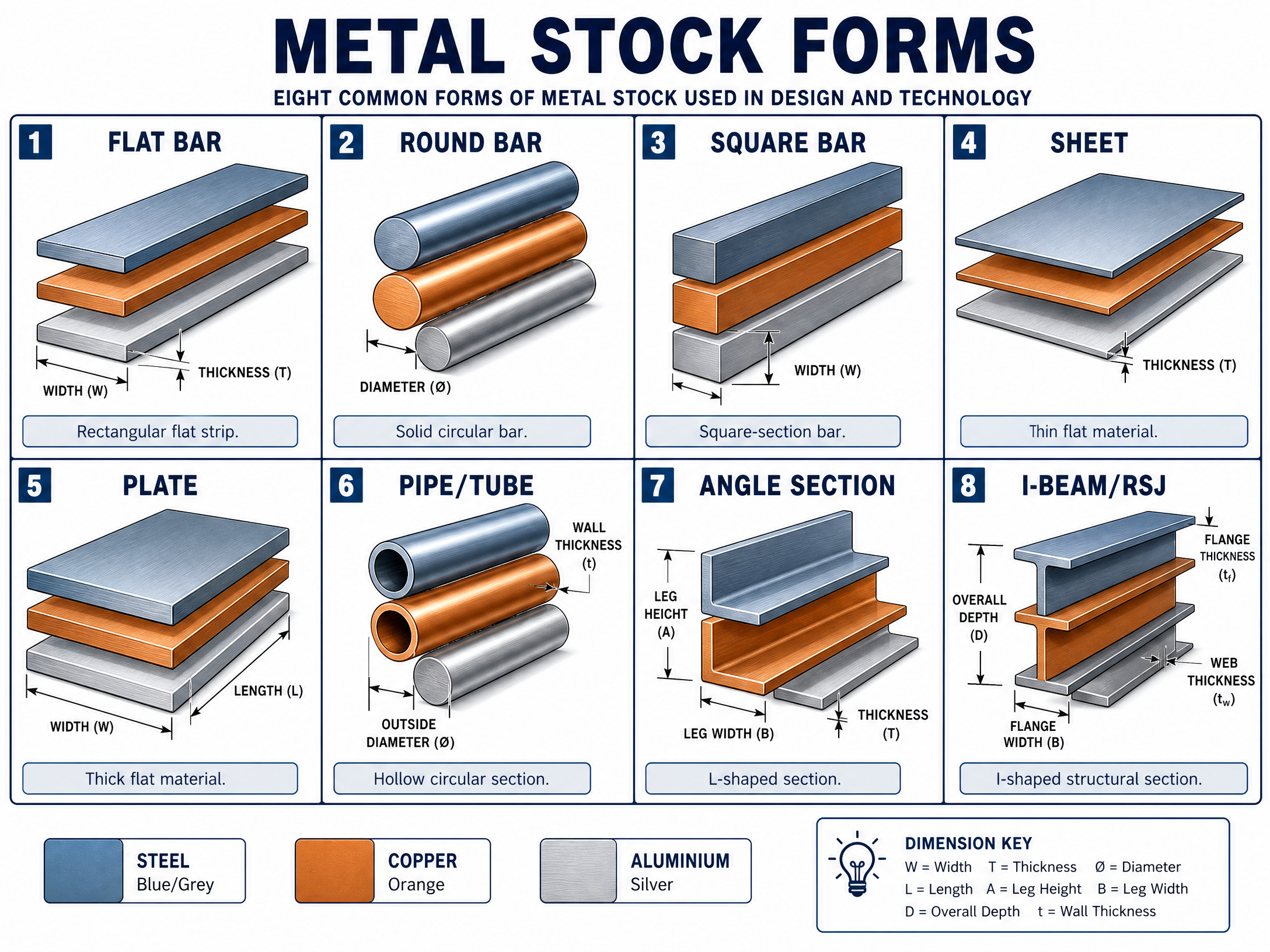
Metals are processed into standard shapes to make them easier to transport, store, and machine. The eight primary stock forms you must know are:
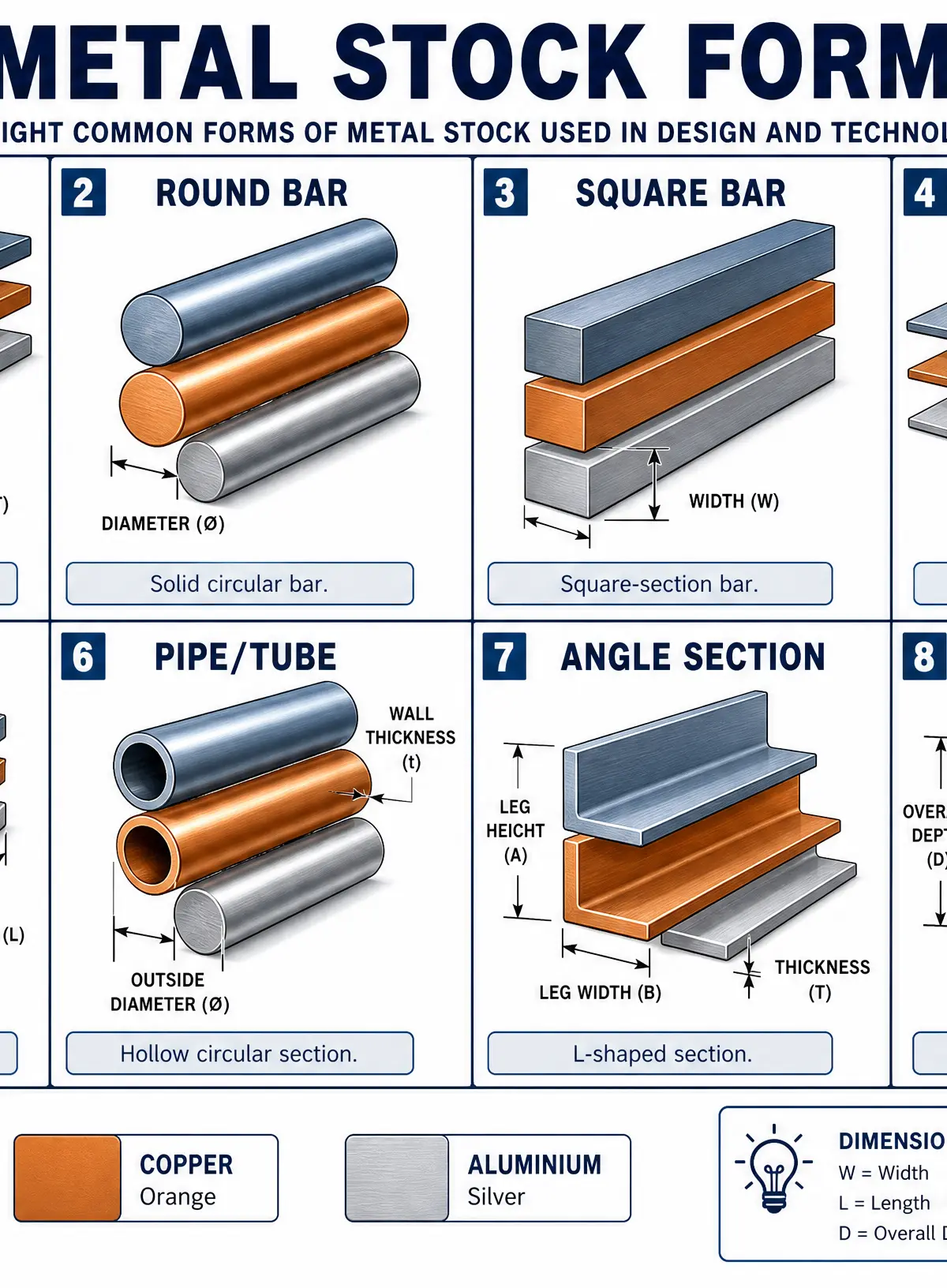
- Flat Bar: A rectangular cross-section. Specified by width and thickness.
- Round Bar: A solid cylindrical shape. Specified by its diameter (Ø).
- Square Bar: A square cross-section. Specified by the width of one side.
- Sheet: Thin, flat metal, generally under 3mm thick. Its thickness is often measured using a gauge system. Crucial exam point: A higher gauge number means thinner material (e.g., 20 gauge is thinner than 10 gauge).
- Plate: Thick, flat metal, generally over 3mm thick. Used for heavy structural work.
- Pipe/Tube: A hollow cylindrical section. Specified by its outside diameter (OD) and wall thickness (t). The inside diameter (bore) is derived from these.
- Angle Section (Angle Iron): An L-shaped profile. Specified by the length of its two legs and the material thickness.
- I-Beam (RSJ - Rolled Steel Joist): An I- or H-shaped structural profile, incredibly strong in bending. Specified by overall depth, flange width, and web thickness.
Technical Vocabulary
- Stock Form: The standard shape and size in which materials are commercially available.
- Gauge: A measurement system for the thickness of sheet metal and wire.
- Cross-Sectional Area: The area of the two-dimensional shape obtained when a 3D object is sliced perpendicular to its length.
- Wall Thickness: The thickness of the material forming the wall of a pipe or tube.
- Waste Allowance: A percentage of extra material added to a calculation to account for material lost during cutting and machining.
- Standard Length: The set lengths that metal bar and tube are sold in (typically 1m, 2m, 3m, 6m).
Practical Skills
Calculating Material Quantities
Calculating the quantity of metal required is a core practical skill tested in both the written exam and your NEA (coursework).
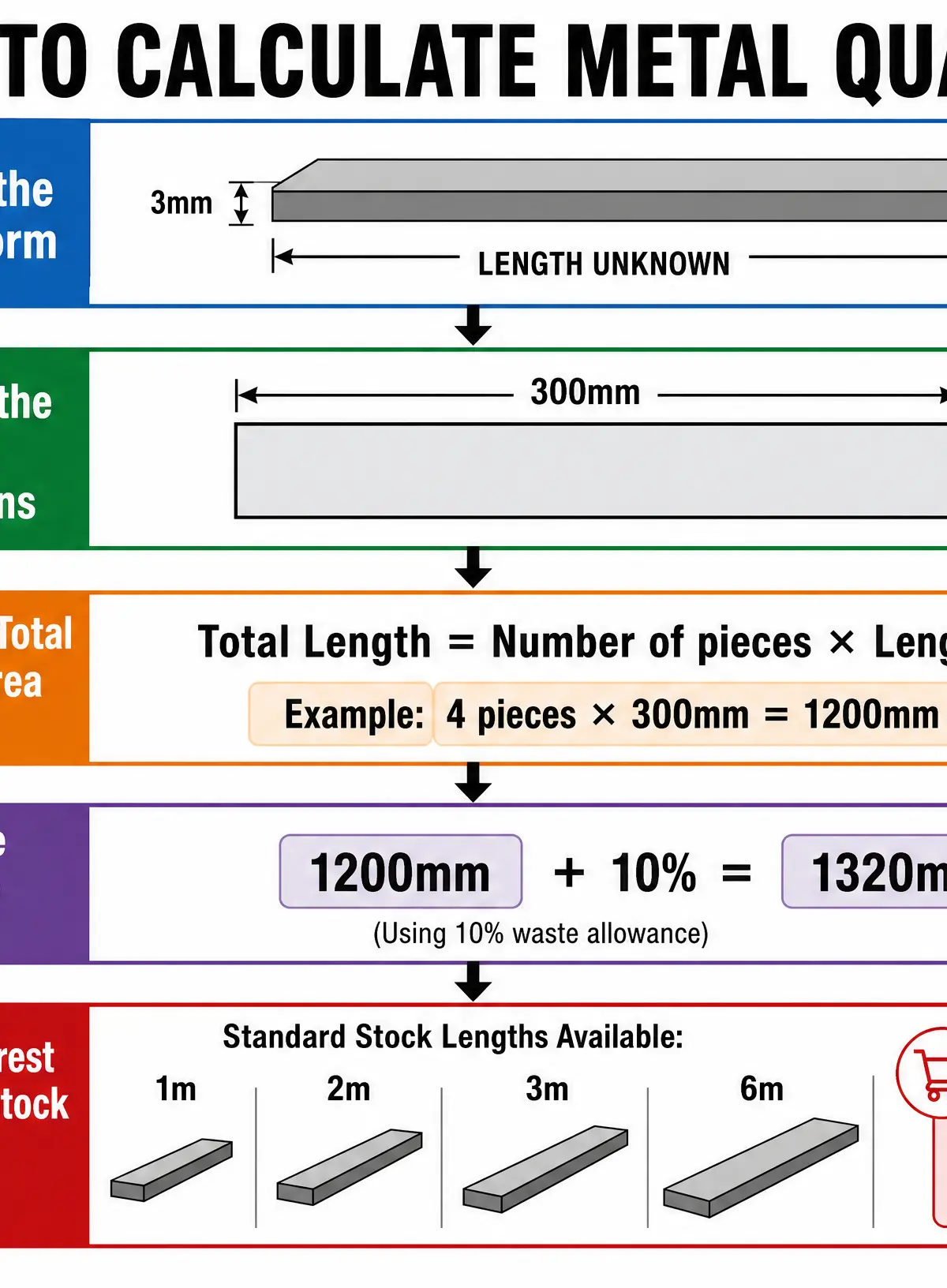
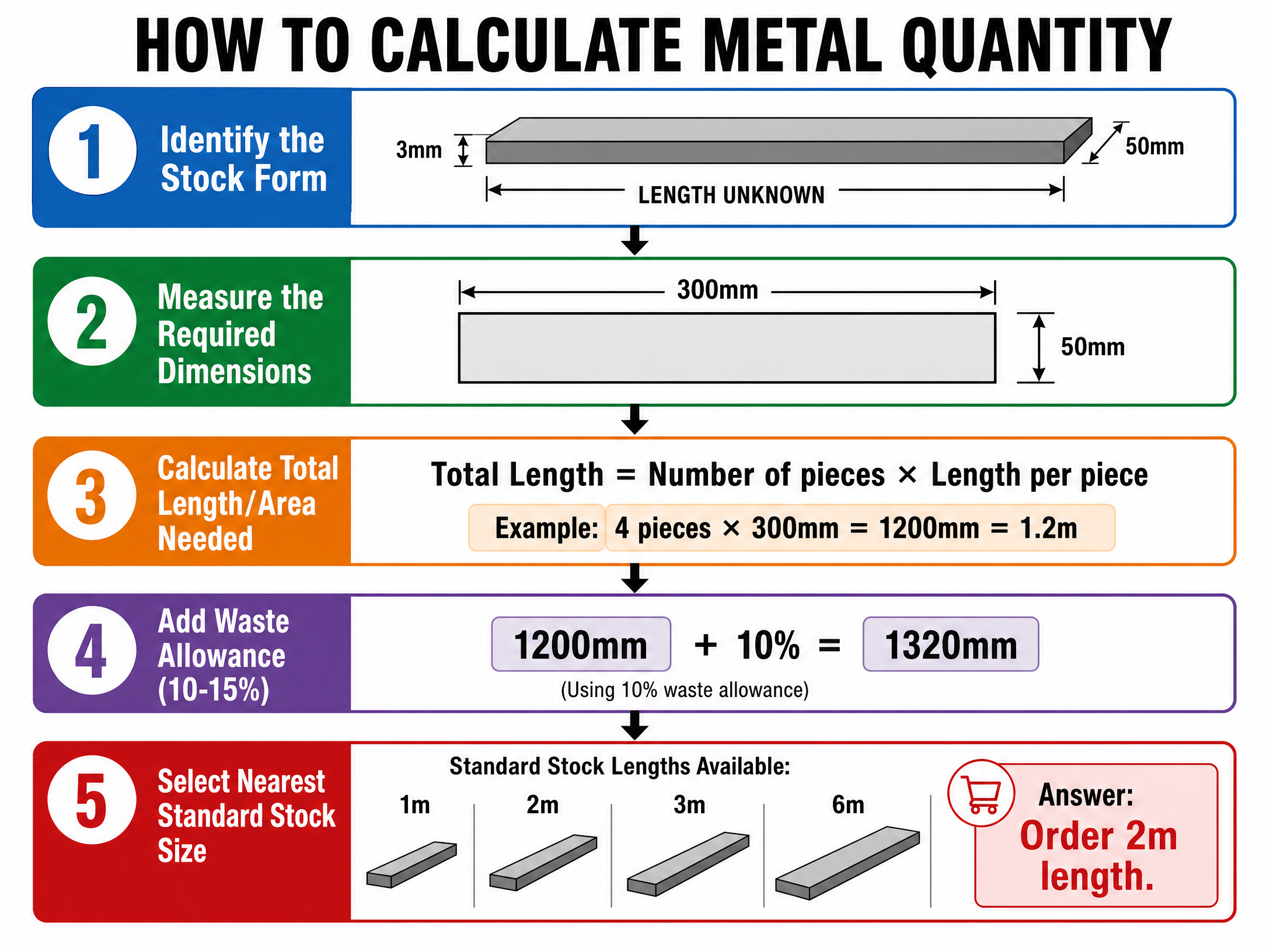
The 5-Step Calculation Method:
- Identify the Stock Form: Determine the shape (e.g., flat bar, round tube) needed for the component.
- Determine Required Dimensions: Extract the required length, width, or area from the working drawings.
- Calculate Total Quantity: Multiply the required dimension by the number of components needed.
- Add Waste Allowance: Always add a standard waste allowance (typically 10-15%) to account for the width of the saw blade (kerf) and machining errors.
- Select Standard Size: Round up the total calculated length (including waste) to the nearest commercially available standard stock size (e.g., 1m, 2m, 3m).
Portfolio/Coursework Guidance
Assessment Criteria
Examiners award marks in the Non-Exam Assessment (NEA) for demonstrating commercial awareness. When producing your cutting list or bill of materials, you must:
- Specify the exact stock form (e.g., 'Mild Steel Flat Bar', not just 'Steel').
- List the standard dimensions required (e.g., 25mm x 3mm).
- Show calculations for the total length required, explicitly including a waste allowance.
- Calculate the total cost based on the required standard lengths.
Building a Strong Portfolio
To access the highest mark bands, your portfolio should include a detailed Cutting List. This table should list every part, its material, the stock form, the required dimensions, the quantity, and the total length needed including waste. Annotate your design development pages to justify why a specific stock form was chosen (e.g., "I selected 20mm aluminium square tube for the frame because the hollow section provides excellent rigidity while keeping the overall weight low").
Exam Component
Written Exam Knowledge
Questions on this topic typically appear in the technical principles section of the paper. They range from 1-mark multiple-choice questions identifying a stock form from an image, to 3-mark calculation questions, up to 6-mark extended response questions requiring you to justify the selection of a specific metal and stock form for a given product.
Practical Exam Preparation
When tackling calculation questions in the exam, always show your working. Even if your final answer is incorrect, examiners will award method marks if they can see you correctly applied the steps (such as adding the waste allowance). Always state the final units clearly (mm or m).
Visual Resources
3 diagrams and illustrations
Interactive Diagrams
1 interactive diagram to visualise key concepts
Conceptual Flow Outline
Decision making process for selecting and calculating metal stock forms.
Worked Examples
3 worked examples — open one to explore the question and available guidance.
Practice Questions
Test your understanding — click to reveal model answers
Identify one ferrous metal and one non-ferrous metal.
Hint: Think about which metals rust (contain iron) and which do not.
Describe the difference between sheet metal and metal plate.
Hint: The difference relates to their thickness.
A student needs to make 12 brackets from aluminium flat bar. Each bracket requires a length of 115mm. The school supplier sells aluminium flat bar in standard 2 metre lengths. Calculate how many 2 metre lengths the student needs to order. Allow 15% for waste.
Hint: Follow the 5-step method. Don't forget to convert your final answer into the number of 2m lengths.
Explain why copper is supplied in the stock form of wire for use in household electrical circuits.
Hint: Link the material properties of copper to the physical characteristics of the wire stock form.