Pearson Edexcel · GCSE · Design and Technology
Papers and Boards: Stock forms, types and sizes in order to calculate and determine the quantity of papers and boards required
This topic covers the essential stock forms, types, and sizes of papers and boards. Mastering this allows you to accurately calculate material quantities for design projects and justify material choices in your exam.
- 5 min read
- 3 worked examples
- 4 practice questions
- 6 key terms
Study Notes
Overview
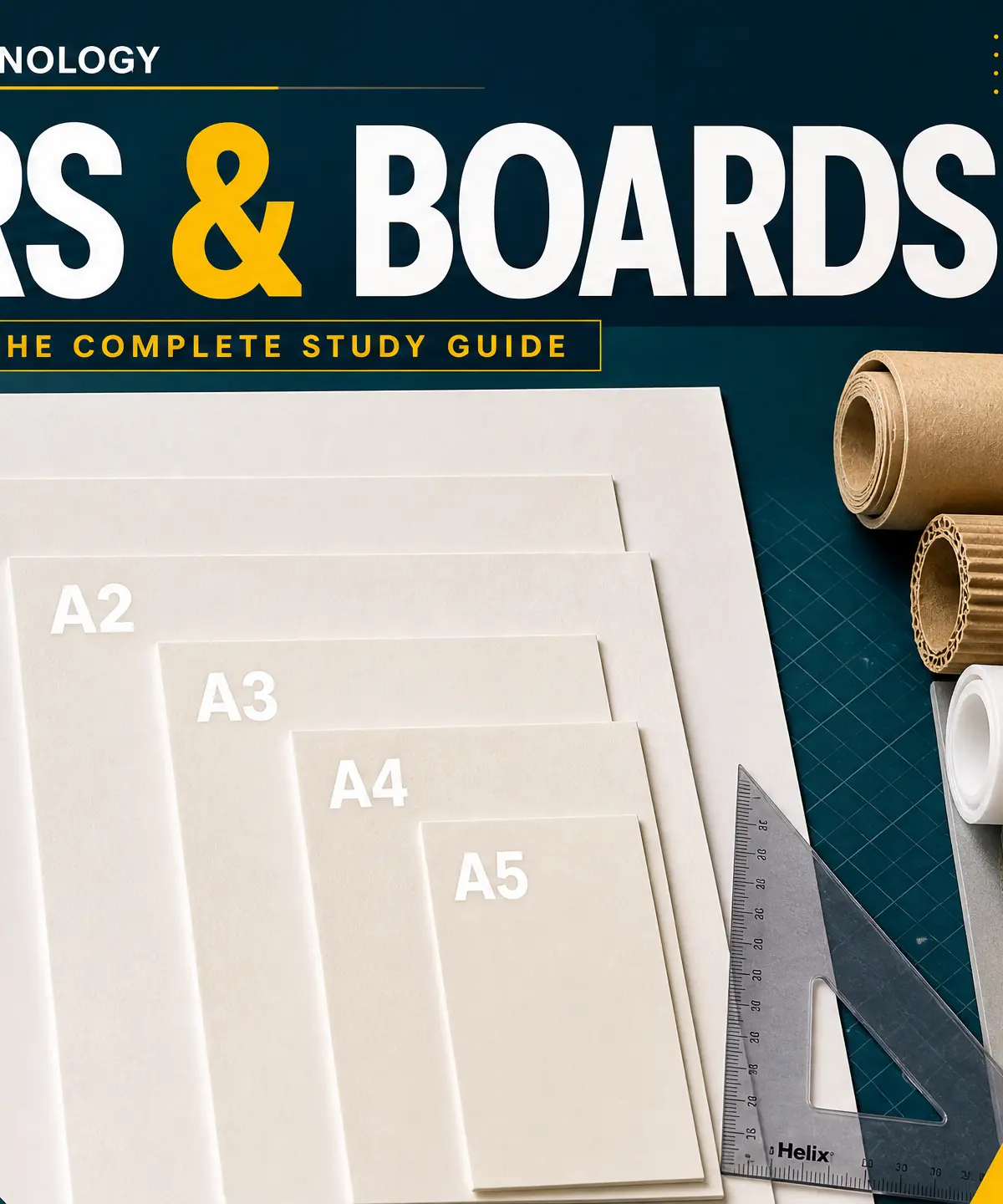
Welcome to the core theory of Papers and Boards. As a Design and Technology student, your ability to select, specify, and calculate materials is fundamental to both your written exam and your NEA (Non-Exam Assessment) portfolio. This topic bridges the gap between theoretical knowledge and practical manufacturing.
Listen to the podcast below for a comprehensive overview and revision quiz:

Key Knowledge & Theory
Core Concepts: Weights and Measures
All papers and boards are measured by weight, specifically in grams per square metre (gsm). This is a critical metric because it dictates the material's thickness, rigidity, and suitability for specific applications.
- Paper is generally classified as anything up to 199 gsm.
- Board is classified as 200 gsm and above.
Standard Sizes: The ISO A-Series
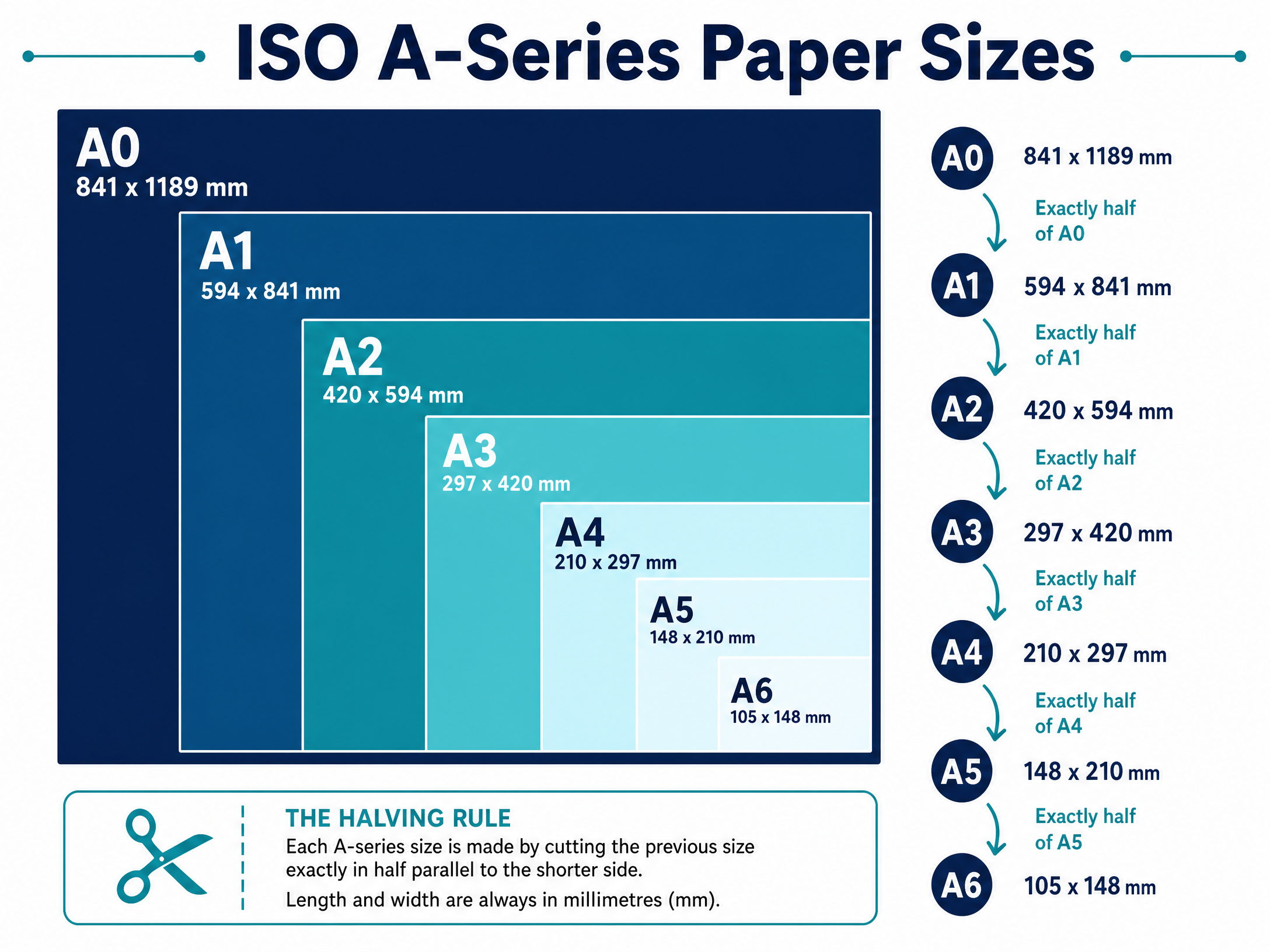
The A-series is an international standard based on the halving principle. Each size is exactly half the area of the size above it. This allows for efficient scaling and zero waste when cutting down from larger stock.
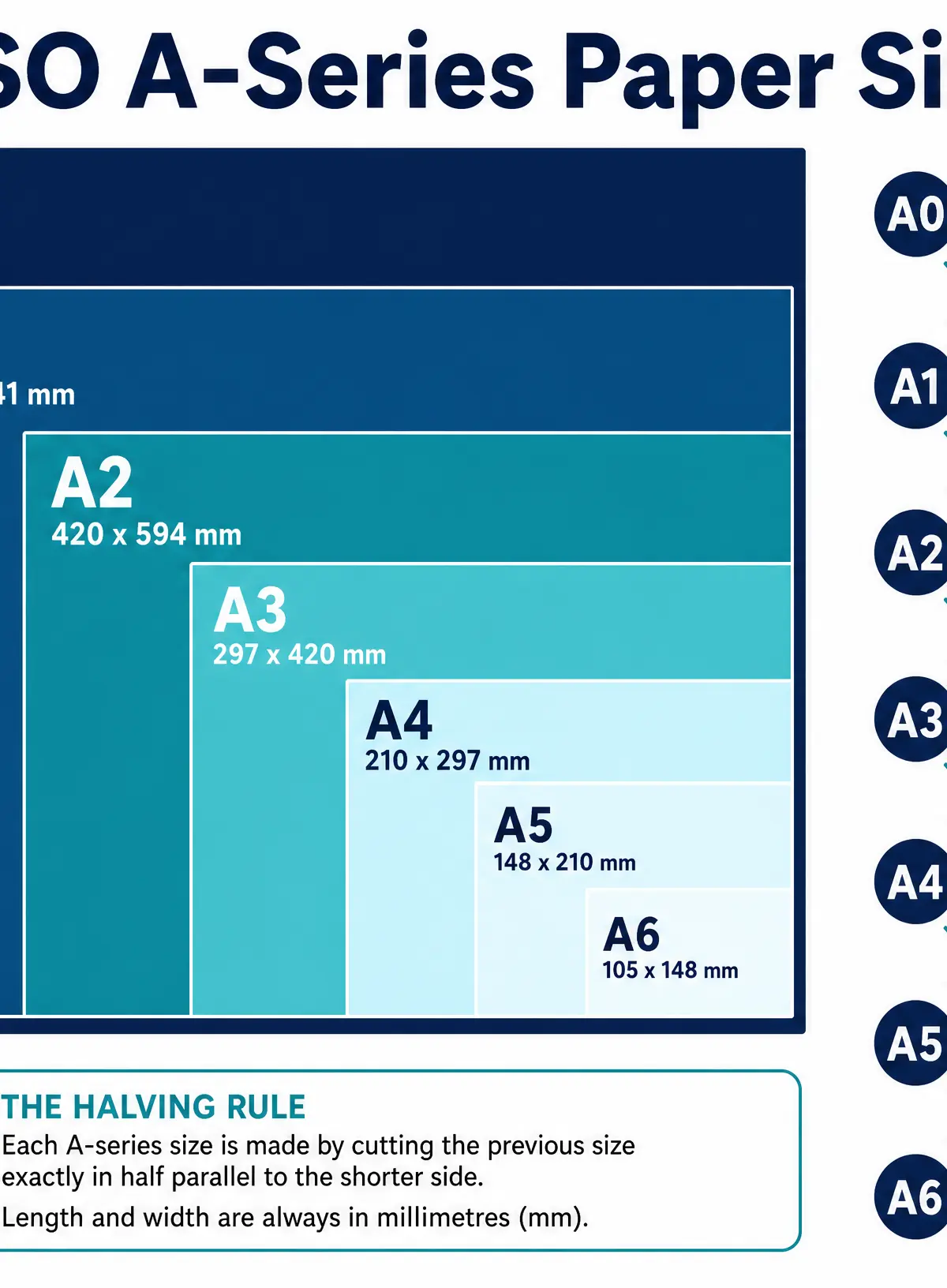
| Size | Dimensions (mm) | Common Uses in D&T |
|---|---|---|
| A0 | 841 x 1189 | Large presentation posters, full-scale architectural plans |
| A1 | 594 x 841 | Flip charts, presentation boards |
| A2 | 420 x 594 | Design portfolios, technical drawings |
| A3 | 297 x 420 | Sketchbook double-page spreads, initial design ideas |
| A4 | 210 x 297 | Standard printer paper, written reports |
| A5 | 148 x 210 | Small sketchpads, leaflets |
| A6 | 105 x 148 | Postcards, small templates |
Technical Vocabulary
Examiners actively look for these terms in your responses:
- Stock Form: The standard shape and size in which a material is commercially available (e.g., sheets, rolls, pads).
- Laminate: A material created by bonding two or more layers together, often to improve strength or add a protective/waterproof surface.
- Net: A flat 2D shape that can be folded to form a 3D object.
- Tolerance: An allowable amount of variation in a specified quantity or dimension.
Practical Skills & Material Selection
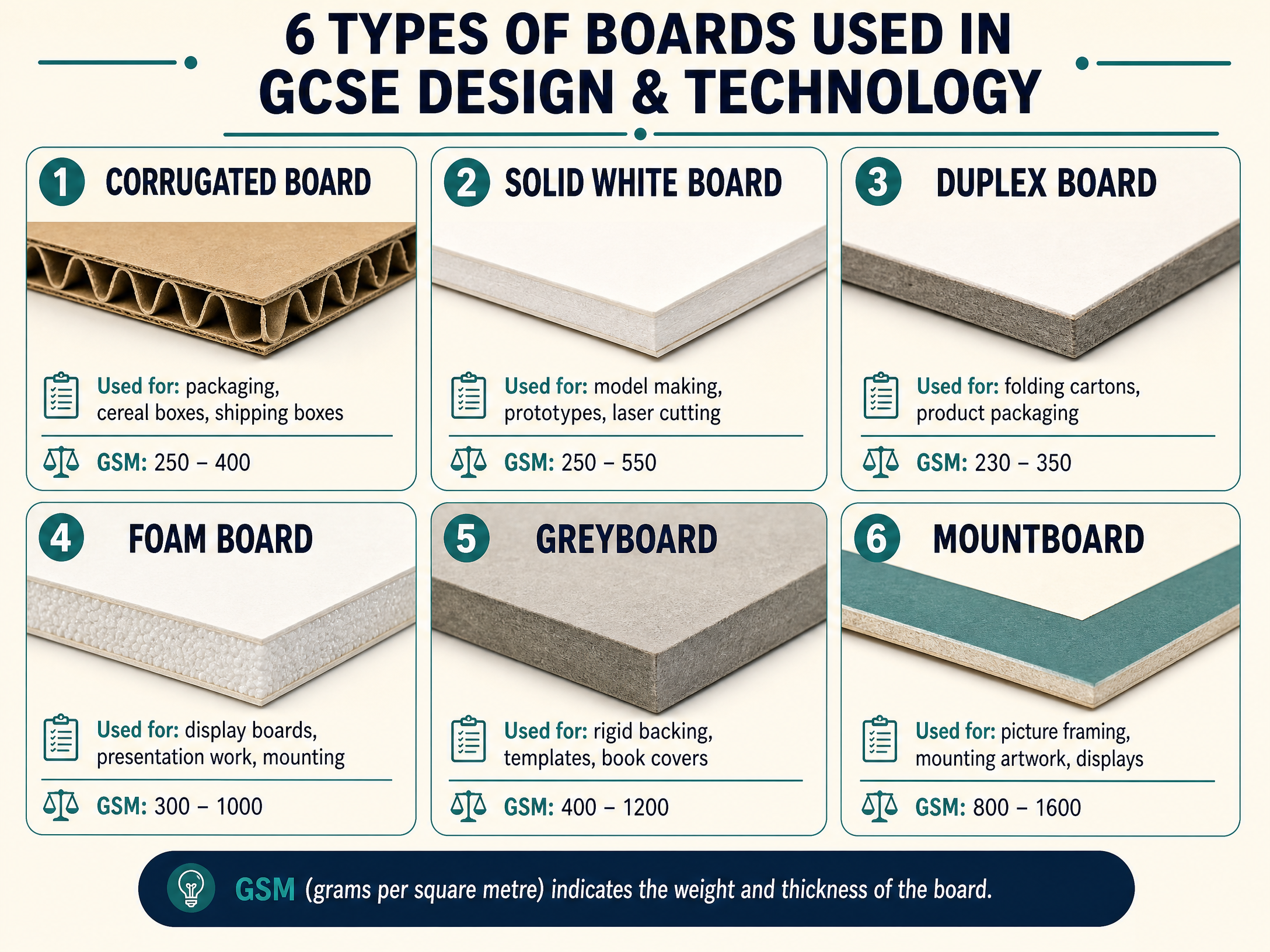
Types of Boards
Understanding the structural properties of different boards is essential for justifying your design choices.
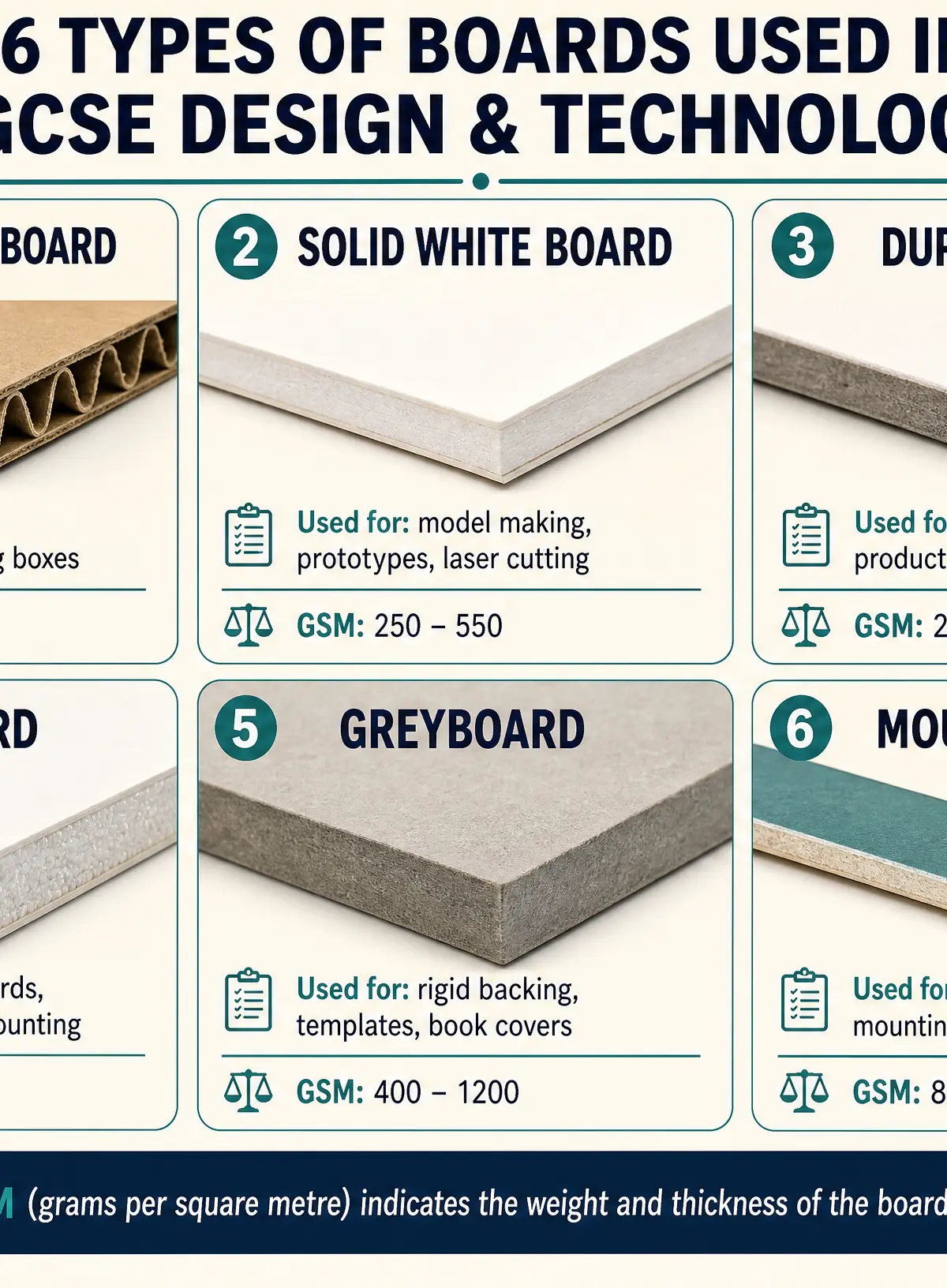
| Board Type | Properties | Typical D&T Applications |
|---|---|---|
| Corrugated Board | Fluted inner core between two flat liners. High strength-to-weight ratio, impact resistant. | Protective packaging, transit boxes, structural models. |
| Solid White Board | High-quality, smooth, bleached surface. Excellent for printing. | Premium packaging, book covers, high-end presentation models. |
| Duplex Board | Two layers: white exterior for printing, grey recycled interior. | Food packaging, folding cartons, cereal boxes. |
| Foam Board | Polystyrene core sandwiched between paper/card faces. Lightweight, rigid. | Architectural models, point-of-sale displays, presentation mounting. |
| Greyboard | Unbleached, recycled material. Very rigid but poor surface finish. | Hardback book covers, rigid templates, backing boards. |
Portfolio/Coursework Guidance (NEA)
Assessment Criteria
In your NEA, you must demonstrate the ability to select appropriate materials and calculate quantities accurately. Marks are awarded for:
- AO2 (Apply): Using the correct stock forms and sizes in your practical making.
- AO3 (Analyse/Evaluate): Justifying why you chose a specific board (e.g., "I selected 400gsm solid white board because its smooth surface allows for high-quality CAD/CAM printing, while providing sufficient rigidity for the structural net.")
Calculating Quantities
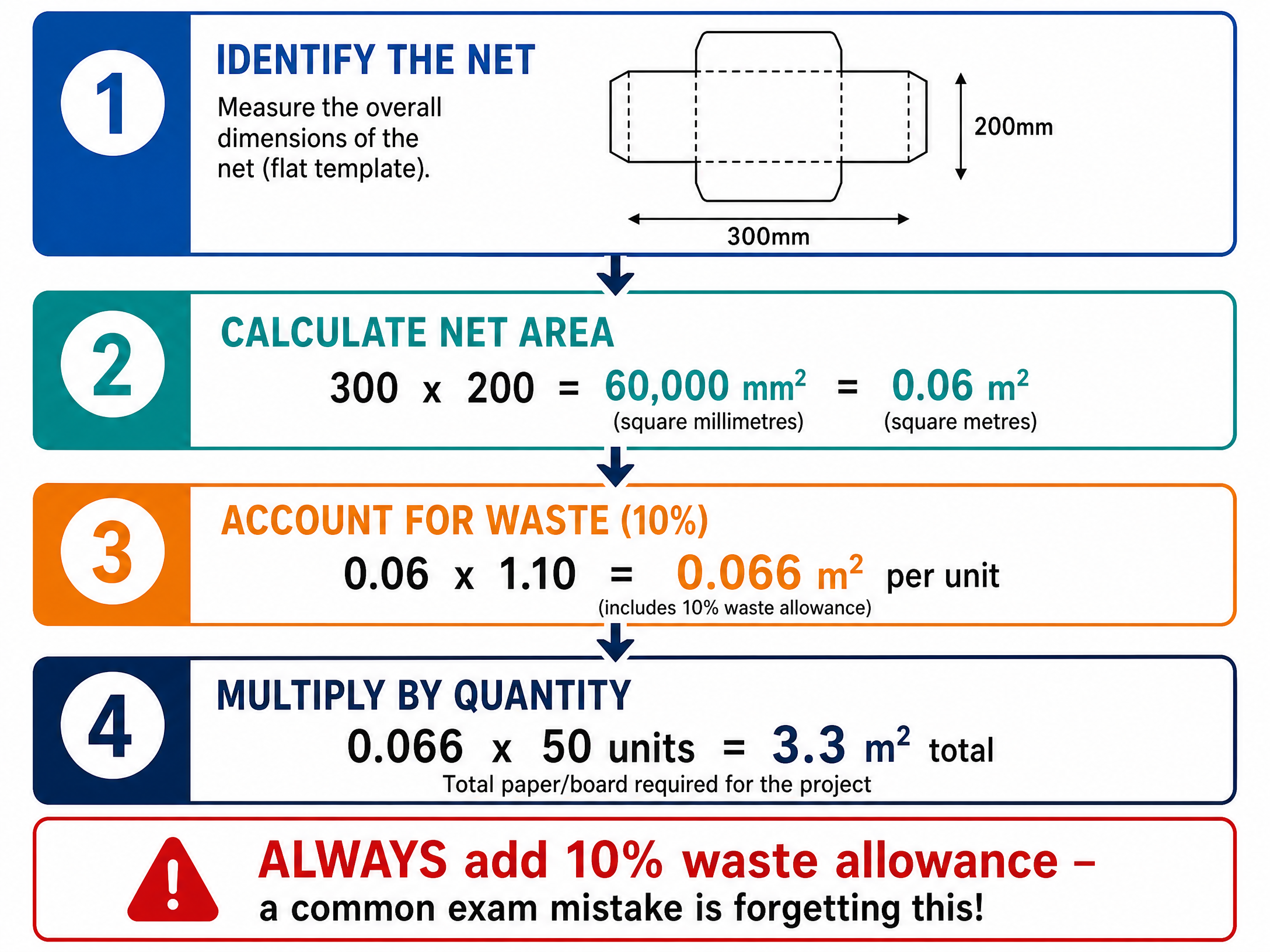
One of the most common practical tasks is determining how much material you need to manufacture a batch of products.
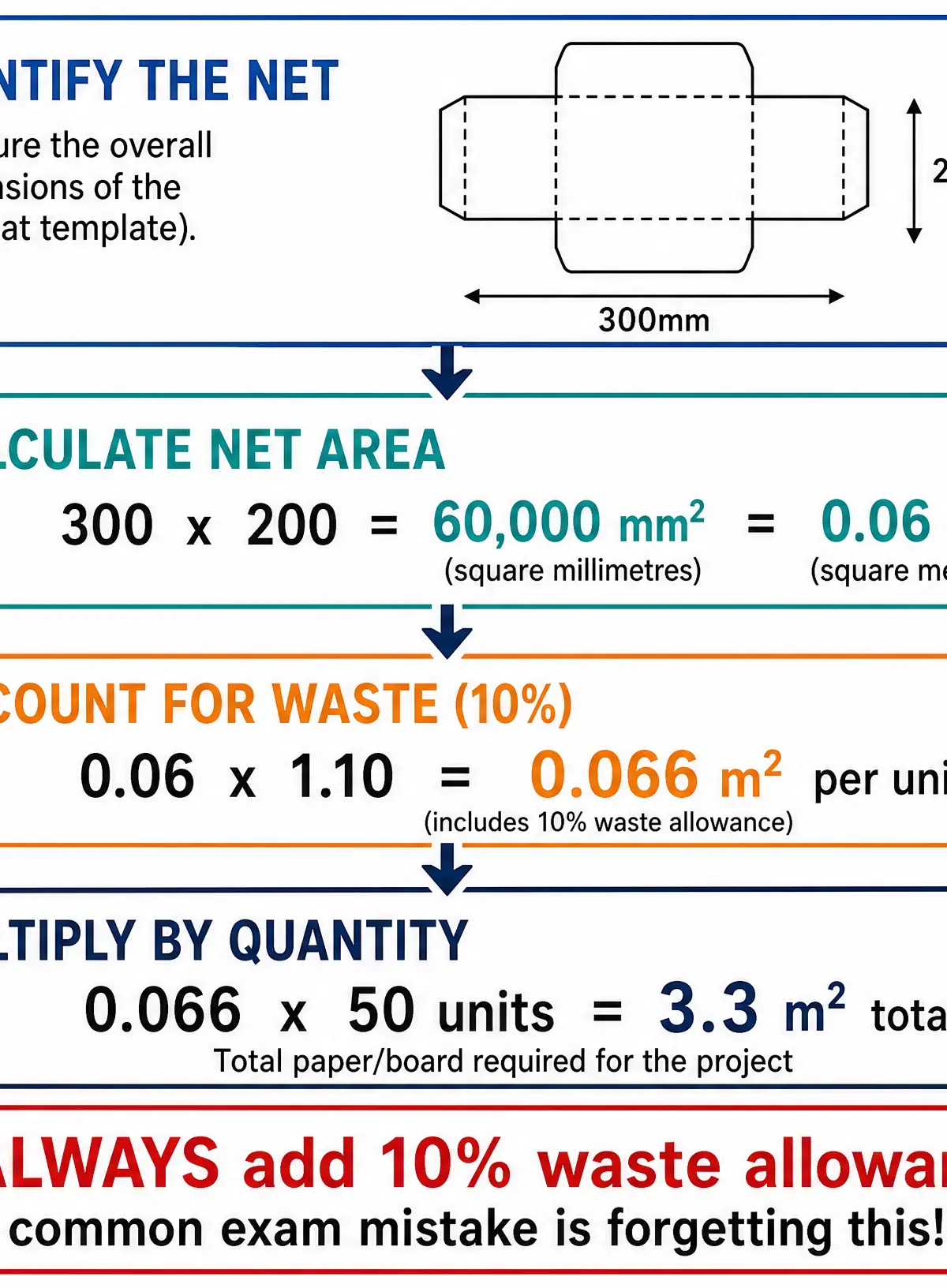
The Golden Rule: Always add a waste allowance (standard is 10%) to account for cutting, trimming, and off-cuts.
Exam Component
Written Exam Preparation
The theory paper will test this topic in three ways:
- Multiple Choice / Short Answer (1-2 marks): Recalling specific sizes or gsm thresholds.
- Calculation Questions (3-4 marks): Working out the area of a net and the total material required for a batch run.
- Extended Response (6-8 marks): Evaluating the suitability of different materials for a specific product context.
Visual Resources
3 diagrams and illustrations
Interactive Diagrams
1 interactive diagram to visualise key concepts
Conceptual Flow Outline
Process flowchart for calculating material quantities
Worked Examples
3 worked examples — open one to explore the question and available guidance.
Practice Questions
Test your understanding — click to reveal model answers
What is the threshold weight (in gsm) that differentiates paper from board?
Hint: Think of the 'magic number' memory hook.
A designer needs to create a point-of-sale display stand for a shop counter. Recommend a suitable board and justify your choice.
Hint: Consider what properties a display stand needs (rigidity, weight, surface finish).
A batch of 250 presentation folders is being manufactured. Each folder requires a net measuring 500mm x 400mm. The manufacturer applies a 15% waste allowance. Calculate the total area of board required in square metres.
Hint: Calculate the area of one net first, convert to m², add the specific waste allowance, then multiply by the batch size.
Evaluate the use of corrugated board versus solid white board for shipping fragile electronics.
Hint: Discuss the structure of both boards, their protective qualities, and their cost-effectiveness.