Pearson Edexcel · GCSE · Design and Technology
Papers and Boards: The impact of forces and stresses on papers and boards and how they can be reinforced and stiffened
This topic covers the fundamental engineering principles of how forces and stresses affect papers and boards, and the clever structural techniques designers use to reinforce them. Mastering this topic is essential for understanding material selection and justifying design decisions in both your coursework and the written exam.
- 8 min read
- 3 worked examples
- 3 practice questions
- 6 key terms
Study Notes
Overview
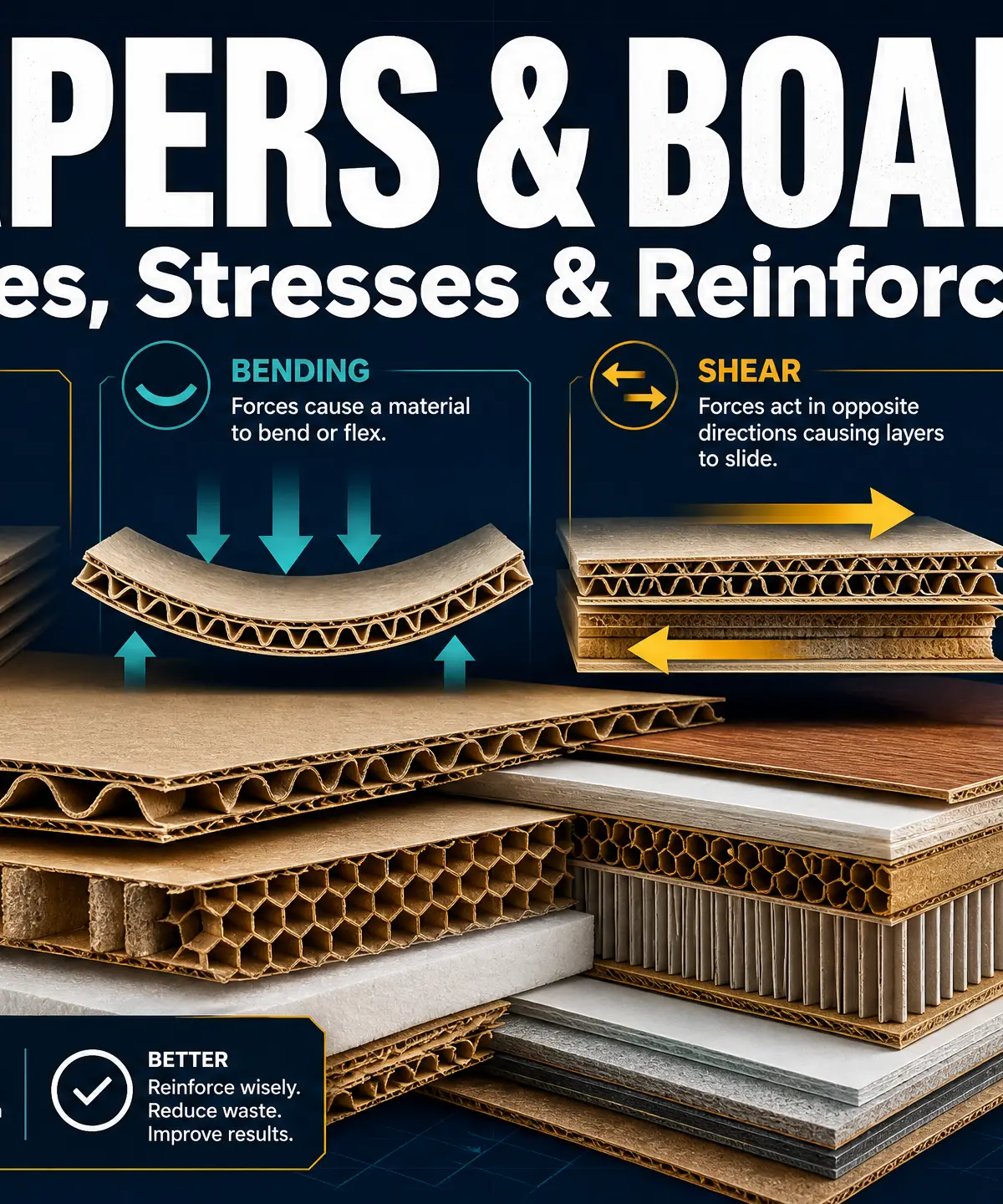
In Design and Technology, understanding how materials behave under load is just as important as knowing how to cut or shape them. Papers and boards are incredibly versatile, lightweight, and recyclable, but they have inherent structural weaknesses compared to timbers or metals. This topic explores the four primary forces and stresses that cause these materials to fail, and the six key reinforcement techniques designers use to overcome these limitations.
Whether you are designing a point-of-sale display, a protective packaging solution, or an architectural model, you must be able to anticipate how forces will act on your product and apply appropriate stiffening methods to ensure it functions successfully.
Key Knowledge & Theory
The Four Forces and Stresses
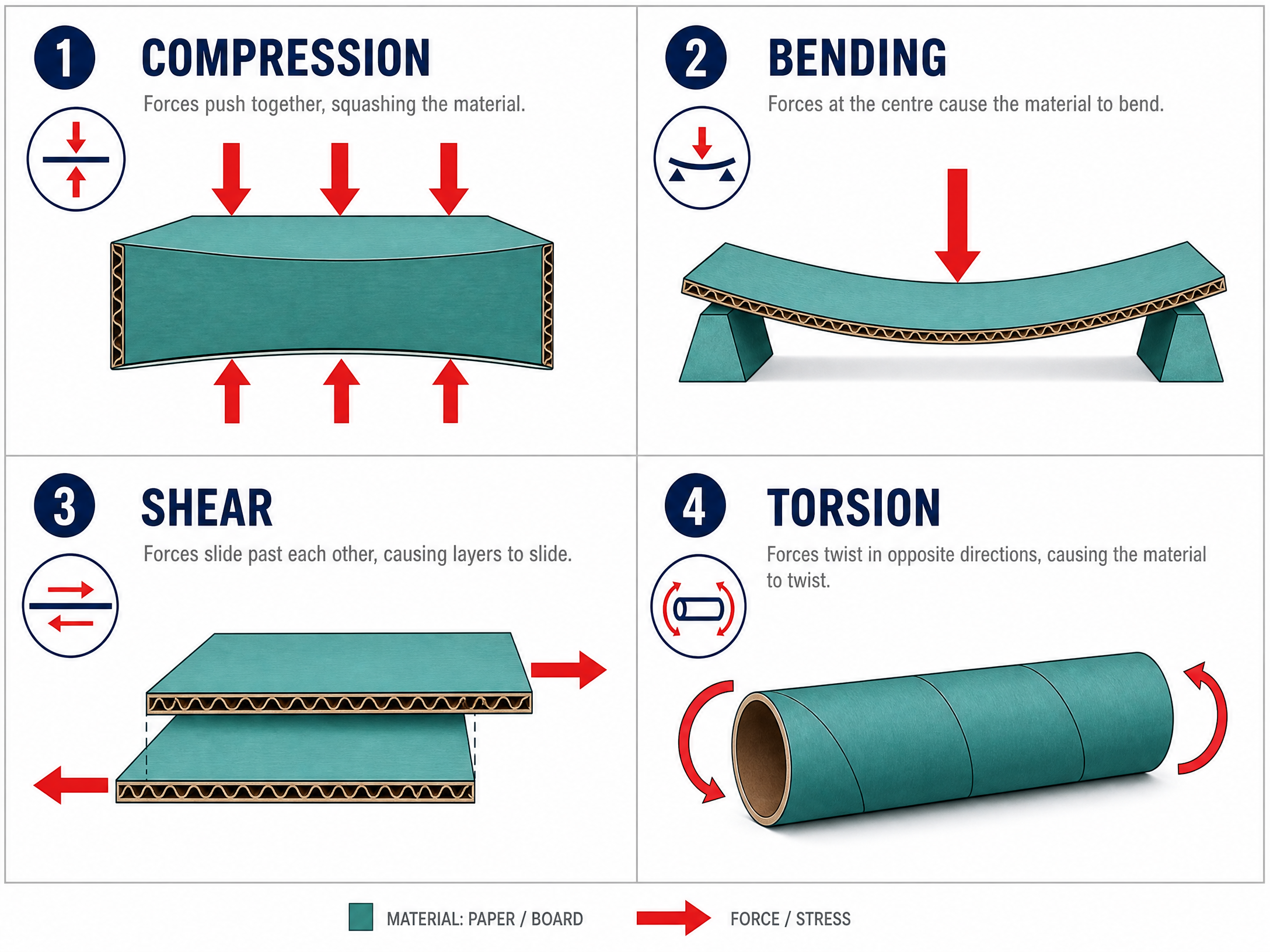
When a force is applied to a material, it creates an internal resistance called stress. If the stress exceeds the material's strength, it will deform or break. You must be able to identify, describe, and explain the effects of the following four forces on papers and boards.
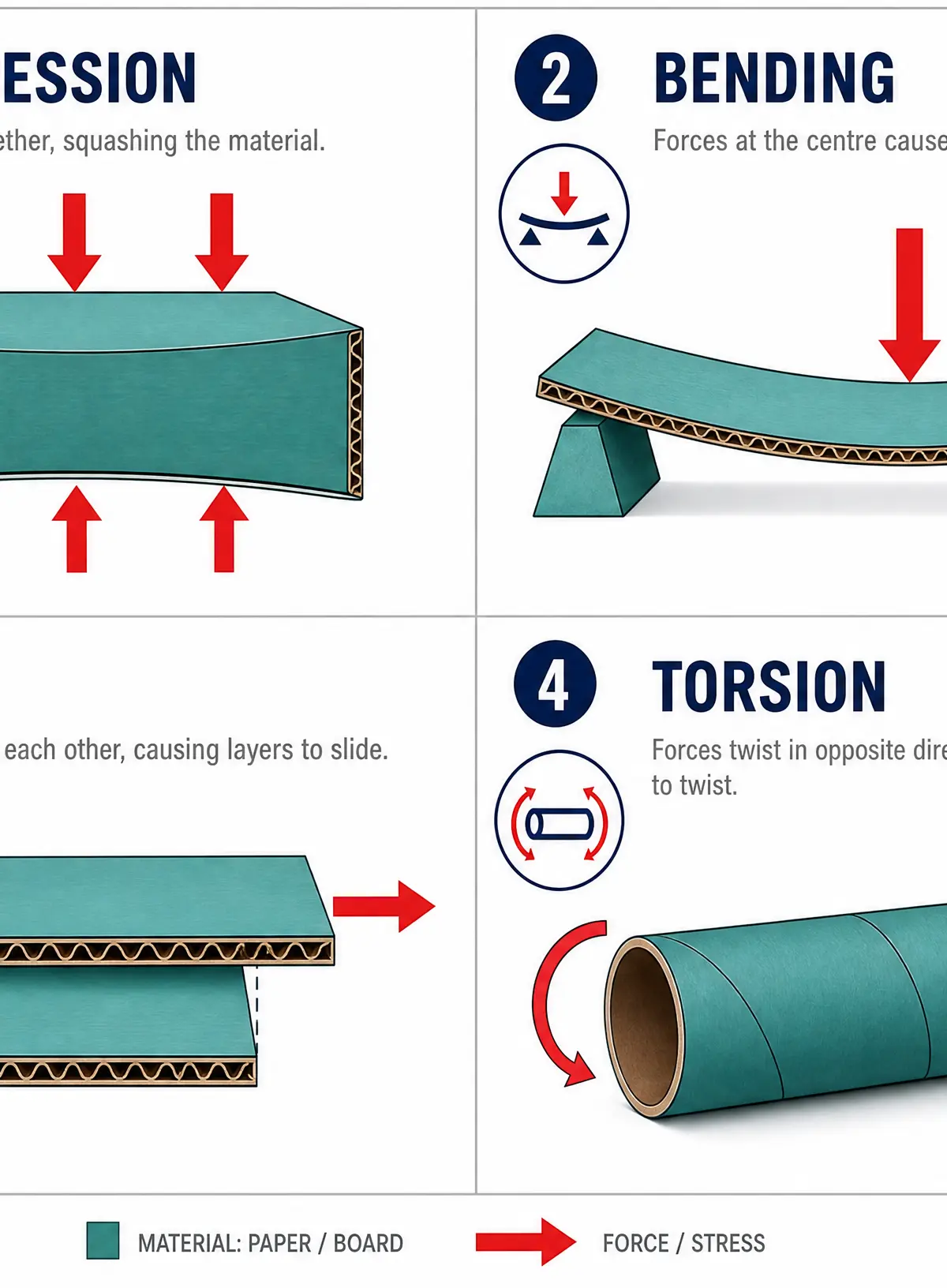
- Compression: A squashing force that pushes inward from opposite sides. When a cardboard box is stacked at the bottom of a pallet, the weight above creates compressive stress. If the force is too great, the board's internal structure will crush and collapse.
- Bending: A force applied to the centre of a material that is supported at its ends (or vice versa), causing it to flex or curve. When a board bends, the top surface is under compression (squashing) while the bottom surface is under tension (stretching). Papers and boards have low stiffness, making them highly susceptible to bending failure.
- Shear: Opposing forces acting parallel to each other, causing adjacent layers or parts of the material to slide past one another. In laminated boards, shear forces can cause the layers to separate (delaminate) if the adhesive bond fails.
- Torsion: A twisting force applied in opposite directions at either end of a material. Torsional stress is common in cylindrical packaging (like a poster tube) and can cause the material to spiral, crack, or tear along its grain.
Reinforcement and Stiffening Techniques
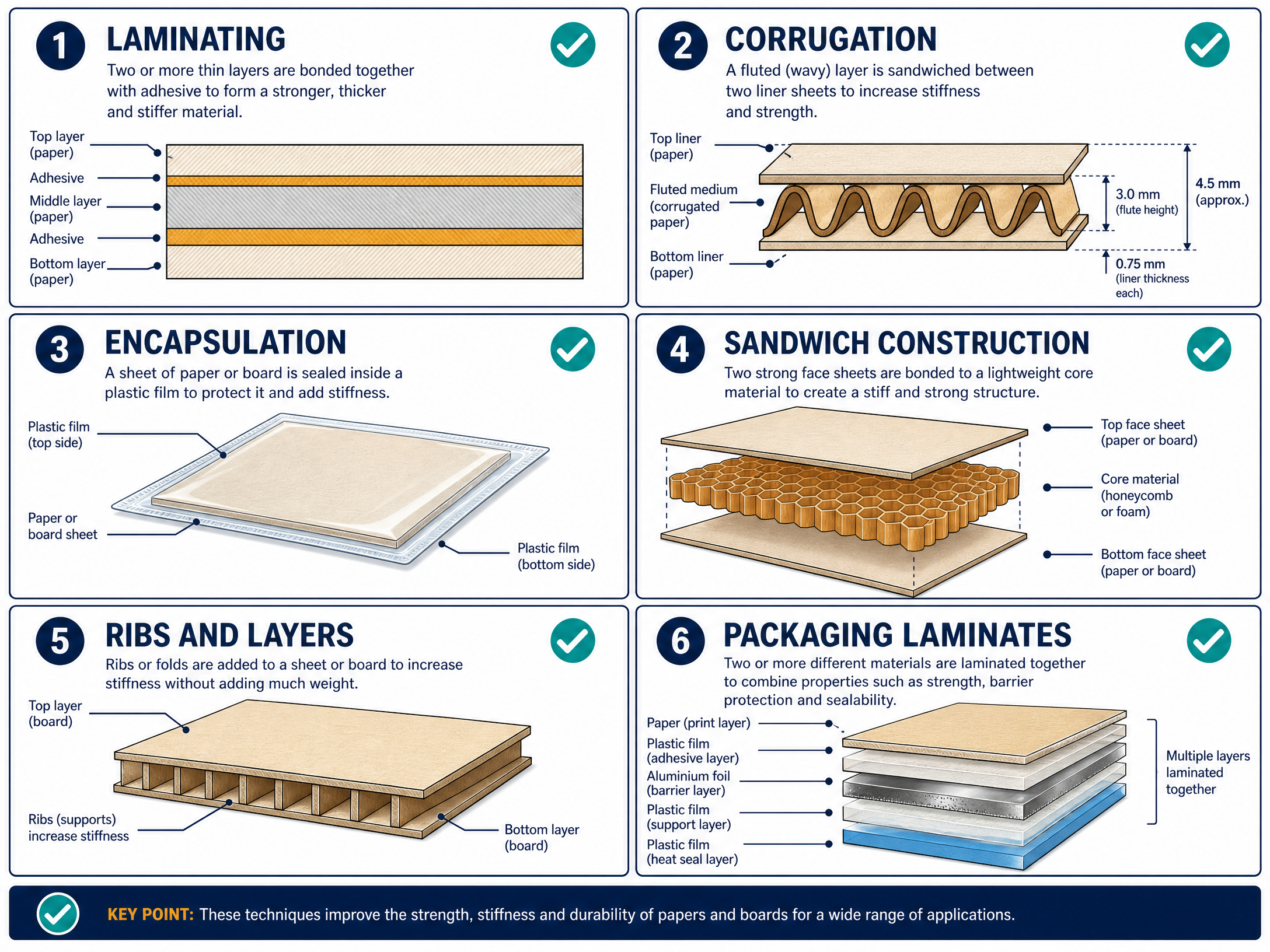
To counter these forces without resorting to heavier, more expensive materials, designers use structural engineering techniques. You need to understand how each of these six methods works.
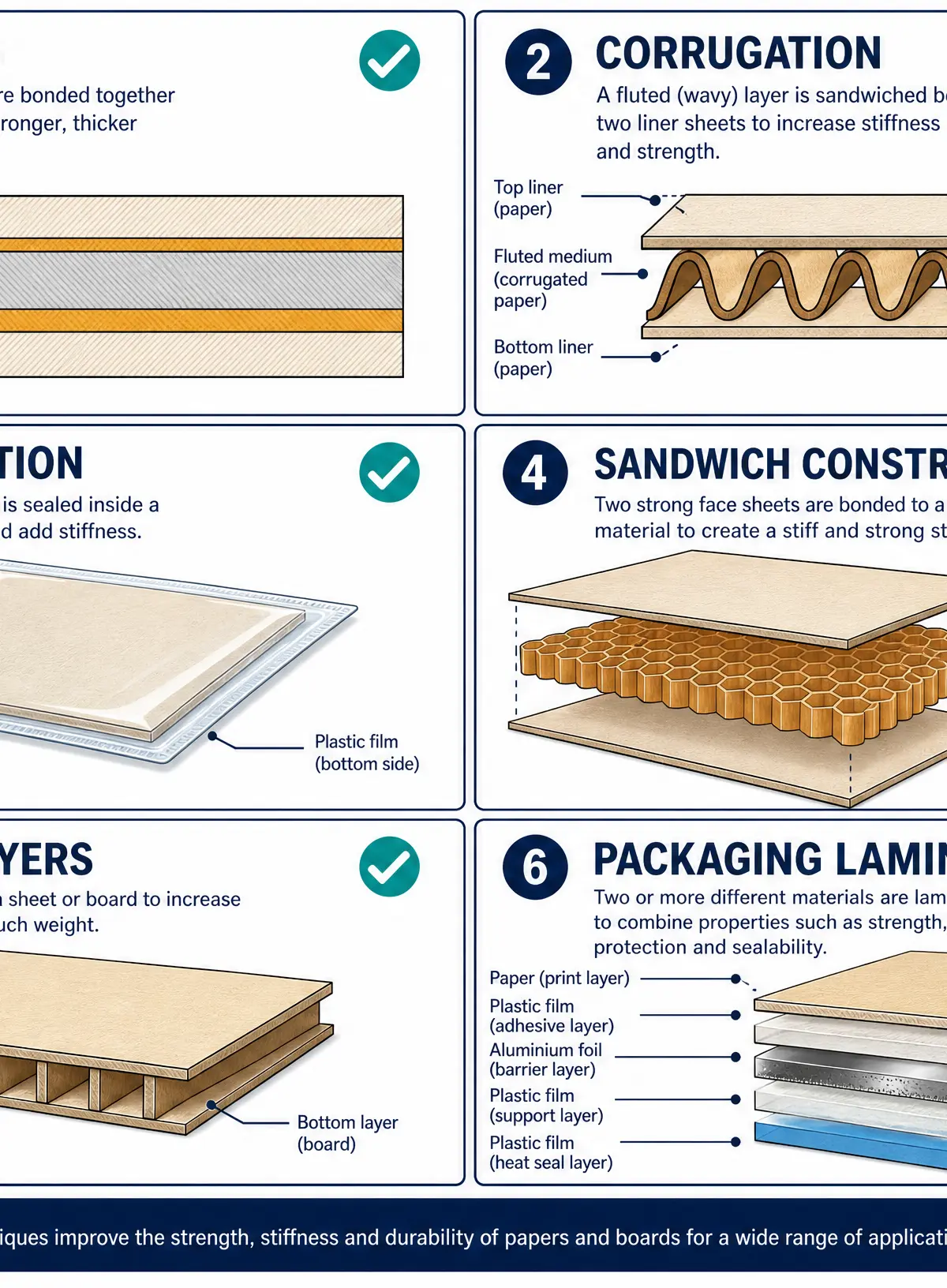
- Laminating: Bonding two or more thin layers of paper or board together using an adhesive. This increases the overall thickness, significantly improving stiffness and resistance to bending and compression.
- Corrugation: Sandwiching a wavy, fluted layer (the fluted medium) between two flat outer layers (liners). The arch shape of the flutes provides exceptional compressive strength, while the overall structure resists bending. It is lightweight and provides impact cushioning.
- Encapsulation: Sealing a sheet of paper or board completely inside a clear plastic film. The plastic adds rigidity and provides a barrier against moisture, which would otherwise severely weaken the paper fibres.
- Sandwich Construction: Bonding two strong, stiff outer face sheets to a lightweight, thick core material (such as a paper honeycomb or foam). The face sheets resist bending stresses, while the core increases the depth of the structure, massively increasing stiffness with minimal weight gain.
- Additions of Ribs and Layers: Adding raised ridges, folds, or extra layers of material to specific areas of a product. Ribs redirect forces along their length, drastically increasing resistance to bending across a flat surface.
- Packaging Laminates: Combining multiple layers of different materials (e.g., paper, plastic film, aluminium foil) into a single composite sheet. Each layer adds a specific property: paper for structure and printing, plastic for waterproofing and heat-sealing, and foil for a barrier against light and oxygen.
Technical Vocabulary
Examiners actively look for these terms in your answers. Using them correctly is the easiest way to access higher mark bands.
- Compressive Strength: The ability of a material to withstand being pushed or squashed.
- Tensile Strength: The ability of a material to withstand being pulled or stretched.
- Delamination: The failure of an adhesive bond causing laminated layers to separate under shear stress.
- Flute / Fluted Medium: The wavy inner layer of corrugated cardboard.
- Composite: A material made from two or more constituent materials with significantly different physical or chemical properties.
- Rigidity / Stiffness: The extent to which an object resists deformation in response to an applied force.
Practical Skills & Coursework Guidance
Applying Theory to your NEA (Non-Exam Assessment)
In your portfolio, you must justify your material choices and construction methods. Examiners award marks for showing that you have considered forces and stresses in your design development.
**Assessment Criteria Focus (AO2 - Apply skills to design and make prototypes):**When designing packaging or display products, you should explicitly document how you have reinforced the material.
- Annotation Example (Weak): "I used corrugated cardboard because it is strong."
- Annotation Example (Strong): "I selected single-wall corrugated board for the outer casing. The internal fluted layer provides high compressive strength, ensuring the box will not collapse when stacked during transit, while keeping the overall weight low."
Building a Strong Portfolio
To evidence your understanding of forces and reinforcement, you should include physical testing in your portfolio:
- Destructive Testing: Create small test pieces of different boards (e.g., solid white board vs. corrugated board). Apply weights to test their bending and compressive strength. Photograph the results and record the failure points.
- Prototyping Reinforcement: Show iterations of your design. For example, make a prototype of a display stand out of 1mm card. Photograph it sagging under the weight of the product. Then, document how you added internal ribs or switched to a sandwich construction to solve the problem.
- Cross-sectional Diagrams: Draw detailed cross-sections of your proposed materials (like the diagrams above) to show the examiner you understand the internal structure.
Exam Component
Written Exam Preparation
Questions on this topic typically appear in the core technical principles section of the exam. They range from 1-mark multiple-choice questions identifying a force, to 6-mark extended response questions requiring you to evaluate a reinforcement method for a specific product.
**Podcast Revision Audio:**Listen to this 10-minute audio guide covering the core concepts, common pitfalls, and a quick-fire recall quiz.

Common Exam Scenarios
- Product Analysis: You will be shown an image of a product (e.g., a takeaway coffee cup or a flat-pack furniture box) and asked to explain why a specific material or reinforcement technique was used.
- Problem Solving: You may be given a scenario where a paper-based product is failing (e.g., a carrier bag handle tearing) and asked to suggest and justify a structural modification to fix it.
- Comparing Techniques: You might be asked to evaluate the suitability of two different reinforcement methods (e.g., laminating vs. encapsulation) for a specific application like an outdoor poster.
Visual Resources
2 diagrams and illustrations
Interactive Diagrams
1 interactive diagram to visualise key concepts
Conceptual Flow Outline
Decision-making process for selecting reinforcement techniques during the design phase.
Worked Examples
3 worked examples — open one to explore the question and available guidance.
Practice Questions
Test your understanding — click to reveal model answers
Identify the force that causes layers of a laminated board to slide past each other.
Hint: Think of the action of a pair of scissors.
Describe the structure of corrugated cardboard.
Hint: What are the specific names for the flat layers and the wavy layer?
A designer is creating a lightweight but rigid display board for an exhibition. Explain how sandwich construction achieves high stiffness with low weight.
Hint: Think about the roles of the different parts of the sandwich. What do the outer layers do? What does the inner layer do?