Pearson Edexcel · GCSE · Design and Technology
Papers and Boards: The sources, origins, physical and working properties of papers and boards and their social and ecological footprint
Master the fundamentals of papers and boards, from their origins and properties to their environmental impact. This topic is essential for understanding material selection, sustainable design, and packaging manufacturing in GCSE Design and Technology.
- 6 min read
- 3 worked examples
- 3 practice questions
- 6 key terms
Study Notes
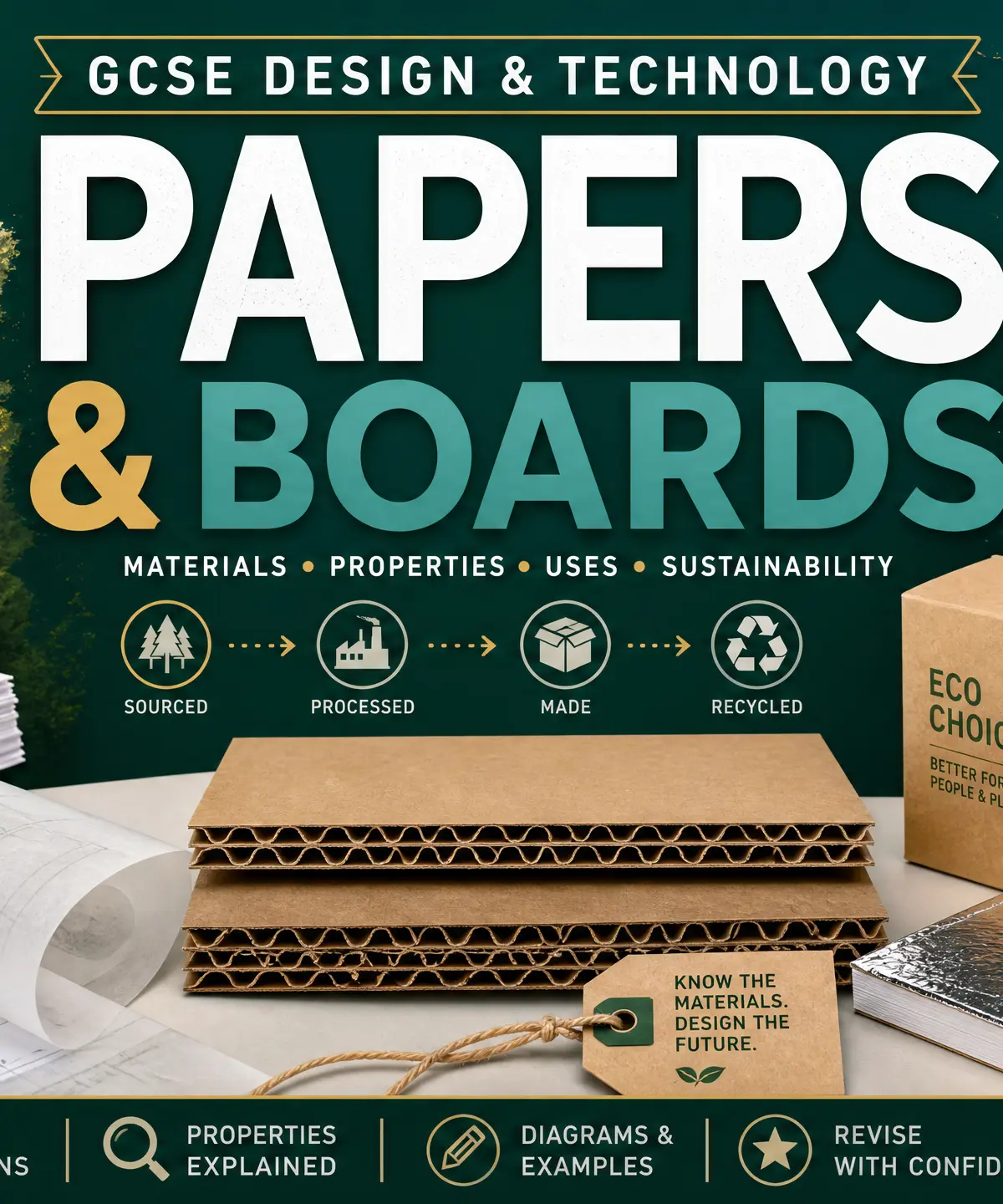
Overview
Papers and boards are fundamental materials in Design and Technology, forming the basis of everything from initial sketches to complex packaging solutions. Understanding their sources, physical characteristics, and working properties is crucial for making informed design decisions. Furthermore, examiners increasingly test candidates on the social and ecological footprint of these materials, making sustainability a core component of this topic.
Key Knowledge & Theory
Core Concepts: Origins and Properties
All paper and board originate from wood pulp, primarily sourced from trees. The wood is broken down into fibres, mixed with water, pressed, and dried. The key distinction between paper and board is thickness and weight, measured in grams per square metre (gsm). Paper is generally up to 200gsm, while board is anything heavier and more rigid.
Physical Characteristics vs. Working PropertiesCandidates frequently confuse these two concepts.
- Physical characteristics describe what the material is (e.g., density, transparency, texture).
- Working properties describe what the material does or how it behaves (e.g., flexibility, printability, absorbency).
Material Types
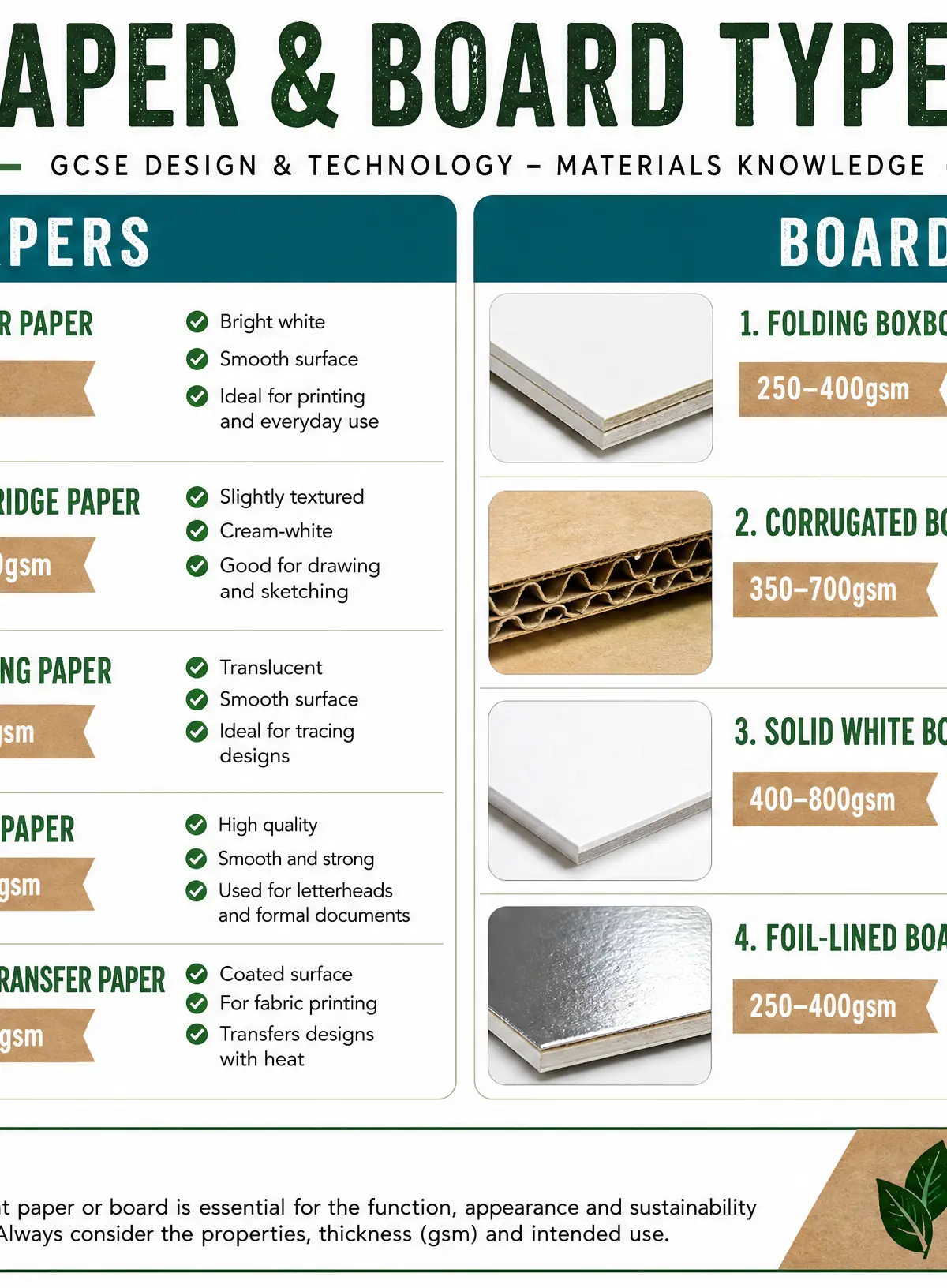
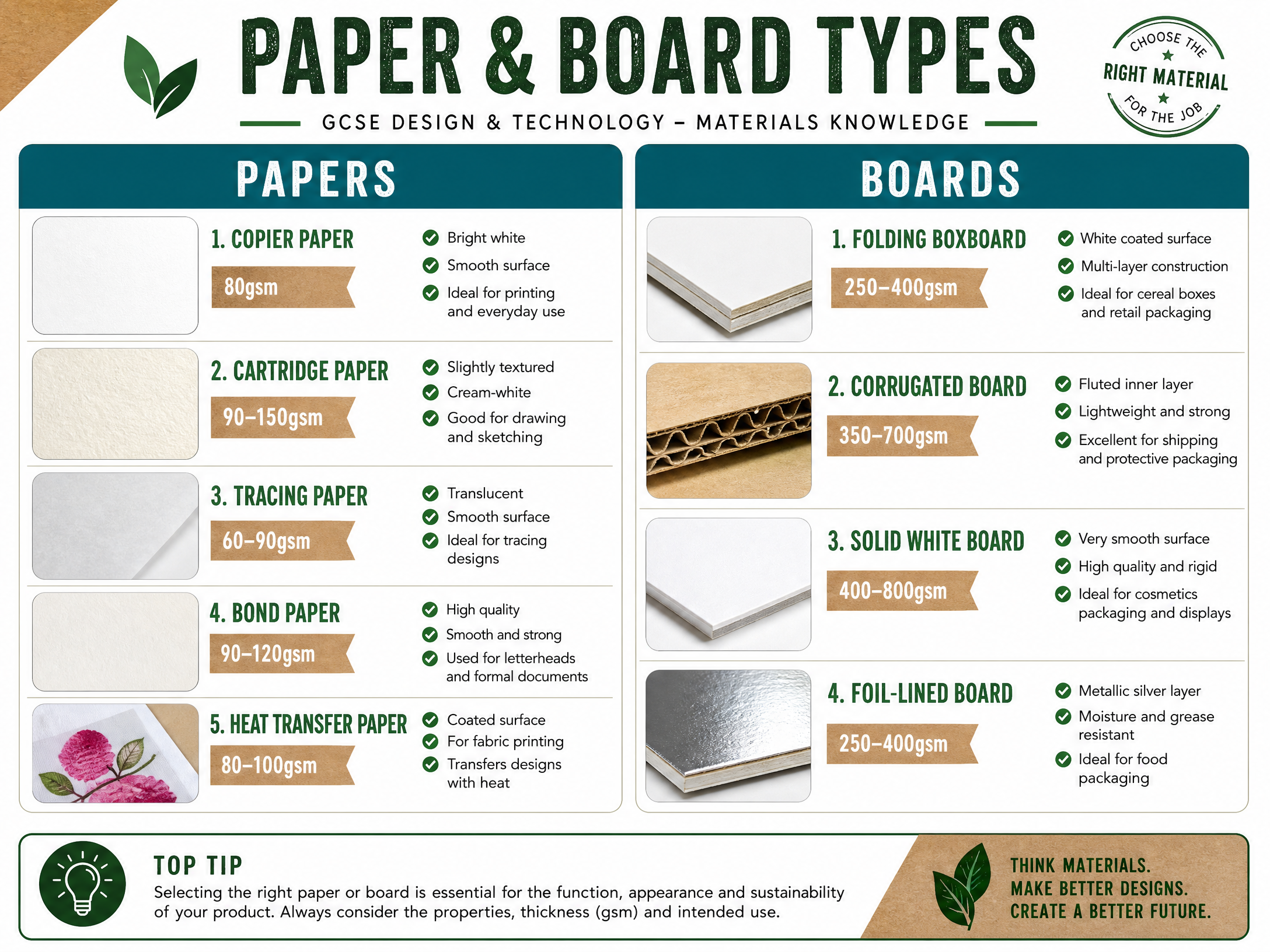
| Material Type | Typical gsm | Key Properties | Common Uses |
|---|---|---|---|
| Copier Paper | 80gsm | Bright white, smooth, lightweight | Printing, everyday writing |
| Cartridge Paper | 90-150gsm | Slightly textured, opaque, cream-white | Drawing, sketching, watercolours |
| Tracing Paper | 60-90gsm | Translucent, smooth, relatively strong | Copying designs, overlays |
| Folding Boxboard | 250-400gsm | Multi-layered, white coated surface, rigid | Cereal boxes, retail packaging |
| Corrugated Board | 350-700gsm | Fluted inner layer, high compressive strength | Shipping boxes, protective packaging |
| Foil-Lined Board | 250-400gsm | Metallic layer, moisture and grease resistant | Food packaging (e.g., takeaway lids) |
The Ecological and Social Footprint
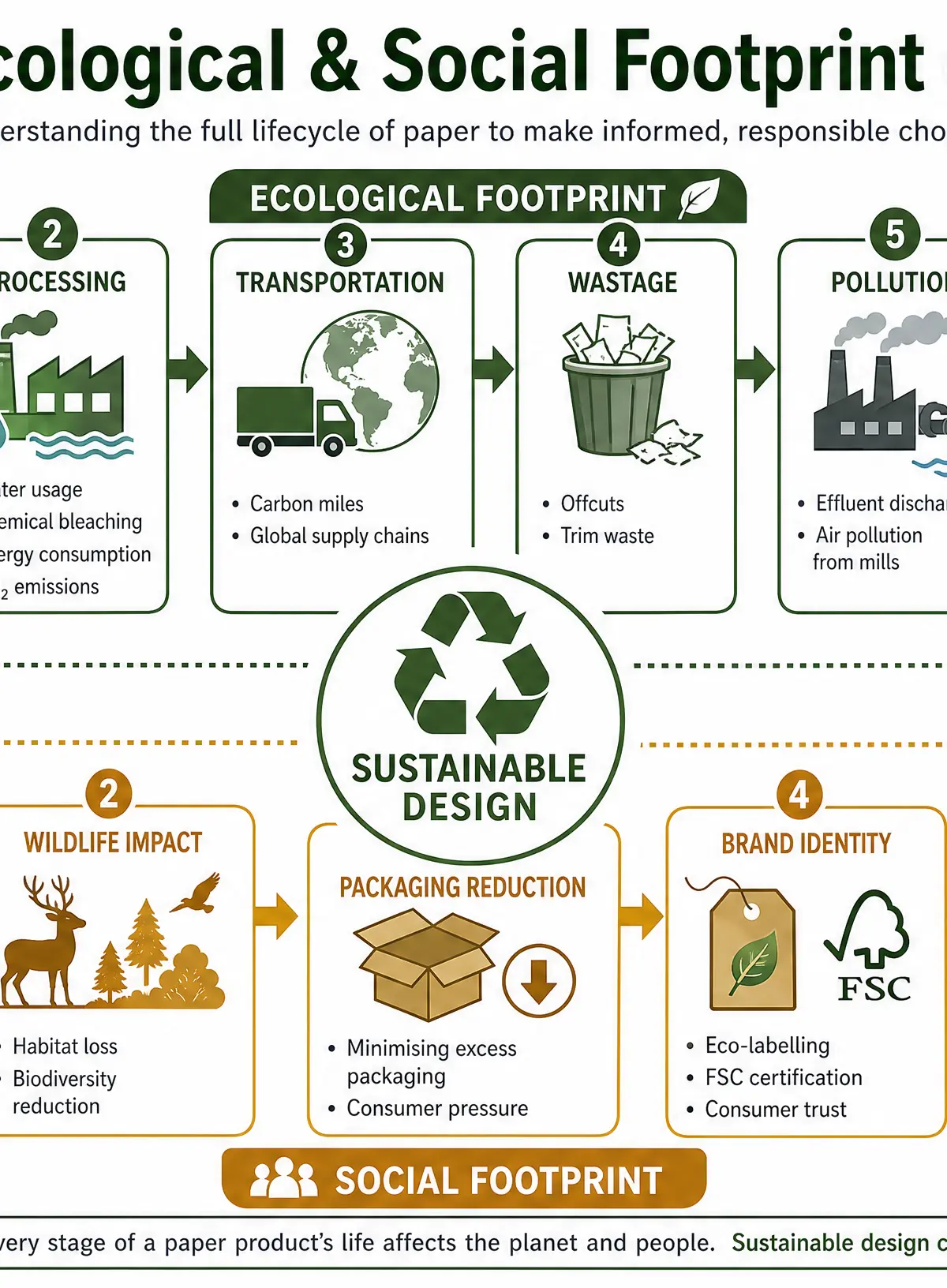
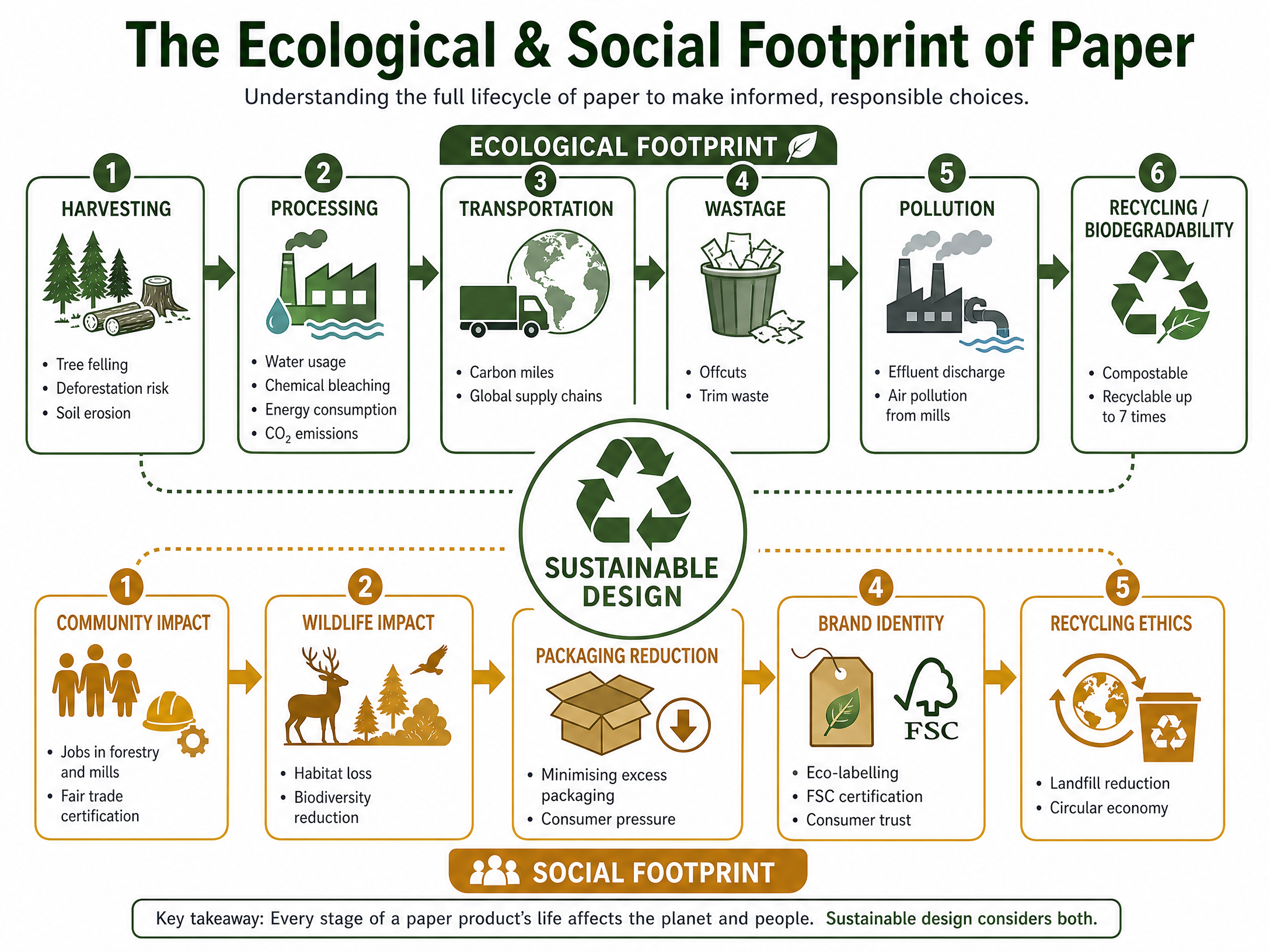
The lifecycle of paper products has significant impacts on both the planet and people. Sustainable design requires evaluating these factors during material selection.
Ecological Footprint:
- Harvesting: Deforestation risks, soil erosion, and habitat destruction.
- Processing: High water usage, chemical bleaching (chlorine), and significant energy consumption leading to CO2 emissions.
- End of Life: Paper is highly biodegradable and recyclable (up to 7 times), making it a crucial material in the circular economy.
Social Footprint:
- Community: Forestry and paper mills provide vital employment, but fair trade and ethical sourcing (e.g., FSC certification) are necessary to protect workers.
- Brand Identity: Consumers increasingly demand sustainable packaging. Using eco-labelled materials builds trust and aligns with corporate social responsibility.
Audio Revision
Listen to this 10-minute podcast episode for a comprehensive overview of the topic, including examiner tips and a quick-fire recall quiz.

Practical Skills
Techniques & Processes
When working with papers and boards in your coursework or practical exams, precision and appropriate technique are essential.
- Marking Out: Always use a sharp pencil and a steel rule. For complex nets (developments), use a template or stencil to ensure accuracy.
- Cutting: Use a craft knife and a safety ruler on a cutting mat for straight lines. Scissors are generally too imprecise for final models. For batch production, CAM (Computer Aided Manufacture) using a laser cutter or die-cutter is preferred.
- Folding and Scoring: To achieve a crisp fold in thick board, you must score the material first. Lightly run a craft knife or a bone folder along the fold line to break the surface fibres without cutting all the way through.
- Joining: Adhesives like PVA (for paper) or double-sided tape are common. For mechanical joints, consider split pins or tabs and slots.
Reinforcement and Stiffening
Designers often need to increase the strength of paper and board without adding excessive weight. Techniques include:
- Corrugation: Adding a fluted layer (as seen in corrugated board).
- Laminating: Bonding multiple layers together (e.g., Tetra Pak combines paperboard, polyethylene, and aluminium foil).
- Encapsulation: Sealing the paper within a plastic film for durability and waterproofing.
Portfolio/Coursework Guidance
Assessment Criteria
Examiners look for clear evidence that material choices are justified. Do not simply state that you used corrugated board; explain why it was the best choice for the specific design context, referencing its working properties and sustainability.
Building a Strong Portfolio
When documenting your models:
- Include photographs of your intermediate (sketch) models and test models.
- Annotate your photographs with the specific materials used (e.g., "250gsm folding boxboard").
- Evaluate the success of the material: Did it fold cleanly? Was it strong enough? How could the ecological footprint be reduced in a mass-produced version?
Exam Component
Written Exam Knowledge
Expect questions that ask you to evaluate material choices based on a given context (e.g., "Evaluate the use of foil-lined board for hot food takeaway packaging"). You must balance functional requirements (grease resistance, heat retention) with environmental concerns (difficulty in recycling composite materials).
Visual Resources
2 diagrams and illustrations
Interactive Diagrams
1 interactive diagram to visualise key concepts
Conceptual Flow Outline
The Circular Lifecycle of Paper and Board
Worked Examples
3 worked examples — open one to explore the question and available guidance.
Practice Questions
Test your understanding — click to reveal model answers
Identify the standard weight (gsm) of typical copier paper.
Hint: Think about the lightweight paper used in a home printer.
Explain two reasons why corrugated board is commonly used for packaging fragile items for shipping.
Hint: Think about the internal structure of the board and how weight affects transportation.
A fast-food company wants to replace its foil-lined board burger boxes with folding boxboard. Evaluate this proposed change, considering functional properties and environmental impact.
Hint: Compare grease resistance against recyclability.